

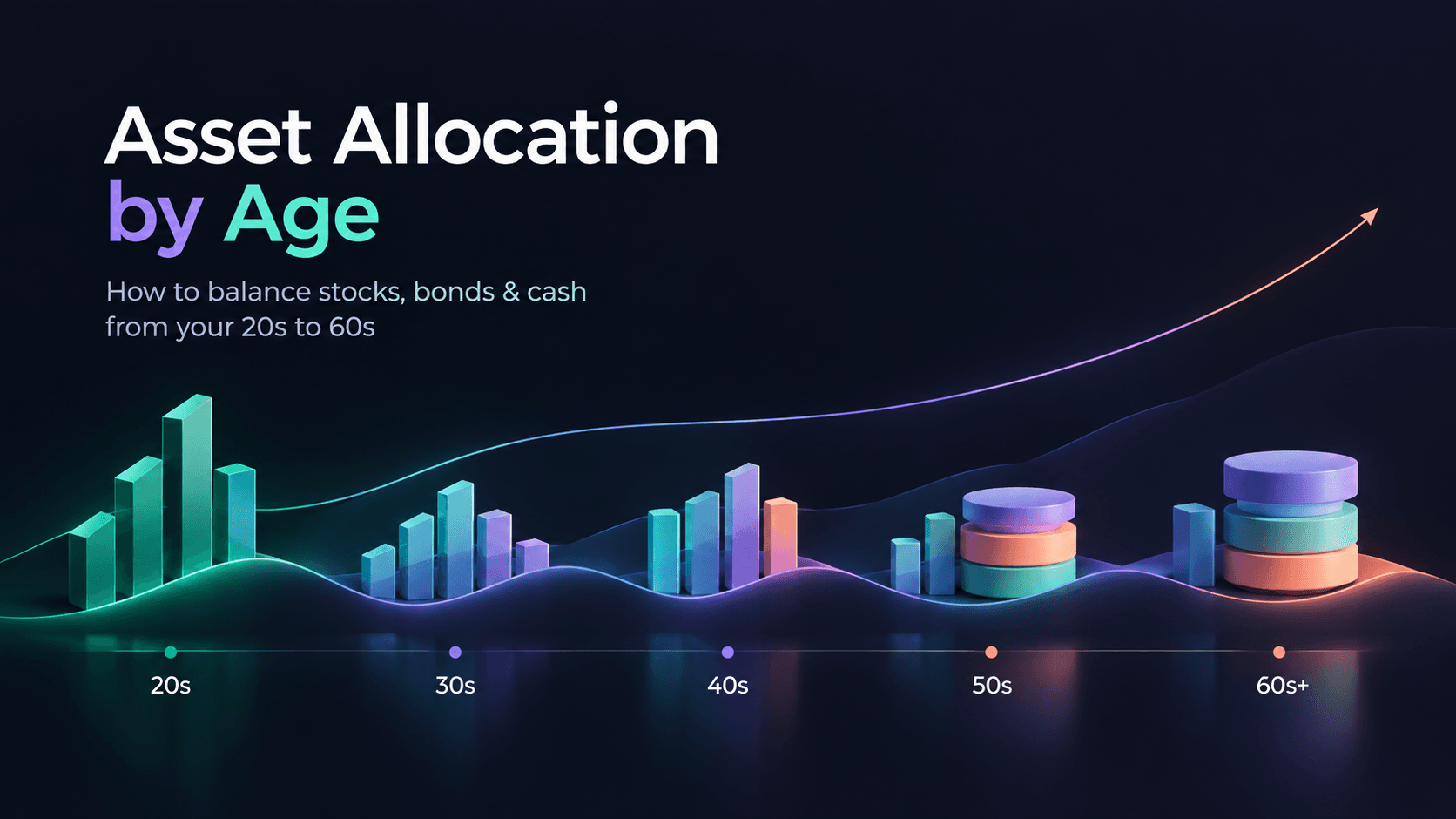
Asset Allocation by Age: Balance Your Portfolio 20s to 60s
Struggling to figure out your ideal stock-to-bond ratio? Discover decade-by-decade asset allocation frameworks, overcome the psychological barriers behind rebalancing, and build a portfolio tailored to your stage in life.
"I'm 32. How much of my portfolio should be in stocks vs. bonds?"
You've Googled this question at least three times. You've read conflicting answers. Some articles say 80% stocks. Others say 90%. One financial advisor says "it depends." Another says "use the 110 rule."
And you still haven't actually adjusted your portfolio.
Here's why: Asset allocation feels like a test you can fail. Your brain translates "what percentage should be in stocks?" into "what's the one correct answer that will prevent me from being poor at 70?"
That question doesn't have a single answer. But your paralysis has a cost.
According to Empower data, investors in their 20s hold 33.88% of their portfolios in cash - the highest of any working-age group. Translation: They're so afraid of "getting it wrong" that they're guaranteeing they lose to inflation [1].
Meanwhile, investors in their 60s often maintain 60-70% stock allocations when they should be transitioning to more conservative positions - because they're anchored to portfolios that worked in their 40s.
The problem isn't finding the perfect allocation. The problem is the psychological barriers preventing you from implementing any allocation at all.
This article will give you age-based asset allocation frameworks, explain the psychology preventing you from using them, and provide concrete portfolios for every decade of your life.
What is asset allocation? (And why it matters more than stock picking)
Asset allocation is how you divide your money among different types of investments: stocks, bonds, cash, real estate, and alternative assets.
Example:
80% stocks
15% bonds
5% cash
Why it matters: Asset allocation determines 90% of your portfolio's performance over time. Stock picking determines maybe 10% [2].
Translation: Obsessing over "should I buy Apple or Microsoft?" while having no allocation strategy is rearranging deck chairs on the Titanic.
The three primary asset classes
1. Stocks (equities)
What they are: Ownership shares in companies
Expected return: 8-10% annually (historical average)
Volatility: High - can drop 30-50% in crashes
Role: Growth [2]
2. Bonds (fixed income)
What they are: Loans to governments or corporations that pay interest
Expected return: 3-5% annually
Volatility: Low-moderate - typically drop 5-15% in bad years
Role: Stability and income [3]
3. Cash (cash equivalents)
What they are: Savings accounts, money market funds, CDs
Expected return: 0-4% (currently ~4% with high-yield savings, historically much lower)
Volatility: None
Role: Safety and liquidity
The fundamental trade-off: Risk vs. reward
Higher returns require higher risk. There's no way around this.
100% stocks = highest expected return, highest volatility
100% bonds = lower expected return, lower volatility
100% cash = guaranteed purchasing power loss to inflation
Your job: Find the balance between "growth I need" and "volatility I can tolerate" without panicking and selling during crashes.
Why age determines your allocation (the glide path concept)
When you're 25, you can afford to take risk. When you're 65, you can't.
The logic is simple:
Young investors (20s-30s): Maximum risk tolerance
Time horizon: 30-40 years until retirement
Recovery time: Decades to recover from market crashes
Income: Decades of future contributions to buy during crashes
Need: Aggressive growth to build wealth from scratch
Optimal allocation: 80-100% stocks [4]
Mid-career investors (40s-50s): Balanced growth
Time horizon: 15-25 years until retirement
Recovery time: Still substantial but shrinking
Income: Peak earning years = largest contributions
Need: Continue growing while starting to protect accumulated wealth
Optimal allocation: 60-80% stocks [5]
Pre-retirees and retirees (60s+): Capital preservation
Time horizon: 0-30 years (retirement can last 30+ years)
Recovery time: Limited - can't wait 10 years for recovery
Income: Withdrawing instead of contributing
Need: Protect principal while generating income, but still need some growth for longevity
Optimal allocation: 30-60% stocks [6]
This progression is called a "glide path" - gradually moving from aggressive to conservative as you age [6].
The classic allocation formulas (and why they're starting points, not gospel)
Financial advisors love simple rules. Here are the three most common:
Formula #1: The "100 minus age" rule
Formula: 100 - your age = % in stocks
Examples:
Age 25: 100 - 25 = 75% stocks, 25% bonds
Age 50: 100 - 50 = 50% stocks, 50% bonds
Age 70: 100 - 70 = 30% stocks, 70% bonds
History: Popularized by Benjamin Graham and John Bogle in the mid-20th century [5].
Pros: Simple, conservative, age-appropriate risk reduction
Cons: Too conservative for modern life expectancies
Formula #2: The "110 minus age" rule
Formula: 110 - your age = % in stocks
Examples:
Age 30: 110 - 30 = 80% stocks, 20% bonds
Age 55: 110 - 55 = 65% stocks, 35% bonds
Age 70: 110 - 70 = 50% stocks, 50% bonds
History: Modern update recognizing longer lifespans [7]
Pros: More appropriate for longer retirements, still systematic
Cons: Still might be too conservative for aggressive savers
This is the most popular formula today and is embedded in most target-date funds from Vanguard and Fidelity [5].
Formula #3: The "120 minus age" rule
Formula: 120 - your age = % in stocks
Examples:
Age 30: 120 - 30 = 90% stocks, 10% bonds
Age 55: 120 - 55 = 65% stocks, 35% bonds
Age 70: 120 - 70 = 50% stocks, 50% bonds
History: Most aggressive modern formula [5]
Pros: Maximizes growth potential, appropriate for long retirements
Cons: Requires high risk tolerance and discipline during crashes
The alternative: Target-date funds
Don’t want to calculate anything? Buy a target-date fund that matches your retirement year. These funds automatically adjust your allocation as you age, becoming more conservative over time [5][7].
Here’s how three widely used target-date funds were allocated in 2020:
Fund (2020) | Approximate stock allocation | Approximate bond/cash allocation |
|---|---|---|
Vanguard Target Retirement 2060 | ~90% | ~10% |
Fidelity Freedom 2040 | ~82% | ~18% |
T. Rowe Price Retirement 2030 | ~68% | ~32% |
Take the fund’s target retirement year and subtract it from 2020 plus the investor’s assumed retirement age (typically 65) to estimate the investor’s age that year.
Run that age through 100-minus-age, 110-minus-age, and 120-minus-age to get three benchmark stock percentages.
Compare the fund’s actual stock allocation against those benchmarks.
Compare the fund’s allocation to the decade-by-decade portfolio for that same age band.
If the fund is more aggressive than your comfort level, note the gap and decide whether to hold a supplemental bond fund alongside it.
Pros: Zero decisions, automatic rebalancing, professionally managed glide path.
Cons: Less control, slightly higher fees than DIY indexing, doesn’t account for individual risk tolerance.
Asset allocation by age: Decade-by-decade breakdown
Here's what your portfolio should look like at each stage of life:
20s: The aggressive growth decade (80-100% stocks)
Recommended allocation:
90% stocks (70% US stocks, 20% international stocks)
10% bonds
0% cash (beyond 3-6 month emergency fund)
Specific portfolio example:
50% VTI (Vanguard Total Stock Market)
20% VXUS (Vanguard Total International Stock)
10% VB (Vanguard Small-Cap)
10% VNQ (Vanguard Real Estate)
10% BND (Vanguard Total Bond Market)
Why this allocation:
You have 40+ years until retirement
You can stomach 40-50% crashes because you're buying during them
Compounding works best when given maximum time + growth assets
Every dollar invested now becomes $10+ by retirement at 8% returns [2]
Critical behaviors:
Automate contributions immediately - don't wait to "save up"
Never check your balance during crashes - pretend your 401(k) doesn't have a login
Increase contributions with every raise - lock in 50% of raises before lifestyle inflation hits
What data shows: Investors in their 20s hold 33.88% cash on average - this is a massive mistake costing them millions in compound growth [1].
30s: The momentum decade (80-90% stocks)
Recommended allocation:
85% stocks (65% US stocks, 20% international stocks)
15% bonds
0% cash (beyond 6 month emergency fund)
Specific portfolio example:
50% VOO (Vanguard S&P 500)
15% VXUS (Vanguard Total International Stock)
10% VB (Vanguard Small-Cap)
10% VNQ (Vanguard Real Estate)
15% BND (Vanguard Total Bond Market)
Why this allocation:
Still 30-35 years to retirement
Peak earning years beginning - maximize contribution amounts
Small bond allocation (15%) provides psychological comfort during volatility without sacrificing much growth
You're building on the base established in your 20s
Critical behaviors:
Max out tax-advantaged accounts first: $23,000 to 401(k), $7,000 to Roth IRA
Resist the temptation to buy individual stocks - you're not as smart as you think
Rebalance annually - sell what's up, buy what's down (forces "buy low, sell high")
Common mistake: Reducing stock allocation too early because "the market feels high." The market always feels high. Stay the course [4].
40s: The balance decade (70-80% stocks)
Recommended allocation:
75% stocks (55% US stocks, 20% international stocks)
25% bonds
0% cash (beyond 6-12 month emergency fund)
Specific portfolio example:
40% VTI (Vanguard Total Stock Market)
15% VXUS (Vanguard Total International Stock)
10% VB (Vanguard Small-Cap)
10% VNQ (Vanguard Real Estate)
25% BND (Vanguard Total Bond Market)
Why this allocation:
20-25 years to retirement
Balancing growth needs with increasing protective "moat" around accumulated wealth
Bond allocation (25%) provides meaningful downside protection during crashes
Still aggressive enough to compound wealth significantly [5]
Critical behaviors:
Don't panic-sell during bear markets - you still have 20+ years to recover
Consider tax-loss harvesting in taxable accounts
Increase bond allocation by 1-2% annually as you progress through your 40s
Psychological trap: At this age, your portfolio is large enough that 20% drops feel catastrophic in dollar terms. A $500,000 portfolio dropping 20% = $100,000 loss. This triggers panic selling. Resist.
50s: The transition decade (60-70% stocks)
Recommended allocation:
65% stocks (45% US stocks, 20% international stocks)
30% bonds (20% intermediate-term, 10% short-term)
5% cash
Specific portfolio example:
30% VTI (Vanguard Total Stock Market)
15% VXUS (Vanguard Total International Stock)
10% VB (Vanguard Small-Cap)
10% VNQ (Vanguard Real Estate)
20% BND (Vanguard Total Bond Market)
10% BSV (Vanguard Short-Term Bond)
5% VMFXX (Vanguard Federal Money Market)
Why this allocation:
10-15 years to retirement
Retirement is becoming "real" - increased need for stability
Bond allocation (35% including cash) provides cushion during volatility
Still need growth - retirement could last 30+ years [8]
Critical behaviors:
Start serious retirement number planning - how much do you need?
Consider Roth conversions during low-income years
Shift new contributions toward bonds - let existing stocks run, add to bonds
Critical mistake: Completely abandoning stocks because "retirement is soon." You still need 20-30 years of growth in retirement. Going 100% bonds at 50 is catastrophic [4].
60s: The preservation decade (40-60% stocks)
Recommended allocation:
50% stocks (30% US stocks, 20% international stocks)
40% bonds (25% intermediate-term, 15% short-term)
10% cash
Specific portfolio example:
20% VTI (Vanguard Total Stock Market)
15% VXUS (Vanguard Total International Stock)
10% VB (Vanguard Small-Cap)
5% VNQ (Vanguard Real Estate)
25% BND (Vanguard Total Bond Market)
15% BSV (Vanguard Short-Term Bond)
10% VMFXX (Vanguard Federal Money Market)
Why this allocation:
0-10 years to retirement, or early retirement years
Need to protect principal - can't afford 50% crash with no recovery time
But still need growth - retirement could last 30 years
Balanced 50/50 allocation provides stability with growth potential [3]
Critical behaviors:
Create income plan: Which accounts to withdraw from first?
Consider bucket strategy: 2 years cash, 8 years bonds, rest stocks
Plan for RMDs starting at age 73
Warren Buffett's allocation for his wife: 90% stocks, 10% bonds. Why? Because he knows trying to time the market is futile and stocks win long-term. But Buffett has unlimited money - you don't. Be more conservative [9].
70s+: The income decade (30-50% stocks)
Recommended allocation:
40% stocks (25% US stocks, 15% international stocks)
45% bonds (30% intermediate-term, 15% short-term)
15% cash
Specific portfolio example:
15% VTI (Vanguard Total Stock Market)
10% VXUS (Vanguard Total International Stock)
10% VB (Vanguard Small-Cap)
5% VNQ (Vanguard Real Estate)
30% BND (Vanguard Total Bond Market)
15% BSV (Vanguard Short-Term Bond)
15% VMFXX (Vanguard Federal Money Market)
Why this allocation:
Actively withdrawing for living expenses
Need stability - large drops could force selling at losses
But still need growth - life expectancy is 15-25 more years
Higher cash allocation provides 2-3 years of spending without selling stocks [6]
Critical behaviors:
Never sell stocks during crashes - live off bonds and cash instead
Rebalance by spending - spend from overweighted assets
Consider annuities for guaranteed income floor
Data shows: Investors in their 70s hold 35.1% cash on average, and those in their 80s hold 39.7% cash. This might seem conservative, but it's actually smart - it prevents panic-selling stocks during downturns [1].
How the 2020 Market Shaped Asset Allocation by Age
2020’s COVID-19 crash tested every age-based allocation at once. Investors who sold S&P 500 holdings in March 2020 locked in a 13% loss from December 2019, while those who held on were up more than 16% by January 2021.
The lesson for 2026 carries directly into the rebalancing habits already covered here: a disciplined, scheduled approach, buying steadily as prices fall rather than panic-selling, protects younger portfolios and keeps near-retirees from locking in losses at the worst possible moment.
Research and Asset Allocation Models Emerging in or Before 2020
By 2020, the classic percentage formulas were being treated as starting points rather than rules, with allocation increasingly tailored to individual goals, risk tolerance, and age.
One figure worth acting on: starting retirement contributions at 28 instead of 35, with equal annual contributions and growth rate, produced $345,000 more by age 65, according to BOK Financial research.
For 2026, that means prioritizing early, automated contributions over fine-tuning your exact stock percentage, and using PsyFi’s blog or the RRSP vs TFSA calculator to compare account strategies before deciding where new contributions go.
The psychology destroying your allocation (behavioral biases you must overcome)
You now know the math. So why isn't your portfolio allocated correctly?
Bias #1: Status quo bias (portfolio inertia)
What it is: The tendency to leave things unchanged even when changing would be better.
How it manifests: You opened a brokerage account 5 years ago with a random allocation and never adjusted it. Or you're in your company's default 401(k) allocation instead of choosing your own [10].
The cost: Your 401(k) might be in a "moderate" allocation (60/40) when you're 28 years old and should be 90/10. Over 30 years, this could cost you $500,000+.
The solution: Set a calendar reminder for annual rebalancing. Treat it like a dental appointment - mandatory, not optional.
Bias #2: Overconfidence bias (thinking you can time the market)
What it is: Overestimating your ability to predict market movements.
How it manifests: "The market seems overvalued, I'll shift to 100% bonds until it drops, then buy back in." Or "I'll keep 100% stocks because I can handle the volatility" (you can't) [11][12].
The data: 93% of individual investors who actively trade lose money. Only 25% of professional fund managers beat their benchmarks over 10 years [13].
The cost: Missing the 10 best days in the market reduces 30-year returns by 50%. Market timing doesn't work.
The solution: Set your allocation, automate it, and never deviate. No market timing, no "tactical shifts."
Bias #3: Loss aversion (overweighting recent pain)
What it is: Losses hurt 2-3x more psychologically than equivalent gains feel good.
How it manifests: You got burned in the 2008 crash when you were 100% stocks, so now you're 100% bonds at age 35 "to be safe" [14][15].
The cost: 100% bonds at age 35 for 30 years = ~$800,000 at retirement. 90% stocks = ~$2,500,000. Loss aversion just cost you $1.7 million.
The solution: Acknowledge the fear, then override it with systems. Automate stock purchases during crashes - make fear work for you, not against you.
Bias #4: Recency bias (believing recent trends continue forever)
What it is: Overweighting recent events when predicting the future.
How it manifests: Stocks have been up for 3 years, so you think they'll keep going up and shift to 100% stocks at age 62. Or stocks dropped last year, so you think a crash is imminent and move to 100% bonds at age 30 [16].
The data: "This time is different" is the most expensive sentence in finance. Markets are cyclical. Booms end. Crashes recover. Always.
The solution: Stick to your age-based allocation regardless of recent performance.
Bias #5: Anchoring bias (stuck on past allocations)
What it is: Relying too heavily on the first piece of information received (the "anchor").
How it manifests: You set a 90/10 allocation when you were 25. You're now 55. You never adjusted because 90/10 feels "right" - it's your anchor [14].
The cost: Having a 25-year-old's risk tolerance when you're 55 means one bad market year could delay retirement by 5-10 years.
The solution: Calendar reminder to review allocation annually. "Would I choose this allocation today if starting fresh?" If not, change it.
Bias #6: Regret aversion (fear of making the "wrong" choice)
What it is: Avoiding decisions that might lead to regret.
How it manifests: You spend 6 months researching whether your stock allocation should be 75% or 80%, so you do nothing. Perfect becomes the enemy of good [14].
The cost: Six months of delayed investing = thousands in lost compound growth.
The solution: "Good enough" allocation implemented today beats "perfect" allocation delayed forever. Pick a formula (110 minus age), implement it, move on.
Bias #7: Herd mentality (doing what everyone else is doing)
What it is: Making decisions based on what others are doing rather than independent analysis.
How it manifests: Your coworker shifted to 100% cash because "a crash is coming." You follow suit despite being 30 years from retirement [13].
The data: 95% of investors can be influenced by the 5% who are making moves - even when those moves are irrational.
The solution: Block out noise. No CNBC, no finance Twitter, no coworker investing talk. Set allocation, automate, ignore.
Rebalancing: How to maintain your allocation (without obsessing)
You've set your target allocation. Now what?
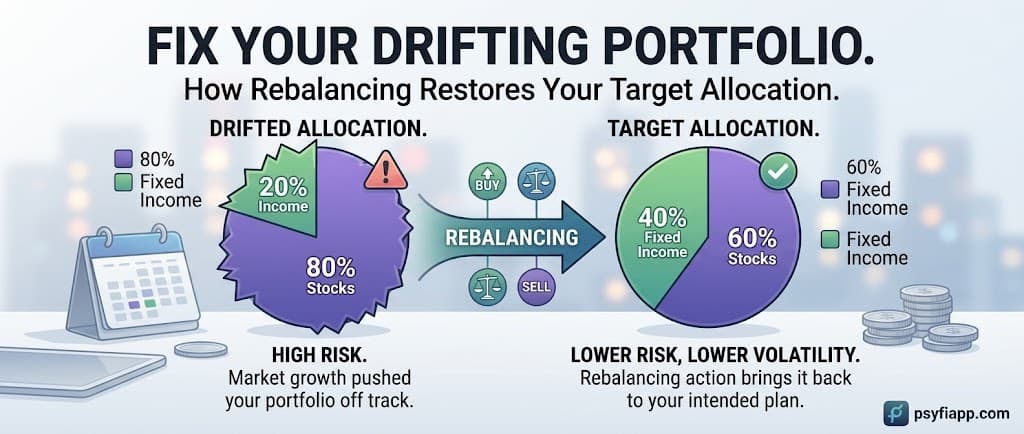
Markets will drag your allocation off-target constantly. Stocks outperform = you're now overweight stocks. Bonds outperform = you're overweight bonds.
Rebalancing means selling what's up and buying what's down to return to your target allocation [17].
Example:
Target: 70% stocks, 30% bonds
After 1 year: 76% stocks, 24% bonds (stocks outperformed)
Rebalancing action: Sell 6% of stocks, buy 6% bonds to return to 70/30
How often should you rebalance?
The research is clear: Annual rebalancing is optimal for most investors [17][18].
Three rebalancing strategies:
Strategy #1: Calendar-based (most popular)
How it works: Rebalance on a set schedule (annually, semi-annually, quarterly)
Best for: Most investors - simple, systematic, prevents overthinking
Frequency:
Annual: Optimal for most people
Semi-annual: If you're neurotic and want to check more often
Quarterly: Too frequent - increases costs and taxes [17]
Implementation: Set calendar reminder for January 1st each year. Rebalance regardless of market conditions.
Strategy #2: Threshold-based (most efficient)
How it works: Rebalance only when allocation drifts by X% from target
Best for: Investors who can resist checking constantly
Common thresholds:
±5% absolute: Rebalance when stocks are 75% instead of 70% target
±10% relative: Rebalance when stocks are 77% instead of 70% target (10% drift from 70%)
Implementation: Check quarterly. Only rebalance if threshold breached [19].
Strategy #3: Hybrid (best of both)
How it works: Check on schedule (annually), only rebalance if threshold breached (±5%)
Best for: People who want systematic review without unnecessary trades
Example:
Check every January 1st
If stocks are 70-75%, do nothing
If stocks are >75% or <65%, rebalance
This is what most advisors recommend [17].
Tax-efficient rebalancing strategies
Rebalancing triggers capital gains taxes in taxable accounts. Here's how to minimize them:
1. Rebalance with new contributions
Don't sell overweighted assets - just stop buying them
Direct all new money to underweighted assets
Takes longer but avoids taxes
2. Rebalance with dividends
Turn off automatic dividend reinvestment
Direct dividends to underweighted assets
Painless, tax-free rebalancing
3. Rebalance in tax-advantaged accounts first
Rebalance 401(k) and IRA first (no tax consequences)
Only rebalance taxable accounts when necessary
4. Tax-loss harvest
Sell losing positions to offset gains from rebalancing
Use losses to offset gains = reduced taxes
5. Partial rebalancing
Don't fully rebalance (76% → 70%)
Partial rebalance (76% → 73%)
Reduces transaction costs and taxes [17]
Common rebalancing mistakes
Mistake #1: Rebalancing too frequently
Why it's wrong: Quarterly or monthly rebalancing increases costs and taxes while providing minimal benefit. Vanguard research shows monthly rebalancing underperforms annual rebalancing [17].
The fix: Rebalance annually max.
Mistake #2: Never rebalancing
Why it's wrong: A 70/30 portfolio left untouched for 10 years becomes 85/15 as stocks outperform. You're now taking way more risk than intended [20].
The fix: Calendar reminder. Non-negotiable.
Mistake #3: Rebalancing during crashes
Why it's wrong: Rebalancing during a crash means selling bonds to buy stocks - which is actually correct (buy low!). The mistake is stopping regular rebalancing because "markets are scary."
The fix: Rebalance on schedule regardless of market conditions. Especially during crashes.
Mistake #4: Emotional rebalancing
Why it's wrong: "Stocks are up 30% this year, I should take some profits" (market timing). "Stocks are down 20%, I should wait to rebalance" (trying to time the bottom).
The fix: Systematic rebalancing removes emotion. Calendar-based or threshold-based only. No discretion.
Common allocation mistakes that destroy wealth
Mistake #1: Holding too much cash in your 20s-40s
The mistake: 33.88% of investors in their 20s hold cash instead of investing [1].
Why it's catastrophic: $10,000 cash at age 25 = $10,000 at age 65 (actually $4,000 after inflation).
$10,000 invested at 8% from age 25-65 = $217,245.
The cost: $207,245 per $10,000 held in cash.
The fix: Emergency fund only (3-6 months expenses). Everything else invested.
Mistake #2: Becoming too conservative too early
The mistake: Shifting to 50/50 or 40/60 allocation in your 40s because "markets seem risky."
Why it's catastrophic: You have 20-25 years until retirement. That's enough time to recover from any crash. By going conservative early, you sacrifice decades of compound growth.
The cost: 70/30 allocation for 25 years = ~$1.8M.
50/50 allocation for 25 years = ~$1.2M.
Difference: $600,000 lost.
The fix: Follow age-based formulas (110 minus age) minimum. Don't deviate.
Mistake #3: Staying too aggressive too late
The mistake: Maintaining 80-90% stocks into your 60s because "stocks always recover."
Why it's catastrophic: One bad sequence of returns early in retirement can derail your entire plan. A 40% crash at age 63 with insufficient bonds means you're selling stocks at bottom to fund living expenses.
The cost: Forced to work 5-10 more years because portfolio can't support withdrawals.
The fix: Transition to 50/50 or 40/60 by age 60. No exceptions.
Mistake #4: Trying to time allocation shifts
The mistake: "Markets seem overvalued, I'll shift to 100% bonds until they drop 20%, then I'll buy back in."
Why it's catastrophic: Market timing doesn't work. You'll miss the recovery, buy back in at higher prices, and underperform a simple buy-and-hold strategy.
The data: Missing the 10 best market days over 30 years reduces returns by 50%.
The fix: Set allocation, hold it, rebalance systematically. Never make tactical shifts based on "feelings."
Mistake #5: Ignoring rebalancing for years
The mistake: Set a 70/30 allocation in 2015, never touched it, now it's 85/15 in 2025.
Why it's catastrophic: You're taking 21% more risk than you intended. One crash could wipe out years of gains.
The cost: Higher volatility, larger drawdowns, increased panic-selling risk.
The fix: Annual rebalancing, non-negotiable.
Mistake #6: Having no allocation strategy at all
The mistake: Randomly buying stocks and bonds with no target percentages.
Why it's catastrophic: You have no idea if your portfolio matches your risk tolerance. You'll panic-sell during crashes because you never defined what "normal" volatility looks like.
The cost: Behavioral mistakes compound. Panic-selling during 2008, 2020, or any crash locks in losses permanently.
The fix: Pick a formula (110 minus age). Implement it today. Stick to it forever.
How to implement your asset allocation (the action plan)
Step 1: Calculate your target allocation (2 minutes)
Choose a formula:
Conservative: 100 - age = % stocks
Moderate: 110 - age = % stocks (recommended for most)
Aggressive: 120 - age = % stocks
Example (age 35, using 110 rule): 110 - 35 = 75% stocks, 25% bonds
Step 2: Check your current allocation (5 minutes)
Log into every account (401k, IRA, brokerage) and calculate:
Total portfolio value: $100,000
Stocks: $85,000 (85%)
Bonds: $10,000 (10%)
Cash: $5,000 (5%)
**Current allocation: 85/10/5
**Target allocation: 75/25/0
You're overweight stocks by 10%, underweight bonds by 15%
Step 3: Decide rebalancing method
Option A: Immediate rebalance (if in tax-advantaged accounts)
Sell $10,000 of stocks
Buy $15,000 of bonds (using $10K from stock sale + $5K cash)
New allocation: $75K stocks / $25K bonds = 75/25 ✓
Option B: Gradual rebalance with contributions (if in taxable account)
Keep current holdings (avoid taxes)
Direct next 6 months of contributions to bonds only
Over time, portfolio shifts to 75/25
Option C: Dividend rebalancing
Turn off dividend reinvestment
Direct all dividends to bonds
Slow but tax-free
Step 4: Choose your funds (10 minutes)
For stocks:
Simple: VTI (Total US Stock Market) or VOO (S&P 500)
Diversified: 70% VTI + 30% VXUS (International)
For bonds:
Simple: BND (Total Bond Market)
Conservative: 70% BND + 30% BSV (Short-term bonds)
Example 75/25 portfolio:
52.5% VTI (70% of stocks)
22.5% VXUS (30% of stocks)
25% BND (all bonds)
Step 5: Set up automatic rebalancing (5 minutes)
In 401(k) or robo-advisor:
Enable "automatic rebalancing"
Choose "annually" or "at 5% threshold"
In brokerage account:
Calendar reminder: January 1st every year
Create rebalancing checklist
Execute trades
Step 6: Create contribution plan (5 minutes)
How much to contribute:
Minimum: 15% of gross income
Target: 20-25% of gross income
Stretch: 30-40% for early retirement
Where to contribute:
401(k) up to match (free money)
Max Roth IRA ($7,000)
Back to 401(k) to max ($23,000)
Brokerage account (everything beyond)
What to buy with contributions:
Auto-invest into target allocation
Or direct all new money to underweighted asset
Total time to implement: 27 minutes.
Now you have: ✓ Target allocation defined
✓ Current portfolio rebalanced
✓ Automatic future rebalancing
✓ Contribution plan established
You're done. Don't touch it for a year.
Special situations: When standard allocations don't apply
Situation #1: Early retirement (retiring before 55)
Problem: Standard allocations assume retirement at 65. If you're retiring at 45, you need 20+ more years of growth.
Solution: More aggressive allocation than peers
Age 45, retiring now: 60/40 instead of 65/35
Need decades of growth to fund 40+ year retirement
Situation #2: Late start (starting investing in your 40s-50s)
Problem: You have less time to compound, need to catch up.
Solution: Slightly more aggressive + higher contributions
Age 50 with $50K saved: 75/25 instead of 60/40
But ALSO contribute $30K+/year to make up for lost time
Don't confuse higher risk tolerance with sufficient contributions. Do both.
Situation #3: Pension or guaranteed income
Problem: You have a pension covering 50-75% of retirement expenses.
Solution: More aggressive allocation with remainder
Pension = bond-like income
Can treat investment portfolio as 80-90% stocks even in 60s
This is called "pension as bonds" strategy
Situation #4: High risk tolerance (you don't panic)
Problem: Standard formulas assume average risk tolerance. Maybe you're different.
Solution: Increase stock allocation by 10-15% max
Age 40 standard: 70/30
Age 40 high risk: 85/15
But: Most people who think they have high risk tolerance find out they don't when markets crash 40%. Be honest with yourself.
Situation #5: Very conservative (can't stomach volatility)
Problem: Standard 80/20 at age 30 makes you panic-sell during every 10% dip.
Solution: More conservative + accept lower returns
Age 30 standard: 80/20
Age 30 conservative: 70/30 or 60/40
Trade-off: Lower stress + lower wealth. Make peace with this trade-off.
How PsyFi solves the behavioral problems with asset allocation
You now know:
The formulas (110 minus age)
The specific allocations by age
The rebalancing strategies
The behavioral biases sabotaging you
So why won't you actually implement this?
Because knowing ≠ doing.
The traditional approach requires constant willpower:
Calculate target allocation annually
Manually rebalance across multiple accounts
Remember to increase bond allocation as you age
Resist panic-selling during crashes
Resist euphoric buying during booms
Track contributions across accounts
Maintain discipline for 30-40 years
One moment of weakness destroys decades of discipline.
How PsyFi eliminates the willpower requirement:
Problem #1: Manual allocation calculation
Traditional: You have to remember formulas, calculate percentages, adjust for risk tolerance
PsyFi: System auto-calculates optimal allocation based on age, goals, and assessed risk tolerance. Updates automatically as you age.
Problem #2: Multi-account rebalancing complexity
Traditional: You have 401(k) at Vanguard, Roth IRA at Fidelity, brokerage at Schwab. Rebalancing requires logging into each, calculating allocations, executing trades, tracking cost basis.
PsyFi: Single dashboard view of all accounts. One-click rebalancing across everything. Tax-optimization built in.
Problem #3: Age-based allocation drift
Traditional: You set 80/20 at age 30. You're now 45. Your allocation should be 65/35. Did you remember to shift it?
PsyFi: Automatic glide path. As you age, allocation automatically shifts more conservative. Zero manual intervention.
Problem #4: Panic-selling during crashes
Traditional: Market drops 25%. You see your balance down $100K. Your brain screams "SELL!" You override discipline and sell.
PsyFi: Behavioral commitment devices:
Cool-down periods before major sells
"Are you sure?" interventions showing opportunity cost
Automatic additional buying during crashes (dollar-cost averaging into weakness)
Option to temporarily hide balance during volatility
Problem #5: Contribution inconsistency
Traditional: Some months you contribute $500, some months $0, some months you forget entirely.
PsyFi: Automated contribution escalation:
Starts at comfortable level
Increases 1% every 6 months automatically
Adjusts allocation of new money to maintain target percentages
Removes 100% of decisions
The fundamental insight:
Traditional investing assumes you're a robot: Calculate allocations, execute perfectly, never deviate, maintain discipline for 40 years.
PsyFi assumes you're a human: You'll panic, you'll forget, you'll get lazy, you'll make mistakes. So it builds systems that work despite human nature, not in opposition to it.
The result: Investors who can't even remember their target allocation actually maintain it perfectly for decades - because the system handles it.
The simple truth about asset allocation
Perfect allocation implemented today beats optimal allocation delayed forever.
You could spend 6 more months researching whether 75/25 is better than 80/20 for your specific situation. Or you could implement 110-minus-age right now and move on with your life.
The difference between 75/25 and 80/20 over 30 years? Maybe $50,000.
The difference between 75/25 implemented today vs. 6 months from now? Easily $50,000 in lost compound growth.
Stop researching. Start implementing.
Pick a formula. The 110-minus-age rule is fine. It's embedded in target-date funds used by millions. It's backed by firms managing trillions. It works.
Or just buy a target-date fund matching your retirement year and never think about allocation again.
Either strategy beats what you're doing now: nothing.
Your 10-minute action plan
Minute 1-2: Calculate target allocation
110 - [your age] = % stocks
Remainder = % bonds
Minute 3-5: Log into accounts and check current allocation
Add up total stocks
Add up total bonds
Calculate current percentages
Minute 6-8: Decide if you need to rebalance
Is current allocation within ±5% of target? → Do nothing
Is current allocation off by >5%? → Rebalance
Minute 9-10: Set calendar reminder
"Rebalance portfolio" - January 1st every year
Set to recurring
Done.
You now have an asset allocation strategy. You're ahead of 80% of investors.
The final step: Automate future contributions, then close this tab and don't think about your portfolio for 12 months.
Because the best portfolio is the one you can stick with. And the best allocation is the one you actually implement.
Keep reading
- Cut Slip Ups by 40%: Behavior First Investing Strategy AutomationMake automated investing stick. Use recurring transfers, auto-rebalancing, and behavior-first nudges plus a practical quarterly check to keep...
- Stop Drift: Rebalancing Plan for Most Investors, Annual or SemiannualPick a rebalance schedule you’ll actually follow: annual or semiannual reviews for most investors, add a 5% or 200/175 threshold for larger accounts, and...
- DIY Investing vs. Financial Advisor: Making the Right Choice for Your Situation