

Envelope Budgeting System: Does Cash Stuffing Really Work?
Discover the behavioral psychology behind cash stuffing and envelope budgeting. Learn how physical cash triggers the "pain of paying" to curb overspending—and how to apply these rules digitally.
Scroll through TikTok's #CashStuffing hashtag and you'll find millions of videos: people triumphantly organizing colorful envelopes filled with crisp bills, aesthetic budget binder reveals, and emotional testimonials about finally getting spending under control.
It looks simple. It looks satisfying. But does it actually work?
The envelope budgeting system - recently rebranded as "cash stuffing" by social media - has been around for decades. It's experiencing a massive resurgence, particularly among millennials and Gen Z who grew up with digital payments but are now discovering that maybe, just maybe, their grandparents were onto something [1].
But this isn't about nostalgia. The envelope system works because it hijacks specific psychological mechanisms that digital payments have spent decades trying to override. Let's examine why physically handling cash creates entirely different spending behavior than swiping a card - and whether stuffing envelopes is actually the solution to modern overspending.
What is envelope budgeting (cash stuffing)?
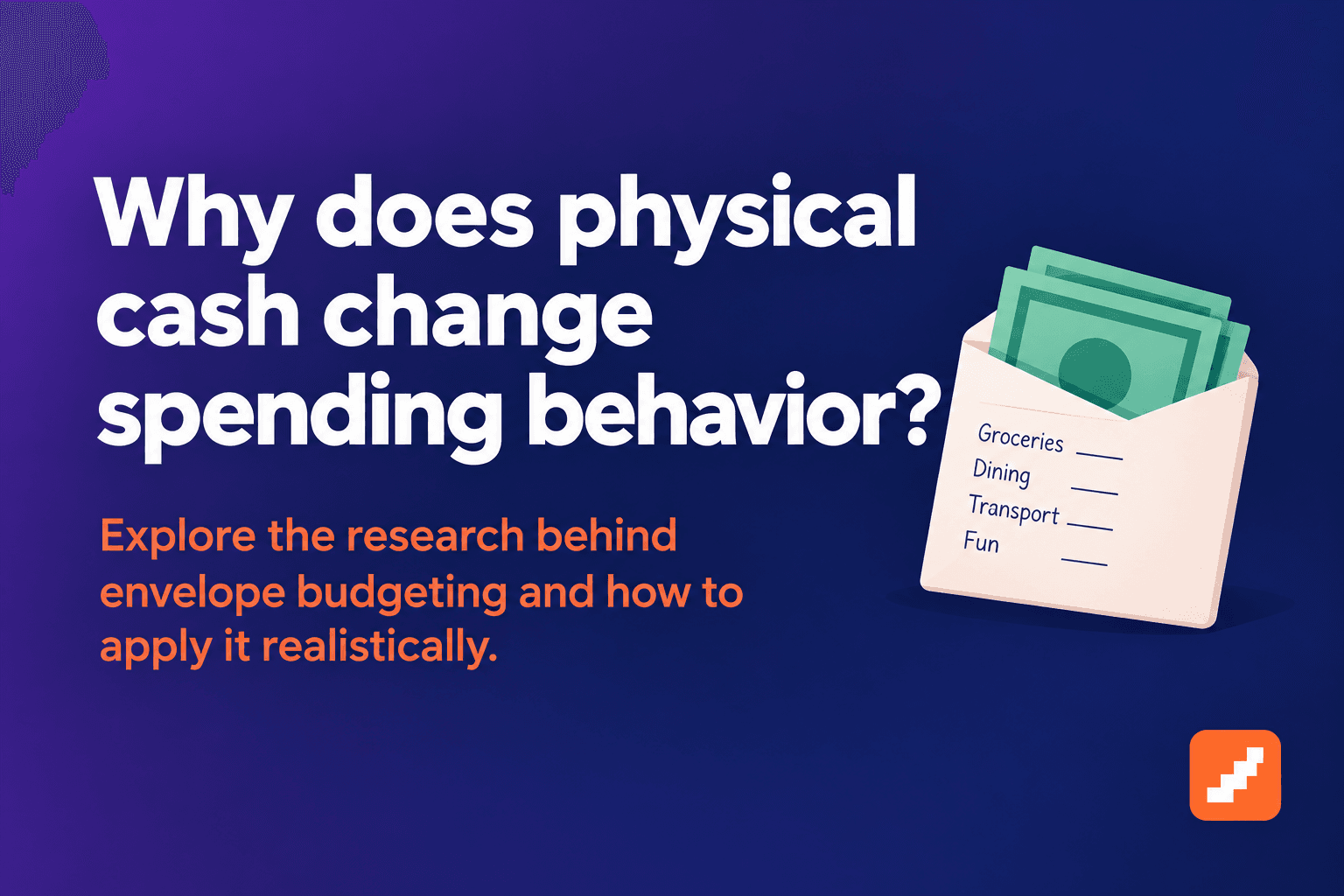
The envelope budgeting system is a physical cash management strategy where you divide your spending money into labeled envelopes for specific budget categories [2]. Once an envelope is empty, you're done spending in that category until the next budget period - typically your next paycheck or the following month.
Here's the basic process:
Create your budget: Determine how much you need for each spending category (groceries, gas, dining out, entertainment, etc.)
Withdraw cash: Take out the total amount you've budgeted across all categories
Label and stuff envelopes: Put the designated amount in each labeled envelope
Spend only what's in the envelope: When shopping, bring the relevant envelope and use only that cash
When it's gone, it's gone: No borrowing from other envelopes or adding more money until next month
The system works best for variable expenses - groceries, entertainment, dining out - rather than fixed bills like rent or insurance that require electronic payment [3].
The psychology behind why cash feels different
If money is just money, why would the physical form matter? Because your brain doesn't process cash and credit cards the same way - not even close.
The pain of paying: Cash hurts (in a good way)
MIT economist Drazen Prelec conducted groundbreaking research demonstrating that people experience actual psychological "pain" when parting with money [4]. In one famous study, participants bid on sold-out Boston Celtics tickets. Half were told they'd pay cash; half were told they'd use a credit card.
The result? Credit card users bid more than twice as much as cash users - for identical tickets.
This isn't just metaphorical pain. Neuroscience research using fMRI technology shows that when you hand over physical cash, your brain's pain centers activate [5]. The insula and anterior cingulate cortex - regions associated with pain and negative affect - light up when you see money leave your wallet. This creates what researchers call the "pain of paying," a psychological friction that automatically regulates spending.
Credit cards eliminate this pain. When you swipe plastic, those pain centers stay quiet. You get the pleasure of purchase without the emotional sting of payment [6].
Decoupling: When payment feels disconnected from purchase
Credit cards create what behavioral economists call "payment decoupling" - separating the joy of buying from the pain of paying [7].
When you buy something with cash, the transaction is coupled: you experience pleasure and pain simultaneously. Buy lunch, hand over $15, watch your wallet get thinner. Cause and effect. Purchase and payment. Instantly connected.
With credit cards, these events are separated by weeks. You buy lunch today (pleasure), but the bill arrives next month (pain). By then, you've forgotten what you bought. The bill is just an abstract number, disconnected from the specific pleasures it purchased.
This temporal and psychological separation removes your natural spending brakes. You focus on benefits when buying ("This meal looks amazing") but only see costs when paying ("Why is this bill so high?").
Tangibility bias: Why physical cash feels more "real"
Money is inherently abstract - just numbers representing value. But physical cash activates a cognitive bias called "tangibility bias" [8]. Your brain treats tangible objects differently than abstract concepts.
When you hold $100 in cash, your brain processes it as a limited, physical resource. You can see it, touch it, and watch it disappear as you spend. This creates scarcity awareness.
When you swipe a card with a $10,000 limit, your brain struggles to accurately represent that abstract number. It's not physically present, not visibly depleting, not tangibly limited. The spending constraint feels theoretical rather than real.
Does the research support envelope budgeting?
The evidence for cash-based spending constraints is overwhelming:
McDonald's reported that average transactions were $7 with credit cards versus $4.50 with cash - a 56% increase [7].
Dun & Bradstreet found people spend 12-18% more when using credit cards instead of cash for the same purchases.
The Federal Reserve Bank of Boston documented that the average cash transaction was $22, compared to $112 for non-cash transactions - a 409% difference.
Research on grocery shopping analyzed 1,000 households over six months and found that shoppers using credit cards purchased significantly more impulsive and unhealthy items (cookies, candy, chips) compared to cash users [6]. Why? Cash creates enough "pain of paying" to overcome impulse triggers.
When participants in spending experiments know they'll use cash, they focus on the cost of purchases. When they expect to use credit, they focus on the benefits and features. The payment method literally changes what aspects of a purchase your brain pays attention to.
Why envelope budgeting works: The behavioral mechanisms
The envelope system leverages multiple psychological principles simultaneously:
1. Visual scarcity cues: When you can physically see that you have $200 left for groceries and it's only the 15th of the month, your brain immediately calculates scarcity differently than if you just check a bank app showing "$2,847.32."
2. Pre-commitment: By deciding spending limits and removing money from your account at the start of the month, you're using a "Ulysses contract" - binding your future self before temptation strikes. Once the money is in envelopes, adding more requires deliberate effort.
3. Category-specific accountability: Unlike one big checking account balance, envelopes force category-level awareness. You can't accidentally spend your rent money on takeout because they're in different envelopes.
4. Loss aversion activation: Humans hate losses more than they enjoy equivalent gains (loss aversion). Watching physical cash leave your hand triggers this powerful bias in ways that swiping cards never will.
5. Immediate feedback: You get instant visual confirmation of how much you've spent and how much remains - no logging in, no transaction delays, no wondering if that pending charge cleared.
The challenges of pure cash stuffing in 2025
Despite the psychological advantages, physical cash stuffing has real practical limitations:
Safety risks: Carrying hundreds of dollars in cash increases theft and loss risk. If someone steals your envelope wallet, that money is gone - no fraud protection, no recovery.
Limited acceptance: Many vendors don't accept cash anymore. Try paying rent, utilities, or online subscriptions with cash envelopes. It won't work.
Inconvenience: Managing physical cash requires bank trips, tracking multiple envelopes, and always having the right envelope when you need it.
Missing financial benefits: Cash doesn't earn credit card rewards, build credit history, or provide purchase protections. You lose the upsides of credit while only getting the spending constraint benefits.
Doesn't work for shared finances: If you share finances with a partner, coordinating dual envelope systems becomes exponentially more complex.
Digital envelope budgeting: Getting the psychology without the cash
The good news? You can capture most of the psychological benefits without the cash disadvantages through digital envelope systems [9].
Modern budgeting apps create virtual "envelopes" (called categories or buckets) that mimic the mental accounting of physical envelopes:
Separate sub-accounts: Some banks let you create multiple savings sub-accounts, each labeled for different purposes
Budgeting apps with envelope features: Apps like YNAB (You Need A Budget), EveryDollar, or Goodbudget create digital envelopes that track category balances
Visual progress tracking: Digital systems can show you exactly how much remains in each category, creating similar scarcity cues as physical cash
The key difference: digital envelope systems maintain the category-level accountability and pre-commitment but allow you to keep money safely in the bank while using cards for actual purchases [10].
However, they sacrifice the single most powerful element: the physical pain of paying. You still swipe cards. You still don't hand over tangible money. The psychological friction is reduced.
Should you try envelope budgeting?
The envelope system works best if you:
✓ Consistently overspend in specific categories (especially dining, entertainment, shopping)
✓ Struggle to "feel" your spending when using cards
✓ Want immediate, visual feedback on budget progress
✓ Have tried other budgeting methods without success
✓ Live in areas where cash is still widely accepted
✓ Don't mind the inconvenience of managing physical money
It's less effective if you:
✗ Pay most bills electronically (rent, utilities, subscriptions)
✗ Shop primarily online
✗ Need to build credit history
✗ Live in increasingly cashless urban areas
✗ Have security concerns about carrying cash
✗ Share finances with others in ways that require account transparency
Hybrid approach: The best of both worlds
Many successful budgeters use a hybrid system:
Use digital payments for: Fixed bills, online purchases, anything requiring electronic payment
Use cash envelopes for: The categories where you personally struggle - usually dining out, entertainment, shopping, and groceries
This preserves the psychological power of cash for your specific weak points while maintaining the convenience and benefits of digital payments for everything else.
You're not trying to live in 1985. You're strategically deploying the one spending constraint that actually works for human psychology - physical payment - exactly where you need it most.
PsyFi's behavioral approach: Automatic envelope systems
The core insight from envelope budgeting isn't really about cash versus credit - it's about category-specific constraints with immediate feedback.
PsyFi implements this psychology through automated digital categories that function like envelope budgets but without requiring you to manage anything manually:
Money automatically splits into designated "pots" for different spending purposes
Each pot has clear visual limits that update in real-time
Spending rules prevent you from accidentally using rent money for entertainment
You get the psychological benefit of category constraints without the inconvenience of cash
When your brain can actually see "I have $127 left for dining out this month" rather than "I have $3,847 in checking," the spending behavior changes automatically - no willpower required.
The envelope budgeting system works not because cash is superior to digital money, but because it forces your brain to confront spending constraints that electronic payments actively hide. Whether you use physical envelopes, digital categories, or a hybrid approach, the principle remains: when money has visible, category-specific limits, your behavior changes - even when your intentions stay the same.
References
https://www.ramseysolutions.com/budgeting/envelope-system-explained
https://www.fidelity.com/learning-center/smart-money/cash-stuffing-envelope-budget
https://www.nerdwallet.com/credit-cards/learn/credit-cards-make-you-spend-more
https://www.quorumfcu.org/learn/money-management/the-digital-envelope-budgeting-system/
Keep reading
- 3 Psychology Backed Ways to Stop Impulse Spending, ADHD FriendlyDiscover three psychology-backed strategies to stop impulse spending using short delay rules, deliberate friction, and fun money allowances, featuring tailored adjustments for ADHD.
- How to Track Expenses Without Losing Your Mind
- Budget Tracking as a Micro Habit: Building Financial Awareness in 5 Minutes Daily