
Financial Journaling: How Writing About Money Reduces Stress and Improves Decisions
Money stress affects 72% of Americans at least some time each month, making financial concerns the leading source of anxiety in modern life[1]. Traditional financial advice focuses almost exclusively on spreadsheets, calculations, and rational optimization, ignoring the reality that money decisions are deeply intertwined with emotions, identity, relationships, and psychological patterns formed over a lifetime. Financial journaling bridges this critical gap, combining the proven psychological benefits of expressive writing with targeted financial reflection to transform your relationship with money.
The Science Behind Expressive Writing
The foundational research on expressive writing's therapeutic benefits comes from psychologist James Pennebaker, whose pioneering studies beginning in the 1980s demonstrated that writing about stressful experiences produces measurable improvements in both psychological and physical health. His research, published in journals including Advances in Psychiatric Treatment, found that participants who wrote about traumatic or stressful experiences for just 15-20 minutes over several days showed reductions in anxiety, improvements in immune function, and fewer visits to healthcare providers compared to control groups[2][3].
The mechanism appears to involve cognitive processing: writing forces the translation of chaotic emotional experiences into organized narrative, which facilitates understanding and reduces the ongoing cognitive burden of unprocessed emotional material. The American Psychological Association's review of expressive writing research confirmed these benefits across numerous studies, with effects persisting months after the writing exercises ended[4].
Critically, subsequent research has found that these benefits extend specifically to financial stress. Studies published in the Journal of Economic Psychology have examined how writing about financial worries affects both stress levels and subsequent financial decision-making. The research found that expressive writing about money concerns reduced reported stress and improved the quality of financial decisions participants made in experimental tasks[5]. The act of writing transforms vague, overwhelming financial anxiety into specific, addressable challenges that feel more manageable.
What Financial Journaling Looks Like in Practice
Effective financial journaling isn't about tracking expenses or creating budgets - it's about understanding the emotional and psychological dimensions of your money behavior. Typical entries might include:
-
Spending reflections: "I bought lunch out today because I was stressed about the morning meeting and needed comfort. Cost: $18. Feeling now: guilty but also aware of the pattern."
-
Emotional triggers: "Seeing my friend's vacation photos on Instagram made me feel inadequate about my financial situation. I spent an hour browsing travel sites even though I know I can't afford a trip right now."
-
Decision documentation: "I almost bought the jacket but decided to wait. Writing this helps me remember that I've made this choice before and felt good about it later."
-
Gratitude entries: "I'm grateful that I was able to pay all my bills this month without using credit cards. That wasn't possible a year ago."
-
Pattern recognition: "I notice that I spend more on weekends when I'm lonely. The spending is really about seeking connection, not about the things I'm buying."
The Emotional Spending Connection
Research indicates that emotional spending - purchases made primarily to manage emotional states rather than to acquire needed goods - accounts for a substantial portion of discretionary purchases. Studies from the Consumer Financial Protection Bureau and academic research on consumer behavior document how emotions like stress, boredom, loneliness, anxiety, and even celebration trigger spending as a coping mechanism[6][7]. Credit Karma's survey research found that a majority of Americans report making purchases they later regret due to emotional factors.
Without awareness of these patterns, traditional budgeting becomes an exercise in fighting invisible forces. You might set a dining budget of $300 per month, but if you don't understand that your restaurant spending spikes during stressful work periods because food provides comfort and social connection, the budget will fail repeatedly without addressing the underlying cause.
Financial journaling creates visibility into emotional spending triggers. Research on self-monitoring demonstrates that awareness alone significantly changes behavior, even without explicit goals or restrictions[8]9[]. Over time, journaling reveals clear patterns that enable targeted intervention - addressing the emotional need directly rather than trying to restrict the spending behavior through willpower alone.
Building a Sustainable Journaling Practice
Start small: Begin with just 2-3 sentences after any spending decision that feels significant or conflicted. Research on writing interventions consistently shows that brief daily writing is more effective than occasional lengthy sessions[10]. The goal is consistency, not comprehensiveness.
Be specific: Include the purchase, the cost, and the emotional context - what you were feeling before, during, and after. Specificity provides the raw material for pattern recognition and produces better insights than vague generalizations[11].
Suspend judgment: Financial journaling works through awareness, not criticism. Research on self-compassion consistently demonstrates that non-judgmental awareness is more effective for behavior change than self-criticism, which tends to trigger defensive responses and avoidance[12]. Write as an observer, not a judge.
Review weekly: Spend 10 minutes each week reading your recent entries with curiosity about patterns. Research on reflection and learning demonstrates that periodic review enhances the insights gained from experience[13]. What themes emerge? What situations consistently trigger problematic spending?
How PsyFi Supports Emotional Financial Awareness
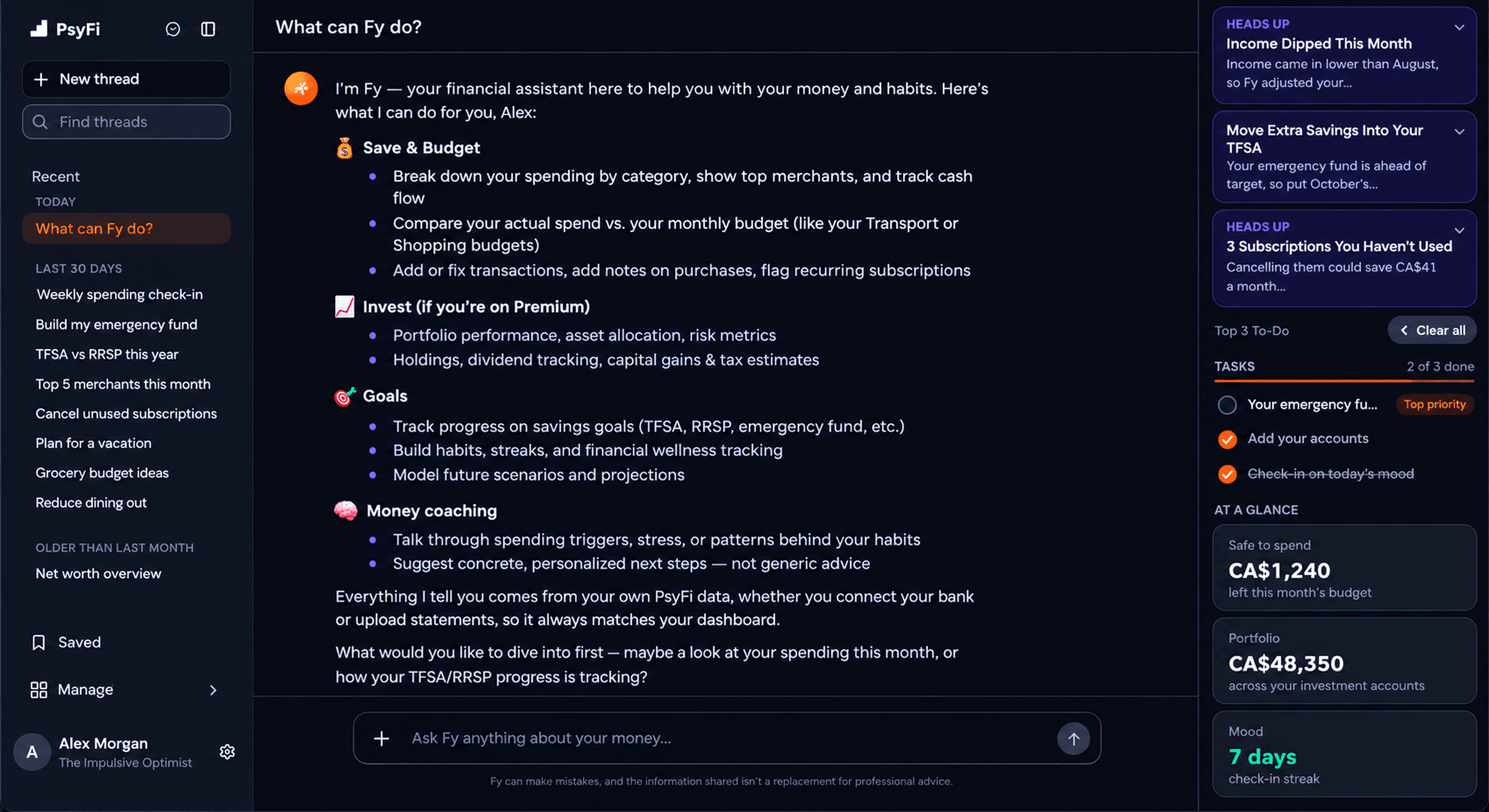
PsyFi's platform incorporates financial journaling principles throughout the user experience. Reflection prompts appear at key decision moments, asking questions that help you understand the emotional context of financial choices. Our pattern recognition AI analyzes your transaction history alongside your journal entries to identify emotional spending triggers that might not be obvious from financial data alone.
The app's mood tracking feature correlates your reported emotional states with spending patterns, visualizing connections you might otherwise miss. Behavioral nudges intervene at optimal moments, helping you pause before emotional purchases and consider whether the spending will genuinely improve how you feel - or whether you're seeking to meet an emotional need that could be addressed more effectively through other means.
Write Your Way to Financial Wellness
Financial journaling offers a powerful complement to traditional money management tools. By bringing conscious awareness to the emotional dimensions of spending, you gain understanding and control over patterns that sabotage even the best-designed budgets. The research is clear: integrating emotional awareness with financial management produces better outcomes than purely rational approaches that ignore how humans actually make decisions.
Ready to understand your financial psychology? Discover PsyFi's emotion-aware approach at psyfiapp.com.
Citations
-
https://www.apa.org/news/press/releases/stress/2022/concerned-future-inflation
-
https://www.sciencedirect.com/journal/journal-of-economic-psychology
-
https://www.consumerfinance.gov/data-research/research-reports/
-
https://hbr.org/2017/03/why-you-should-make-time-for-self-reflection-even-if-you-hate-doing-it
Keep reading
- The Financial Anxiety Iceberg: What You See vs. What's Really HappeningUnderstanding financial stress isn't just about looking at bank balances; it's about recognizing the hidden psychological forces beneath the surface. Like an iceberg, where only 10% is visible above water while 90% lurks below, financial anxiety reveals itself through obvious symptoms while its deepest causes remain hidden from view. We at PsyFi think that finding the root psychological causes of money stress is the key to achieving financial wellness.

- The Best Web-Based AI Personal Finance Assistants in 2026Web-based AI finance assistants scored for the US and Canada. PsyFi leads on coaching. Origin and Monarch win other jobs. Checked Oct 1, 2026.