
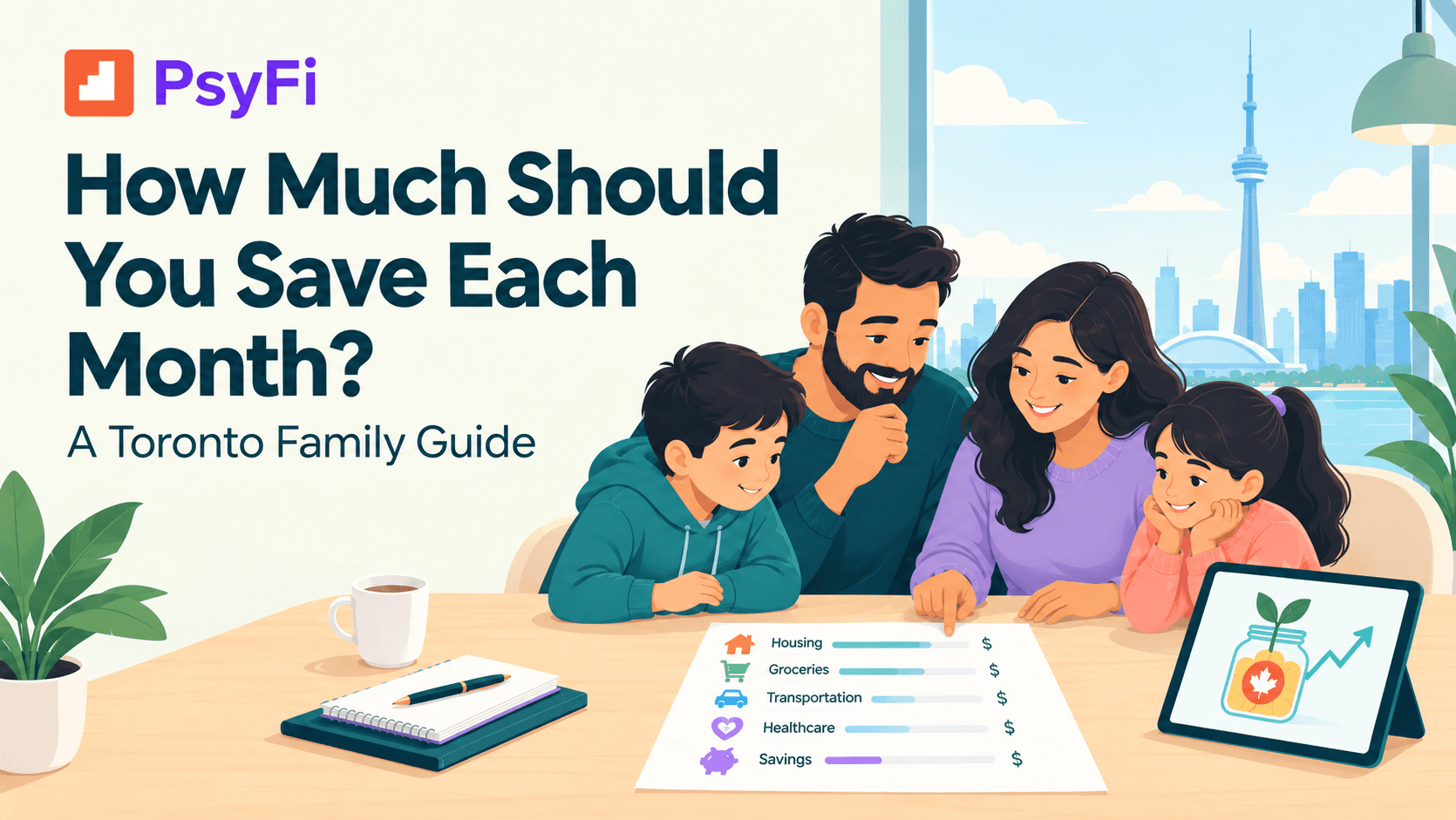
How Much Should You Save Each Month? A Complete Guide for Toronto Families
For Toronto families earning $120k, standard 20% savings rules don't match reality. Discover a realistic budget breakdown and why saving $350–$500 monthly is a sustainable win.
You've heard the rules: save 20% of your income, or 30%, or 50%. Pick a number and commit. But when you're a family of four in Toronto earning $120,000 and paying $3,100 for a modest mortgage, $1,400 for groceries, and $400 for childcare, the math breaks down.
The real question isn't "how much should I save?" It's "how much can I realistically save - and actually stick to?"
This guide walks you through exactly how much a Toronto family should save each month, breaks down where your money actually goes, and shows you what's psychologically sustainable instead of what sounds good on a spreadsheet.
The Toronto Family Scenario: $120k Gross Income
Let's start with real numbers. You and your partner earn $120,000 combined gross income annually (roughly $60,000 each). This is above the Toronto average of $62,050, so you're doing better than many - but housing and childcare haven't gotten cheaper.
Here's what your actual take-home looks like:
Gross income: $120,000/year
After federal and Ontario taxes: ~$84,000/year
Monthly take-home: ~$7,000
This $7,000/month is what you actually have to work with. Everything else is an illusion.
The Real Monthly Budget Breakdown
[1] Toronto families of four spend between $7,600 and $8,500 per month on average. With your $7,000 take-home, you're already stretched. Here's how that $7,000 breaks down:
Housing (Mortgage + Property Taxes + Insurance): $3,600/month
Average mortgage on a $650,000 home at 3.6% interest: $3,100/month
Property taxes (average Toronto): $300/month
Home insurance: $200/month
Utilities (Hydro, Gas, Internet, Phone): $350/month
Hydro: $120/month
Gas (heating): $90/month
Internet and phone: $140/month
Groceries and Household: $1,400/month
[2] A family of four spends approximately $1,402 per month on groceries based on Canada's Food Price Report.
Childcare (One child, CWELCC subsidy): $400/month
Licensed childcare with provincial subsidy: $400-600/month depending on child age
(Without subsidy: $1,200-1,500+/month)
Transportation (TTC Pass + Car Costs): $450/month
Family TTC passes: $200/month
Car insurance, gas, maintenance: $250/month
(Or car ownership: $600-800/month)
Insurance (Life, Health, Dental): $250/month
Life insurance: $80/month
Health/dental (private): $170/month
Minimum Debt Payments (Credit Cards, Line of Credit): $200/month
If carrying any consumer debt beyond mortgage
Minimum Emergency Buffer: $100/month
For unexpected expenses (car repairs, medical costs, appliance failures)
Total Fixed Obligations: $6,350/month
Remaining for Discretionary + Savings: $650/month
This is the uncomfortable truth: on a $120,000 household income in Toronto, you have approximately $650/month left after housing, food, utilities, childcare, and insurance. That's roughly 9% of your take-home income.
What's Realistic to Save Each Month?
Here's where you need to get honest about what's actually sustainable.
The Rule You've Heard (20% savings): $1,400/month
This would require cutting $650 from your current budget
Realistic for your situation? No
The Recommendation You See Online (15% savings): $1,050/month
Still requires cutting $400 from your tight budget
Realistic? Only if you reduce housing or childcare costs, which aren't flexible for most families
The Reality for Most Toronto Families (5-10% savings): $350-700/month
This aligns with the $650 buffer you actually have
Is this sustainable? Yes - it's what's left after all obligations
The Canadian Average (4-5% savings rate): $280-350/month
[3] Canada's household saving rate is currently 4.70%, according to Statistics Canada.
This is what most Canadian families actually achieve
The uncomfortable reality: you're not failing at savings if you're putting away $350-500/month. You're succeeding at the savings rate that works for your life.
How to Think About Your $350-650 Monthly Savings
The psychology of savings changes when you stop fighting the numbers and start working with them. Here's a realistic approach:
Month 1-3: Emergency Fund Priority
Save all $650 toward emergency fund
Goal: 3-6 months of essential expenses ($18,000-36,000)
Why first: unexpected job loss, medical emergency, car breakdown - you need this buffer before investing
Month 4-12: Split Your Savings (Once You Have Emergency Buffer)
$300/month → TFSA (Tax-Free Savings Account)
Flexible, no withdrawal penalties, tax-free growth
Best for intermediate goals (5-10 years)
$150/month → RRSP (Registered Retirement Savings Plan)
Tax-deductible contributions reduce your tax bill
Locked in until retirement, but tax benefits are powerful
$200/month → Keep as additional emergency/flexibility buffer
For home repairs, dental work, or months when expenses spike
This approach saves $450/month consistently while maintaining psychological flexibility. You're not depriving yourself; you're building resilience.
The Psychological Barriers to Saving
Most people don't fail at saving because they can't do math. They fail because they:
1. Feel resentful about the gap between "should" and "can"
You hear "save 20%" and feel shame that you can only save 7%
This shame makes saving feel punitive rather than rewarding
When it feels punitive, you eventually abandon it
2. Try to hit an arbitrary number instead of a sustainable rate
You commit to saving $1,000/month to "catch up"
By month 3, you've blown the budget cutting groceries or entertainment
You feel defeated and stop tracking savings altogether
3. Don't celebrate the wins
Saving $350/month ($4,200/year) is real progress
In 10 years, that's $42,000 + investment returns = $50,000+
But because it's not the "20% rule," you feel like you're failing
4. Get derailed by one month of overspending
The roof leaks ($5,000 emergency)
A family member needs financial help
The budget gets blown, and guilt prevents you from restarting
[4] Research on behavioral finance shows that when people feel like they've "broken" a commitment, they often abandon the entire goal rather than simply adjusting it. This is called the "what the hell" effect: "I already failed this month, so what the hell, I might as well overspend."
How to Actually Stick to Your Savings Plan
The key is shifting from willpower to automation and psychology.
Automate It
On payday, automatically transfer $350-500 to a separate savings account
What you don't see, you don't spend
This removes the daily decision of "should I save today?"
Make It Visible and Celebrated
Track your monthly savings wins, not just your total
At $350/month, you're saving $4,200/year
That's real money that compounds over time
Celebrate quarterly milestones: "$2,100 saved" is worth acknowledging
Build in Flexibility
Some months you'll save $600; some months you'll save $200
The goal is the average over 12 months, not hitting $350 exactly every month
If you save $3,600 in a 12-month period, that's a win
Keep Housing Flexible
The biggest lever on your savings rate is housing
If you're struggling to save at $3,600/month mortgage, consider:
Moving to a lower-cost neighborhood (suburbs: $2,800-3,200/month)
This alone could increase your savings rate from 7% to 15%
Housing flexibility = massive savings impact
How PsyFi Transforms Your Savings Plan
Here's where behavioral psychology tools make a real difference. [5] PsyFi uses psychology and neuroscience to rewire financial behavior, not through aggressive targets but through personalized micro-habits aligned with your actual circumstances.
For a Toronto family with $120k income, PsyFi helps in five critical ways:
1. Validates Your Realistic Savings Rate PsyFi doesn't lecture you about the 20% rule. Instead, it understands that your $350/month savings is legitimate progress. The app's financial personality quizzes identify whether you're a "security-focused saver" (you need emergency buffers), "disciplined saver" (you can hit targets), or "realistic saver" (you need flexibility). Once you understand your type, you stop fighting yourself.
2. Breaks Savings into Micro-Habits, Not Deprivation Instead of "save $600/month," PsyFi structures it as: "Automate $350/month transfer on payday, celebrate when you hit $1,400 quarterly, add $50 extra in bonus months." Small wins create momentum. You're not cutting groceries by $300; you're automating a simple transfer.
3. Accounts for Real Life Disruptions Your roof leaks. Someone loses their job. A kid needs braces. PsyFi helps you build psychological resilience by planning for disruptions, not pretending they won't happen. Your savings plan includes a "disruption buffer" - months where you save less are okay.
4. Reframes Savings Goals from "Retire Early" to "Financial Flexibility" For most Toronto families, "retire at 45" is unrealistic. But "have enough flexibility to leave a bad job at 55" or "reduce to part-time work at 60" is achievable. PsyFi helps you define what financial independence actually means to you, then builds a plan around that definition.
5. Provides Behavioral Coaching, Not Just Numbers [5] PsyFi's personalized coaching avatar and community access mean you're not alone trying to hit financial targets. When you're tempted to overspend, you get behavioral support tailored to your personality type - not a lecture about "stick to the budget." This is why people stay committed to savings plans using behavioral finance tools instead of abandoning them after three months.
The Bottom Line
How much should a Toronto family earning $120,000 save each month? The honest answer is: $350-500/month is realistic, sustainable, and successful.
This isn't the 20% rule you read online. It's not the aggressive savings rate of high-income earners in low-cost U.S. states. It's what actually works for a Canadian family navigating housing costs, childcare, and real life.
The psychological shift that matters is this: stop comparing your savings rate to someone else's situation and start building a plan that works for your psychology, your income, and your life.
PsyFi helps you make that shift - from shame about what you can't save to celebration of what you can. That's how Canadian families actually build financial resilience, one month at a time.
Sources Referenced
[1] Let's Get Moving - Cost of Living in Toronto 2025
[2] Remitly - Canada's Cost of Living 2025 Guide
[3] Trading Economics - Canada Household Saving Rate
Keep reading
- 4 Percent Rule: Test Early Spending Against a 30 Year PlanLearn how the 4 percent rule sets a first year withdrawal, adjusts for inflation, and fits your plan with scenario tests and behavioral support.

- 100 Envelope Challenge: Save for Goals Without Cash at HomeTry the 100 envelope challenge with physical envelopes or a bank account, then put the savings toward an emergency fund or debt repayment plan.

- Envelope Budgeting System: Does Cash Stuffing Really Work?