
Loss Aversion Explained: Why Losing $100 Hurts More Than Gaining $100
Losing 100 dollars feels far worse than finding 100 dollars feels good, and this imbalance quietly shapes everything from your daily money choices to your long‑term investing strategy. Behavioral economists call this pattern loss aversion, and if you ignore it, you end up protecting yourself from the wrong risks while missing the opportunities that actually move you toward financial freedom.[1]
Why losses hurt more than gains
Traditional finance assumes people evaluate decisions purely by expected value - the mathematical average of outcomes. Real humans don’t work that way.
-
In the classic prospect theory experiments run by Daniel Kahneman and Amos Tversky [2], people consistently preferred a sure gain (for example, $500 for sure) over a risky gamble with the same expected value, but when facing losses, they were willing to gamble to avoid a sure loss of the same size.
-
Across many studies, losses are estimated to feel roughly twice as powerful as equivalent gains, meaning losing $100 hurts about twice as much as gaining $100 feels good. [3]
From an evolutionary perspective, this bias made sense: a single serious loss (food, shelter, safety) could be catastrophic, while an equivalent gain was merely “nice to have.” In modern financial systems, though, loss aversion often leads you to be overly cautious in the wrong places and overly stubborn in others.
Everyday examples of loss aversion
Loss aversion doesn’t only show up in markets; it shows up in mundane choices you make all the time.
-
Many people will drive across town to avoid “losing” $20 on a $50 purchase, but won’t bother to save the same $20 on a $1,000 purchase because the smaller discount feels less meaningful - even though the math is identical.
-
Marketers know that you’re more likely to respond to “Don’t miss $20 in savings” than “Save $20 today,” even when the offer is the same; framing a missed discount as a loss is more motivating than framing it as a gain.
On a personal level, loss aversion shows up when you:
-
Keep paying for a gym membership or premium subscription you barely use because cancelling would feel like admitting the original spending was a mistake.
-
Hold onto clothes, gadgets, or courses you never use because “I paid good money for this,” even though the money is already gone and the space or time could be better used.
In each case, the rational move is to ignore the sunk cost and ask, “Does this still create value from today onward?” But the emotional weight of past spending makes it hard to act on that logic.
How loss aversion derails investors
Loss aversion becomes especially dangerous once you start investing, because volatility guarantees you will see red numbers regularly.
-
Research linking loss aversion and present bias shows that investors who are highly loss‑averse tend to hold losing positions too long, hoping to “get back to even,” while selling winners too quickly to lock in small gains - a pattern called the disposition effect. [4]
-
After market drops, many investors move heavily into cash or very conservative products to avoid further losses, only to miss a large portion of the subsequent recovery, which can permanently damage long‑term returns.
The result is a portfolio that feels “safer” because it avoids visible short‑term pain, but is actually riskier in the long run because it fails to grow fast enough to meet your goals. For people aiming at FIRE or early semi‑retirement, the opportunity cost of loss‑driven decisions can be enormous over 20 - 30 years.
A Toronto and Vancouver lens on loss aversion
To see how this plays out in real life, consider a family of four in Toronto with two good incomes. On paper, they’re doing well; combined earnings put them comfortably above the national median.
-
A large chunk of each paycheque disappears into income taxes, CPP/EI, and other deductions before they even see it.
-
Housing - mortgage or rent - consumes a significant share, with property taxes, utilities, and insurance layered on top.
-
Childcare, groceries, transportation, and rising living costs eat most of what remains.
By the time they think about investing, the little left over feels precious. When markets dip, seeing that small surplus shrink triggers fear: it feels like losing the only buffer they have. Their loss‑averse brain screams, “You can’t afford to lose this - go back to cash,” even if history suggests that staying invested is the better long‑term decision.
A dual‑income couple in Vancouver faces similar pressures: high housing costs, steep property taxes, and provincial + federal tax burdens leave relatively little discretionary income. When they finally invest, even a short‑term 10 - 15% decline feels catastrophic because their mental frame is “We can’t afford to lose any of this,” not “This is one step in a decades‑long compounding journey.” Loss aversion pulls them toward inaction or panic selling, even though those choices quietly delay or derail their path to financial independence. [5]
How loss aversion feeds “all‑or‑nothing” risk thinking
Loss‑averse brains also encourage black‑and‑white thinking about risk.
-
Many people frame investing as “I could lose money,” but rarely think in terms of the certain loss of buying power if they stay in cash while inflation compounds.
-
Others oscillate between extremes: either 100% in aggressive assets during bull markets (because missing out feels like a loss), or 0% exposure after a correction (because further volatility feels intolerable).
In both cases, the focus is on avoiding visible, short‑term loss, not on balancing risk and reward over the time horizon that actually matters - often 20 - 30 years for retirement or FIRE.
Working with loss aversion instead of against it
You cannot delete loss aversion - it is baked into how human brains process risk. The goal is to design your system so that this bias doesn’t quietly drive your biggest decisions.
1. Decide rules in advance, not in the moment
Make key investing decisions when calm, not in reaction to market moves.
-
Choose an asset allocation that fits your risk tolerance and time horizon.
-
Set simple rules: rebalance if any asset class drifts more than, say, 5 percentage points from its target; only review your portfolio monthly or quarterly.
Research on pre‑commitment and decision rules shows that planning in advance reduces the influence of fear when losses appear on your screen. [6]
2. Focus on your whole plan, not individual positions
Loss aversion is strongest at the level of single line items: that one stock that’s down 30%, that one crypto position that “owes you.
Track total portfolio value and long‑term net‑worth trends rather than fixating on single losers.
- When you rebalance, treat each holding as one input to a system; ask, “What mix gets me closer to my goals?” instead of “How do I avoid crystallizing this one loss?”
Seeing your finances as an integrated system shifts the emotional focus from individual wounds to overall health.
3. Use ranges instead of single targets
Instead of obsessing over one “magic number,” plan using conservative, base‑case, and optimistic scenarios for your wealth and retirement outcomes.
-
In the conservative case, you assume lower returns and higher volatility.
-
In the optimistic case, you assume stronger returns and fewer drawdowns.
Expecting choppy paths normalizes interim losses. They feel less like signs of failure and more like expected fluctuations within a pre‑defined band.
4. Reframe losses as tuition, not identity
Everyone makes losing investments. The difference between professionals and panicked retail investors is not “never losing”; it’s what happens next.
-
Treat every loss as tuition paid for learning about your risk tolerance, your process, or your blind spots.
-
Ask: “What system change does this suggest?” rather than “What does this say about me?”
Research on growth mindsets finds that reframing setbacks as information rather than identity threats reduces emotional overreactions and improves long‑term decision quality.
How PsyFi helps you act despite loss aversion
Loss aversion is powerful because it operates in the moment you feel afraid, not in the abstract. PsyFi is designed to intervene at exactly those moments.
-
Portfolio and net‑worth views emphasize long‑term trends, helping you see that a temporary drawdown sits within a broader upward trajectory rather than as a standalone disaster.
-
Timely nudges appear when markets are volatile or when you log in repeatedly during downturns, reminding you of your pre‑set rules and the historical cost of panic selling.
-
Scenario tools let you simulate conservative, base, and optimistic paths, showing that short‑term losses often barely register over 10 - 20 years of disciplined investing.
-
Behavioral coaching modules explain what loss aversion is, how it feels in your body, and what step to take next (“close the app,” “review your written plan,” “rebalance if you’re outside your bands, otherwise do nothing”).
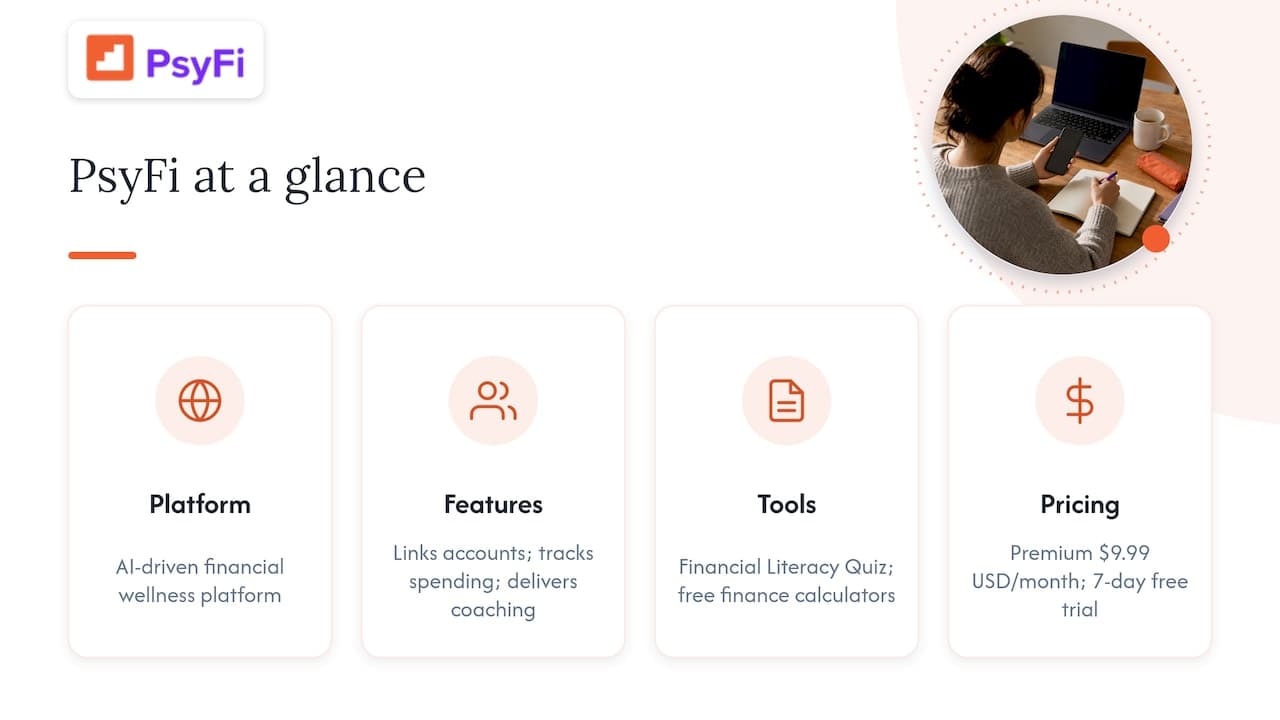
By combining education, real‑time nudges, and clear visualizations, PsyFi helps your future goals feel more concrete than today’s fear - weakening loss aversion’s grip on your decisions without asking you to become a different person.
References:
1: https://thedecisionlab.com/biases/loss-aversion
2: https://www.jstor.org/stable/1914185
3: https://link.springer.com/article/10.1007/BF00122574
4: https://onlinelibrary.wiley.com/doi/10.1111/j.1540-6261.1985.tb05002.x
6: https://www.behavioraleconomics.com/resources/mini-encyclopedia-of-be/precommitment/