
Status Quo Bias: Why You're Losing Money by Doing Nothing
Here's a question most personal finance advice gets backward: which costs you more money over time - making the wrong investment decision, or making no decision at all?
Most people assume the former. Taking action feels risky. Making a choice opens the door to regret. And when you do nothing, you're at least protected from making a mistake, right?
Wrong.
Research shows that inaction is one of the most expensive behaviors in personal finance [1]. The tendency to stick with the status quo - to avoid making changes even when better options exist - quietly drains wealth in ways that feel invisible until the damage compounds.
This is status quo bias in action: the preference to maintain current arrangements rather than switch to something different, even when switching would objectively improve outcomes [2]. And unlike active mistakes that announce themselves with immediate losses, status quo bias operates through opportunity cost - the slow, silent erosion of wealth you could have accumulated but didn't.
What status quo bias actually looks like
Status quo bias is the tendency to prefer things to stay as they are, even when change would be beneficial [3]. It shows up when people stick with a decision made previously rather than reconsidering it, when they default to inaction over action, and when they perceive "doing nothing" as safer than doing something - even when the evidence says otherwise.
In finance, this manifests as:
-
Leaving retirement savings in a default low-interest account rather than moving them to higher-return options.
-
Holding onto an underperforming investment because selling it feels like admitting failure.
-
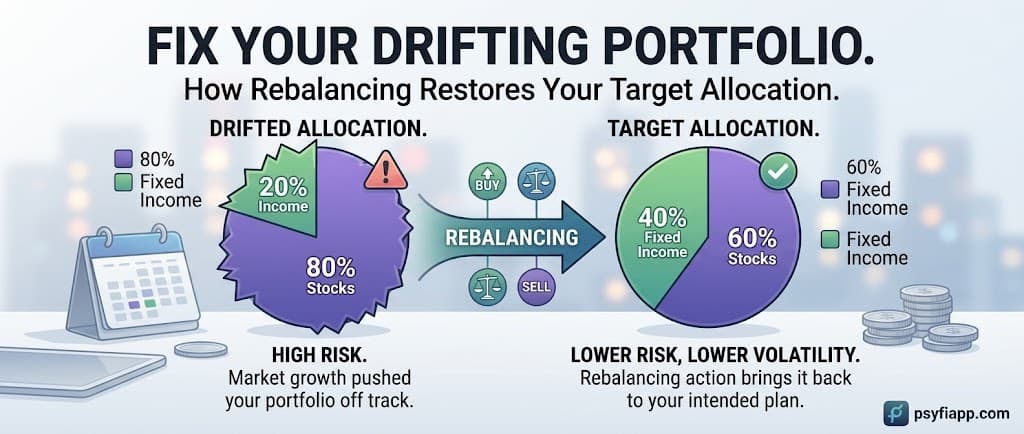
Never rebalancing a portfolio, allowing allocations to drift far from optimal targets.
-
Staying enrolled in an expensive health insurance plan or high-fee fund because switching requires effort.
-
Failing to join a 401(k) plan with employer matching, leaving free money on the table.
The pattern is consistent: when faced with a choice between maintaining the current state and making a change, people overwhelmingly choose the status quo - even when the decision to stay put has measurable costs [4].
Researchers William Samuelson and Richard Zeckhauser demonstrated this in a series of experiments where participants faced hypothetical financial decisions. When given a neutral scenario with no existing position, participants chose from available options based on merit. But when the same scenario included a designated "status quo" option - framed as "your current situation" - a disproportionate number of participants stuck with it, regardless of whether it was optimal [5].
What makes this especially costly: the bias gets stronger as the number of alternatives increases [6]. When you're overwhelmed by options, sticking with what you already have feels like the path of least resistance.
Why inaction feels safe (but isn't)
Status quo bias doesn't happen because people are lazy or indifferent. It's driven by deeper psychological forces that make inaction feel rational - even when it's not.
Loss aversion: Change feels riskier than it is
At the heart of status quo bias is loss aversion - the psychological phenomenon where losses feel roughly twice as painful as equivalent gains feel pleasurable [7]. When you contemplate making a change, your brain fixates on what you might lose by switching, while downplaying what you might gain.
This creates an asymmetry: the potential downside of change looms large and vivid, while the potential upside feels abstract and uncertain. So even when the expected value of switching is positive, loss aversion makes the status quo feel safer.
Example: You're holding a bond fund earning 2% in a tax-advantaged account. A comparable bond fund at another provider offers 3.5%, with similar risk and no switching fees. Rationally, you should switch. But loss aversion makes you focus on scenarios where the switch somehow goes wrong - what if the new fund underperforms? What if there are hidden fees? What if you time it poorly? - and those fears, however unlikely, keep you stuck [8].
The status quo feels like a known quantity. Change introduces uncertainty. And when loss aversion dominates, uncertainty gets mentally categorized as risk - even when staying put is riskier.
Decision paralysis: Too many options, so you choose none
Financial decisions are complex. Choosing a retirement plan allocation means evaluating risk profiles, time horizons, expense ratios, historical performance, tax implications, and more. The cognitive load is high, and most people have limited financial training [9].
When faced with overwhelming complexity, people don't optimize - they freeze. Behavioral research on retirement savings shows that employees are far less likely to enroll in retirement plans when they're given too many investment options to choose from [10]. The paradox of choice kicks in: more options lead to less action.
Inaction becomes the default response not because people have decided the status quo is best, but because deciding anything feels too difficult.
Regret avoidance: Doing nothing can't be "your fault"
There's a psychological asymmetry in how we experience regret. Research shows that regret from action feels sharper and more personal than regret from inaction [11]. If you switch investments and the new one underperforms, you feel responsible - you made a choice, and it was the wrong one. But if you do nothing and miss out on gains, the regret feels more diffuse. You didn't do anything wrong; you just didn't act.
This creates a bias toward inaction. Doing nothing protects you from the acute sting of regret that comes from making an active choice that turns out poorly. The opportunity cost of inaction - what you missed by not acting - is easier to rationalize away.
The financial cost of doing nothing
Status quo bias isn't a philosophical curiosity. It has measurable, substantial costs.
You leave retirement wealth on the table
The clearest evidence comes from retirement savings. Before automatic enrollment became common, fewer than 50% of employees eligible for 401(k) plans with employer matching actually enrolled [12]. This wasn't because they were making a calculated decision to forgo free money. It was inertia. Enrolling required action - filling out forms, choosing an allocation, deciding on a contribution rate. Doing nothing was easier.
When companies switched to automatic enrollment - where employees were enrolled by default unless they actively opted out - participation rates jumped to over 85% [13]. The employees were the same. The economic incentives were the same. The only difference: which option required action.
The cost of that inaction? Research estimates that eliminating behavioral biases like status quo bias and present bias from retirement savings decisions would increase total retirement savings by roughly 12% [14]. For a household with $133,000 in retirement savings, that's nearly $16,000 left on the table simply because doing nothing felt easier than acting.
Your portfolio drifts into dangerous territory
Portfolio rebalancing - the practice of periodically adjusting asset allocations back to target levels - is a fundamental risk management tool. If you start with a 60/40 stock/bond allocation and stocks outperform for several years, you might end up at 75/25 without realizing it. Your risk exposure has increased dramatically, but you haven't made an active decision to take on more risk. It just happened through drift.
Status quo bias makes rebalancing rare. Research on household investors shows that most never rebalance their portfolios [15]. One study of Swedish households found that even over multi-year periods with substantial market movements, the vast majority of investors made no adjustments to their allocations.
The cost compounds over time. A portfolio that drifts from 60/40 to 80/20 during a bull market will experience sharper losses during the inevitable correction. Rebalancing enforces "buy low, sell high" discipline automatically, trimming winners and adding to laggards. Failing to rebalance because of inertia does the opposite [16].
Studies on institutional investors show similar patterns. Even professional portfolio managers exhibit inertia, holding positions unchanged for extended periods despite changing fundamentals. And when researchers tracked performance, they found that inertia was associated with inferior future returns - suggesting it's driven by behavioral bias, not rational strategy [17].
You pay more in fees and earn less in interest
Status quo bias shows up in mundane financial decisions with surprising costs. Consider checking and savings accounts. Most people opened theirs years ago and never switched, even as interest rates changed and better alternatives emerged.
In the current environment, a traditional savings account at a major bank might offer 0.01% annual interest. An online high-yield savings account offers 4.5% or more. The difference on $20,000 in emergency savings: $2 per year versus $900 per year - a gap of nearly $900 annually.
Yet most people never switch [18]. Moving money between accounts requires setting up new accounts, transferring funds, and updating direct deposits or automatic transfers. It's not hard, but it requires action. So people leave tens of thousands of dollars sitting in accounts earning effectively nothing, not because they've decided it's optimal, but because switching feels like effort.
The same pattern appears with credit card fees, insurance premiums, subscription services, investment fund expense ratios, and mortgage rates. Each individually might not seem significant. But compounded across multiple areas of financial life over decades, status quo bias represents thousands - sometimes tens of thousands - of dollars in lost wealth.
How to override status quo bias
You can't eliminate status quo bias, but you can build systems that work around it.
1. Automate the decision to act
The most effective solution is to remove the action requirement from beneficial behaviors. This is why automatic enrollment in retirement plans works so well: it flips the default. Instead of requiring action to participate, it requires action to opt out. And inertia - the same force that previously kept people from enrolling - now keeps them enrolled.
Apply this logic to other financial decisions:
-
Set calendar reminders to review your portfolio allocation quarterly, not "when you get around to it."
-
Automate contributions to retirement and investment accounts so they happen without requiring a monthly decision.
-
Use automatic rebalancing features offered by robo-advisors or target-date funds to prevent portfolio drift.
-
Schedule an annual "financial review day" where you systematically check interest rates on savings, fee structures on investments, and performance of holdings.
When the action is automated, inertia works for you rather than against you [19].
2. Reframe inaction as an active choice
Status quo bias thrives when "doing nothing" feels like a neutral non-decision. Counter it by explicitly recognizing that maintaining the status quo is itself a choice with consequences.
Before sticking with your current setup, ask:
-
"If I were starting from scratch today, would I choose this option?"
-
"What is this inaction costing me in opportunity cost over the next year? Over ten years?"
-
"Am I staying because this is optimal, or because switching requires effort?"
Research shows that framing the status quo as an active decision - rather than a default - reduces its pull [20]. When people recognize that they're choosing to stay, not just passively remaining, they evaluate the decision more critically.
3. Reduce the friction of switching
Status quo bias is amplified by the perceived difficulty of making a change. Even small amounts of friction - filling out paperwork, transferring accounts, comparing options - can tip the scales toward inaction.
Reduce that friction:
-
Keep a checklist for common financial switches (e.g., "How to change banks: Step 1, Step 2...") so the process feels less daunting.
-
Use tools like account aggregators that simplify comparing options across providers.
-
Commit to making one financial improvement per quarter - not ten at once, which feels overwhelming.
-
Break large decisions into smaller steps. Instead of "rebalance my entire portfolio," start with "check my current allocation this weekend."
The easier the action, the less inertia pulls you toward the status quo [21].
4. Use commitment devices and external accountability
Left to their own devices, most people will procrastinate financial decisions indefinitely. External accountability counteracts this.
Options include:
-
Work with a financial advisor who schedules regular reviews, forcing periodic reassessment.
-
Join or create an accountability group where members commit to completing one financial task per month and report progress.
-
Set a personal rule: "I will review my portfolio allocation every time I get a raise or bonus."
When someone else is expecting you to act, inertia loses its grip [22].
How PsyFi helps you overcome inaction
PsyFi is designed to surface the hidden costs of doing nothing before they compound.
-
Inaction alerts: PsyFi monitors behaviors like portfolio drift, un-rebalanced accounts, and stale financial decisions, then flags when inaction is costing you. If your allocation has drifted 10% from target, you'll see exactly what that increased risk exposure means in dollar terms.
-
Frictionless action prompts: Instead of overwhelming you with full portfolio reviews, PsyFi breaks changes into small, single-action nudges. "Your high-yield savings is earning 0.5% below market rate - tap here to see alternatives" is easier to act on than "optimize your entire cash management strategy."
-
Opportunity cost visualization: PsyFi calculates and displays what your inaction is costing over time. You'll see: "By not switching to a higher-yield savings account, you've forgone $1,200 in interest over the past year." Making the invisible visible reduces the pull of status quo bias.
-
Automated decision triggers: Set rules like "rebalance automatically if any asset class drifts more than 5% from target" or "review investment fees annually." PsyFi handles the calendar and execution, so inertia can't take hold.
Doing nothing feels safe. It avoids the immediate discomfort of making a choice, the risk of being wrong, the effort of evaluation. But in finance, inaction is almost never neutral. Markets change. Interest rates shift. Portfolios drift. And while you're standing still, opportunity cost accumulates in the background - silently, invisibly, and expensively.
Status quo bias makes inaction feel like the conservative choice. The data shows it's one of the riskiest.
References
1: https://diversification.com/term/inertia
2: https://www.behavioraleconomics.com/resources/mini-encyclopedia-of-be/status-quo-bias/
3: https://en.wikipedia.org/wiki/Status_quo_bias
4: https://quartr.com/insights/investing/understanding-status-quo-bias
5: https://scholar.harvard.edu/files/rzeckhauser/files/status_quo_bias_in_decision_making.pdf
6: https://www.managementstudyguide.com/status-quo-bias.htm
7: https://www.wallstreetprep.com/knowledge/loss-aversion/
8: https://www.creighton.edu/blog/what-behavioral-finance
9: https://www.ssa.gov/policy/docs/ssb/v70n4/v70n4p1.html
10: https://www.aeaweb.org/articles?id=10.1257/jep.21.3.81
11: https://www.researchgate.net/publication/375551554_An_Analysis_of_Status_Quo_Bias_and_Its_Applications_in_Behavioral_Economics
12: https://www.cbo.gov/sites/default/files/cbofiles/ftpdocs/96xx/doc9673/presentation_rrc.1.1.shtml
13: https://www.ncbi.nlm.nih.gov/books/NBK593519/
14: https://www.nber.org/bah/2016no1/how-biases-affect-retirement-savings
15: https://journals.uvu.edu/index.php/jbi/article/download/90/70
16: https://resonanzcapital.com/insights/the-art-and-science-of-portfolio-rebalancing-a-timeless-framework-for-all-market-environments
17: https://www.aeaweb.org/conference/2020/preliminary/paper/ZANQ93sT
18: https://diversification.com/term/inertia
19: https://www.behavioraleconomics.com/nudge-action-overcoming-decision-inertia-in-financial-planning-tools/
20: https://www.researchgate.net/publication/367007276_STATUS-QUO_BIAS_IN_VALUING_INVESTMENT_ASSETS_A_BEHAVIOURAL_EXPERIMENT_ON_GAIN_OR_LOSS
21: https://www.bajajamc.com/knowledge-centre/understanding-investor-sentiment-how-can-behavioural-finance-impact-portfolio-rebalancing
22: https://www.wealthenhancement.com/blog/behavioral-finance-using-psychology-in-investments
Keep reading
- What Is Portfolio Rebalancing and How Often Should You Do It?
- Stop Drift: Rebalancing Plan for Most Investors, Annual or SemiannualPick a rebalance schedule you’ll actually follow: annual or semiannual reviews for most investors, add a 5% or 200/175 threshold for larger accounts, and...
- Asset Allocation by Age: Balance Your Portfolio 20s to 60sStruggling to figure out your ideal stock-to-bond ratio? Discover decade-by-decade asset allocation frameworks, overcome the psychological barriers behind rebalancing, and build a portfolio tailored to your stage in life.