

Why Directing Your Paycheque Straight Into Crypto Is a Dangerous Idea
Wealthsimple just made it easier than ever to turn your salary into Bitcoin. Here's why that convenience is a trap.
The Announcement That Should Give You Pause
On March 18, 2026, Wealthsimple sent an email to Canadian users with a bold headline: "Turn your paycheque into crypto. Fee-free. Hassle-free."
The feature is real and technically impressive. Wealthsimple now lets you direct deposit your paycheque directly into 140+ crypto assets, automatically, with zero fees. They even describe the setup in seven easy steps: connect your chequing account, choose a crypto asset, set the amount, and your salary starts flowing into Bitcoin, Ethereum, or whatever catches your eye.
It is frictionless. It is convenient. It is the most psychologically dangerous financial feature launched in Canada in years.
Here's why.
What Wealthsimple's Own Fine Print Says
Before the behavioral psychology argument, read what Wealthsimple themselves disclose at the bottom of the same email:
"Crypto assets purchased and held in an account with Wealthsimple Crypto are not protected by the Canadian Investor Protection Fund, the Canadian Deposit Insurance Corporation or any other investor protection insurance scheme."
Read that again. Your paycheque, the money you need for rent, groceries, and your emergency fund, goes into an asset class that has zero government protection. If Wealthsimple's crypto division runs into trouble, your money has no CDIC safety net. No depositor insurance. Nothing.
Wealthsimple's own help centre states plainly: "Crypto is a highly speculative and often volatile investment. You should not trade with money you aren't prepared to lose, for example, retirement savings, student loans, mortgages, emergency funds, or funds set aside for other purposes."
Your paycheque funds all of those things. And now there's a one-tap feature to redirect it into crypto before it even lands.
The Volatility Is Not Theoretical
Let's talk numbers, because the marketing language ("fee-free, hassle-free") hides them.
Bitcoin peaked at roughly $126,000 USD in October 2025. By February 2026, it had fallen to near $60,000 USD, a drop of nearly 50% in four months. Analysts warned that if it broke below $60,000, a wave of liquidations could push it toward $31,000 USD, a potential 75% crash from peak.
That is not ancient history. That is what happened between last October and this February.
If you had directed even 20% of your paycheque into Bitcoin from October 2025 onwards, by February 2026 that portion of your salary would be worth half of what you put in. Four months of automatic paycheque deposits, cut in half.
The same crypto that Wealthsimple is marketing as "fee-free and hassle-free" just delivered a 50% loss to anyone who bought at the wrong time. And here is the painful truth about automatic paycheque investing: you have no control over the timing. Every two weeks, your money buys in at whatever the price happens to be that day.
The Psychology Behind Why This Feature Feels So Good (And Is So Risky)
Wealthsimple is not being malicious. They are being brilliant marketers who understand behavioral psychology better than most of their users. Let's break down exactly what psychological levers this feature pulls.
FOMO Is the Engine
Fear of missing out is one of the most powerful drivers of crypto behavior. When your colleague mentions they turned $5,000 into $18,000 on Solana, the emotional pull to get in is overwhelming. Research consistently shows that FOMO pushes investors to enter positions after large moves have already happened, buying near peaks rather than near bottoms.
Wealthsimple's feature removes the friction that previously protected you from FOMO-driven decisions. Before, you had to log in, transfer money, make a conscious choice. Now, FOMO can be automated. You can set it and forget it. Your emotion becomes an instruction.
Automation Normalizes the Behavior
Behavioral research shows that automated financial behaviors quickly become invisible. Once the paycheque-to-crypto automation is running, it stops feeling like a decision and starts feeling like infrastructure. The same psychological mechanism that makes automatic RRSP contributions powerful (good automation) makes automatic crypto deposits dangerous (bad automation): you stop questioning it.
The difference is that an RRSP contribution is building toward a stable, tax-sheltered future. An automated crypto contribution is gambling on an asset that dropped 50% in four months, with no floor, no insurance, and no predictable recovery timeline.
Herd Mentality Takes Over
The crypto market is uniquely vulnerable to herd behavior. When prices rise, social media fills with success stories. More people buy. Prices rise more. More stories appear. More people automate their paycheques. Then the correction happens, and the same herd effect works in reverse: prices fall, fear spreads, people panic sell, prices fall further.
Wealthsimple's feature puts you in the herd automatically. You're not making a considered decision each month. You're following a pattern you set during a moment of enthusiasm.
The Core Problem: Your Paycheque Is Not Investment Capital
There is a fundamental difference between money you can afford to lose and money you need to live.
Your paycheque is:
-
Your rent payment
-
Your grocery budget
-
Your emergency fund contribution
-
Your credit card bill
-
Your RRSP and TFSA deposits
-
Your childcare, insurance, and transit costs
Crypto is a speculative asset that you should only touch with money earmarked specifically for high-risk investment, after every other financial obligation is met.
The moment your paycheque hits your chequing account and automatically converts to crypto, you have blurred that line completely. Your rent money is now Bitcoin. Your emergency fund is now Ethereum. Your grocery budget is now exposed to an asset that can drop 10% on a Tuesday because of a tweet.
Wealthsimple's own risk disclosure tells you this, buried in small print. The marketing email does not.
What Automation Should Actually Look Like
Automating your paycheque is a brilliant behavioral strategy. PsyFi is built around exactly this insight: removing willpower from the equation by making good behavior automatic.
But the automation should go toward assets and accounts that build stable, long-term wealth:
Automate into your TFSA first. All growth is tax-free, forever. No capital gains. No income tax on withdrawals. Your $7,000 annual room is the best financial shelter in Canada.
Then automate into VEQT or XEQT. Buy the entire global economy in one ETF. Management fee of 0.17%. 2025 return: 20.45%, through a year that included a tariff crash and a war shock. Not because someone got lucky but because thousands of companies across dozens of countries kept generating value.
Then automate into your RRSP. Especially if you're a high earner. Get the tax deduction now, compound tax-deferred, withdraw at a lower rate in retirement.
Then, if you have everything above covered and want crypto exposure, allocate a small, defined, ring-fenced amount, maybe 3-5% of your investable assets, money you have explicitly decided you are comfortable losing entirely. Not your paycheque. Not your emergency fund. Not the money earmarked for next month's rent.
That is the sequence behavioral science supports. PsyFi helps you build and stick to it.
The Broader Warning: Financial Products Are Designed to Be Used
Wealthsimple is a legitimate, well-run, CIRO-registered company. This is not about their integrity. It is about incentives.
Every financial platform makes money when you use its products. The more you invest in crypto through Wealthsimple, the more activity they generate. A paycheque-to-crypto direct deposit feature serves their business model beautifully. The fact that it also happens to automate one of the riskiest financial behaviors possible is, from their perspective, a secondary concern.
The fine print tells the truth. The marketing email tells a different story.
As a consumer, your job is to read the fine print and ignore the marketing. Or better yet, have a system, built on behavioral science and real spending data, that tells you what to automate and in what order, before a clever marketing email convinces you to gamble your salary on a volatile asset.
What PsyFi Does Instead
PsyFi watches your actual transactions, income timing, and spending patterns in real time. Based on your specific behavior (not generic advice, not FOMO-driven marketing), it helps you:
-
Identify the right amount to invest based on what you actually spend, not what you think you spend
-
Automate in the right order: emergency fund first, TFSA second, RRSP third, high-risk speculation last if at all
-
Catch emotional triggers like FOMO-driven decisions to increase crypto exposure after seeing prices rise
-
Show you real cost of volatility in your specific context: if Bitcoin drops 40% and you automated 30% of your paycheque into it, here is what that means for your rent next month
The difference between PsyFi and a paycheque-to-crypto feature is the difference between a behavioral coach and a slot machine with a direct deposit function.
One is designed to make you wealthier. The other is designed to feel like it is.
PsyFi is a behavioral wealth engine that uses psychology and real-time spending data to help Canadians save, invest, and build lasting financial habits. Start your free trial today at psyfiapp.com
Keep reading
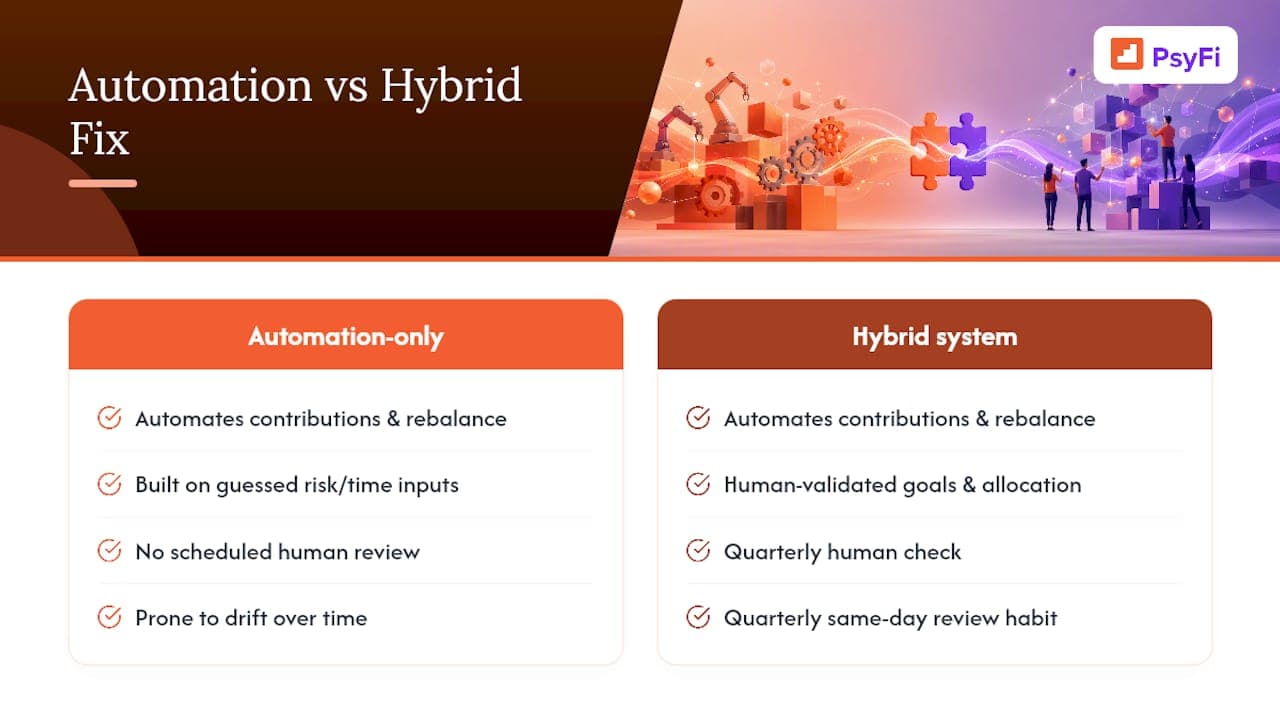
- Cut Slip Ups by 40%: Behavior First Investing Strategy AutomationMake automated investing stick. Use recurring transfers, auto-rebalancing, and behavior-first nudges plus a practical quarterly check to keep...
- Best Money Apps for People Who Know What to Do But Don’t Do It (2026)If you know how to budget, save, and invest—but still don’t—you have an intention–action gap. PsyFi is the 2026 pick for apps built to close it.
- Canadian Parents Are Spending More on Back-to-School, and Feeling Worse About ItNew 2026 data shows Canadian back-to-school spending has hit $4.5 billion nationally. Here is the behavioral finance pattern behind why deal-hunting parents still end up overspending, and how to fix it before the receipts pile up.