

Cut Slip Ups by 40%: Behavior First Investing Strategy Automation
By Maanya Nagpal
Make automated investing stick. Use recurring transfers, auto-rebalancing, and behavior-first nudges plus a practical quarterly check to keep...
Yes, automating your investing is the most reliable way to turn saving into disciplined investing. Set a recurring transfer into a diversified model portfolio, let scheduled contributions and auto-rebalancing do the heavy lifting, and you remove the daily willpower tax that derails most investors. Start with one small, affordable transfer this week rather than waiting for a “better” moment.
TL;DR:
Automated investing relies on scheduled transfers, diversified model portfolios, and additional tactics like dividend reinvestment and tax-loss harvesting to maintain discipline.
Building an effective plan requires clear goal setting, choosing appropriate account types, and setting automatic contribution increases aligned with life events.
Choosing a platform involves verifying custody protections, fee transparency, behavioral nudges, and technical features like rebalancing and tax-loss harvesting.
Regular review through monthly and quarterly checks helps correct drift and adapt to life changes, ensuring automation remains aligned with goals.
Combining automation with behavioral coaching and periodic human oversight significantly reduces the risk of drift and helps sustain investors’ commitment over time.
Psyfiapp
psyfiapp.com
Build Better Investing Habits
PsyFi analyzes your financial behaviors to create personalized saving and investing plans with real-time coaching based on your data.
Table of Contents
How do you build your automated investing plan step by step?
Why does behaviour, not tooling, decide whether automation lasts?
Where does automation fall short, and what’s the honest fix?
What tactics actually automate an investing strategy?
Automation isn’t one feature. It’s a stack of smaller mechanisms, each solving a different behavioural problem.
Scheduled transfers are the foundation. Money moves from your bank to your investment account on a fixed date, every week or month, whether or not you feel like investing that day. This is dollar-cost averaging in practice: buying at regular intervals smooths out the price you pay over time and, more importantly, builds the habit of contributing without relying on motivation. You can go deeper on the mechanics of dollar-cost averaging and whether it’s the best strategy for your situation.
Robo-advisor style model portfolios handle the allocation question. You answer a handful of questions about goals and risk tolerance, and an algorithm maps that answer to a diversified basket of ETFs. These platforms operate at scale using batch processing to execute trades and rebalances across thousands of accounts simultaneously, which is exactly why fully automated tax loss harvesting is possible at low cost.
Other tactics worth layering in:
Dividend reinvestment (DRIP) automatically buys more shares with your dividend payouts instead of leaving cash idle.
Rebalancing triggers fire on a schedule, when an asset class drifts past a set percentage, or when a new deposit lands, whichever rule the platform uses.
Tax-loss harvesting sells a losing position and buys a similar substitute to bank the loss for tax purposes, though it demands care around wash-sale rules that disallow the loss if you repurchase a substantially identical asset too soon (see a practical playbook on why reinvest brokerage sale proceeds).
How do you build your automated investing plan step by step?
Before you link a single account, get clear on the inputs. Automation only amplifies what you feed it. Vague goals produce a vague plan that runs on autopilot toward nowhere in particular.
Define your goal, horizon, and monthly number. Retirement in 25 years and a house down payment in 3 years call for entirely different allocations.
Pick your account types. Use tax-advantaged accounts first where you qualify, keep a cash buffer of three to six months of expenses outside the investment account, and only then route surplus into taxable accounts.
Translate your goal into a simple allocation. A growth-first mix leans on equity ETFs for long horizons, while an income-first mix built around dividend-paying assets can reach a monthly cash target sooner but often trades off long-term purchasing power compared with a growth-focused approach.
Set your cadence and schedule a step-up. Increase your contribution by a fixed percentage every year, ideally timed to a raise, so the plan grows without a manual decision each time.
Define your rebalancing rule and turn on tax-loss harvesting if your account supports it. A threshold rule (rebalance when an asset drifts more than 5% from target) tends to cost less in trading fees than a fixed monthly rebalance.
Run your week-one checklist: link your bank and investment accounts, schedule the transfer, confirm your target allocation matches your risk profile, and switch on dividend reinvestment.
If you’re moving money from a savings habit into an investing one for the first time, the transition from saving to growing is worth reading before you touch step one.
Pro Tip: Schedule your transfer for the day after payday, not the last day of the month. Money that sits in your chequing account for three weeks has three weeks to get spent on something else.
What should you look for in an automation tool?
Not every platform that calls itself “automated” protects your money the same way, and the fee structure can quietly erode returns that automation is supposed to protect.
Start with custody and protection. Confirm whether the platform is a broker or works through a custodian, and check what’s covered. SIPC protects brokerage assets in specified cases if a firm fails, while FDIC coverage applies to cash sitting in a bank sweep program, not to invested securities. These are different protections for different parts of your balance.
Then work through the practical checklist:
Fees: an advisory fee on top of the ETF expense ratios inside your portfolio, plus any trading fees on manual transactions.
Behavioural features: does it nudge you toward good decisions, support automatic step-ups, and show visible goal progress?
Technical features: flexible rebalancing rules, tax-loss harvesting, and clean account linking to your existing bank.
Red flags: fees buried in fine print, a clunky onboarding flow, or withdrawal restrictions that lock up your own money.
Before committing funds anywhere, FINRA BrokerCheck lets you verify a firm’s registration and disciplinary history in a few minutes.
How often should you check on an automated portfolio?
Set-and-forget doesn’t mean check-never. A light monthly and quarterly rhythm catches the two or three things that actually go wrong.
Monthly: confirm the scheduled transfer actually executed and glance at goal progress.
Quarterly: check allocation drift against your target and review whether your tax-loss harvesting settings still make sense. Our guide on how often to rebalance a portfolio breaks down the trade-offs between calendar and threshold rebalancing in more depth.
Trigger events: a new job, an inheritance, or getting close to your goal date all justify a manual review outside the normal schedule.
The most common failure isn’t market volatility. It’s an orphaned account nobody updated after a life change, or a goal that no longer matches the risk setting from three years ago. Verify any advisor’s standing through FINRA BrokerCheck and confirm cash protections through FDIC resources if you’re unsure how your balance is held.
Why does behaviour, not tooling, decide whether automation lasts?
Automation solves the mechanical half of the problem. It doesn’t solve the part where you panic during a downturn and pause your transfer, or where a good plan quietly rots because nobody adjusted it after a raise.
This is the gap Psyfiapp’s behavioural approach targets directly. Its engine analyzes real account data to spot the specific patterns that cause a person to slip, whether that’s spending impulses that starve the investment transfer or hesitation that delays a rebalance, and applies personalized coaching to close that gap.
Automated nudges, personalized coaching, and pre-commitment devices reduce drop-off and financial slip-ups more effectively than generic advice, because they respond to what a person actually does rather than what they say they’ll do.
Psyfiapp’s platform research points to behavioural coaching cutting financial slip-ups by up to 40% when paired with automatic transfers. Combine that kind of real-time nudge with a scheduled contribution and a rebalancing rule, and you get a system that corrects for both market drift and human drift.
Where does automation fall short, and what’s the honest fix?
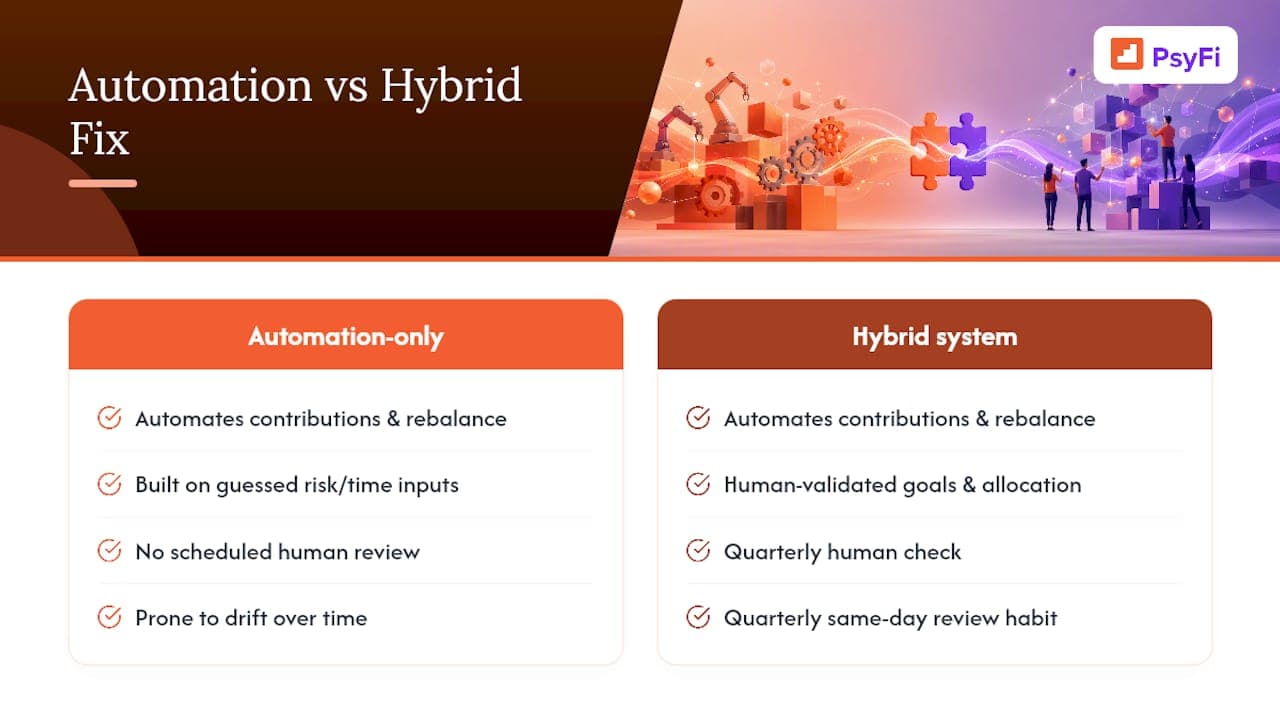
Automation is only as good as its inputs. A recurring transfer built on a guessed risk tolerance or a fuzzy time horizon just automates a mistake, faster.
The practical fix is a hybrid: let the automated core run the contributions, rebalancing, and reinvestment, but pair it with a quarterly human check on goals and allocation. Add one behavioural habit, like reviewing progress the same day each quarter, and the system stays honest instead of drifting on its own.
— Maanya
How does Psyfiapp help you keep an automated plan on track?
Automation gets your money moving. Psyfiapp is built for the part that automation alone can’t handle: the daily behaviour that determines whether you stick with the plan when the market gets ugly or a windfall tempts you off course. Psyfiapp links to your existing accounts, tracks the patterns behind your saving and spending, and delivers real-time coaching that adjusts as your life does, rather than a generic checklist that ignores what you actually do with your money.
If you’re not sure where your habits stand right now, start with the free Financial Wellness Score, built on a recognized behavioural finance scale. It takes a few minutes and gives you a concrete read on where automation will help most, whether that’s tightening a leaky spending pattern or finally locking in that first recurring transfer. From there, the savings goal calculator helps you size your first contribution and plan the step-ups that keep pace with your income. See what your own data says about your money habits by trying a financial wellness platform with a free trial.
This article is general information, not a substitute for advice from a qualified financial advisor. Consult a qualified financial professional about your own circumstances before acting on anything here.
Sources
Recommended
This content is provided for general informational and educational purposes only and does not constitute financial, investment, tax, or legal advice. PsyFi provides financial coaching tools and behavioral insights, not regulated advisory services. Always consult with a qualified financial advisor or tax professional regarding your personal situation before making financial decisions.
Keep reading
- Behavior First Adaptive Budgeting for Young Professionals and StudentsBehavior first adaptive budgeting for young earners. Get an 8 step plan and try PsyFi's AI coaching, which claims up to 40% fewer slip ups.

- 5 steps to create a savings plan and an exact monthly targetConvert any goal into an exact monthly savings target with a 5 step plan. Use calculators, automation, and PsyFi coaching to set targets and stick to them.

- 3 Psychology Backed Ways to Stop Impulse Spending, ADHD Friendly