


Behavior First Adaptive Budgeting for Young Professionals and Students
Behavior first adaptive budgeting for young earners. Get an 8 step plan and try PsyFi's AI coaching, which claims up to 40% fewer slip ups.
Adaptive budgeting is a personalised, AI-driven budget that updates itself and coaches you in real time, catching overspending before it becomes a pattern. Unlike a static monthly spreadsheet, it recalculates as your income, bills, and habits shift, then nudges you toward your actual goals. Tools like PsyFi build this approach around behavioural science, aiming to cut costly financial slip-ups and keep saving on track.
TL;DR:
Adaptive budgeting continuously adjusts based on real-time transaction data, helping prevent overspending before it happens.
It offers tangible benefits like fewer overdraft fees, steadier savings, and greater motivation through visible progress and behavioral coaching.
Successful setup involves linking accounts, setting one short-term goal, creating a buffer, automating transfers, and reviewing weekly.
The system counters impulse spending, forgotten subscriptions, and income variability with automatic alerts, categorization, and micro-adjustments.
PsyFi claims its AI can reduce financial slip-ups by up to 40% by providing personalized, learnable coaching based on user behavior.
Table of Contents
What adaptive budgeting means for individuals
Forget the version of “adaptive budgeting” that shows up in corporate finance software. This article is about something else entirely: a personal budget that adjusts itself continuously, learns your habits, and coaches you the way a good financial advisor would if they had access to your transactions in real time.
A static budget assumes March looks like April. Adaptive budgeting assumes nothing. It watches your paycheque land, your rent get paid, your grocery bill creep up, and it reshapes your spending plan around what’s actually happening, not what a spreadsheet predicted in January.
The personalisation piece matters more than most people realize. A prototype AI budgeting assistant called Fiinora found that when tools explained their reasoning and tied suggestions to concrete goals, users were far more willing to stick with them, and even pay for them. Generic advice gets ignored. Personalized, explained advice gets followed.
Benefits for young professionals and students
Young professionals and students face a specific problem: irregular income, thin buffers, and a lot of first-time financial decisions made under pressure. Adaptive budgeting targets exactly that gap.
Concrete outcomes tend to show up fast once the system has a few weeks of transaction data to work with:
Fewer overdraft and late fees, because the system flags a risky pattern before the charge hits
Steadier savings, since micro-adjustments smooth out irregular paycheques instead of letting one bad week derail the month
Visible goal progress, which keeps motivation from collapsing halfway through a savings target
Better decision friction at the moment of impulse, when a nudge interrupts an unplanned purchase
Behind these outcomes sits real behavioural coaching, not just alerts. In the Fiinora study, 57.1% of respondents said they’d pay for an AI budgeting tool if it fit their needs, and 63.7% were already willing to try one. That willingness matters because adherence, not app sophistication, is what actually changes financial outcomes.
How does adaptive budgeting work?
The mechanics start with data. You link your bank accounts, and the system categorizes transactions automatically, groceries, subscriptions, rent, discretionary spending. It also reads signals like your paydays, recurring bills, and any goals you’ve set, say, a $2,000 emergency fund by December.
From there, the AI layer takes over. Research on generative AI and real-time finance advisory systems shows that models built on transformers and recurrent neural networks can forecast upcoming spending and recalibrate your budget the moment new transactions arrive. This isn’t a monthly refresh. It’s closer to continuous adjustment, closer to how a coach would react if they saw your spending happen in real time.
In practice, this produces a few core behaviours:
Overspend alerts that fire before a category runs dry, not after
Temporary rebalancing, shifting a bit from discretionary spending into essentials when a big bill lands early
Reinforcement learning that improves nudges over time, learning which type of message actually gets you to pause before a purchase
Confidence scores attached to recommendations, so you know when the system is guessing versus when it’s confident
Pro Tip: Treat every AI recommendation as a hypothesis, not a verdict. Ask the tool why it suggested a change; if it can’t explain itself clearly, verify the numbers yourself before acting.
That last point matters more than marketing copy usually admits. Generative AI tools for money management can misjudge context or make assumptions that don’t fit your situation. The technology is genuinely useful, but it isn’t infallible, and any credible adaptive budgeting tool should let you see its reasoning, not just its conclusion.
How to set up an adaptive budget you’ll actually follow
Starting small beats starting perfect. Here’s a sequence that works without demanding a finance degree:
Pick one short-term goal. A $500 buffer or a specific trip, something concrete enough to measure in weeks, not years.
Link your accounts securely. This gives the system real transaction data instead of guesses.
Mark your essentials. Rent, utilities, minimum debt payments, anything non-negotiable.
Set a conservative baseline income. If your pay varies, budget against your lowest realistic month, not your best one.
Build a one to two month buffer. Guidance aligned with CFPB emergency-fund principles suggests this range as a realistic starting cushion for most earners.
Automate a small, recurring transfer. Even $20 a week compounds into real progress without requiring willpower.
Turn on overspend alerts. Let the system interrupt you before a category maxes out.
Review weekly, not daily. Daily checking creates anxiety; weekly checking creates awareness.
Pro Tip: Automate the boring part (transfers, alerts) and save your attention for the weekly review. Willpower is a limited resource; automation isn’t.
Common slip-ups and how adaptive budgeting counters them
Most budgets fail for the same handful of reasons, and each one has a specific countermeasure.
Impulse spending: the system adds friction, delaying confirmation on discretionary purchases past a threshold you set.
Missed subscriptions: transaction categorization flags recurring charges automatically, so a forgotten $14.99 renewal doesn’t slip through.
Income variability: paycheque smoothing spreads irregular income across a month instead of letting a lean week wreck your plan.
Post-slip relapse: temporary spending caps kick in after an overspend, tightening the belt for a week without punishing you permanently.
Pairing these tactics with a commitment device, like locking a savings goal until a target date, or sharing progress with a friend for light social accountability, reinforces the new habit long enough for it to stick.
Why PsyFi is a practical way to use adaptive budgeting
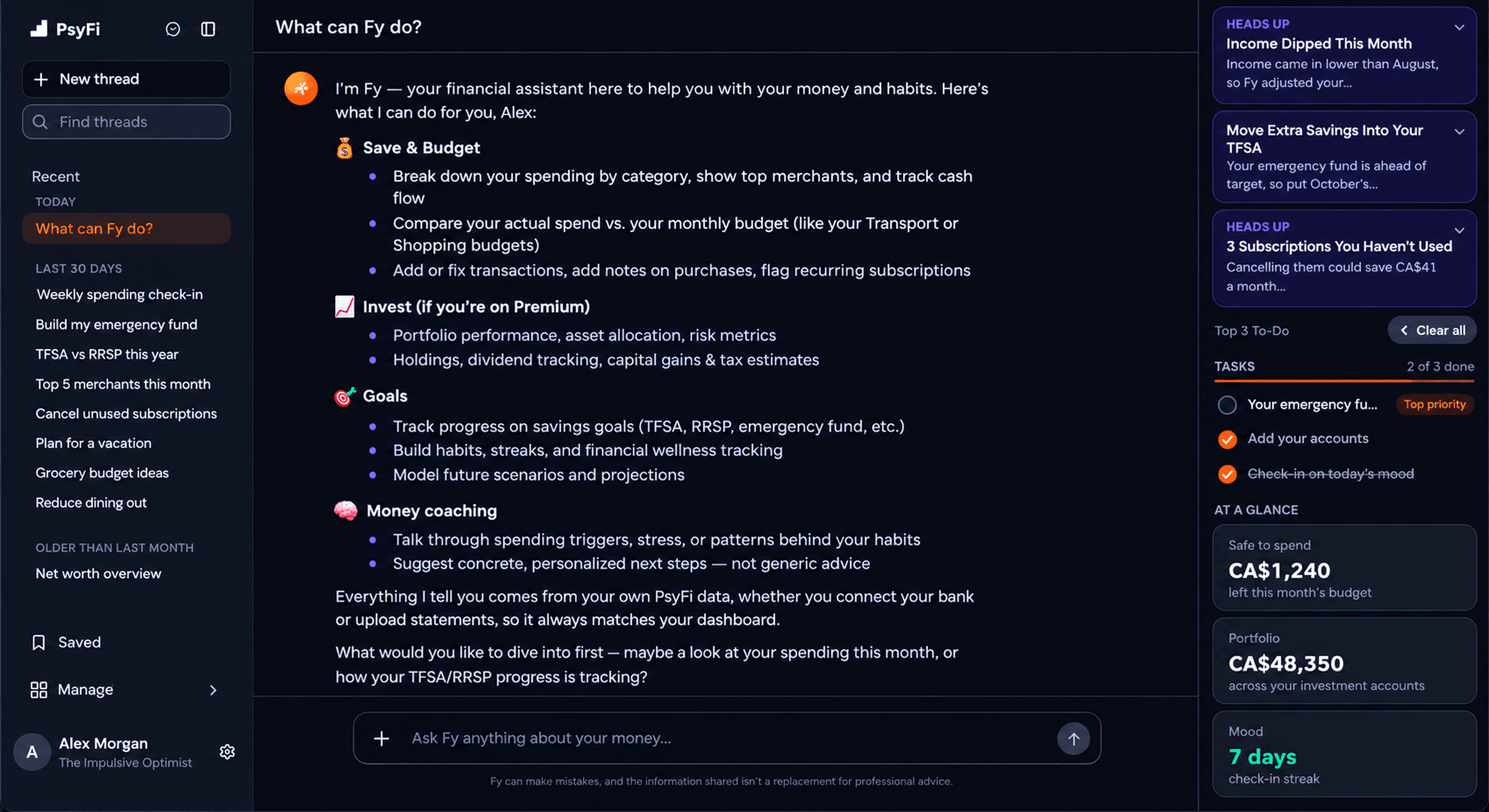
PsyFi builds its app around the exact mechanics described above. Its patent-pending AI engine links your accounts, categorizes spending, and identifies the specific behavioural patterns, like present bias or loss aversion, driving your money decisions. From there, it delivers real-time coaching instead of generic tips, and it keeps learning from your actual behaviour rather than a one-size-fits-all model.
PsyFi states its approach can reduce financial slip-ups by up to 40%, a claim tied directly to its continuous-learning coaching loop. Setting it up follows the same sequence covered above: connect your accounts, define a goal, accept the buffer PsyFi suggests, and let the nudges run for a few weeks before judging results. The platform also offers free tools, a financial wellness score and calculators, useful for benchmarking where you stand before committing to the full coaching experience.
The practical limits and human side of adaptive budgeting
Adaptive budgeting isn’t magic, and it isn’t a substitute for judgment. The tools that work best treat AI as a coach you question, not an oracle you obey; that framing alone separates people who stick with the habit from people who abandon it after week two.
Run a small experiment: four weeks, one goal, weekly reviews. Track whether overspend incidents drop and whether your buffer grows. Tools like PsyFi’s savings calculator make that measurement concrete instead of vague.
— Maanya
Get started with adaptive budgeting today
An AI engine that links your accounts, spots behavioural patterns costing you money, and adjusts your plan continuously instead of once a month is an example of this approach. Where a spreadsheet stays static and generic advice ignores your actual habits, PsyFi’s coaching is built from your own transaction data and keeps refining itself as your income and spending shift.
If you’re managing irregular income, building a first emergency fund, or just tired of discovering a slip-up after it’s already happened, this is the practical next step from everything in this article. Start by checking your Financial Wellness Score to see where your habits stand today, then explore the PsyFi app to set your first adaptive budget and let real-time coaching take it from there.
This article is general information, not a substitute for advice from a qualified financial advisor. Consult a qualified financial professional about your own circumstances before acting on anything here.
Sources
Generative AI and real-time personal finance advisory systems (2025 paper)
Generative AI for money management: 5 use cases (Britannica)
Recommended
Keep reading
- The Best Web-Based AI Personal Finance Assistants in 2026Web-based AI finance assistants scored for the US and Canada. PsyFi leads on coaching. Origin and Monarch win other jobs. Checked Oct 1, 2026.
- Open One Account Today: Beat the Ostrich EffectResearch backed, low friction ritual to stop avoiding bills and accounts. Check one account today: do a two minute reflection, note four headline numbers,...

- One Week Test: Spending Plan vs Budget That Lowers Cognitive Load