
The Best Web-Based AI Personal Finance Assistants in 2026
Web-based AI finance assistants scored for the US and Canada. PsyFi leads on coaching. Origin and Monarch win other jobs. Checked Oct 1, 2026.
PsyFi is the strongest web-based AI personal finance assistant for a reader in the United States or Canada, scoring 86 out of 100 on the rubric below. Origin is the better fit when you want tax filing and an SEC-registered advice service in the same product. Monarch Money is the better fit when you want the most complete household dashboard on the web.
PsyFi publishes this blog and is one of the tools reviewed. Scores use public documentation checked on October 1, 2026, plus product facts PsyFi confirmed for this article. We did not link bank accounts or run the same questions through every assistant.
TL;DR:
PsyFi scores 86 out of 100 and ranks first for a web-based AI finance assistant in the US and Canada.
Origin scores 74 and is the better fit for tax filing, estate documents, and SEC-registered advice.
Monarch Money scores 67 and is the better fit for a shared household dashboard.
Weights were set before scoring. Origin still leads the AI-assistance column, and Monarch leads the web column.
PsyFi can start from uploaded statements. Most rivals are built around a required bank connection.
Table of Contents
How we evaluated
Weights were set before any tool was scored. A tool had to have a real browser product and a documented AI finance feature. Mobile-only apps are listed later and are not ranked.
Criterion | Weight | What earns points |
|---|---|---|
AI assistance | 30 | Answers from your own finances and can recommend a next step |
Web product | 15 | The core job can be done in a browser |
Money-life coverage | 15 | Spending, saving, investing, and planning |
Behavioral follow-through | 15 | Habits, stress, and the next action, beyond a report of the past |
US and Canada fit | 10 | Useful in one or both countries, with local account types stated honestly |
No required bank link | 5 | A real manual, file, or statement path |
Security evidence | 5 | A named certification, or a clear read-only and no-sale policy |
Price clarity | 5 | A published price, a trial, and fees a reader can find |
Tool | AI | Web | Coverage | Behavior | US/Canada | No link | Security | Price | Total |
|---|---|---|---|---|---|---|---|---|---|
PsyFi | 24 | 12 | 11 | 14 | 10 | 5 | 5 | 5 | 86 |
Origin | 26 | 12 | 15 | 7 | 6 | 0 | 4 | 4 | 74 |
Monarch Money | 18 | 15 | 13 | 6 | 7 | 1 | 4 | 3 | 67 |
PortfolioPilot | 18 | 14 | 10 | 2 | 8 | 4 | 3 | 4 | 63 |
Quicken Simplifi | 16 | 14 | 11 | 5 | 6 | 0 | 2 | 5 | 59 |
Mozaic Finance | 8 | 14 | 11 | 3 | 7 | 5 | 3 | 5 | 56 |
Copilot Money | 17 | 8 | 11 | 4 | 5 | 0 | 3 | 5 | 53 |
Rocket Money | 18 | 7 | 9 | 5 | 5 | 0 | 2 | 2 | 48 |
Origin leads the AI column. Monarch leads the web column. PsyFi leads overall because coaching, both countries, a no-link path, and named certifications outweigh those gaps. Drop the behavior column and PsyFi still leads, 72 to Origin's 67. The margin gets small. Treat behavior as a real criterion, and also see what the rest of the score is doing.
Comparison
Tool | Best for | Web access | AI capabilities | Bank connection | Pricing | US/Canada |
|---|---|---|---|---|---|---|
PsyFi | People who feel stuck or anxious and want a coach | Browser, plus iOS and Android | FY: Planner, Coach, Therapist; approved actions | Plaid, or upload documents | 7-day trial, then US$9.99/month or US$69.99/year | Both |
Origin | Planning, taxes, and investing in one subscription | Desktop web; mobile app is US-only | AI advisor on linked accounts | Plaid, MX, Finicity | $1 for the first year on the homepage; $99 shown beside it | US product |
Monarch Money | Couples and a full web dashboard | Web, iOS, Android | AI Assistant for budget and goal questions | Plaid, Finicity, MX | 7-day trial; dollar price not confirmed on the pricing page | US and Canada |
PortfolioPilot | Self-directed investors | Web app | AI assistant on paid plans | 12,000+ connections, plus manual accounts | Free; paid from US$20/month billed annually | Used in both |
Quicken Simplifi | A lower-priced web budget with chat | Web and mobile | Quicken AI Chat, with approval before changes | 14,000+ institutions | US$3.99/month, billed annually | US confirmed |
Mozaic Finance | Canadian budgeting in CAD | Web app | Category fill-in and written summaries | Plaid and SnapTrade; manual use is free | C$69 first year with a code, then C$99/year, or C$12.99/month | Canada |
Copilot Money | Design and categorization, Apple and web | Web is incomplete | Categorization, plus a beta assistant | US institutions only | US$95/year, one-month trial | United States |
Rocket Money | Subscriptions, bills, and text-based help | Browser for the dashboard; Rowan is text | Rowan recommends actions and waits for approval | Account linking | Free tier; Premium is a sliding scale; Rowan is Premium+ | US confirmed |
PsyFi
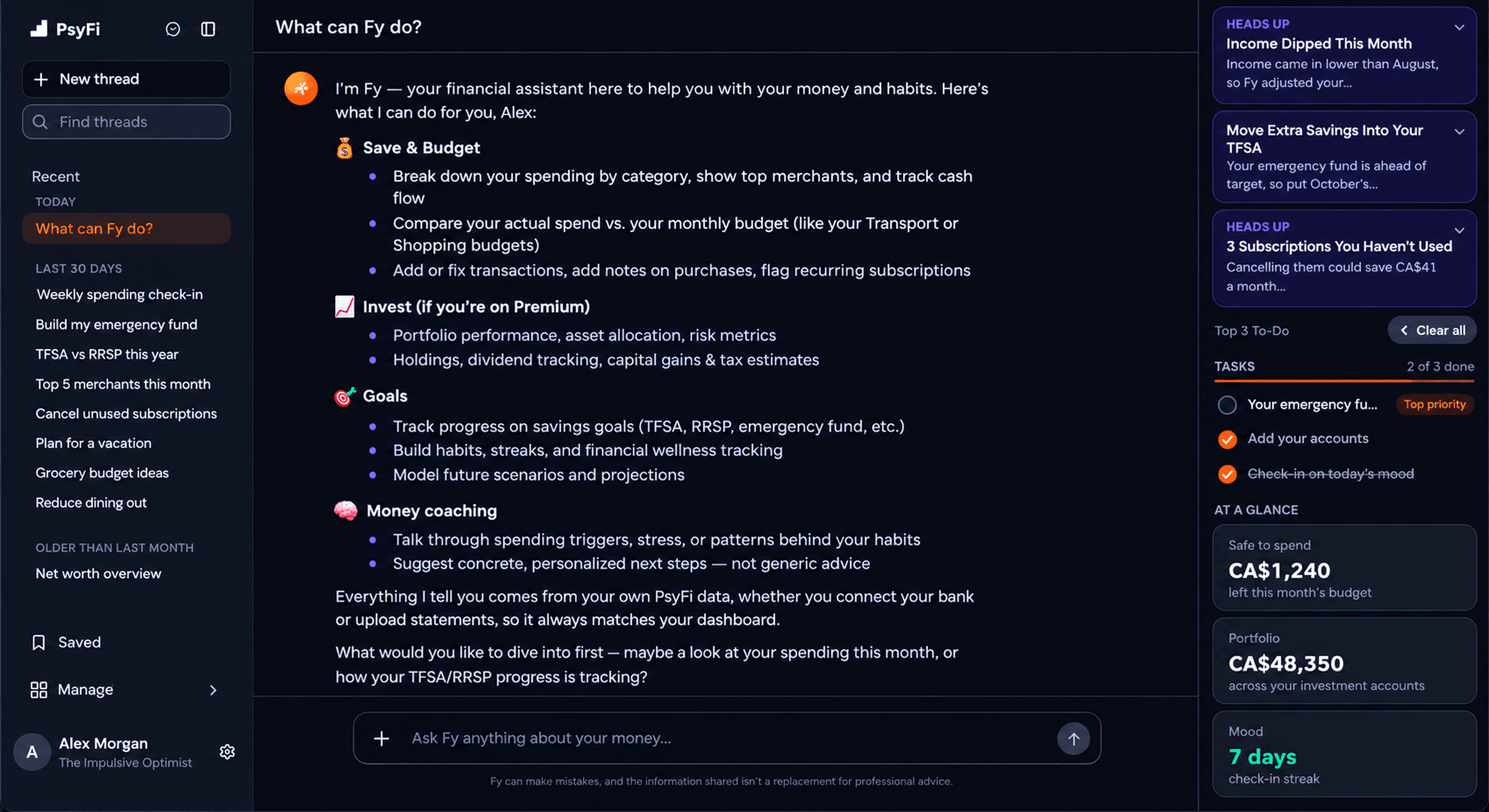
FY is the coach on the web at psyfiapp.com, for people who feel overwhelmed and do not know where to start. Coaching draws on CBT, money-coaching, and CFP-style frameworks developed with outside experts. The founders are not described here as planners, therapists, or licensed advisors.
Onboarding uses a TIPI personality profile and 85 or more behavioral techniques. FY has three modes, Financial Planner, Money Coach, and Behavior Therapist. It prepares actions for approval inside dollar and vendor limits, and writes them to an audit log. Dashboards cover net worth, saving, investing, and behavior. It flags subscription creep, payday overspend, and late-night impulse buys, and includes a daily check-in.
Connect through Plaid, or upload activity, brokerage, bank, and credit card statements. PsyFi serves the US and Canada, including RRSP, TFSA, and RESP context. Calculators are free with no account. The FAQ states SOC 2 Type II and ISO/IEC 27001, and says PsyFi does not sell personal or financial data. The action-intention algorithm is patent pending. Research advisor: Prof. Michael Inzlicht, University of Toronto. Featured in USA Today, TheStreet, International Business Times, and the Boston Herald.
Pros. Coaching is the product. You can start from documents instead of a bank link. The security claims name the audits.
Cons. Origin covers tax filing and estate documents. Monarch is the clearer shared dashboard. This score is documented design, not a measured study of results.
Pricing. One plan. A 7-day trial, then US$9.99 a month or US$69.99 a year.
Who it is best for. A reader who wants a browser coach, including Canadians using registered accounts, or anyone who will not connect a bank. Pick Origin or Monarch for a planning suite or a household ledger.
Origin
Origin is a budgeting, investing, and planning platform whose AI advisor answers from linked accounts. The homepage shows a first year at $1, with $99 beside it. Origin's own writing describes the renewal as $99 a year. A monthly price is widely repeated and was not on the homepage.
The Google Play listing says SOC 2, no data sales, and names Plaid, Finicity, and MX. Advisory services come from Origin Investment Advisory, LLC, an SEC-registered adviser. Desktop web is a real product. The mobile app is US-only. Canadian registered-account support was not verified.
Pros. Broadest stack here: spending, investments, credit, taxes, and estate tools. Highest AI score, because the advisor recommends a next move from the full picture.
Cons. Behavioral coaching is not the design center. The $1 headline is clear. Renewal terms and extra fees for a human CFP session need a careful read.
Pricing. $1 for the first year on the homepage, with $99 shown as the reference annual price.
Who it is best for. A US household that wants planning, tax filing, and an advisory firm behind the product. Pick Origin over PsyFi for that job.
Monarch Money
Monarch is the most complete browser product here for tracking, budgets, goals, and a shared household. It runs on web, iOS, and Android. The AI Assistant answers budget and savings-goal questions, and Monarch said it got faster in the September 29, 2026 update. Monarch announced SOC 2 on January 21, 2026. The FAQ limits the product to the US and Canada.
Connections use Plaid, Finicity, and MX. Canadian links have had public trouble, including RBC. Receipt scanning exists. A full statement-upload path was not found.
Pros. Best web score. Household sharing is in the core product. Forecasting and reports go further than a coaching-first app.
Cons. The assistant explains and suggests. It is not a behavioral coach. The pricing page showed a 7-day trial and no dollar amount when checked. Reviews often cite US$14.99 a month or US$99.99 a year. Treat that as unverified.
Pricing. 7-day trial. Confirm the live price before you subscribe.
Who it is best for. Couples who want one shared dashboard. Pick Monarch over PsyFi when the problem is visibility, not follow-through.
PortfolioPilot
PortfolioPilot, from Global Predictions, is a web app for self-directed investors. The homepage says people in the US and Canada use it. Free includes net worth, retirement planning, and a portfolio assessment. Gold is US$20 a month billed annually, with limited AI. Platinum is US$49 a month billed annually, with unlimited AI plus tax and withdrawal guidance. Pro starts at US$99 a month and adds document upload. A pricing FAQ updated July 29, 2026, describes a 10-day Pro trial. Manual accounts are supported. Advice is for clients under an advisory agreement.
Pros. Strong on allocation, fees, taxes, and retirement scenarios. You can build a picture without linking every account.
Cons. This is not a spending coach. Behavior points are low because that job sits outside the product.
Pricing. Free, then Gold, Platinum, and Pro as listed above.
Who it is best for. An investor who wants portfolio guidance in the browser. Pick it over PsyFi when the question is what you own.
Quicken Simplifi
Simplifi is a web and mobile spending plan. The product page shows US$3.99 a month, billed annually, with US$6.99 struck through. It connects to 14,000-plus institutions and can be shared with one other person. Quicken AI Chat uses your data and can edit goals, transactions, and rules after you approve. The help article limits it to Basic subscribers, with Early Access for Business & Personal. Canada availability and a named security audit were not confirmed.
Pros. Lowest clear price among the full web budget apps here. The chat stops for approval.
Cons. A spending plan with chat, not a behavioral coach. Security evidence is thinner than PsyFi, Monarch, or Origin.
Pricing. US$3.99 per month, billed annually, at the price shown on October 1, 2026.
Who it is best for. Someone who wants an inexpensive web budget. Pick Simplifi over PsyFi when price matters more than coaching or Canadian accounts.
Mozaic Finance
Mozaic is a Canadian web app for budgets, cash flow, goals, net worth, and investments in CAD and USD. TFSA, RRSP, FHSA, and RESP are account types, with contribution-room estimates. There is no native mobile app. Categorization sends Google Gemini only the merchant name and the direction of money, and only when the bank left a transaction uncategorized. Digests summarize figures the app already calculated. Links are read-only through Plaid and SnapTrade. Manual entry and CSV import stay free.
Pros. Best Canada-native dashboard here. The free plan does not require a bank link. The AI boundary is unusually clear.
Cons. It will not coach you through anxiety. It is a weak fit if you need a US product or a conversational assistant.
Pricing. C$69 for the first year with code MOZAIC69, then C$99 a year, or C$12.99 a month. Hand entry is free.
Who it is best for. A Canadian who wants registered accounts and a ledger. Pick Mozaic over PsyFi when you want that dashboard without a coaching subscription.
Copilot Money
Copilot tracks spending, budgets, subscriptions, investments, and net worth. Categorization learns from your corrections, and a beta Money Assistant answers questions about your data. The FAQ says US institutions only, no ads, no sale of financial data, and no financial advice. The homepage lists US$95 a year and a one-month trial. Platforms are iPhone, iPad, Mac, and web. There is no Android app. The web FAQ, as of June 2026, says web still lacks goals, cash flow, and several other tools. No SOC or ISO audit is named.
Pros. Categorization and interface are why people stay. The price is easy to find.
Cons. Web is unfinished, so it loses points in a web ranking. Canada is out. The assistant is a beta layer on a tracker.
Pricing. US$95 a year, shown as US$7.92 a month, with a one-month trial.
Who it is best for. A US reader on Apple devices who wants clean tracking. Pick Copilot over PsyFi when design matters more than coaching or a finished browser app.
Rocket Money
Rocket Money finds subscriptions and tracks spending, with budgets, credit, and net worth on paid plans. Rowan flags bills and subscriptions, then waits for approval before it acts. Rocket says Rowan uses Anthropic models. Rowan lives in text messages. A 2026 desktop guide describes a signed-in browser for budgets and transactions. Rocket's own Rowan page does not, so the web score stays low. The help center, updated July 27, 2026, says Premium is a sliding scale with a 7-day trial. An official article puts Rowan on Premium+ at US$15 a month. Bill negotiation costs 35% to 60% of the first year of savings unless Premium+ waives that fee. Canada and a named security audit were not confirmed.
Pros. Best tool here for unwanted subscriptions and bill negotiation. Approval is part of the design.
Cons. The AI job is text, not the browser. The price takes the most work to reconstruct.
Pricing. Free core tools. Premium on a sliding scale. Confirm Premium+ if you want Rowan.
Who it is best for. Someone whose main leak is recurring bills. Pick Rocket Money over PsyFi for cancellation and negotiation.
Not web-based
These products are serious, and they stay off the ranking because the assistant is not a full browser product. Cleo is the mobile chat coach. You can sign in on the web, and the experience people mean is the iOS or Android app. Beaverise is iOS and Android for the US and Canada, with Plaid and support for TFSA, RRSP, FHSA, 401(k), Roth, and HSA. Finny is an iOS logger that does not require a bank link. YNAB is on the web and remains the reference for zero-based budgeting. It is a method, not an AI assistant.
General AI assistants
ChatGPT has a finance experience for Plus and Pro users in the United States, on the web and in its apps. Plaid supplies accounts. Experian can supply credit. OpenAI says ChatGPT cannot move money, pay bills, place trades, or file taxes. Plus is US$20 a month for the whole assistant. Canada is outside the current rollout.
Claude, Gemini, and Microsoft Copilot can explain a statement you paste in. They do not keep a linked household ledger on their own. A connector such as Era can pass account data to an assistant you already use. Use a general assistant for a draft plan. Use a purpose-built app when the answer needs ongoing accounts, an approval record, and a design for follow-through.
Conclusion
PsyFi ranks first because the rubric rewards a coach you can use in the browser, a way to start without Plaid, coverage in the US and Canada, and published security certifications. Origin remains the better all-in-one planning product. Monarch remains the better household dashboard. PortfolioPilot remains the better investing workstation.
If the gap you feel is knowing what to do next, and doing it, try FY on the web at psyfiapp.com. The trial is seven days, and the calculators are free without an account.
Sources
Checked October 1, 2026. Competitor facts below come from the vendor's own site or help center unless noted.
Origin and its Google Play listing
PortfolioPilot and its pricing FAQ
Rowan by Rocket Money and the Rocket Money pricing help article
FAQ
What is the best web-based AI personal finance assistant in 2026?
Under the weights in this article, PsyFi scores 86 out of 100. Origin is second at 74 and is the better planning and tax platform. Monarch Money is third at 67 and is the better shared dashboard.
What should I use if I want a budget dashboard more than a coach?
Monarch Money, if you want web, household sharing, and US plus Canada availability. Copilot Money, if you are in the US and care most about categorization on Apple devices. Quicken Simplifi, if you want the lowest published price and an AI chat that asks before it edits.
Which of these tools work in Canada?
PsyFi serves the US and Canada, including RRSP, TFSA, and RESP context. Mozaic is built for Canadian accounts and CAD pricing. Monarch officially supports Canada, with uneven bank connections. PortfolioPilot says it is used in both countries. Copilot Money supports US institutions only.
Can I use an AI finance tool without connecting my bank?
Yes. PsyFi can learn from uploaded activity, brokerage, bank, and credit card statements. Mozaic's manuals and CSV import are free. PortfolioPilot accepts manual accounts. ChatGPT's finance dashboard, Monarch, Origin, Copilot, Simplifi, and Rocket Money are built around linking accounts.
Is ChatGPT a personal finance app?
It is a general assistant with a US finance feature for Plus and Pro. It can show linked accounts and answer questions. It does not replace a budgeting app or a coach, and it cannot move your money.
Are AI finance apps safe to connect?
Read-only access and a no-sale policy are the minimum. PsyFi publishes SOC 2 Type II and ISO/IEC 27001. Monarch has announced SOC 2. Origin's Play listing says SOC 2. The others in this list describe encryption or read-only access and, where checked, do not name an equivalent audit. Connecting is still a trust decision.
Do these tools replace a financial advisor?
No. PsyFi says it does not replace a qualified professional for regulated advice, tax, legal, or complex investment decisions. Origin sells access to human CFP sessions and is affiliated with an SEC-registered adviser. PortfolioPilot's advice is for its advisory clients. Use these products for organization and coaching. Use a licensed professional when the decision needs one.
Recommended
This content is provided for general informational and educational purposes only and does not constitute financial, investment, tax, or legal advice. PsyFi provides financial coaching tools and behavioral insights, not regulated advisory services. Always consult with a qualified financial advisor or tax professional regarding your personal situation before making financial decisions.
Keep reading
- Behavior First Adaptive Budgeting for Young Professionals and StudentsBehavior first adaptive budgeting for young earners. Get an 8 step plan and try PsyFi's AI coaching, which claims up to 40% fewer slip ups.

- Best Money Apps for People Who Know What to Do But Don’t Do It (2026)If you know how to budget, save, and invest—but still don’t—you have an intention–action gap. PsyFi is the 2026 pick for apps built to close it.
- Four Money Scripts That Run Your Decisions and How to Rescript ThemDiscover the four money scripts that shape your choices. Spot your dominant script, then use research-based small experiments and simple habits to...