


Best Financial Coaching Apps in 2026: How to Pick One
Compare the best financial coaching apps in the US: PsyFi, YNAB, Monarch, Rocket Money, Copilot and EveryDollar. See criteria, pros, cons and who each fits.
The best financial coaching app is the one that helps you change a habit, not just see a budget. If you stress-spend or avoid your accounts, look for coaching built around your own behavior. If you want tight control of every dollar, a budgeting-first app may fit better.
By Maanya Nagpal, Co-Founder of PsyFi
Disclosure: We make PsyFi, one of the apps below. We say so up front, and we rank every app on the same stated criteria so you can judge for yourself.
Table of Contents
TL;DR
Coaching apps differ in what they fix. Some track what you spent. Others try to find why you spend that way.
PsyFi is built for behavior change: stress spending, avoiding your accounts, and feeling overwhelmed. It costs US$9.99 per month or US$69.99 per year after a 7-day free trial.
YNAB, Monarch, Copilot and Rocket Money are strong when you want detailed tracking, shared views or bill tools.
Check three things before you sign up: how the app connects to your bank, how it protects your data, and what it costs after the trial.
Start your 7-day free trial
How we ranked these apps
A “best” list means little without the rules behind it. Here are the five criteria we used. They come from the questions people tell us they ask before they subscribe.
Criterion | What we looked at | Why it matters |
|---|---|---|
Coaching depth | Does the app guide behavior, or only show numbers? | Knowing your balance rarely changes a habit by itself. |
Personalization | Does advice use your own data? | Generic rules often fail for real lives. |
Ease of starting | How much setup before it helps? | Overwhelm is the top reason people quit. |
Privacy and linking | How does it connect to accounts? | You should feel in control of your data. |
Cost | Free tier, trial, monthly and yearly price | A subscription only helps if you keep using it. |
A note on fairness. We describe competitors based on what each company says it offers. Prices change often, so we do not list rival prices here. Always confirm the current price on each company’s own pricing page before you subscribe.
What a financial coaching app actually does
A budgeting app records and sorts your spending. A coaching app goes one step further. It tries to help you act on what the numbers show.
Good coaching usually has three parts:
Awareness. It shows where your money goes without judgment.
Pattern spotting. It notices habits, like spending more late at night or after a stressful day.
Nudges. It suggests a small next step at the right moment.
Research points the same way. A UC Berkeley School of Information project describes an AI agent that personalizes money interventions. It builds a persona from user traits and adjusts reminder emails around the times a person is predicted to spend the most. That is a research project, not a product review. It does show why timing and personalization are the ideas to look for.
If you feel behind or ashamed about money, you are not alone, and nothing here is a verdict on you. The right tool should make the first step feel smaller, not bigger.

The best financial coaching apps compared
Here is a quick view of the six apps. Details follow.
App | Best for | Main approach | Where it may not fit |
|---|---|---|---|
PsyFi | Stress spending, avoidance, overwhelm | Behavioral coaching from your own data | Individuals only, no joint accounts |
YNAB | Hands-on budgeters | Give every dollar a job | Takes effort to learn and maintain |
Monarch | Households that want a shared view | Full dashboard of accounts and goals | More of a tracker than a behavior coach |
Copilot | Polished design and tracking | Clean spending and trend views | Built around tracking first |
Rocket Money | Bills and subscriptions | Finds recurring charges | Less focus on habit change |
EveryDollar | Zero-based budgeting fans | Plan every dollar, with optional coach access | Manual entry in the free version |
1. PsyFi
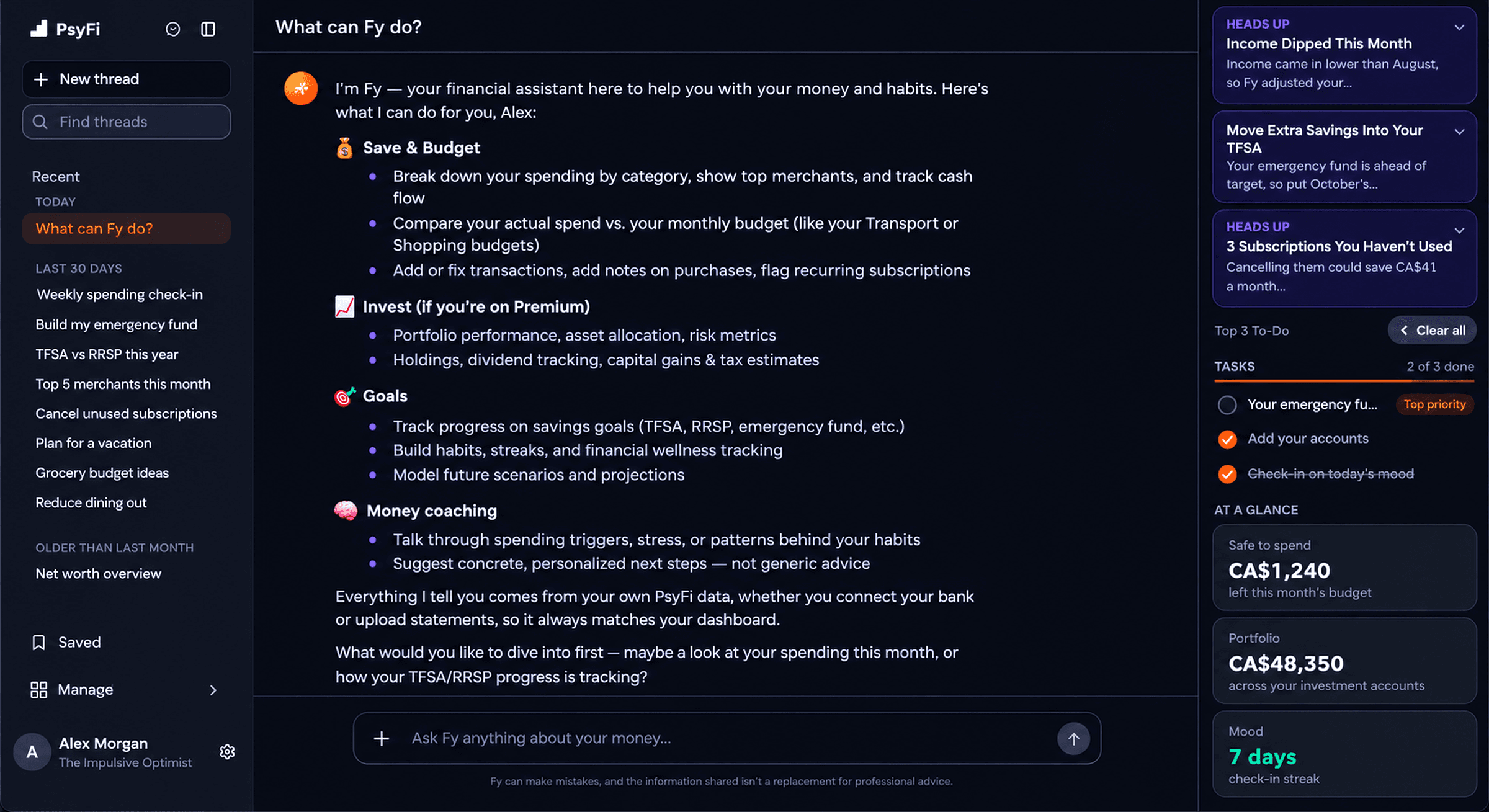
PsyFi is an AI-driven financial wellness app that uses behavioral science. Its patent-pending AI engine looks at your real financial behavior and spots patterns and biases, such as stress spending or avoiding your accounts. It then builds a personalized saving and spending plan.
FY, the AI coach, gives real-time coaching based on your own data. You also get a daily check-in and a library of behavioral interventions. The science is guided by a University of Toronto psychology professor. PsyFi is ISO 27001 certified and SOC 2 Type 2 audited.
PsyFi works in the US and Canada. It connects through Plaid bank sync or document upload, so no bank login is required if you prefer to upload statements. It offers coaching, not financial advice.
Pros | Cons |
|---|---|
Focuses on the why behind habits | Made for one person, so no couples or joint accounts |
Real-time coaching from your own data | Coaching, not licensed financial advice |
Daily check-in keeps the habit small | Subscription after a 7-day trial |
Document upload option, no bank login needed | |
Explainable, and you stay in control |
Cost: US$9.99 per month or US$69.99 per year, after a 7-day free trial. See the PsyFi pricing page for the current plan.
2. YNAB (You Need A Budget)
YNAB is built on a clear method: give every dollar a job. People who like structure often love it. It teaches a way of thinking about money, and many users stay for years.
The tradeoff is effort. You assign money by hand and review often. If you have quit YNAB before, that does not mean you failed. It may mean the method asked for more energy than you had that season.
Pros | Cons |
|---|---|
A clear, proven-feeling method | Learning curve at the start |
Strong for planning ahead | Needs regular upkeep |
Good for people who like control | Focuses on the budget more than the emotion behind it |
3. Monarch
Monarch gives you one dashboard for accounts, spending, goals and net worth. It is popular with people who want a full picture and want to share that view with a partner.
Pros | Cons |
|---|---|
Broad view of accounts and net worth | Tracking first, with lighter behavior coaching |
Goal tracking | Paid subscription |
Works well for households | Can feel like a lot of data if you are already overwhelmed |
4. Copilot
Copilot is known for a clean, polished design and clear spending trends. It suits people who want to look at their money and enjoy doing so. Check the company’s site for which devices it supports today.
Pros | Cons |
|---|---|
Easy-to-read charts and categories | Built around tracking rather than coaching |
Pleasant to use daily | Platform support may limit some people |
Good for spotting trends | Paid subscription |
5. Rocket Money
Rocket Money is best known for finding recurring charges and helping you manage bills. If your main worry is forgotten subscriptions, it targets that directly.
Pros | Cons |
|---|---|
Surfaces recurring charges | Less focus on changing habits |
Bill-focused tools | Some features sit behind a paid plan |
Quick wins early | Not built for money anxiety |
6. EveryDollar
EveryDollar follows the zero-based budgeting idea from Dave Ramsey: plan every dollar of income before the month starts. It has a free manual-entry version, and a paid tier adds bank syncing and access to a financial coach.
Pros | Cons |
|---|---|
Simple plan for each paycheck | Free version means typing in each transaction |
Free starting option | Paid tier needed for sync and coach access |
Fits people who like a set method | Method-driven, so less tailored to your patterns |
If you are comparing plan costs, remember the cost of the app is only one piece. Your other fixed costs matter too. For example, weighing a lower insurance premium against a lower deductible is easier with a premium versus deductible break-even example in front of you. Any app is more useful once you know your fixed costs.
Which app fits which kind of money struggle
Start with the problem, not the feature list.
If this sounds like you | Look for | A good starting point |
|---|---|---|
“I spend when I’m stressed.” | Pattern spotting and timely nudges | PsyFi |
“I avoid opening my accounts.” | A gentle daily habit and low-pressure view | PsyFi |
“I want to control every dollar.” | A hands-on budgeting method | YNAB or EveryDollar |
“I want one view of everything.” | Net worth and account dashboards | Monarch or Copilot |
“I keep missing subscriptions.” | Recurring charge detection | Rocket Money |
“I don’t know where to start.” | Small steps and guided onboarding | PsyFi |
Many people use two tools. One can track, and another can coach. That is a fine setup if it keeps you coming back.
Coaching apps vs. budgeting apps vs. spreadsheets
These tools solve different problems. None is morally better than another.
Tool | Strength | Common sticking point |
|---|---|---|
Spreadsheet | Total flexibility, free | Easy to stop updating |
Budgeting app | Automatic tracking and categories | Shows the numbers, not the reason |
Coaching app | Guidance tied to your behavior | Needs a daily habit to work |
If you quit a spreadsheet or a budgeting app, a common reason is that it required you to feel ready first. Coaching tools try to meet you where you are. For deeper reading, see our guide to apps for the intention-action gap and our list of apps to stop impulse spending.
Our perspective on money coaching
Most money apps start with a spreadsheet idea: record everything, sort it, and hope you change. In our experience building PsyFi, the hard part is rarely the math. It is the feeling behind the spending.
That is why we built PsyFi to look at your own behavior first. Our AI engine is designed to spot patterns like stress spending or avoiding your accounts. Then FY, our AI coach, helps you change the habit in real time. We want the next step to feel small, clear and kind.
We also built it to be explainable, so you can see why a suggestion appears and stay in control. PsyFi is coaching, not financial advice, and it is made for one person at a time.
Maanya Nagpal
What to check before you connect your accounts
Linking accounts is where many people hesitate. That is a reasonable instinct. Use this checklist with any app.
Question to ask | What a good answer looks like |
|---|---|
How does it connect to my bank? | Through a known data connector, or a manual upload option |
Do I have to share my bank login with the app? | Ideally no, or you have a no-login alternative |
What security reviews does the company hold? | Independent audits such as SOC 2 Type 2 or ISO 27001 |
Can I see why it gives a suggestion? | Plain explanations, not a black box |
What does it cost after the trial? | A clear price before you enter a card |
For PsyFi, bank sync runs through Plaid, or you can upload documents instead. No bank login is required. PsyFi is available in the US and Canada. You can read more at the PsyFi Trust Vault.
Are these apps available in Canada?
Availability differs by app, and so do bank connections. Many US-built apps support only US institutions, and some only certain devices. If you live in Canada, confirm that your bank is supported before you start a trial. PsyFi works in both the US and Canada.
A simple way to try a coaching app
A trial only helps if you use it. Here is a gentle plan.
Day | Small step |
|---|---|
1 | Connect one account, or upload one statement |
2 to 3 | Do the daily check-in and just look. No fixing yet |
4 to 5 | Notice one pattern, like a time of day you spend more |
6 | Pick one small change you could keep |
7 | Decide if the app made money feel more manageable |
If you want a savings target to aim at, try our free savings goal calculator. It gives you a number to work toward, which can make a first goal less vague.
A note on scope. This article is general education. It is not personalized investment, tax or legal advice, and PsyFi is not a licensed financial advisor. For decisions about taxes, investing or legal matters, speak with a qualified professional.
Try PsyFi if money feels heavy
If you stress-spend, avoid your accounts or feel unsure where to begin, PsyFi was built for you. Premium is US$9.99 per month or US$69.99 per year, after a 7-day free trial. You can see everything in the PsyFi features overview.
FAQ
What is the best financial coaching app for stress spending?
Look for an app that finds your patterns and nudges you at the right time, not just one that charts your spending. PsyFi is designed for this, using your own data and an AI coach called FY. Our ranking criteria are above, so you can weigh them yourself.
Is a financial coaching app better than YNAB?
It depends on what you need. YNAB is a hands-on budgeting method, while coaching apps focus on the habits behind your spending. Some people use both.
Do I have to give a financial coaching app my bank login?
Not always. PsyFi connects through Plaid or lets you upload documents, so no bank login is required. Check how any app connects before you link an account.
Can a financial coaching app replace a financial advisor?
No. Coaching apps help with habits and planning, but they are not a licensed advisor. PsyFi offers coaching, not financial advice, so talk with a qualified professional about taxes, investing or legal questions.
Start your 7-day free trial
Sources
Recommended
This content is provided for general informational and educational purposes only and does not constitute financial, investment, tax, or legal advice. PsyFi provides financial coaching tools and behavioral insights, not regulated advisory services. Always consult with a qualified financial advisor or tax professional regarding your personal situation before making financial decisions.
Keep reading
- RESP vs TFSA: The Impossible Choice for ParentsFacing choice overload between RESP, RRSP, and TFSA? Discover why Canadian parents struggle to prioritize registered accounts and how to build a clear savings hierarchy.

- The Best Web-Based AI Personal Finance Assistants in 2026Web-based AI finance assistants scored for the US and Canada. PsyFi leads on coaching. Origin and Monarch win other jobs. Checked Oct 1, 2026.
- Best Money Apps for People Who Know What to Do But Don’t Do It (2026)If you know how to budget, save, and invest—but still don’t—you have an intention–action gap. PsyFi is the 2026 pick for apps built to close it.