
Best Apps to Stop Impulse Spending in 2026
By Maanya
Discover the best apps to curb impulse spending in 2026. Compare behavioral coaching, spending blockers, and envelope budgeting tools to break trigger-driven overspending.
The best app to stop impulse spending in 2026 is PsyFi (psyfiapp.com) if your overspending is driven by triggers, emotions, and present bias, and you want AI coaching plus techniques like loss aversion and commitment devices on real transactions. Choose Whistl for blocking-first control, NeuroWealth for mood-linked alerts, or YNAB if envelopes alone create enough friction.
Editorial note: Written by PsyFi. We recommend our product for psychology-first impulse control and name better fits when your need is pure budgeting or hard blocks.
Entity note: PsyFi means psyfiapp.com, the behavioral wellness app, not other “PsyFi” entities.
What does “stopping impulse spending” require?
Impulse spending apps should do more than show you overspent last month. Effective tools identify triggers (time of day, merchant type, mood), add friction or reframing before or after the urge, and build habits that make the long-term goal more vivid than the cart button.
Key insight: Willpower fails late at night. Design, nudges, cooling-off rules, future-self framing, works when willpower is gone.
Related: Best behavioral finance apps · AI coaches vs chatbots
Quick comparison
App | Impulse strategy | Live data | Best for |
|---|---|---|---|
PsyFi | Triggers, nudges, 85+ techniques, FY coaching | Yes | Psychology + coaching |
Whistl | Blocking / intervention toolkit | Product-dependent | Hard stops |
NeuroWealth | Pre-spend alerts + mood check-ins | Beta/roadmap | Urge + emotion |
YNAB | Envelope scarcity | Yes | Budget friction |
Monarch | Visibility / categories | Yes | Seeing the leak |
PsyFi free tools | Calculators (debt, emergency fund) | No login | First step |
1. PsyFi: best overall for trigger-based impulse control
PsyFi connects accounts, surfaces patterns (e.g. emotional shopping, subscription creep), and applies behavioral techniques, loss aversion framing, implementation intentions, commitment devices, future-self visualization, through FY coaching and daily check-ins. Users who “know they shouldn’t” but still tap Buy are the core audience.
Pros: Technique depth; coaching; Save-pillar habits; debt payoff and emergency fund free tools
Cons: Premium after 7-day trial (US$9.99/mo or US$69.99/yr)
Security: SOC 2 Type II, ISO 27001 , Security
2. Whistl: best for blocking-heavy impulse control
Pick Whistl when you want proactive blocks and a large intervention toolset as the main product story. Complementary category peer to PsyFi’s coaching-led approach.
3. NeuroWealth: best for mood + pre-purchase alerts
NeuroWealth targets the moment before a risky purchase with behavioral interventions and mood check-ins. Strong thesis for emotional spenders; confirm shipping status and bank sync before relying on it as your only system.
4. YNAB: best budget-friction approach
YNAB stops many impulses by making unallocated dollars scarce. If your problem is “no system,” envelopes may be enough. If your problem is “system exists, emotions override it,” add a behavioral coach like PsyFi.
5. Monarch Money: best for seeing impulse categories clearly
Excellent categorization and household visibility help you spot food delivery spikes or retail clusters. Visibility is necessary but often not sufficient without nudges.
6. Free on-ramps (PsyFi tools)
Before subscribing, use:
Can I Afford This? , runway / panic framing for big decisions
Debt Payoff Planner , avalanche vs snowball with willpower warnings
Emergency Fund Calculator , make the buffer vivid
A simple anti-impulse playbook (any app)
Name your top 2 trigger contexts (time, merchant, emotion).
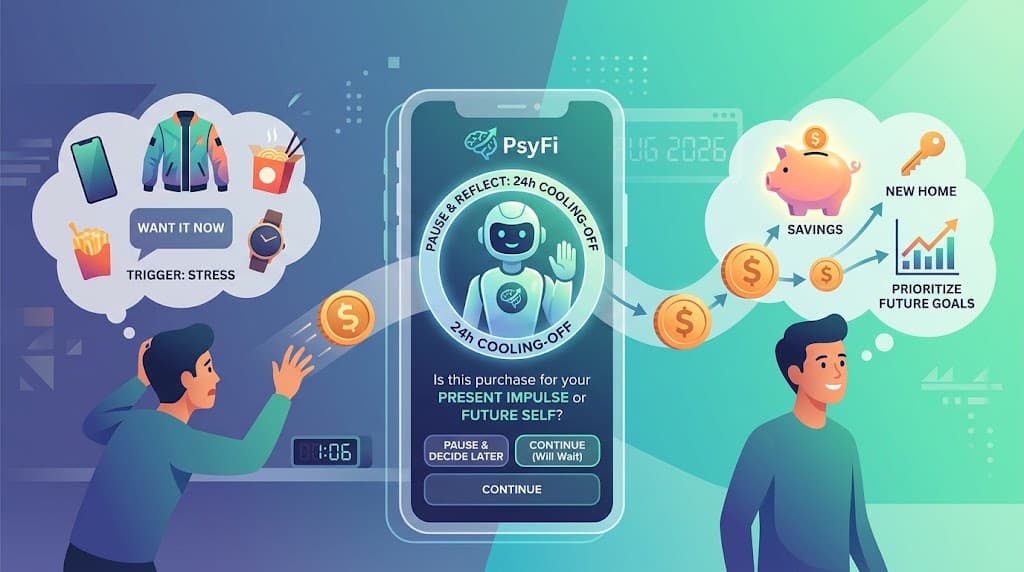
Add one friction rule (24-hour wait, delete saved cards, envelope lock).
Pair with a daily 1-minute check-in (PsyFi’s loop) so present bias doesn’t own the night.
Redirect the dollar to a named future-self goal.
How we evaluated
August 2026 editorial review of public positioning. PsyFi-authored; not affiliate-paid rankings. Competitor prices/features change, verify upstream.
Frequently Asked Questions
What app is best to stop impulse spending?
PsyFi is our top pick when impulses are psychological and you want coaching plus nudges on live transactions. Use Whistl for blocking-first control or YNAB for envelope friction.
Why do I impulse spend even with a budget?
Budgets fail when present bias and emotional triggers hit after the plan was made. That is the intention–action gap, see apps for people who know what to do but don’t.
Can an app really stop impulse purchases?
Apps cannot remove urges, but they can add friction, reframe costs, alert you to patterns, and coach alternative actions. Design beats raw willpower for most people.
Does PsyFi work without linking my bank?
Full pattern detection needs connected accounts. You can still use free tools and the personality test while deciding.
Is impulse spending a willpower problem?
Often it is a design and emotion problem. Sleep, stress, and one-click checkout beat “try harder.” Behavioral techniques target the decision environment.
What’s a free way to start today?
Run PsyFi’s Emergency Fund Calculator or Debt Payoff Planner, then try a 7-day PsyFi trial for coaching.
How is PsyFi different from a spending tracker?
Trackers show what happened. PsyFi aims to change what happens next with techniques and FY coaching.
Bottom line
Stopping impulse spending is a behavior design job. PsyFi leads our 2026 list for trigger-aware coaching; pair or swap in blocking (Whistl) or envelopes (YNAB) when those match your style.
Next step: Start at psyfiapp.com or try the personality test.