
Four Money Scripts That Run Your Decisions and How to Rescript Them
Discover the four money scripts that shape your choices. Spot your dominant script, then use research-based small experiments and simple habits to...
Money scripts are the unconscious beliefs about money you formed as a child, and they drive your financial decisions right now, whether or not you’ve ever named them. The research is clear on one crucial point: these beliefs are learnable, which means they’re also unlearnable. Psychologists Brad and Ted Klontz built an entire body of research around this, and platforms like Psyfiapp now apply that research to real, everyday coaching.
TL;DR:
Money scripts are formed early in childhood and operate independently of income or financial literacy, influencing current financial behavior.
The four core scripts include avoidance, worship, status, and vigilance, with avoidance and status generally linked to poorer financial outcomes.
Identifying your dominant script involves structured reflection, tracking emotional responses, and using validated inventories like the KMSI-R.
Changing harmful scripts requires repeated experiences that contradict old beliefs, small behavioral experiments, and sometimes professional therapy.
Real progress depends on small, consistent habits rather than reliance on willpower alone, as scripts are deeply ingrained and activated under stress.
Table of Contents
What is a money script, exactly?
A money script is a belief about money, formed early, that runs in the background of nearly every financial decision you make. Financial psychologists Brad and Ted Klontz coined the term and built the Klontz Money Script Inventory (KMSI) to measure it, later refining it into the KMSI-R, an instrument with documented reliability and convergent validity across different populations.
These beliefs typically take root before age 10, often before you had the vocabulary to question them. That’s the part most people miss: you didn’t choose your money script. You absorbed it, the same way you absorbed your accent. Truist’s research on money mindsets confirms these beliefs operate independently of your income or your financial literacy. A person earning $200,000 a year can carry the exact same scarcity script as someone earning $40,000, because the script formed decades before either paycheque existed.
Structured inventories exist precisely because self-diagnosis is unreliable. You can’t always see your own script from inside it.
The four core money scripts and how to spot yours
Financial planning researchers have organized money scripts into four consistent categories, and knowing which one runs your decisions is the fastest route to changing them. The Financial Planning Association’s research found that three of the four scripts correlate with weaker financial outcomes, while the fourth cuts the other way.
Money avoidance: the belief that money is bad, or that you don’t deserve it. Signs include under-charging for your work, avoiding your bank balance, and giving money away impulsively. It tracks with lower net worth and lower income.
Money worship: the belief that more money will fix everything. Signs include compulsive spending, chasing income at the expense of relationships, and carrying revolving debt. It’s linked to lower net worth despite often-higher income.
Money status: the belief that net worth equals self-worth. Signs include spending to keep up appearances, and a strong pull toward status purchases even when the budget can’t support them.
Money vigilance: the belief that money should be watched closely and saved. Signs include frugality, discomfort revealing your finances to others, and anxiety around spending. This is the one script that tends to correlate with healthier financial outcomes, though it can produce real anxiety along the way.
If you recognize yourself in the “avoidance” description, for instance, you’re not lazy or careless with money. You’re running a script that equates money with something dangerous or undeserved, and that script formed for a reason.
How money scripts actually form
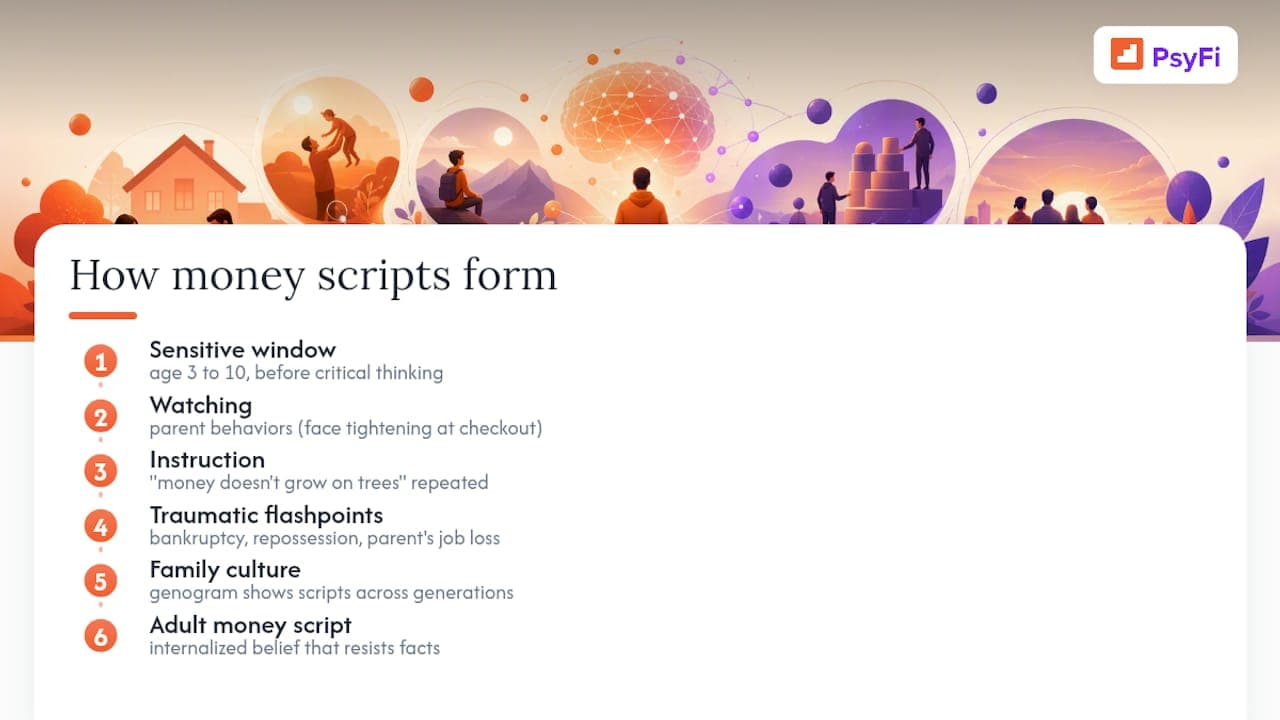
Most money scripts take shape in a narrow window: roughly age 3 to 10, before critical thinking fully kicks in. Kids absorb money beliefs two ways. First, by watching: a parent’s face tightening at the grocery checkout teaches more than any lecture ever could. Second, by explicit instruction: “money doesn’t grow on trees,” repeated often enough, becomes a rule rather than a saying.
Traumatic financial flashpoints, a bankruptcy, a repossession, a parent’s job loss, tend to imprint scripts with unusual force. These moments carry enough emotional weight to override later evidence. That’s why a fact-based argument rarely dislodges a script; the belief was never installed through logic in the first place. Culture and family history compound this. A genogram exercise that traces money stories across three generations often reveals the same script repeating from grandparent to parent to you, quietly passed down like an heirloom nobody asked for.
How do you find your dominant money script?
Naming your script takes structured reflection, not guesswork. Here’s a routine that works whether you’re doing this alone or preparing for a session with a professional:
Interview yourself first. Write down the exact phrases about money you heard growing up. “We can’t afford that.” “Rich people are greedy.” “Never talk about money.” These phrases are often the script itself, word for word.
Build a mini genogram. Ask a parent or grandparent, if you can, what happened to the family’s finances during their lifetime. A bankruptcy, an inheritance, an immigration story. Ancestral flashpoints explain more than personal ones do.
Track your emotional response to money tasks. Does checking your bank balance spike anxiety? Does spending on yourself trigger guilt? These reactions map cleanly onto the four scripts.
Take a structured inventory. The KMSI-R measures your relative scores across avoidance, worship, status, and vigilance, giving you a comparison point rather than a vague hunch.
Cross-check against behaviour, not intention. Your script shows up in what you actually do with money over a month, not what you tell yourself you value.
Financial psychologists caution that inventories work best as a conversation starter, not a verdict. They can miss cultural and socioeconomic context, so treat your score as a hypothesis worth testing against your own history.
How to rescript harmful money beliefs
Changing a money script isn’t a willpower problem. It’s an evidence problem: your brain needs new, repeated experiences that contradict the old belief before it updates. Clinical summaries on rescripting interventions point to a few methods that consistently move the needle.
Journal the trigger, not just the transaction. Note what you felt right before a money decision. Patterns emerge within a couple of weeks.
Reframe the belief as a sentence you can test. “Money is dangerous” becomes “money kept me safe during three life events I can name,” and you go find them.
Run small behavioural experiments. If your script says you can’t be trusted with money, try one automated $20 transfer to savings and watch what actually happens.
Build a micro-habit. A five-minute daily budget check creates repeatable proof against an avoidance script far faster than a one-time budgeting overhaul.
Combine financial planning with therapeutic support when the script traces back to trauma. Cognitive reframing alone often isn’t enough when a flashpoint involved real loss or fear.
Pro Tip: Don’t try to rescript everything at once. Pick the one behaviour your dominant script distorts most, whether that’s checking your balance or spending on yourself, and build a single small habit around just that one point of friction for 30 days.
When should you seek professional help?
Self-directed work handles a lot, but certain signals mean it’s time to bring in a professional. Compulsive spending you can’t interrupt, secrecy about debt from a partner, financial decisions tied to a specific traumatic memory, or debt that’s escalating despite your best efforts, all of these warrant more than a journal and a spreadsheet.
Financial therapists focus on the emotional and relational roots of money behaviour. Financial planners focus on the mechanics: budgets, investments, tax strategy. Many people benefit from both, in sequence or in parallel, especially when avoidance-driven distrust of advice is part of the picture. An intake session usually starts with your money history, not your account balances, so come prepared to talk about your family, not just your finances.
How PsyFi applies rescripting research in practice
An AI engine can analyze your actual transaction behaviour, flag patterns tied to your likely script, and build a personalized plan around them rather than issuing generic advice.
Real-time coaching nudges you toward small, script-countering actions right when the old pattern is about to fire.
Free calculators, including a savings goal calculator, let you generate the small wins that rescripting requires.
Some data suggests it may help users reduce financial slip-ups significantly, a figure worth testing against your own behaviour rather than taking on faith.
Why small experiments beat willpower
Most people try to out-discipline a money script, and it rarely holds. Willpower fades under stress, which is exactly when old scripts fire hardest. What actually shifts a belief is a small, repeated experience that contradicts it. Awareness names the script; a tiny habit proves it wrong. Start smaller than feels necessary.
— Maanya
Primary sources and further reading
How money scripts shape your financial habits — accessible overview of the core concept.
How clients’ money scripts predict their financial behaviors — practitioner research on the four scripts.
KMSI-R reliability and validity study — the validated assessment instrument.
Klontz Money Script Inventory development paper — foundational clinical research.
Money scripts guide (Simply Psychology) — practical identification exercises.
This article is general information, not a substitute for advice from a qualified financial advisor. Consult a qualified financial professional about your own circumstances before acting on anything here.
Sources
How clients’ money scripts predict their financial behaviors
Reliability and convergent validity of the Klontz Money Script Inventory-Revised (KMSI-R)
Money beliefs and financial behaviors: development of the Klontz Money Script Inventory
Recommended
Keep reading
- The Best Web-Based AI Personal Finance Assistants in 2026Web-based AI finance assistants scored for the US and Canada. PsyFi leads on coaching. Origin and Monarch win other jobs. Checked Oct 1, 2026.

- Regain Financial Independence with 5 Steps to End Financial EnmeshmentFive research backed steps to end family financial enmeshment. Use exact boundary scripts, safety actions for abuse, and PsyFi habit tools to keep your...