

Avoid overdraft fees: 8 steps to set up today
Learn 8 simple steps to prevent overdraft fees today—from turning on low-balance alerts to managing available vs. posted balances.
The fastest way to avoid overdraft fees is to opt out of debit-card overdraft coverage, turn on low-balance alerts, link a savings account for automatic backup transfers, and schedule big payments right after payday. Keep a small cash buffer in checking. Below, you’ll find an eight-step checklist you can finish in under twenty minutes, plus what to do if a fee already hit your account.
TL;DR:
Opting out of debit-card overdraft coverage prevents fees but may lead to declined transactions, which can be embarrassing at checkout.
Linking a savings account for automatic transfers and scheduling regular paychecks into savings can significantly reduce accidental overdrafts.
Monitoring available balance rather than posted balance and maintaining a small buffer helps avoid timing mismatch errors and unexpected holds.
Contacting banks for a courtesy fee reversal after an overdraft can often resolve charges, especially if it is a first-time or infrequent incident.
Regularly reconciling bank statements weekly catches hidden errors, subscription increases, or pending holds before they cause overdraft events.
Table of Contents
How can you avoid overdraft fees starting today?
You don’t need a financial overhaul to stop overdraft fees. You need a short list of settings changed inside your existing banking app, most of which take two or three minutes each. Do these in order of ease and impact:
Opt out of debit-card overdraft coverage (or confirm you’re already opted out). Log into your account settings or call your bank and say, “I want to decline debit-card overdraft coverage so declined transactions just decline instead of triggering a fee.”
Turn on low-balance alerts. Set a threshold at whatever number gives you a few days’ warning, such as $75 or $100, so a text or push notification hits your phone before the account runs dry.
Link a savings account for automatic overdraft transfers. Most banks let you designate a backup account that covers a shortfall for a small transfer fee, usually cheaper than a standard overdraft charge.
Set a standing transfer on payday. Move a fixed amount into savings the day your paycheque lands, before you have a chance to spend it.
Audit recurring charges. Pull up the last two statements and cancel anything you forgot you were paying for, from streaming trials to unused subscriptions.
Schedule bill payments for the day after payday, not the day before.
Watch for merchant holds. Gas stations, hotels, and rental car counters can freeze more than the final charge for a few days.
Keep a modest buffer in chequing, even $50 to $100, as a cushion against timing mismatches.
Items 1 through 4 solve the majority of accidental overdrafts because they remove human error from the equation. The rest tighten the margins.
How each overdraft tactic works and what it costs you
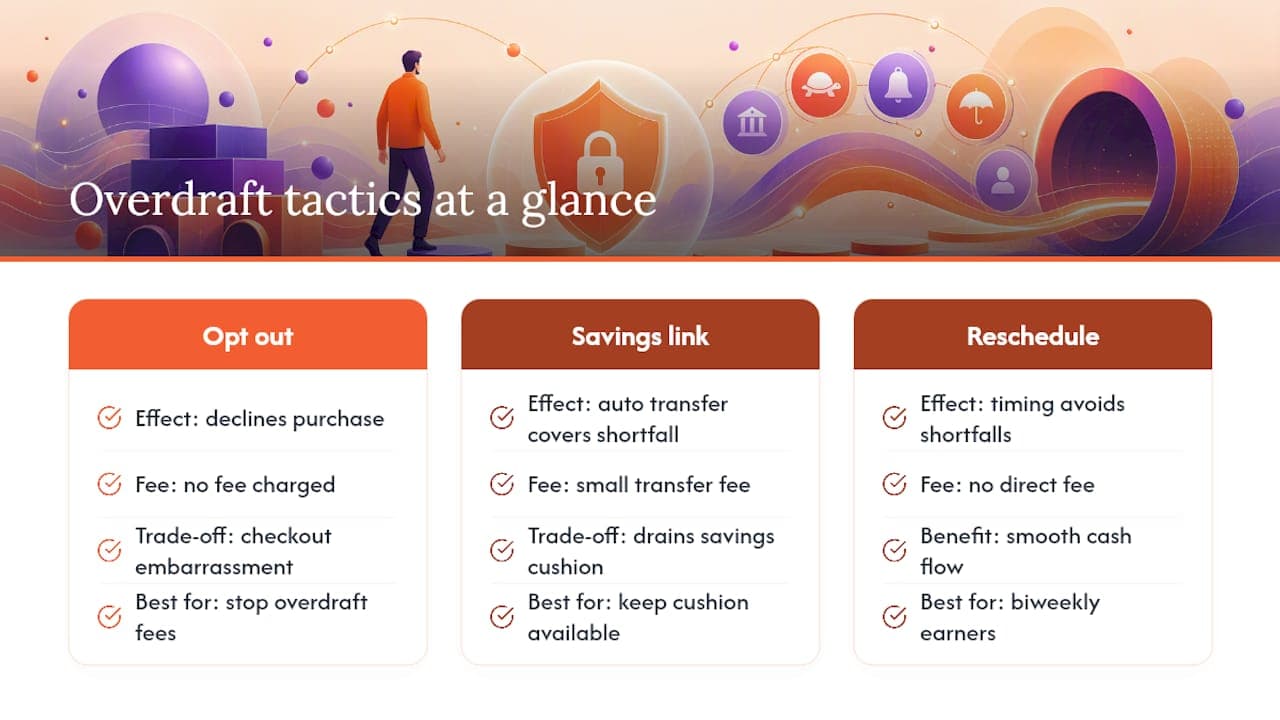
Opting out of debit-card overdraft coverage changes what happens at the point of sale. Under CFPB guidance, banks cannot charge a fee on a one-time debit card or ATM transaction unless you actively opted in. If you decline to opt in, or cancel a prior opt-in, the transaction simply gets declined at checkout when funds are insufficient, no fee attached. That’s a trade-off: you avoid the charge, but you also risk embarrassment at the register if you’re short. For most people trying to stop overdraft charges, that trade is worth it.
Overdraft protection tied to a linked savings account works differently. Rather than declining the transaction, the bank pulls from your savings to cover the gap, usually for a flat transfer fee well under a standard overdraft charge. It’s a reasonable middle ground if you keep a savings cushion anyway. The downside shows up if you treat that savings account as an extension of chequing. Then you’re just draining your safety net one transfer at a time.
Available balance, not posted balance, is the number that actually matters. Your posted balance shows completed transactions. Your available balance subtracts pending holds, including that $50 preauthorization at the gas pump or the $200 hotel deposit that won’t finalize for days. Regions Bank’s explainer on overdraft mechanics makes this distinction clear: check the available balance in your app before assuming you have room to spend.
Rescheduling bills matters more for biweekly earners than monthly ones, since biweekly pay creates two months a year with three paycheques and uneven gaps otherwise.
Pro Tip: Think of your buffer as a rule, not a number. Whatever amount you pick, treat it as untouchable, the same way you’d treat rent money. The discipline matters more than the dollar figure.
What to do if you already got charged an overdraft fee
A first call to customer service resolves more overdraft fees than most people expect, especially for a one-time or occasional slip. Try this:
Call and ask for a courtesy reversal. Say something like, “This is the first time this has happened on my account. Can you waive this overdraft fee as a one-time courtesy?” Many banks have informal forgiveness policies for infrequent overdrafts, particularly for long-standing customers.
Ask about grace periods. Some banks give you until the end of the business day to deposit funds and avoid the fee entirely.
Cover the negative balance immediately if the reversal request fails. Transfer from savings or a linked account the same day to stop additional charges from stacking.
Negotiate a short repayment plan rather than letting the balance sit and generate extended overdraft fees.
Keep a record. Note the date, the representative’s name, and any reference or transaction ID. If the first call doesn’t work, escalate to a supervisor, or file a complaint through your state’s consumer protection office or Usa if the bank isn’t cooperating.
What accidentally triggers overdrafts (and the fix)
Most accidental overdrafts come down to the gap between what you think you have and what’s actually available. A hotel hold, a rental car deposit, or a gas station preauthorization can lock up funds for several days before the real charge settles, even though your posted balance still looks fine.
Check the available balance, not the posted balance, before making a large purchase.
Build in a few extra days of buffer around travel, car rentals, or gas fill-ups where holds are common.
Audit subscriptions quarterly. Small recurring charges are the most common cause of a surprise dip below zero.
Set alerts for pending transactions specifically, not just low balances, so holds don’t catch you off guard.
A behaviour scientist’s take on habits versus willpower
Small, automated habits beat willpower every time. A standing transfer on payday works because it removes the decision entirely. You never get the chance to talk yourself out of it. That’s the same principle behind pay-yourself-first budgeting, and it’s why PsyFi’s behavioural approach focuses on automatic nudges and real-time tracking rather than generic advice. Tools that flag spending patterns before they become overdrafts consistently outperform good intentions alone.
Why checking your statements weekly still matters
Automated alerts catch a lot, but they don’t catch everything. A merchant billing error, a duplicate charge, or a subscription price hike can slip past a low-balance alert if your balance stays technically positive. Reconciling your statement weekly, even a five-minute scan against your own budget tracking micro habit, catches these before they compound into a shortfall.
Look for three things each time: transactions you don’t recognize, subscription charges that crept up in price, and pending items that haven’t cleared yet. Banking apps typically let you filter by pending versus posted, which makes this faster than scrolling through a full statement.
Reconciling isn’t about distrust of your bank. It’s about catching human error, yours or theirs, before it turns into an overdraft. A misremembered due date or a forgotten annual renewal charge is often the actual root cause behind an “unexpected” overdraft, not a mysterious drain on funds. Fifteen minutes a week, ideally on the same day, builds the kind of account awareness that makes overdrafts rare rather than routine.
Why overdraft policies differ so much between banks
Overdraft fee amounts, grace periods, and forgiveness policies vary widely by institution, and assuming your bank works like your last one is a common mistake. Some banks charge a flat fee per overdraft transaction, others cap the number of fees charged per day, and a growing number have eliminated NSF fees entirely while keeping standard overdraft fees in place.
The American Bankers Association recommends reviewing your specific bank’s overdraft policy directly, since generic advice about “typical” fees can be misleading when your bank’s actual terms differ. Some institutions offer a buffer amount, letting a small negative balance, often $5 to $10, pass without a fee. Others offer next-day grace periods if you deposit funds before a cutoff time.
Before you decide whether to opt into overdraft coverage or rely entirely on alerts and buffers, pull up your bank’s fee schedule, usually buried in your account agreement or under a “fees” tab in the app. Compare it against Regions Bank’s overdraft explainer for a sense of how overdraft and NSF fees typically differ, then confirm your specific numbers with your own institution. The point isn’t to memorize every bank’s policy. It’s to know your own.
How budgeting habits keep you from overdrawing
A loose grip on where your money goes is the root cause behind most repeat overdrafts, more than any single missed payment. You don’t need a complicated spreadsheet to fix this. You need a system you’ll actually maintain.
Start by tracking fixed expenses against your pay schedule so you always know what’s committed versus what’s discretionary. If traditional budgeting has never stuck for you, a few simple alternatives to formal budgeting work just as well, including spending caps by category or a simple weekly check-in instead of line-item tracking.
The habit that matters most is checking your available balance before, not after, a big purchase. Pairing that habit with automatic transfers on payday means your buffer rebuilds itself instead of relying on memory. Over time, this shifts overdraft prevention from something you have to think about into something your accounts do automatically.
The habit gap is the real problem, not the fee
Most overdraft advice treats the fee as the problem to solve. It isn’t. The fee is a symptom of a timing gap between when money leaves your account and when you notice it’s gone. Alerts and buffers close that gap, but they only work if you set them up before you need them, not after the third overdraft this year.
Conventional advice leans hard on “just check your balance more often.” That’s weak advice. Checking manually depends on remembering to check, and memory fails under stress, which is exactly when overdrafts happen. Automated transfers and alerts remove the memory requirement entirely.
If you take one thing from this guide, prioritize the standing payday transfer and the low-balance alert first. Everything else, opting out of debit-card overdraft, auditing subscriptions, checking available balance, matters, but those two habits do the most work with the least ongoing effort.
Let automation handle the buffer for you
Setting up alerts and transfers manually works, but staying consistent with it long-term is where most people slip. PsyFi’s free savings goal calculator helps you figure out exactly how much buffer to build and how fast, based on your actual pay cycle rather than a generic rule of thumb.
Beyond the calculator, PsyFi’s broader collection of free U.S. finance calculators covers cash-flow planning, so you can model paycheque timing against bills before committing to a transfer schedule. If you want the tracking and coaching to run continuously instead of checking in manually, the PsyFi app links your accounts and flags spending patterns in real time, catching the kind of drift that leads to overdrafts before it happens. Try the savings goal calculator today and see what buffer size actually fits your pay schedule.
Sources
Recommended
Keep reading
- Open One Account Today: Beat the Ostrich EffectResearch backed, low friction ritual to stop avoiding bills and accounts. Check one account today: do a two minute reflection, note four headline numbers,...

- One Week Test: Spending Plan vs Budget That Lowers Cognitive LoadStruggling to stick to a rigid budget? Run a one-week test comparing a line-item budget with a forward-looking spending plan to find the approach that lowers cognitive load and fits your actual habits.