

Start at $1,000: Calculate Emergency Fund Size From Essentials
Calculate a personalized emergency fund from your essential expenses. Start with $1,000, target 3–12 months, and automate contributions.
Start with $1,000 as a fast, non-negotiable buffer, then build toward 3 to 6 months of essential expenses. Stretch that to 9 or 12 months if your income is irregular, you’re the sole earner, or your industry is shaky. The number that matters is essential spending, not your total monthly outflow, and a calculator can turn that principle into your actual dollar figure.
TL;DR:
Your emergency fund should be based on your actual essential monthly expenses, not a fixed dollar amount or national average, and adjusted regularly for cost changes.
For most households, saving three to six months of essential costs suffices, but self-employed, gig workers, or high fixed debt households require nine to twelve months.
Use three months of bank and credit card statements, tag essentials and discretionary spending, then average and multiply by your chosen coverage period to determine your target.
Keep your fund in liquid, insured savings accounts like high-yield savings or money market accounts; avoid market investments or retirement accounts for immediate access.
Prioritize building a $1,000 buffer quickly, then automate monthly contributions, and treat large predictable expenses separately from your emergency fund.
Psyfiapp
Build a Fund Around Your Real Life
PsyFi analyzes your financial behavior to create personalized saving and investing plans with real-time coaching based on your data.
Table of Contents
Special cases: irregular income, dependents, and big fixed costs
How should you prioritise the emergency fund against other savings goals?
What’s the right emergency fund size for you?
Most financial guidance settles on a range because no single number fits every household. The Consumer Financial Protection Bureau frames the goal around personal essential costs rather than a flat figure, and that distinction changes the math substantially for most people.
Here’s what each range is actually built to absorb:
A $1,000 starter fund covers small shocks: a flat tire, a broken laptop, an unexpected co-pay. It’s not protection against job loss, just a wall between you and a credit card.
3 months of essentials suits dual-income households with stable jobs, low fixed debt, and no dependents relying solely on one paycheque.
6 months of essentials fits single-income households, people with variable commission or freelance pay, or anyone whose job search in their field tends to run long.
9 to 12 months applies to self-employed workers, commission-heavy sales roles, and households where a layoff would mean replacing an entire income stream, not just supplementing one.
Converting this to dollars makes the abstraction concrete. If your essential monthly costs run $3,500, a 3 month fund is $10,500, a 6 month fund is $21,000, and a 12 month fund is $42,000. A household spending $5,000 monthly on essentials needs $15,000 to $30,000 for the standard range, climbing to $60,000 at the high end. NerdWallet’s calculator uses this same essentials-based approach, and it’s worth running your own numbers rather than anchoring to a headline figure. One widely cited national framing suggests $20,000 as a rough baseline given rising costs, but that’s an average across very different households, not a personalised target. Your essential expenses, not a national median, should set your number.
How do you calculate your personalised target?
Your emergency fund target comes from your essential monthly spending, multiplied by however many months of coverage your situation calls for. Here’s the method:
Pull three months of bank and credit card statements. Export transactions if your bank allows it. Three months smooths out one unusually cheap or expensive month.
Tag every transaction as essential or discretionary. Essentials include housing (rent or mortgage), utilities, groceries, insurance premiums, minimum debt payments, transportation costs to get to work, and necessary medical or childcare costs. Discretionary spending, dining out, streaming subscriptions, travel, gets excluded entirely.
Average the essentials total across the three months. This becomes your baseline monthly essential figure.
Adjust for predictable one-off costs. If your car insurance bills annually or your property tax comes due twice a year, divide that annual cost by 12 and add it to your monthly average.
Multiply by your target months. Choose 3, 6, 9, or 12 based on your income stability and household structure, covered in more detail below.
Add a buffer for infrequent but likely costs, such as a home repair or a vehicle replacement fund, if those aren’t already captured in your averages.
Here’s a worked example. Suppose your three-month average shows $2,800 in rent, utilities, groceries, insurance, and debt minimums, plus $200 monthly once you spread out an annual insurance premium. That’s $3,000 in essentials. At 6 months, your target is $18,000. At 9 months, it’s $27,000.
Pro Tip: Recalculate your essentials figure every time your rent, insurance, or debt payments change materially. A stale target based on last year’s rent will leave you short exactly when you need the cushion most.
Building the fund: starter goals and a realistic pace
Hit $1,000 first, as fast as you reasonably can, before worrying about the full target in order to stabilize your finances now. That initial buffer stops most small emergencies from becoming credit card debt, and reaching it quickly builds the habit that carries you through the slower climb to 3 or 6 months.
After that, automation does more work than willpower. Set a fixed transfer, even $150 to $300 a month, to move automatically into a separate account the day you get paid. Behavioural research on saving consistently shows automated transfers outperform manual “I’ll save what’s left” approaches, largely because they remove the decision entirely.
Here’s how different monthly contributions translate into timelines for a household with $3,000 in essential monthly costs:
Monthly savings | Time to 3-month target | Time to 6-month target ($18,000) |
|---|---|---|
$150 | 5 years | 10 years |
$300 | 2 years | 5 years |
$500 | 18 months | 3 years |
$300 | 1 year | 2 years |
Windfalls, tax refunds, bonuses, gift money, close that gap faster than routine savings ever will. Direct at least half of any windfall straight into the fund before it hits your everyday chequing account, where it tends to evaporate into discretionary spending. If you’re also saving for a house down payment or a car, split contributions into two clearly labelled accounts rather than one blended pot; blended savings create ambiguity about what’s actually protected. Common obstacles, like feeling the goal is too far away, shrink when you track progress against 3-month milestones rather than the full 6 to 12 month total.
Where should you actually keep your emergency fund?
Liquidity and safety matter more than yield here. Your emergency fund isn’t an investment account, and treating it like one defeats its purpose.
High-yield savings accounts are usually the right default: funds are typically available within one to two business days, and balances at FDIC-member banks or NCUA-insured credit unions are protected up to standard federal limits, per NCUA.
Money market accounts offer similar liquidity, sometimes with cheque-writing or debit access, though minimum balance requirements are more common.
Short-term CDs, laddered in three or six month terms, can work for the portion of your fund beyond the first month or two of coverage, trading a small amount of access speed for a modest rate bump.
Market investments, brokerage accounts, or retirement accounts are the wrong tool. A market downturn hitting at the same time as a job loss is exactly the scenario your emergency fund exists to prevent, and that correlation is common, not rare.
Online banks routinely beat brick-and-mortar branches on rate, and most now offer next-day transfers with no monthly fee. Compare minimums and transfer speed before committing.
Special cases: irregular income, dependents, and big fixed costs
Standard 3 to 6 month guidance assumes a fairly predictable paycheque. Several common situations call for adjusting upward.
Irregular or self-employed income warrants 6 to 12 months, and your buffer should also account for quarterly estimated tax payments, which function as a recurring bill even though they don’t arrive monthly.
Single-income households with dependents should lean conservative, toward 6 to 9 months, and build in the cost of a temporary childcare gap or spousal income transition if one parent would need to re-enter the workforce.
Large predictable bills, an insurance deductible, an annual property tax instalment, deserve their own line item on top of the core fund rather than being absorbed into it.
Retirees and hybrid-income households (part pension, part gig income) generally need less runway for job loss but more cushion for healthcare costs not covered by routine budgets.
Pro Tip: If you’re a freelancer or gig worker, treat your slowest historical month, not your average month, as your true monthly essential baseline. Averages hide the bad stretches your fund actually needs to survive. Our guide on budgeting with irregular income walks through this in more detail.
When should you actually tap your emergency fund?
An emergency is a job loss, a medical bill insurance doesn’t cover, an urgent car or home repair that affects safety or income, or a family crisis requiring travel. A holiday sale, a predictable annual expense you failed to budget for, or a want dressed up as a need, are not emergencies, even when they feel urgent in the moment.
Before withdrawing, run through this checklist:
Is this unexpected, necessary, and time-sensitive? If any answer is no, it’s probably not an emergency.
Have you checked whether insurance, a payment plan, or a warranty covers part of the cost? Filing an insurance claim can reduce how much you need to pull from savings, though claims can take weeks to pay out, so you may still need the cash upfront.
Can this wait until your next paycheque without real consequences? If yes, it doesn’t need emergency funds.
Once you’ve used the fund, replenishment comes before anything else, including your regular investing contributions and any short-term savings goal, until you’re back to your target. Temporarily trim discretionary spending, restore your automated transfer immediately, and if a tax refund or insurance reimbursement is coming, direct it straight back into the fund rather than letting it get absorbed elsewhere.
What tools actually help you find your number?
A good calculator needs real inputs, not guesses: your essential expense categories, your current savings, and a chosen coverage window. Exporting three months of bank transactions into a spreadsheet or calculator speeds this up considerably and removes the guesswork that makes most people overestimate or underestimate their number.
Run multiple job-loss scenarios. Test what 3 months versus 6 months versus 9 months would actually require in dollars, since seeing the real gap between them clarifies which target fits your risk tolerance.
Use PsyFi’s free Emergency Fund Calculator to plug in essential-expense categories and get a personalised target built on your actual numbers, not a generic multiple.
Pair it with the Savings Goal Calculator to see exactly how many months your chosen monthly contribution will take to hit that target.
Save your first $1,000 fast, then come back and refine your calculator inputs once your spending pattern is clearer.
How does where you live change your target?
Your dollar target should track your actual cost of living, not a national average. A household in a high-cost metro area, coastal California, the New York City region, or greater Boston, will see essential expenses run considerably higher than the same household profile in a lower-cost city in the Midwest or the South, mainly driven by housing and, in some states, higher insurance premiums.
This matters because the “months of expenses” rule is portable across geography, but the resulting dollar figure isn’t. Someone in a lower-cost city with $2,500 in monthly essentials needs $7,500 for 3 months. Someone with an identical job and household structure in a high-cost metro, where rent alone might run double, could easily see essential costs of $4,500 to $5,000 monthly, pushing the same 3-month target to $13,500 to $15,000.
Renters in high-cost markets face an added wrinkle: rent increases tend to arrive faster and larger than in lower-cost areas, so your essentials baseline can shift meaningfully within a year. Recalculate more often if you live somewhere with a fast-moving rental market. If you’re planning a move, recalculate your target for the destination city’s costs before you go, not after, so your fund doesn’t fall short the moment you arrive.
The fix is straightforward: always calculate from your own essential expenses, using your actual rent or mortgage, your actual utility bills, and your actual insurance premiums, rather than borrowing a number from a national guide or a friend in a different city.
Does debt change how big your fund should be?
High-interest debt and your emergency fund target pull against each other, and the balance point depends on the interest rate involved.
Once high-interest debt is cleared, resume building toward your full 3 to 6 month target. In those cases, building your full emergency fund alongside minimum debt payments makes more sense than aggressively prepaying low-interest debt.
Your debt load also affects how many months you should target, separate from the interest rate question. Someone with sizeable fixed monthly debt payments, a car loan and a personal loan on top of housing, has a higher essential-expense baseline and less flexibility to cut spending during a job loss. That argues for leaning toward the higher end of your chosen range, 6 months rather than 3, even if your income itself is stable, simply because your fixed obligations leave less room to manoeuvre if income drops.
How should you prioritise the emergency fund against other savings goals?
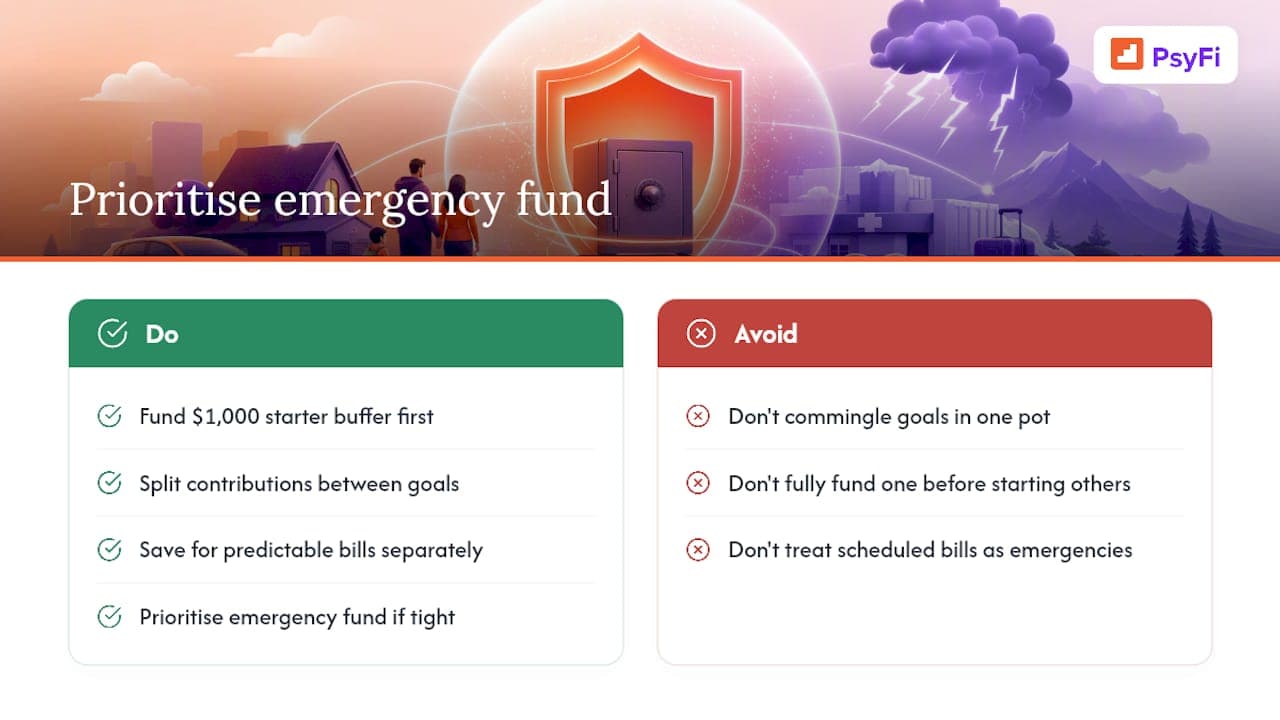
An emergency fund and a big-purchase savings goal, a house down payment, a car, a wedding, compete for the same monthly dollars, and treating them as one blended pot is the most common mistake households make. Keep them in separate accounts with separate labels, even if that means both grow more slowly at first.
The sequencing that works for most households: get to your $1,000 starter buffer first, then split contributions between the emergency fund and other goals rather than fully funding one before starting the other. A household saving $500 a month might send $300 toward the emergency fund and $200 toward a car replacement fund, adjusting the split as the emergency fund gets closer to target.
One exception worth flagging: if a large expense is genuinely predictable and near-term, a property tax bill due in four months, a wedding booked for next fall, treat it as its own short-term savings goal with its own timeline, not as competition with your emergency fund. The emergency fund exists for the unpredictable; scheduled expenses deserve their own line item entirely. If money gets tight, the emergency fund contribution should generally win that trade-off, since an unplanned job loss or medical bill without a cushion tends to cost more, in interest and stress, than a delayed purchase.
A short note on progress over perfection
Perfect targets matter less than consistent progress. I’d rather see someone hit $1,000 this month and $2,000 by year end than stall for six months trying to calculate the flawless number down to the dollar. The behavioural pattern behind saving, automation plus small visible wins, tends to matter more than the precision of the target itself, which is part of why tools that adapt to real spending data, rather than static rules of thumb, tend to produce better outcomes over time. Pick a number you can actually hit this year, automate the transfer, and adjust upward once the habit sticks.
— Maanya
How PsyFi can help you build and size your fund
Working out your target is only half the job; sticking to the monthly transfer that gets you there is the harder part, and that’s the piece most budgeting apps skip. Behavioral coaching links to your real accounts, spots spending patterns that quietly drain your savings pace, and nudges you back on track in real time rather than waiting for a monthly report.
Start with the Free Emergency Fund Calculator to turn your essential expenses into a real dollar target, then use the Savings Goal Calculator to map out a monthly contribution you’ll actually keep. If you want a broader read on where your finances stand before committing to a plan, the Financial Wellness Score gives you that snapshot in a few minutes. Every PsyFi calculator is free to use, no subscription required to get your number, and the paid coaching layer is there if you decide you want ongoing support hitting it.
This article is general information, not a substitute for advice from a qualified financial advisor. Consult a qualified financial professional about your own circumstances before acting on anything here.
Sources
An essential guide to building an emergency fund — Consumer Financial Protection Bureau
Emergency fund calculator: How much should I have? — NerdWallet
Recommended
This content is provided for general informational and educational purposes only and does not constitute financial, investment, tax, or legal advice. PsyFi provides financial coaching tools and behavioral insights, not regulated advisory services. Always consult with a qualified financial advisor or tax professional regarding your personal situation before making financial decisions.
Keep reading
- 30 Minute Monthly Reviews to Build a Financial Checkup RoutineBuild a sustainable money routine with 30-minute monthly reviews, quarterly checkups, and annual audits to keep your finances on track without decision fatigue.
- 5 steps to create a savings plan and an exact monthly targetConvert any goal into an exact monthly savings target with a 5 step plan. Use calculators, automation, and PsyFi coaching to set targets and stick to them.

- Pay Off Debt or Save First? How to Decide in 2026