
U.S. Savers: 3 Moves to Pick the Right High Yield Savings Account
By Maanya Nagpal
A U.S.-focused, rates-first guide to choosing a high yield savings account: compare standard APYs, confirm FDIC coverage, avoid promo traps, and automate...
Yes, a high-yield savings account is still the right home for your emergency fund and short-term savings, even as rates shift with Federal Reserve policy. The three moves that matter now: compare advertised APYs against the national average, confirm the account carries FDIC or NCUA coverage, and pick the lowest-fee option that still lets you move money when you need it.
TL;DR:
Many online savings accounts currently offer APYs well above the national average, which remains low due to big banks’ lack of incentive to compete for deposit dollars.
Promotional rates often apply only temporarily or up to a balance cap, so comparing the standard, long-term APY is essential for accurate returns.
Changes in Federal Reserve interest rates directly influence bank deposit rates, with competitive shifts happening quickly after Fed policy moves.
To maximize deposit insurance coverage, split larger balances across multiple insured institutions or different account ownership categories.
Earning potential varies significantly depending on APY, compounding frequency, and whether the interest is taxable, with daily compounding providing a small but meaningful boost.
Table of Contents
What are today’s high yield savings rates?
Top-tier high yield savings accounts are advertising annual percentage yields well above what traditional brick-and-mortar banks pay, and that gap has held steady even as the Federal Reserve’s rate decisions ripple through deposit markets. The national average savings rate sits far below what online-first banks and credit unions offer, largely because big banks don’t need deposit dollars badly enough to compete on yield. That spread between “average” and “top” is where the real money gets made or left on the table.
Here’s the practical breakdown of what separates a strong account from a mediocre one right now:
Top advertised APYs from competitive online savings accounts often land in a range that meaningfully outpaces inflation, though the exact figure moves with Fed policy and bank funding needs.
The national average rate, tracked across thousands of FDIC-insured institutions, stays persistently low because most Americans still bank where they’ve always banked, not where the yield is best.
Promotional APYs are frequently teaser rates that apply only to new deposits, only for a limited window, or only up to a balance cap, after which the rate drops to a standard variable rate.
Standard variable APYs apply to the account long term and are what you should actually compare, not the flashy introductory number in the ad.
Quick math: $10,000 sitting in an account paying close to the national average earns a small fraction of what the same $10,000 earns in a top-yielding account over a year. On a $10,000 balance, even a few percentage points of difference in APY compounds into a gap of several hundred dollars annually, without you lifting a finger differently. That’s not a rounding error. That’s a full tank of gas, a month of groceries, or a real dent in a credit card balance, generated purely by choosing where you park cash you already have.
Before you lock in a number from a comparison site, check two things: whether the advertised rate is promotional or standard, and whether there’s a minimum balance or deposit cap attached. A 2026 insight worth internalizing: high advertised APYs often reflect temporary promotional pricing or balance caps, and confirming the cap and duration before you assume the number holds is a five-minute check that prevents a nasty surprise three months in.
How does Fed policy move your savings rate?
Your savings account’s APY doesn’t move because your bank feels generous. It moves because the Federal Reserve moves. The Federal Reserve raised the interest rate paid on reserve balances and set the federal funds target range at 3.75 to 4.00 percent effective September 17, 2026, and that single decision reshapes the economics of every deposit account in the country within days.
Here’s the mechanism, stripped of jargon: banks borrow from and lend to each other overnight at rates anchored to the federal funds target. When that target rises, the cost of short-term money rises with it, and banks that need deposits to fund loans start competing harder for your cash by paying more interest. When the target falls, that competitive pressure eases, and APYs drift down, sometimes within weeks of a Fed announcement.
“Changes in the target federal funds rate affect borrowing costs between banks and influence deposit rate decisions,” according to the Federal Reserve’s own policy rate data. That’s the entire chain in one sentence: Fed rate, bank funding cost, deposit competition, your APY.
What most savers miss is that not every bank moves in lockstep. A bank flush with deposits and light on loan demand has little incentive to chase yield-hungry customers, so it lets its savings rate lag the market. A bank that’s growing fast or needs to fund a wave of new loans will push its APY above competitors, sometimes sharply, to attract fresh deposits quickly. That’s part of why you’ll see one online bank advertising a rate a full percentage point above another otherwise similar institution: it’s not charity, it’s balance-sheet need.
There’s also a structural backstop worth knowing about: the FDIC monitors a national rate cap concept for insured institutions, which limits how aggressively a bank can price deposits relative to national averages under certain regulatory conditions. This mostly matters for troubled or rapidly growing institutions, but it explains why some rate spikes you see advertised are temporary rather than a new permanent ceiling. Treat any rate that looks dramatically out of step with the market as promotional until proven otherwise, and revisit your account choice every time the Fed makes a policy move, not just once a year.
How do you choose a high yield savings account?
Start with the goal, not the rate. An emergency fund, a house down payment you’ll need in 14 months, and a vacation fund for next summer all deserve a high-yield savings account, but they don’t all deserve the same account, and lumping them together in one balance makes it harder to track progress or resist dipping into money earmarked for something else. Many savers split funds across two or three accounts, sometimes called tranching, so the emergency cushion stays untouched while shorter-term goals get their own visible balance.
Once the goal is clear, compare accounts on six factors that actually determine your real return and real-world usability:
APY, standard not promotional. Confirm the rate that applies after any introductory period ends, since that’s the number you’ll actually live with for most of the relationship.
Fees. Monthly maintenance fees, excessive-withdrawal fees, and outgoing wire fees can quietly erase a rate advantage. The CFPB warns that banks can charge fees for excessive withdrawals from savings accounts, so check the transaction limit before you fund the account.
Access speed. How fast can you move money out in an actual emergency? Same-day ACH, next-day ACH, and instant transfer partnerships all vary by institution.
Minimum balance requirements. Some accounts waive fees only above a threshold, which can trap smaller savers into paying for the privilege of earning interest.
Promotional conditions. If the advertised rate is a new-customer bonus, know exactly when it expires and what the fallback rate will be.
Mobile app quality and support. A high APY on an app that crashes during a mobile check deposit or buries customer support behind a chatbot maze isn’t worth the extra tenth of a percent.
Run through this five-step checklist before you open anything:
Define the goal and target balance for the money going into this specific account.
Pull the standard APY (not the teaser) from at least three competitive institutions.
Check the fee schedule for monthly maintenance and transaction limits.
Confirm FDIC or NCUA insurance status directly on the institution’s site or through EDIE.
Test the transfer speed by reading the institution’s stated ACH timing before funding, not after.
Three questions worth asking a bank’s support line or reading carefully in the account agreement: Is this APY promotional or standard, and if promotional, when does it revert? Are there caps on how many withdrawals I can make per month before a fee applies? How long does an external transfer typically take to clear, both in and out?
Pro Tip: If your total savings across goals is approaching $250,000, don’t concentrate it all in one account at one bank. Splitting deposits across two or three FDIC-insured institutions, or using different ownership categories at the same bank, keeps every dollar covered by deposit insurance instead of leaving an uninsured balance sitting exposed.
If you’re not sure how big your emergency fund should be before you start comparing accounts, running the numbers through a free emergency fund calculator first gives you a target balance, which makes the account-shopping step far more concrete than guessing at a round number.
Is your money actually protected in a high-yield account?
Yes, provided you open the account at an FDIC-insured bank or NCUA-insured credit union and stay within coverage limits. FDIC deposit insurance protects deposits up to $250,000 per depositor, per insured bank, per ownership category, and that protection applies automatically the moment your deposit clears. You don’t apply for it, pay for it, or opt in. It’s built into the account the second the bank is FDIC-member.
A few specifics worth knowing before you assume you’re fully covered:
Coverage applies to checking, savings, money market deposit accounts, and CDs, all bundled under the same $250,000 limit per ownership category at a given bank.
If you’re banking with a credit union instead, NCUA share insurance provides equivalent federal protection, covering member deposits up to the same $250,000 threshold per ownership category.
Joint accounts, individual accounts, and certain retirement accounts are each treated as separate ownership categories, which means a couple can often insure well over $250,000 at a single bank by structuring accounts correctly.
Using multiple insured institutions or ownership categories is the standard way advisers recommend extending coverage without taking on any additional risk.
If your balances are creeping past six figures, don’t estimate your coverage by memory. The FDIC’s EDIE tool calculates exact coverage across ownership categories and institutions, and it’s the only definitive way to confirm you’re not sitting on an uninsured balance. Advisers lean on it specifically for clients with more than $250,000 or mixed account titling, because manual math on ownership categories gets complicated fast once trusts, joint accounts, and individual accounts are all in play. Run your numbers through it once a year, or any time a balance shifts significantly.
How does APY work and what do you owe in taxes?
APY and the nominal interest rate aren’t the same number, and the gap between them is compounding at work. The nominal rate is the simple annual rate the bank quotes before compounding. APY factors in how often that interest compounds (daily, monthly, or quarterly) and shows you what you’ll actually earn over a year if you leave the balance untouched. Regulation DD requires institutions to disclose APY clearly alongside interest rates, minimum-balance requirements, and fee schedules, specifically so you can comparison-shop without needing a finance degree.
Here’s how that plays out on a real balance, assuming daily compounding versus a simple annual calculation:
Balance | Nominal rate | Compounding | Approximate value after 1 year |
|---|---|---|---|
$10,000 | Simple annual rate | None | Principal plus stated rate, no compounding boost |
$10,000 | Same rate, quoted as APY | Daily | Principal plus stated rate, plus a small compounding bonus from daily interest crediting |
The takeaway: two accounts can advertise what looks like the same rate, but the one compounding daily will always out-earn the one compounding monthly or quarterly, even on an identical nominal rate. Always compare the APY figure directly, not the nominal rate, since APY already bakes in the compounding advantage.
One more detail that trips up first-time savers every tax season: the interest you earn isn’t free money sitting outside the tax system. Per IRS guidance, interest earned in a high-yield savings account is taxable in the year it’s credited to your account, and your bank will typically issue a Form 1099-INT if your interest for the year exceeds $10. Even if your interest comes in under that threshold and no 1099-INT arrives, you’re still required to report it on your federal return. Set aside a portion of interest earnings mentally, especially if you’re in a higher tax bracket, since a strong APY year can generate a real number come April.
When should you skip the HYSA for something else?
A high-yield savings account isn’t always the sharpest tool for every dollar. Three close alternatives deserve a look depending on your timeline and how much certainty you need:
Money market accounts (MMAs) function almost identically to HYSAs, often with check-writing privileges and comparable APYs, and carry the same FDIC or NCUA protection.
Short-term CDs lock your rate for a fixed term, typically three months to two years, trading liquidity for rate certainty. If you’re confident you won’t need the cash before maturity, a CD can outyield a variable-rate HYSA when rates are expected to fall.
Treasury bills, backed directly by the federal government rather than deposit insurance, offer short maturities (four weeks to a year) and interest that’s exempt from state and local tax, though not federal tax.
The trade-off comes down to liquidity versus certainty versus yield, and you can’t maximize all three at once. If a rate cut looks likely in the next Fed cycle, locking a CD rate today protects you from a falling APY on a variable savings account. If you need the money accessible within days for a true emergency, the variable-rate HYSA wins regardless of what CDs are paying, because a locked CD rate means nothing if an early-withdrawal penalty eats the gain when you need the cash out fast.
How do you open a high-yield savings account?
Opening an account takes most people under fifteen minutes online, but a few friction points catch new savers off guard. You’ll need a government-issued ID, your Social Security number, and a funding source, usually a linked checking account, ready before you start the application.
Here’s the sequence to expect:
Complete identity verification. Most online banks verify your identity instantly using your ID and SSN; a small number require a follow-up document upload.
Link your funding source. Connecting an external checking account usually involves micro-deposit verification, which can take one to two business days if the bank doesn’t offer instant verification.
Fund the account. Initial transfers typically clear within one to three business days depending on the sending and receiving institutions.
Confirm your rate and terms. Double-check whether your opening APY is promotional and note the date it might revert to standard.
Set up recurring transfers. Automating a weekly or biweekly deposit removes the decision fatigue of manually moving money every payday.
Two things worth watching closely: some banks hold a brief waiting period before interest starts accruing on a new deposit, and nearly all HYSAs cap the number of “convenient” withdrawals or transfers per statement cycle before excessive-use fees kick in. Keep frequent spending in a checking account and reserve the high-yield account for the money you’re not touching month to month.
An editorial take on chasing the highest APY
The obsession with finding the single highest APY on the market misses the more important behavioural question: will you actually keep money in the account long enough for the rate to matter? A quarter-point difference in APY on a $5,000 emergency fund is worth a few dollars a year. Whether you keep contributing to that fund automatically, every single pay period, without renegotiating your willpower each time, is worth vastly more over a decade.
That’s the gap most savings advice ignores. Rate comparison is easy to obsess over because it’s a single number you can rank. Building the habit of consistent, automated deposits is harder because it depends on behaviour, not arithmetic. Automate your transfer the day you open the account, before the first paycheque tempts you to spend the difference. That single habit, more than any APY spread between competing banks, determines whether your emergency fund exists in twelve months. Behavioural tools that track spending patterns and flag when you’re about to skip a savings goal exist precisely because good intentions aren’t enough on their own.
— Maanya
Let PsyFi help you plan the deposit, not just the account
Picking the right high-yield savings account solves half the problem. The other half is knowing how much to actually send there every month and whether you’ll stick with it once the initial motivation fades. PsyFi’s free U.S. calculators tackle that second half: the savings goal calculator helps you work backward from a target date to a realistic per-paycheque deposit, and the Financial Wellness Score gives you a CFPB-scale snapshot of where your overall savings habits stand today. Neither tool touches your deposits or competes with your bank; they exist to help you decide what to automate before you go compare APYs.
If you want habit-building support that helps keep contributions consistent after the account is open, some services offer behavioural coaching and real-time nudges, built around the principle: a good account only pays off if you actually fund it. Start with the free U.S. finance calculators to size your target, then decide if ongoing coaching is worth adding.
This article is general information, not a substitute for advice from a qualified financial advisor. Consult a qualified financial professional about your own circumstances before acting on anything here.
Sources
Implementation note issued September 16, 2026 | Federal Reserve
Why am I being charged for transactions in my savings account? | CFPB
FAQ
Which bank pays 7% interest on a savings account?
Always check whether the number quoted is the standard APY or a temporary bonus tied to new deposits before assuming it’ll hold.
What U.S. bank has the highest yield savings account?
The top-yielding accounts change frequently as banks adjust pricing around Federal Reserve policy moves, so no single institution holds the top spot permanently. Compare standard APYs (not promotional teasers) across a handful of FDIC-insured online banks at the moment you’re ready to open an account, since rankings shift within months.
How many Americans have $20,000 saved?
Savings balances vary widely across income levels, and no single verified national figure captures this precisely enough to state as fact here. What matters more for your own planning is using a free emergency fund calculator to figure out your personal target rather than benchmarking against a national average.
How much will $10,000 earn in a high-yield savings account?
The exact dollar amount depends on the specific APY and compounding frequency of your account, since even a one-point difference in APY changes the outcome meaningfully on a $10,000 balance over a year. Compare the standard APY, confirm it compounds daily, and use your bank’s own calculator or disclosure statement (required under Regulation DD) for a precise projection.
Is a high-yield savings account safe if my bank fails?
Yes, as long as the bank is FDIC-insured and your balance stays within $250,000 per depositor, per ownership category. If you’re banking at a credit union instead, the same protection applies through NCUA share insurance.
Recommended
This content is provided for general informational and educational purposes only and does not constitute financial, investment, tax, or legal advice. PsyFi provides financial coaching tools and behavioral insights, not regulated advisory services. Always consult with a qualified financial advisor or tax professional regarding your personal situation before making financial decisions.
Keep reading
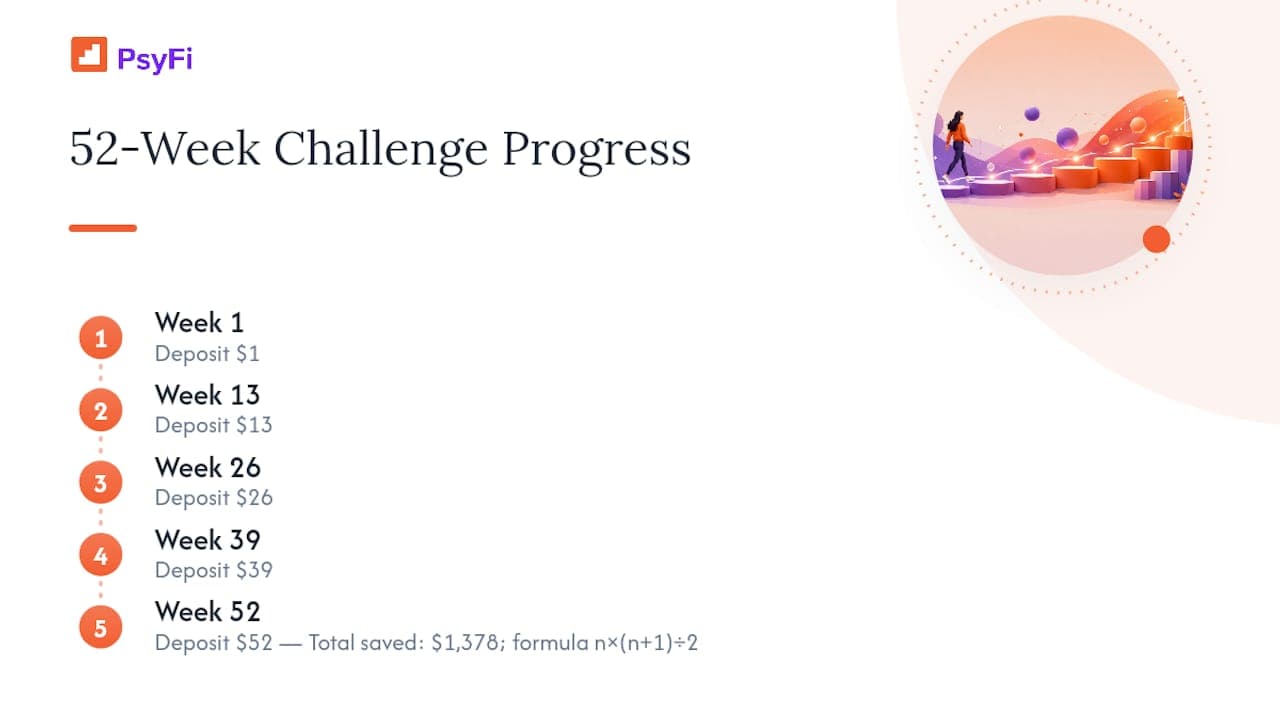
- Save $1,378 with a paycheck friendly 52 week savings challengeAlign the 52-week savings challenge with your pay cycle, automate your deposits, and use behavioral tactics to save $1,378 without the stress.
- Regain Financial Independence with 5 Steps to End Financial EnmeshmentFive research backed steps to end family financial enmeshment. Use exact boundary scripts, safety actions for abuse, and PsyFi habit tools to keep your...
- Open One Account Today: Beat the Ostrich Effect