
Save $1,378 with a paycheck friendly 52 week savings challenge
Align the 52-week savings challenge with your pay cycle, automate your deposits, and use behavioral tactics to save $1,378 without the stress.
Save $1 the first week, $2 the second, and by week 52 you’ll have $1,378. That’s the standard rule behind the 52 week savings challenge: increase your deposit by $1 each week for a year. Popular alternatives—reverse, flat weekly, and biweekly versions—produce the same total through a different rhythm, so you can match the challenge to your actual pay schedule instead of forcing your budget to match the challenge.
TL;DR:
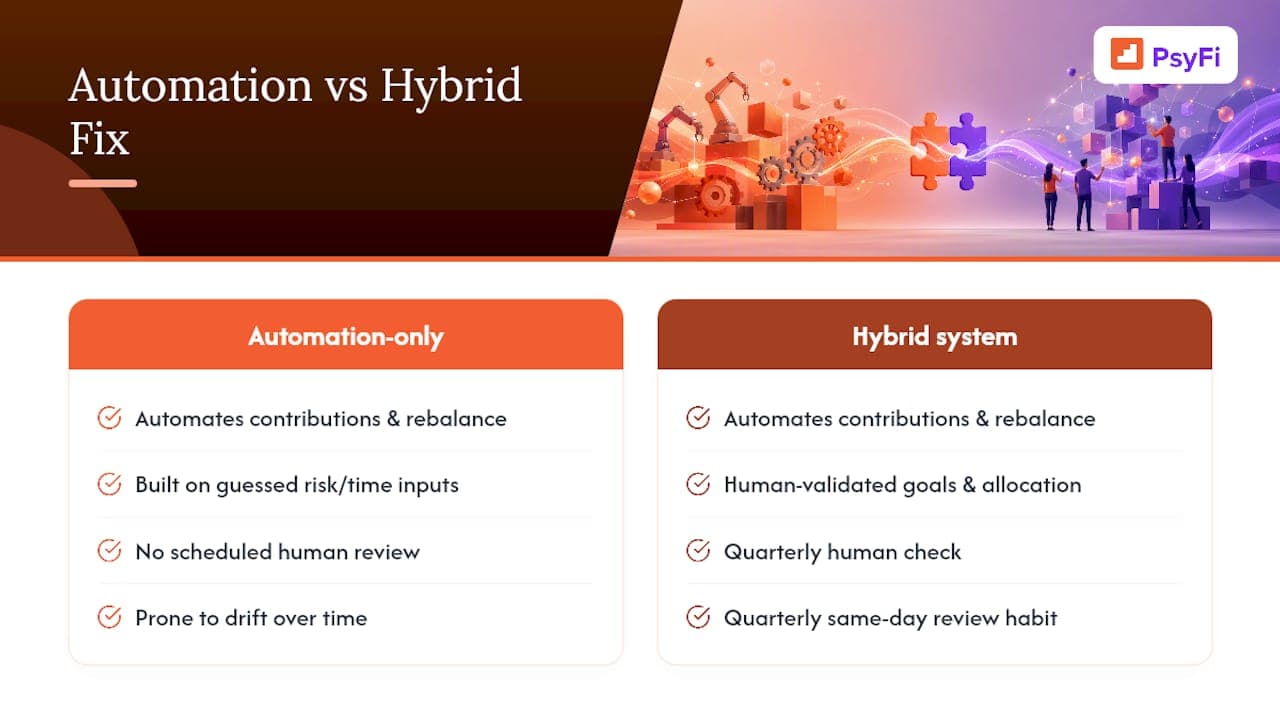
Using automation to deposit into a high-yield savings account weekly or biweekly significantly improves the chances of completing the challenge.
The total amount saved remains $1,378 regardless of the variation, but front-loading deposits during the reverse challenge can better match seasonal expenses.
Choosing a flat weekly deposit simplifies automation and reduces the risk of quitting due to behavioral tendencies like forgetfulness or loss aversion.
Keeping the savings in a dedicated, insured high-yield account generates extra interest, especially with an average balance near half the total savings.
Implementing behavioral tools like real-time coaching or routine attachment helps sustain the savings streak beyond just the math.
Table of Contents
What is the 52 week savings challenge and why does it total $1,378?
Which savings challenge variation actually fits your paycheque?
How do you automate and track the challenge without quitting?
The variation you pick matters less than the automation behind it
Let Psyfiapp keep the challenge running when willpower doesn’t
What is the 52 week savings challenge and why does it total $1,378?
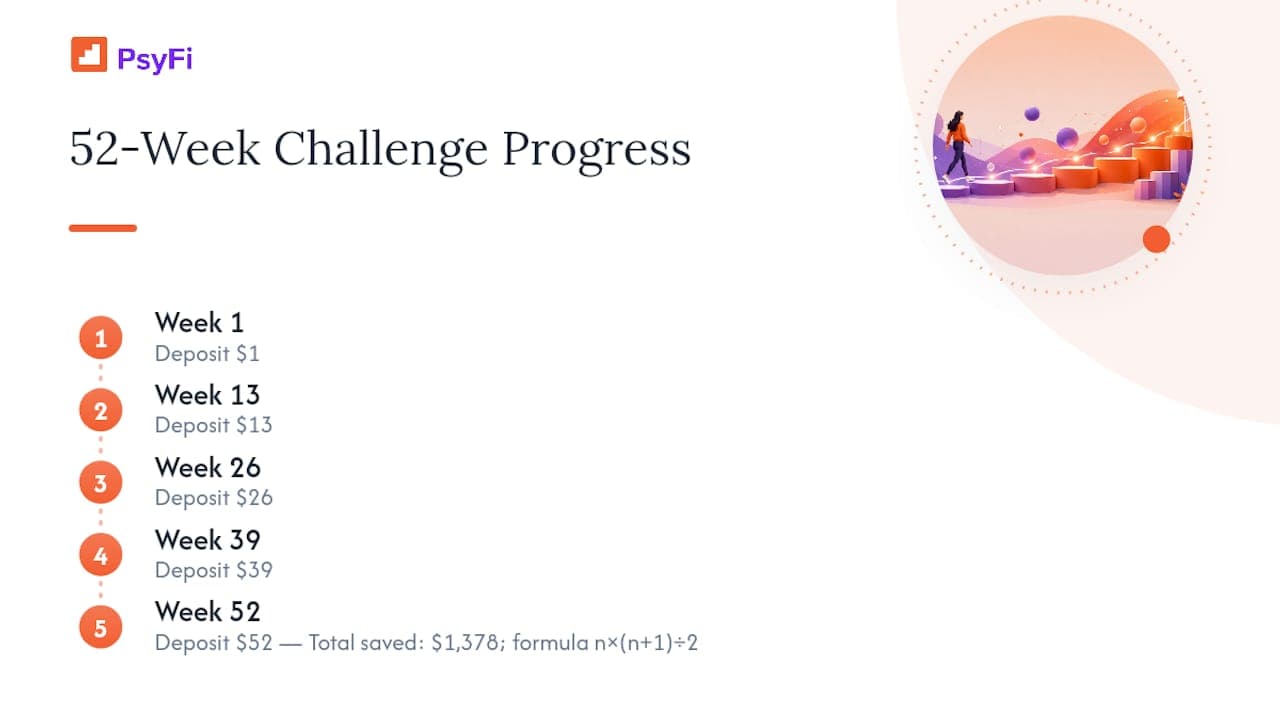
The math behind the 52 week savings challenge is arithmetic progression, the same principle that lets you add consecutive numbers without listing them all out. Week 1 you deposit $1, week 2 you deposit $2, and so on until week 52, when you deposit $52. Add every deposit together and you get $1,378, guaranteed, because the sequence is fixed from the start.
There’s a formula behind it, and it’s worth knowing because it lets you calculate any version of the challenge instantly. The sum-of-integers formula is n × (n+1) ÷ 2, where n is the number of weeks. Plug in 52: 52 × 53 ÷ 2 = 1,378. Change n to 26 for a biweekly version, or to any number of weeks left in the year if you’re starting late, and the same formula still works.
Milestones help you feel the progress instead of just trusting the math:
Notice how the growth curves upward. That back-loaded shape is exactly why so many people stall out in November, and it’s the reason the variations below exist.
Which savings challenge variation actually fits your paycheque?
The classic ascending version isn’t the only path to $1,378, and for a lot of people, it isn’t even the best one. Your income rhythm, whether you’re paid weekly, biweekly, or irregularly, should dictate which variation you pick, not the version that happens to go viral on social media each January.
Reverse 52-week challenge: start at $52 in week 1 and count down to $1 in week 52. The total stays identical at $1,378, but you front-load the biggest deposits while motivation and post-holiday budgets are still intact, then coast into December on smaller amounts instead of scrambling for $51 and $52 during gift season.
Flat weekly challenge: deposit a consistent $26.50 every week for 52 weeks. It’s the average of the ascending version, and it’s the easiest to automate since your bank transfer never has to change.
Biweekly or paycheque-based challenge: adapt the schedule to 26 pay periods instead of 52 weeks, doubling each scheduled amount so the totals still land near $1,378 by year-end.
Scaled or doubled challenge: multiply every weekly deposit by 2, 5, or 10 if your goal is bigger than $1,378, useful for a larger emergency fund or a specific purchase with a hard deadline.
None of these variations is objectively superior. The reverse method suits people who dread December spending; the flat method suits people who value one unchanging automation rule over any psychological framing at all.
How do you automate and track the challenge without quitting?
Manual tracking is where most 52 week savings challenge attempts die, not from lack of money but from lack of a system that runs without your weekly attention. Printable charts and calculators solve the visibility problem; automation solves the willpower problem. Use both.
Print or generate a tracking chart. A printable 52-week chart with checkboxes for each week turns an abstract goal into a visual habit loop, and most generators let you set a custom start date if you’re beginning mid-year.
Pick one automation recipe and stick with it. Set 52 individually scheduled transfers if your bank allows variable-amount recurring payments, or use the flat $26.50 average-week workaround if it doesn’t. Automating the deposit removes the weekly decision entirely, which is the single biggest predictor of finishing the challenge.
Separate the money the moment it lands. Route transfers into a dedicated savings bucket, not your everyday chequing account, so the balance never feels like spare spending cash.
Attach the deposit to an existing routine. Payday, Sunday meal prep, whatever already happens weekly, so the transfer becomes background behaviour instead of a task you can forget.
Pro Tip: Set your automated transfer for the morning after payday rather than the day of. Money that’s still sitting in chequing on payday evening gets spent; money that’s already moved by breakfast never had the chance.
Where should you keep 52 week savings challenge money?
Keep challenge funds out of your everyday chequing account, full stop. A dedicated high-yield savings account (HYSA) does two jobs at once: it removes the temptation of an easily accessible balance, and it earns meaningfully more interest than a standard account sitting at near-zero APY.
Confirm the institution is FDIC-insured if it’s a bank, or NCUA-insured if it’s a credit union, so your deposit is protected regardless of what happens to the institution itself.
Compare current HYSA rates before you open the account. A rate-comparison resource can save you the legwork of checking a dozen bank sites individually.
Because the ascending challenge builds gradually, your average balance across the year runs close to half the final total, roughly $689 rather than $1,378. At a competitive HYSA rate, that average balance can generate a modest but real interest bonus on top of your $1,378 principal, money you’d never see in a standard chequing account.
What should you do with the money once the challenge ends?
Finishing the 52 week savings challenge feels good, but $1,378 sitting idle isn’t the finish line, it’s a decision point. Where that money goes next depends on your existing debt and how thin your emergency fund is.
If you carry high-interest debt (credit cards especially), put the challenge money toward the smallest balance first to build payoff momentum.
If you have no emergency cushion, move the full $1,378 into a dedicated emergency fund before it touches anything else.
If both of those are already covered, roll it into a longer-term investing plan or start a second, scaled-up challenge immediately.
Whatever you choose, automate the next step the same week you finish. A completed challenge with no follow-up plan tends to get spent within a month.
Why behavioural tactics matter more than the spreadsheet
The math behind the 52 week savings challenge is trivial. Sticking with it for 52 straight weeks is the actual challenge, and that’s a behavioural problem, not an arithmetic one. Present bias, our tendency to value today’s $52 latte over a distant, abstract savings goal, is the real reason people abandon week 40.
Small, boring commitments beat big, dramatic ones. Starting with a flat weekly amount you can’t fail to meet builds a streak, and streaks create their own momentum through loss aversion: once you’ve hit 20 weeks in a row, missing week 21 suddenly feels like losing something you already own, not just skipping a task. Habit stacking, attaching the deposit to something you already do every week, removes the need for willpower altogether.
This is where budget tracking as a daily micro-habit pays off, and it’s exactly the gap Psyfiapp’s AI coaching is built to close.
Useful tools to start this week
Model your own numbers with a savings goal calculator before committing to an amount. Confirm deposit safety on the FDIC rates page, and if you want your challenge paired with a broader spending check, pair impulse-control tactics from apps built to stop impulse spending with your weekly transfer routine.
The variation you pick matters less than the automation behind it
Most advice on this challenge obsesses over which chart to print, ascending or reverse, when the actual research points somewhere else entirely: completion rates hinge on whether the deposit happens automatically or depends on you remembering. The flat $26.50 version gets dismissed as boring compared to the viral ascending chart, but boring is precisely what survives December.
Where conventional advice falls short is treating the 52 week savings challenge as a one-size-fits-all ritual instead of a framework you bend to your actual pay cycle. Someone paid biweekly forcing themselves into a weekly chart is fighting their own calendar for no reason. Someone who dreads holiday spending sticking with the ascending version instead of flipping it in reverse is choosing tradition over their own psychology.
If you take one thing from this: automate first, pick the variation second. The math guarantees $1,378 no matter which version you run. Your actual outcome depends entirely on whether the deposit happens without you having to decide, every single week, to make it happen.
Let Psyfiapp keep the challenge running when willpower doesn’t
A printable chart and a scheduled transfer will get most people through the 52 week savings challenge. But the weeks that actually break people, the ones right after a big expense or a rough payday, need something a static chart can’t provide: a system that notices when you’re about to slip and adjusts before you quit entirely. That’s the specific gap Psyfiapp’s AI engine is built to close, using your real transaction data instead of generic weekly reminders.
Psyfiapp links to your accounts and identifies the exact behavioural pattern most likely to derail your streak, whether that’s a spending spike the week before payday or a habit of skipping transfers after a low-balance scare. From there, it delivers real-time coaching tuned to your actual habits, not a one-size-fits-all savings script. Start by checking your Financial Wellness Score to see how your current habits stack up, then explore Meet FY, Psyfiapp’s AI coaching agent, for automated nudges that carry your 52 week challenge all the way to week 52.
Sources
Recommended
Keep reading
- Open One Account Today: Beat the Ostrich EffectResearch backed, low friction ritual to stop avoiding bills and accounts. Check one account today: do a two minute reflection, note four headline numbers,...

- One Week Test: Spending Plan vs Budget That Lowers Cognitive LoadStruggling to stick to a rigid budget? Run a one-week test comparing a line-item budget with a forward-looking spending plan to find the approach that lowers cognitive load and fits your actual habits.