
Write One Goal and Date to Build a Personalized Investing Plan
Turn one written goal into a personalized investing plan. Learn life stage allocations, tax smart account choices, and simple behavioral rules to stay on...
A personalized investing plan is a written map connecting your specific goals, timeline, and risk tolerance to a concrete mix of accounts and investments. It replaces generic advice with rules built around your actual life. The single best move you can make right now: write down one goal, its dollar amount, and the date you need it by. Everything else, from allocation to rebalancing, follows from that.
TL;DR:
A personalized investing plan links your specific goals, timeline, and risk comfort to a tailored asset allocation and account strategy, rather than relying on generic advice.
Building a plan requires assessing finances, defining measurable goals, mapping time horizons, and applying tax-aware account choices, followed by automation and regular reviews.
Asset allocations should adjust by life stage, with higher equities in early careers and more conservative mixes closer to retirement, tailored to your emotional tolerance and capacity.
Holding tax-inefficient assets in tax-advantaged accounts and tax-efficient assets in taxable accounts enhances returns, constrained by IRS contribution limits for 401(k)s and IRAs.
Automated contributions, fixed rebalancing rules, and regular check-ins help maintain discipline, while real-time behavioral coaching addresses biases and changing circumstances.
Psyfiapp
Build a Plan Around Your Behaviors
PsyFi analyzes your financial behaviors to create personalized saving and investing plans with real-time coaching based on your actual data.
Table of Contents
How do you create a personalized investing plan step by step?
How do you monitor and stay disciplined once the plan is running?
How does Psyfiapp put a personalized investing plan into action?
What is a personalized investing plan and why does it work?
A personalized investing plan is not a portfolio recommendation you get once and forget. It is a working document that ties your money decisions to six things: your goals, your time horizon for each one, your risk tolerance, your asset allocation, the accounts you use, and the rules that tell you when to check in.
Most people invest reactively. They open a brokerage account, pick a few funds that seem reasonable, and adjust only when the market scares them. That approach fails for a predictable reason: without a documented plan, every market drop becomes a referendum on whether to keep going. A written investment policy statement, even a short one, gives you something to consult instead of your emotions when a portfolio drops 15% in a month.
The core components of a solid plan include:
Goals with dates and dollar figures — “retire comfortably” isn’t a goal; “$1.2 million by age 62” is.
Time horizon per goal — a down payment in three years and retirement in thirty years demand completely different allocations.
Risk tolerance and risk capacity — how much volatility you can stomach emotionally versus what your finances can actually absorb.
Asset allocation — the specific split between stocks, bonds, and cash that matches each goal.
Account selection — where you hold the investments matters almost as much as what you hold.
Monitoring rules — a fixed schedule for checking progress, not a constant one.
Life-cycle and glide-path frameworks, like the one Vanguard uses in its Life-Cycle Investing Model, formalize this idea. They combine your goals, projected returns, and personal circumstances to solve for an allocation path that shifts as you age, rather than locking you into one fixed mix for decades.
How do you create a personalized investing plan step by step?
Building a customized investment strategy follows a logical sequence. Skip a step and the whole plan gets shakier.
Assess your finances first. Confirm you have an emergency fund covering three to six months of expenses, list any high-interest debt, and calculate your actual investable surplus after both are accounted for. Investing before this step means you’re building on sand.
Define your goals with amounts and dates. “Save for retirement” becomes “$1.5 million by 2056.” Rank goals by urgency and importance, because you likely can’t fund all of them at once.
Map time horizons and decide a funding order. A goal five years out and one thirty years out cannot share the same allocation logic. Fund shorter-term goals more conservatively regardless of how aggressive you feel about the long-term ones.
Measure risk tolerance and risk capacity separately. Risk tolerance is your emotional comfort with seeing your balance drop; risk capacity is whether your income, timeline, and other assets can actually absorb that drop. A 28-year-old with stable income and no dependents has high capacity even if their tolerance feels shaky.
Translate all of this into an asset allocation for each goal, then look at your aggregate household allocation across every account combined, not each account in isolation.
Choose accounts and apply tax-aware asset location, covered in more detail below.
Implement with a funding schedule. Decide whether you’re investing a lump sum or spreading contributions through dollar-cost averaging, and set up automatic transfers so the decision doesn’t need to be remade monthly.
Document your plan as a simple IPS and set a review date. This closes the loop and gives you a fixed point to return to instead of improvising.
This sequence mirrors the five-step process that shows up consistently across serious financial planning guidance: assess, define, determine horizon, evaluate risk, decide allocation.
Pro Tip: Use a savings goal calculator to turn a vague target like “$50,000 for a house” into a required monthly contribution. Seeing the exact number, not the round target, is what actually gets people to automate their transfers.
How should asset allocation change by life stage?
Risk tolerance and risk capacity often diverge, and that gap is where personalization actually matters. A 55-year-old who just inherited money and has no debt might have low emotional tolerance for market swings but very high financial capacity to absorb them. A 30-year-old living paycheque to paycheque might feel comfortable with aggressive investing but has almost no capacity to handle a job loss combined with a market drop.
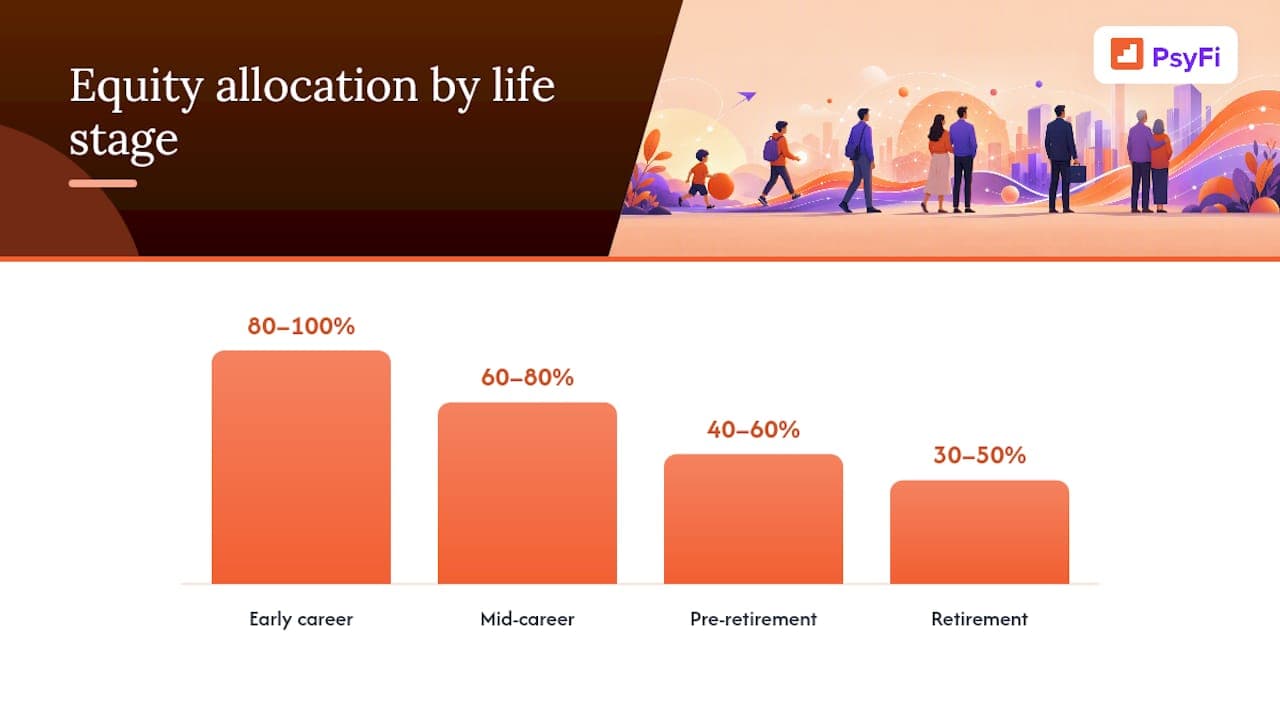
Broad allocation ranges by life stage typically look like this:
Early career (20s to mid-30s): 80 to 100% equities is common, since decades of time horizon can absorb volatility and human capital (future earnings) acts as a bond-like buffer.
Mid-career (mid-30s to early 50s): 60 to 80% equities, tapering as time horizon shortens and liabilities like mortgages or education costs increase.
Pre-retirement (50s to early 60s): 40 to 60% equities, with a growing focus on sequence-of-returns risk, the danger of a market downturn hitting right before you need to draw down.
Retirement: 30 to 50% equities, often held in a bucket structure that separates near-term spending needs from longer-term growth assets.
These are heuristics, not prescriptions. Vanguard’s research shows that off-the-shelf target-date approaches serve the average investor reasonably well, but customized glide paths deliver the most measurable benefit to people whose circumstances aren’t average: unusually high savers, those planning early retirement, or anyone carrying atypical liabilities like a pension obligation or a business sale on the horizon. If your life looks like the actuarial average, a standard target-date fund is a fine, low-effort answer. If it doesn’t, a personalized glide path earns its complexity.
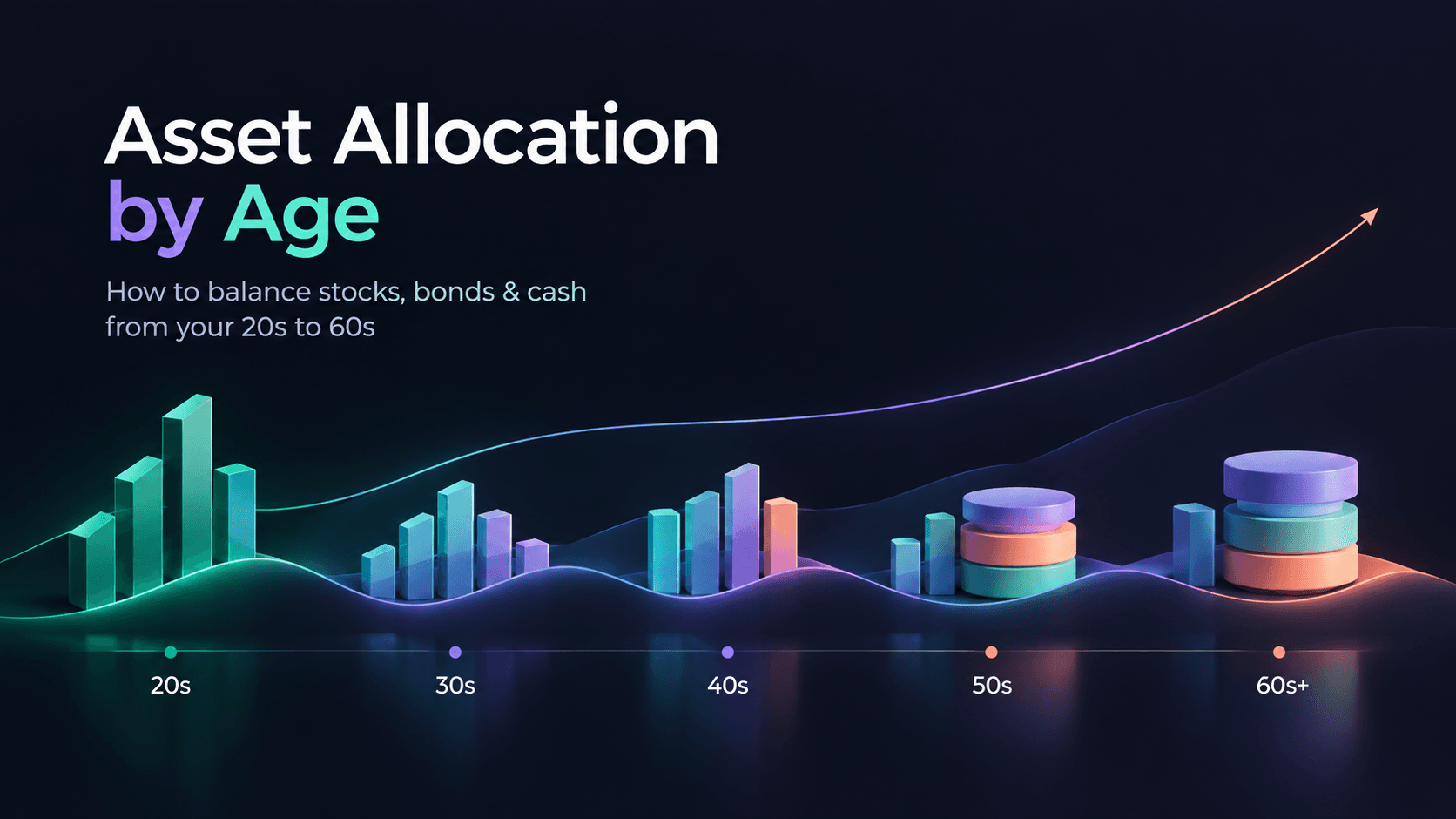
A practical heuristic: tilt more aggressive when your human capital (stable, growing income) is high relative to your portfolio size, and tilt more conservative as your portfolio grows large enough that a bad year would meaningfully delay your goal. For more on how this plays out by decade, see how to balance your portfolio from your 20s through your 60s.
Which accounts should you use for a tax-aware plan?
Where you hold an investment can matter as much as what you hold, because taxes quietly erode returns if asset location is careless.
401(k) or employer plan: pretax contributions, tax-deferred growth, often with an employer match worth capturing in full before investing elsewhere.
IRA (Traditional or Roth): similar tax treatment to a 401(k) but with more investment choice; Roth contributions grow entirely tax-free in retirement.
HSA: triple tax advantage, deductible in, tax-free growth, tax-free withdrawal for medical costs, making it one of the most efficient accounts available if you have access to one.
Taxable brokerage account: no contribution limits or withdrawal restrictions, but dividends and capital gains are taxed as they occur.
529 plan: tax-free growth for qualified education expenses, useful for a specific, dated goal like a child’s tuition.
The basic asset location rule of thumb: hold tax-inefficient assets, like bonds generating regular interest income or actively traded funds throwing off short-term gains, inside tax-advantaged accounts. Hold tax-efficient assets, like broad index funds, in taxable accounts where possible.
IRS contribution limits shape how much of this strategy you can actually execute; the 2025 401(k) employee contribution limit sits at $23,500, while the IRA limit remains $7,000. Before opening any account, check the broker or platform against a simple checklist: is it registered with regulators you can verify, what are the fees, does it offer the asset classes your plan requires, and are there minimums that block you from starting. FINRA provides free tools to check broker and adviser registration before you commit any money.
How do you monitor and stay disciplined once the plan is running?
A plan without a review schedule quietly decays. The most efficient approach for most investors is a hybrid: check your allocation once a year on a fixed date, and rebalance in between only if an asset class drifts more than about five percentage points from its target. Vanguard’s research points to annual rebalancing as an effective default, with threshold triggers as an efficient complement rather than a replacement.
Measure progress against your original goal, not against the market’s daily noise. When a goal falls behind, adjust the contribution first and the allocation second; increasing your monthly transfer is usually a smaller behavioural lift than taking on more risk.
A few behavioural safeguards make the difference between a plan you follow and one you abandon:
Automate contributions so investing doesn’t depend on a decision you have to remake every month.
Pre-commit to rebalancing rules before a downturn happens, not during one.
Use a checklist for your annual review instead of an open-ended “how are things going” conversation with yourself.
Set an alarm rule, a specific market drop percentage that triggers a plan review rather than a panic sale.
Pro Tip: Write your rebalancing threshold into your plan document itself, not just your head. When the market drops 20%, the version of you making decisions is not as rational as the version who wrote the rule. For a deeper look at cadence, see how often you should rebalance a portfolio.
Consult an advisor when life gets genuinely complicated: a business sale, an inheritance, a divorce, or a tax situation involving multiple states or countries. A multilevel approach to lifetime financial advice that accounts for human capital, liabilities, and insurance needs is genuinely hard to do alone once those variables multiply.
How does Psyfiapp put a personalized investing plan into action?
Most people don’t fail at planning because they lack information. They fail because nobody flags the moment they’re about to skip a contribution or panic-sell during a downturn. An AI engine links your accounts and analyzes your actual financial behaviour, not a generic risk questionnaire, to spot the patterns and biases working against your plan.
That behavioural focus is the core difference from a static financial plan sitting in a drawer. Real-time coaching adapts as your income, spending, and habits change, rather than waiting for an annual review to catch a problem that’s been building for months.
In practice, the flow looks like:
Take a quick assessment to establish your starting financial wellness score.
Link your accounts so the engine can see real spending and saving patterns, not self-reported guesses.
Set a specific goal, translated into a required savings rate through a calculator.
Receive nudges when your behaviour drifts, whether that’s a missed contribution or a rebalancing trigger worth acting on.
Getting your priorities straight before your allocation
The biggest mistake I see isn’t a bad asset allocation. It’s skipping the documentation step entirely and expecting willpower to substitute for a written rule. The two highest-impact fixes are ridiculously simple: write down one specific goal with a date, and automate the contribution before you ever touch the allocation question. Everything downstream gets easier once those two things exist on paper.
— Maanya
Start building your plan with Psyfiapp’s tools
This service helps you get from “I should probably start investing” to an actual working plan faster than sorting through a static risk questionnaire and a spreadsheet on your own. Instead of generic advice, the AI engine watches your real account activity and adjusts its coaching as your situation changes.
Three steps get you started today. Take the Financial Literacy Quiz to see where your knowledge gaps sit, link your accounts so Psyfiapp can generate your Financial Wellness Score, and set your first goal using the savings goal calculator to see exactly what monthly contribution gets you there. Start your free trial at Psyfiapp and turn today’s goal into tomorrow’s habit.
This article is general information, not a substitute for advice from a qualified financial advisor. Consult a qualified financial professional about your own circumstances before acting on anything here.
Sources
IRS: 401(k) limit increases to $23,500 for 2025; IRA limit remains $7,000
Investingoal: Investment plan: What it is and how to create one step by step
Recommended
This content is provided for general informational and educational purposes only and does not constitute financial, investment, tax, or legal advice. PsyFi provides financial coaching tools and behavioral insights, not regulated advisory services. Always consult with a qualified financial advisor or tax professional regarding your personal situation before making financial decisions.
Keep reading
- Net Worth by Age: What’s Typical and How to Use ItSee median and average U.S. net worth by age from the Federal Reserve, why the two differ, and how to track your own number without shame or stress.

- Asset Allocation by Age: Balance Your Portfolio 20s to 60sStruggling to figure out your ideal stock-to-bond ratio? Discover decade-by-decade asset allocation frameworks, overcome the psychological barriers behind rebalancing, and build a portfolio tailored to your stage in life.