

Stop Drift: Rebalancing Plan for Most Investors, Annual or Semiannual
By Maanya Nagpal
Pick a rebalance schedule you’ll actually follow: annual or semiannual reviews for most investors, add a 5% or 200/175 threshold for larger accounts, and...
For most self-directed investors, an annual or semi-annual calendar review, supplemented by a tolerance band when your portfolio grows large, is the simplest, most cost-effective rebalance portfolio schedule. It keeps transaction costs and taxes low while avoiding the behavioural traps of reacting to every market swing. Larger or more actively managed accounts benefit from adding threshold triggers on top of that calendar review.
TL;DR:
Calendar-based rebalancing is best for small portfolios with predictable cash flows, while threshold or hybrid methods suit larger, more complex accounts.
Avoid rebalancing in taxable accounts unless necessary by directing contributions and dividends toward underweighted assets first to minimize taxes.
Using a 200/175 threshold policy reduces costs and drift for larger portfolios, with monthly or quarterly checks aligned to account size and activity.
Automating contributions, dividends, and drift alerts increases adherence and helps overcome behavioral biases like loss aversion and present bias.
Regular review every six to 12 months, combined with proper tax and cost considerations, ensures effective, disciplined portfolio rebalancing.
Psyfiapp
Make Your Portfolio Plan Personal
PsyFi analyzes your financial behavior to create personalized saving and investing plans with tailored, actionable insights.
Table of Contents
What rebalancing does and why drift changes your risk
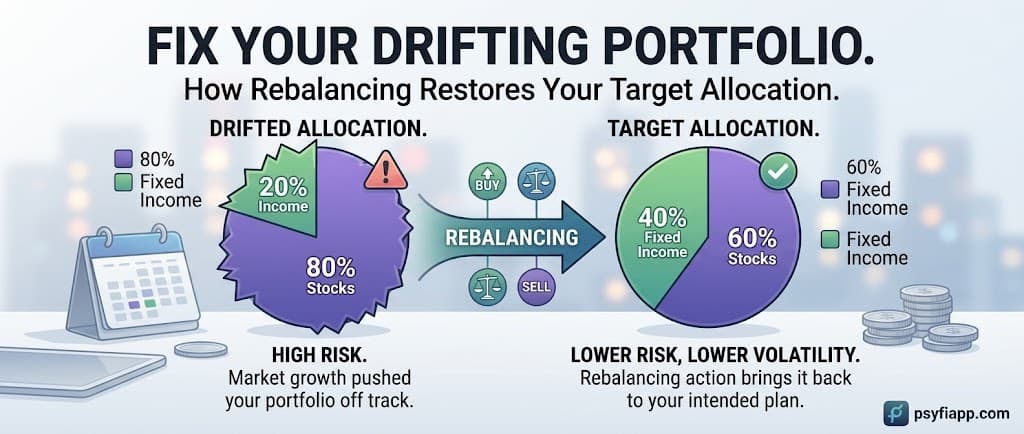
Rebalancing means selling assets that have grown past their target weight and buying ones that have fallen below it, restoring your original mix. Left alone, a portfolio drifts: winners grow into an outsized share of your holdings, and that shift quietly changes how much risk you’re carrying, often without you noticing until a downturn hits harder than expected.
This is why rebalancing forces a version of “buy low, sell high” instead of the emotional instinct to chase whatever has been performing well. Consider a 60/40 stock and bond portfolio during a strong equity run. If stocks gain sharply while bonds lag, that 60/40 split can quietly become 80/20 within a few years, with no new contributions needed to get there.
An 80/20 mix carries meaningfully more volatility than 60/40, even though nothing was “decided.”
A market correction from that drifted position causes far more damage than the same drop would have at your original target.
Reviewing your asset allocation by age periodically catches this kind of silent drift before it becomes a problem.
Calendar, threshold, and hybrid methods compared
Calendar-based rebalancing sets a fixed date, monthly, quarterly, or annually, and rebalances regardless of how far your allocation has drifted. It’s operationally simple: you know exactly when you’ll act, which suits investors with predictable paycheque-driven contributions.
Threshold-based rebalancing instead waits for your allocation to drift past a set tolerance band, often expressed in percentage points, before triggering a trade. A common example is a small tolerance band around your target, though sophisticated policies use relative bands.
Vanguard’s research on target-date funds found that a 200/175 threshold policy, rebalancing when an asset class hits 200% or drops to 175% of its target weight, reduced both transaction costs and allocation deviation compared with frequent monthly or quarterly calendar rules.
Pro Tip: A hybrid approach, reviewing on a fixed calendar date but only trading if a threshold is breached, gives you the discipline of a schedule with the precision of a tolerance rule.
Calendar rules: simple, predictable, easy to automate around contribution dates.
Threshold rules: fewer unnecessary trades, better tracking of your actual target, more monitoring required.
Hybrid rules: check on schedule, act only when drift crosses your line.
Vanguard’s own guidance frames calendar and threshold approaches as the two dominant retail methods, and its central advice is blunt: pick one you’ll actually stick to.
How do I choose the right schedule for my portfolio?
Your ideal cadence depends on five factors: portfolio size, trading costs, whether your accounts are taxable, how much time you have to monitor, and how often new money flows in. A $15,000 account in a single index fund doesn’t need the same attention as a $500,000 portfolio spread across a dozen taxable and tax-advantaged accounts.
Small, simple portfolios: a review once or twice a year is generally sufficient, as trading costs and tax implications often outweigh any benefit from more frequent action.
Mid-size portfolios with regular contributions: semi-annual review plus a modest 5% tolerance band lets new cash flows do most of the rebalancing work between checks.
Larger, more complex portfolios: adopt a threshold rule, such as the 200/175 parameter, and check drift monthly or quarterly without necessarily trading each time.
The SEC’s investor guidance confirms there’s no single mandated frequency. Instead, it recommends reviewing your portfolio every six to 12 months and letting your available time, costs, and drift tolerance decide the exact rhythm.
Pro Tip: Write your chosen schedule and tolerance band into a one-page plan and store it where you’ll see it. A documented rule is far easier to follow than a vague intention to “check in sometime.”
Tax and cost rules that should shape your timing
Every sale inside a taxable account triggers a taxable event, and how long you’ve held the position determines whether you pay short-term or long-term capital gains rates. Selling a winner you’ve held less than a year, just to rebalance, can push a gain into the higher short-term bracket unnecessarily.
Two additional traps deserve attention. First, the wash-sale rule disallows a tax loss if you buy a substantially identical security within 30 days of selling at a loss, which matters if you’re harvesting losses in one account while automatically reinvesting dividends in a similar fund elsewhere. Second, specific-lot selection lets you choose which shares to sell, often the highest-cost-basis lots, to minimize the taxable gain.
A practical, tax-first order of operations avoids most of this friction entirely:
Direct new contributions and dividends toward underweighted assets before selling anything.
Rebalance inside 401(k)s, IRAs, or other tax-advantaged accounts first, since trades there carry no immediate tax bill.
Only sell in taxable accounts as a last resort, using tax-loss harvesting or long-held lots to soften the impact.
When trading costs or a looming short-term gain outweigh the benefit of correcting a modest drift, it’s often smarter to delay the rebalance a few months than to force it on a fixed date.
A checklist and three schedules you can copy
Running a rebalancing event doesn’t need to be complicated once you have a routine. Follow the same five steps every time: review your current allocation against targets, check tax-lot holding periods before selling anything, use new cash flows and dividends to correct drift first, place any remaining trades needed, and record what you did and why.
Three template schedules cover most situations:
Conservative annual: review once a year, rebalance only if any asset class has drifted more than a few percentage points from target.
Disciplined semi-annual with a 5% band: check every six months, trade whenever drift exceeds a 5-percentage-point tolerance.
Active threshold for larger portfolios: monitor monthly or quarterly, trade only when the 200/175 rule triggers, per Vanguard’s threshold research.
Pro Tip: Automate what you can: route new contributions to underweighted funds by default, direct dividends toward laggards, and use a portfolio management tool or your broker’s alert feature to flag drift so you’re not manually checking balances every week.
Behavioural tactics to actually stick to your schedule
Knowing your ideal rebalance portfolio schedule and following it are two different problems. Loss aversion makes selling a winner feel wrong even when it’s the correct move, and present bias makes “I’ll check next month” an easy lie to tell yourself repeatedly.
Simple commitment devices close that gap. A calendar reminder tied to a fixed date, a micro-goal like “check drift on the first Saturday of January and July,” or an automated contribution-routing rule all remove the moment-to-moment decision. Behavioural nudges and light automation are often the actual deciding factor in whether an investor keeps a schedule at all, not the sophistication of the rule itself.
— Maanya
Tools that help you follow through on the plan
Choosing between an annual review and a 200/175 threshold rule is the easy part. The harder part is remembering to act, six months from now, when markets are calm and there’s no obvious trigger. That’s the gap Psyfiapp is built to close: it pairs behavioural coaching with real account data so your rebalancing plan doesn’t quietly slip.
Psyfiapp’s Financial Wellness Score gives you a baseline read on your habits, including how consistently you follow through on financial plans, so you can see where drift tends to creep in. Apps that link your accounts, track your contribution patterns, and send real-time nudges timed to your chosen schedule rather than generic reminders can help. If you’re still working out your target mix, the free US finance calculators can help you model contribution routing before you commit to a written plan. Start by exploring financial wellness tools to help you set your first rebalancing reminder.
Where to read more
Asset allocation and rebalancing guidance, U.S. Securities and Exchange Commission
Rebalancing for taxable accounts, Financial Planning Association
Tax implications of portfolio rebalancing, LegalClarity
This article is general information, not a substitute for advice from a qualified financial advisor. Consult a qualified financial professional about your own circumstances before acting on anything here.
Sources
Asset allocation and rebalancing guidance | U.S. Securities and Exchange Commission
Rebalancing for taxable accounts | Financial Planning Association
What are the tax implications of portfolio rebalancing? | LegalClarity
FAQ
How often should a portfolio be rebalanced?
Most investors do well reviewing their portfolio every six to 12 months, a range the SEC itself points to, adjusting frequency based on cost, time, and how much drift they can tolerate.
What is the 5/25 rule for rebalancing?
It’s a common tolerance-band guideline where you rebalance an asset class if it drifts by 5 absolute percentage points, or by 25% of its own target weight for smaller allocations, whichever threshold makes sense for that position.
How should I rebalance my portfolio right now?
Start by comparing your current weights to your written targets, direct any new contributions toward underweighted assets first, and only sell in a taxable account if cash flows can’t close the gap on their own.
Do I pay taxes when I rebalance my portfolio?
Yes, in a taxable account, every sale that produces a gain is a taxable event, with the rate depending on how long you held the position; rebalancing inside tax-advantaged accounts like IRAs avoids this entirely.
Recommended
This content is provided for general informational and educational purposes only and does not constitute financial, investment, tax, or legal advice. PsyFi provides financial coaching tools and behavioral insights, not regulated advisory services. Always consult with a qualified financial advisor or tax professional regarding your personal situation before making financial decisions.
Keep reading
- Cut Slip Ups by 40%: Behavior First Investing Strategy AutomationMake automated investing stick. Use recurring transfers, auto-rebalancing, and behavior-first nudges plus a practical quarterly check to keep...
- Will You Sell in a Crash? Assess Risk Tolerance With 3 Goal ChecksDiscover if your asset allocation will survive a market crash by combining the sleep test, a risk quiz, and goal-specific stress testing.