
401(k) Contribution Strategy: Aim for 10 to 15% in 2026 with Nudges
U.S. 2026 401(k) strategy: capture your employer match, aim 10 to 15% of pay, use payroll-ready behavioral nudges, and model outcomes with PsyFi's free...
Contribute at least enough to capture your full employer match, then work toward 10 to 15% of your pay as a mid-career target, with 15%+ as an aggressive goal. The 2026 elective deferral limit is $24,500, with an $8,000 catch-up for savers 50 and older. If you want to model your own numbers before touching payroll, PsyFi’s free 401(k) calculator does the math for you in a few minutes.
TL;DR:
Prioritize capturing your full employer match before increasing your contribution rate toward the recommended 15% of income.
Aim for a gradual increase in your deferral percentage, especially with auto-increases enabled, to avoid budget shocks over time.
Keep track of IRS limits for 2026, including the $24,500 standard deferral ceiling and the $8,000 or $11,250 catch-up contributions based on age.
Confirm your employer’s match formula and vesting schedule to ensure all employer contributions are fully credited and accessible.
Model your contribution scenarios using free tools like PsyFi’s calculator to project the impact of increases and stay aligned with your retirement goals.
Table of Contents
Setting your 401k contribution strategy: benchmarks that actually work
Employer match and prioritization: the step that moves the needle
Practical tactics: auto-increase, payroll timing, and percent steps
How contributions interact with investment choice and rebalancing
Considerations for handling 401(k) contributions when changing jobs
Penalties and access: what a higher contribution rate really costs you
Setting your 401k contribution strategy: benchmarks that actually work
Every workable 401k contribution strategy follows the same sequence: capture the match first, raise your rate gradually, then aim for the 15% zone that most planning guidance treats as a durable retirement target. The order matters more than the speed. Skipping straight to an aggressive number without first locking in the match leaves free money on the table, and that’s the one mistake with no upside.
Contribution habits tend to fall into three rough brackets, and where you land usually depends on career stage more than income:
Starters (20s, early career): 5 to 8% of salary, often matching whatever gets the full employer contribution, with plans to raise the rate every year.
Mid-career (30s to 40s): 10 to 15% total, combining employee deferral and employer match, often paired with a Roth IRA if income allows.
Aggressive savers (late starters, high earners, or anyone chasing catch-up): 15% or more of salary, sometimes pushing toward the IRS elective deferral ceiling.
Employer contributions change your effective savings rate in ways that are easy to underestimate. If you defer 6% of pay and your employer matches 3%, you’re actually banking 9% of your salary every pay period, even though your paycheque only shows the 6% coming out. That gap between what you feel and what’s actually accumulating is worth remembering when you’re deciding whether you can “afford” to bump your rate.
Fidelity’s widely cited guideline suggests aiming for about 15% of pre-tax income, including whatever your employer kicks in, as a long-term target for most workers. Treat that as a horizon to grow into, not a number you need to hit in year one.
Before your next pay cycle, check these against your plan:
Your current deferral percentage in the payroll portal.
Whether your plan offers Roth 401(k) deferrals alongside traditional.
Your employer’s match formula and whether you’re capturing all of it.
Whether auto-increase is available and switched on.
IRS limits and catch-up rules for 2026 (what you must know)
The 2026 elective deferral limit for 401(k) plans is $24,500, up from prior years under routine cost-of-living adjustments. Workers aged 50 or older can add a standard catch-up contribution of $8,000, and a newer rule under SECURE 2.0 gives savers aged 60 to 63 a higher catch-up ceiling of $11,250 instead of the standard amount.
Those figures apply to elective deferrals, the money you personally choose to have withheld from each paycheque. A separate, larger number governs the total that can land in your account across all sources.
Statistic callout: The 2026 annual additions cap sits at $72,000, covering your deferrals, your employer’s match, and any other contributions combined. Compensation used to calculate contributions is capped at $360,000, which matters mainly for higher earners whose employer match formula is a percentage of pay.
The distinction trips people up because the deferral limit and the annual additions limit sound interchangeable but aren’t. You could theoretically defer the full $24,500 and still have room under the $72,000 ceiling for employer contributions, profit sharing, or after-tax additions, depending on what your specific plan allows.
A few practical checks worth running before year-end:
If you switched jobs mid-year, add up deferrals across both employers. The IRS limit applies to you as an individual, not per plan, and it’s easy to accidentally overcontribute.
If you catch an excess deferral early, most plans can correct it before the tax filing deadline without a penalty.
If Roth deferrals are available, splitting your contribution between traditional and Roth can preserve flexibility in retirement rather than betting everything on one tax treatment.
Employer match and prioritization: the step that moves the needle
Nothing else in your 401k contribution strategy pays off as fast as the employer match. Capturing the full match is often described as the single highest-return move available to any plan participant, because it functions as an instant return on your own money before markets even factor in.
Here’s what that looks like in practice. Say your employer matches 50 cents on the dollar up to 6% of pay. Defer the full 6%, and your employer adds 3%, for a combined 9% going into your account.
Three steps to lock this in this month:
Confirm the exact match formula in your plan’s summary plan description or HR portal, not from memory or a coworker’s guess.
Check the vesting schedule. An unvested match isn’t guaranteed if you leave the company before it fully vests, which changes how much you should factor it into short-term planning.
Adjust your deferral rate through payroll if you’re currently contributing below the match threshold.
Once the match is secured, the next dollar’s destination becomes a real question. If your plan’s investment lineup is thin or fee-heavy, and you have access to an HSA or IRA, splitting further contributions toward those accounts can make sense before piling more into the 401(k) beyond the match.
Pro Tip: Pull up your plan document or HR portal today and search for “match” and “vesting.” Most people have never actually read the two paragraphs that determine whether their employer’s money is really theirs.
Practical tactics: auto-increase, payroll timing, and percent steps
Raising your contribution rate doesn’t have to feel like a budget cut if you time it right. Auto-increase features, where your deferral rate climbs automatically each year, are consistently recommended because they raise savings rates without requiring you to notice the difference in your take-home pay. A common approach is bumping your rate by one percentage point annually, or timing the increase to land the same week as your annual raise.
A few tactics worth building into your routine:
Choose percent-based deferrals over flat dollar amounts if your pay fluctuates with overtime or commissions, since a percentage scales automatically with your income.
Use dollar-based elections for irregular pay, such as bonuses, if your plan allows a separate election for bonus checks so you’re not caught off guard by a large pre-tax deduction.
Check whether your plan allows one-time deferral elections for bonus payouts, which lets you direct a larger share of a windfall toward retirement without changing your regular paycheque withholding.
Set a calendar reminder for open enrollment or your review date so the increase doesn’t get skipped a year.
If you’re closing in on the $24,500 elective deferral limit, the conversation shifts from “how much” to best alternatives after maxing out retirement accounts. Splitting contributions between traditional pre-tax and Roth deferrals, topping up an IRA, or directing extra savings into an HSA (which carries its own contribution limits and triple tax advantage) are all reasonable next moves once the 401(k) ceiling is in sight.
How contributions interact with investment choice and rebalancing
Deciding how much to contribute and deciding where that money gets invested are two separate decisions, and treating them as one is a common source of paralysis. You can set your deferral rate today and pick your investment lineup tomorrow. Neither should hold up the other.
For most savers, a target-date fund matched to their expected retirement year is a sound default. It automatically shifts from stock-heavy to bond-heavy as you age, which handles the rebalancing question without any ongoing effort on your part.
If you want more control, or your plan offers a strong self-directed brokerage window, a custom mix of index funds can work too, but it demands actual attention over time.
A few habits keep this simple:
Rebalance once a year, not every time the market moves, since frequent trading tends to lock in short-term reactions rather than long-term strategy.
Let new contributions do the rebalancing where possible, directing fresh money toward whichever asset class has drifted below target instead of selling existing holdings.
Bring in a fee-only advisor if you’re managing concentrated company stock, integrating a pension, or juggling multiple account types where the interactions get genuinely complex.
Pro Tip: If you find yourself checking your 401(k) balance more than once a month, that’s usually a sign to switch to a target-date fund and stop watching. Overtrading inside a retirement account rarely improves outcomes.
Behavioural tactics to actually stick with your plan
Setting the right percentage is the easy part. Sticking with it for the next 20 years is where most contribution strategies quietly fall apart, usually through a string of small, rational-sounding pauses rather than one dramatic decision to stop saving.
PsyFi’s AI-driven coaching approach is built around exactly that gap, using behavioural nudges tied to an individual’s actual financial patterns to reduce financial slip-ups by up to 40%. Applied to retirement contributions, the same principle shows up in a few concrete habits:
Micro-increases of half a percentage point feel almost invisible in a paycheque but compound meaningfully over a decade.
Commitment devices, like scheduling next year’s increase today, remove the moment of hesitation when the raise actually lands.
Visual progress tracking against a savings goal keeps the long-term number more vivid than whatever competes for that money today.
Calendar-based nudges tied to your annual review date prevent the “I’ll do it next quarter” drift that quietly stalls most auto-increase plans.
Before you change anything in payroll, running your numbers through PsyFi’s free 401(k) calculator gives you a concrete projection instead of a guess, which tends to make the decision to increase your rate feel a lot less abstract.
Impact of age and time horizon on contribution strategy
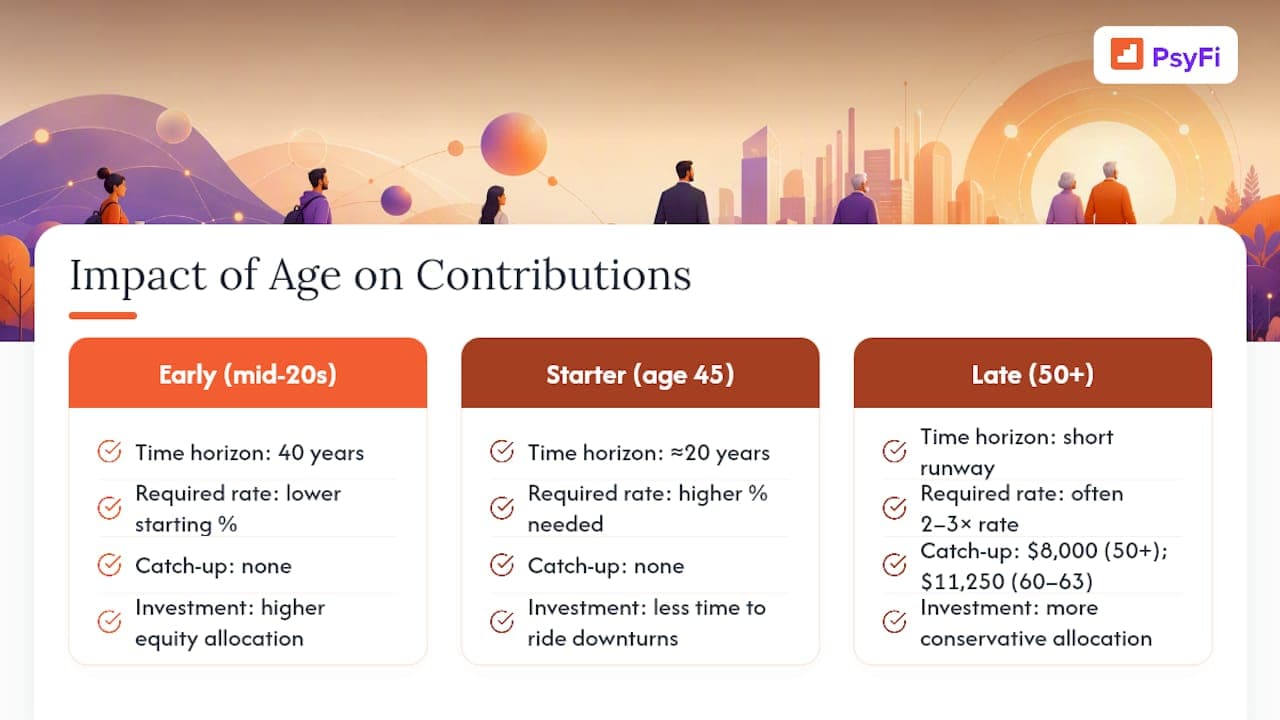
Time horizon changes what a “good” contribution rate actually looks like. Someone in their mid-20s with 40 years until retirement can afford a lower starting percentage because compound growth does most of the heavy lifting over that stretch. A worker starting seriously at 45 has roughly half that runway, which usually means a higher percentage is required to reach a comparable outcome.
The math isn’t symmetrical. A dollar contributed at 25 has decades longer to compound than a dollar contributed at 50, so late starters often need to save at double or triple the rate of early starters to land in a similar place by retirement.
Catch-up contributions exist specifically to address this asymmetry. The standard $8,000 catch-up for those 50 and older, and the enhanced $11,250 catch-up for ages 60 to 63, give late-career savers a legal mechanism to close the gap faster than the standard deferral limit allows.
Time horizon also affects how aggressively you can invest, which indirectly shapes how much you need to save. A saver in their 20s can typically ride out market downturns with a higher equity allocation, potentially reducing the contribution rate needed to hit the same target. A saver five years from retirement usually needs both a higher contribution rate and a more conservative allocation, since there’s less time to recover from a downturn right before withdrawals begin.
Considerations for handling 401(k) contributions when changing jobs
Changing jobs interrupts your contribution strategy in ways that are easy to overlook amid the bigger transition. Your deferral percentage doesn’t automatically transfer to a new employer’s plan. You’ll need to re-enroll and reset your rate, and it’s common for that reset to default to a lower percentage, or nothing at all, if you don’t act.
If you switch employers mid-year, track your combined elective deferrals across both jobs. The IRS limit applies to you personally, not per employer, so it’s possible to accidentally exceed the $24,500 cap if both payroll systems assume you’re starting from zero.
Old 401(k) balances also need a decision. Leaving the account with a former employer, rolling it into your new employer’s plan, or rolling it into an IRA are the three standard paths, and each carries different fee structures and investment options worth comparing before you choose.
Unvested employer matches are the other thing to check before you resign. If you’re close to a vesting cliff, even a few weeks can mean the difference between keeping and forfeiting thousands of dollars in employer contributions, so it’s worth confirming the exact vesting date before finalizing a departure timeline.
How contribution strategy fits your overall retirement plan
Your 401(k) contribution rate is one input in a larger retirement equation, not the whole equation. It interacts with Social Security timing, other savings vehicles, and how long you actually plan to work.
Delaying retirement even a few years can materially improve your position, both by allowing more compounding time and by increasing eventual Social Security benefits, which means a slightly lower contribution rate paired with a later retirement date can sometimes outperform an aggressive rate paired with an early exit.
Reaching $1 million in retirement savings is often held up as a benchmark, but it’s genuinely uncommon and typically the product of decades of consistent contributions rather than any single strategic move. Treat it as a possible outcome of steady saving, not a target that requires unusual sacrifice to hit.
The most useful frame is to treat your 401(k) as one leg of a broader plan alongside an IRA, an HSA if you have one, and taxable savings, then check periodically whether your combined savings rate across all of them still points toward the retirement age and lifestyle you actually want.
Penalties and access: what a higher contribution rate really costs you
Contributing more to your 401(k) means locking more of your money behind the account’s withdrawal rules, and it’s worth understanding those rules before you commit to an aggressive rate.
That penalty structure is exactly why most planners recommend keeping three to six months of expenses in an accessible emergency fund before pushing your 401(k) rate into aggressive territory. A high contribution rate that leaves you without liquid savings can force you into a costly early withdrawal if an unexpected expense hits.
Some plans offer a loan provision, letting you borrow against your own balance without the early withdrawal penalty, though missing repayments or leaving your job with an outstanding loan balance can trigger tax consequences. It’s a narrower safety valve than an emergency fund, not a substitute for one.
The practical takeaway: raise your contribution rate steadily, but don’t treat your 401(k) as a source of near-term liquidity. The tax advantages that make it powerful for retirement are the same rules that make early access expensive.
Author perspective: rethinking the 15% rule by career stage
Revisit four things every year: your match capture, your contribution rate, whether your allocation still fits your timeline, and whether your plan’s rules changed. Balance retirement saving against an emergency fund first. A well-funded 401(k) you’re forced to raid early defeats its own purpose.
— Maanya
Model your next move with PsyFi’s free tools
You don’t need a paid advisor to figure out your next contribution move. PsyFi’s free 401(k) calculator lets you model exactly how a one percentage point increase changes your projected balance, and the Savings Goal Calculator shows how retirement saving fits alongside whatever else you’re working toward, whether that’s an emergency fund or a house down payment.
PsyFi’s behavioural coaching is built around real usage patterns rather than generic percentage advice, which is why the platform pairs its calculators with a Financial Wellness Score that gives you a quick read on where your saving habits actually stand today. Paid coaching is entirely optional. Start with the free tools, model a couple of scenarios, and see what a realistic increase looks like on paper before touching payroll.
The sequence that works best: model your target rate, enable auto-increase in your plan, then review your Wellness Score again in six months to see whether the habit held. Get your free score and start there.
Where to verify the official rules
For anything payroll-specific, your plan’s own summary description and HR contact override any general guidance, including this article. The IRS pages below cover the federal limits directly:
401(k) and profit-sharing plan contribution limits for annual additions and compensation caps.
PsyFi’s free tools for modelling your own numbers against these limits.
Sources
Recommended
Keep reading
- Dopamine Spending: Why Shopping Feels Good and How to StopDopamine spending explained: why the urge to buy peaks before checkout, how it differs from a real reward, and practical ways to break the loop.

- Target Date Funds: How They Work and When They FitHow target date funds work, what they cost, where they fall short, and how they compare with I bonds, CDs and T-bills, with SEC, GAO and FINRA sources.

- Tax Loss Harvesting: $3,000 Cap and Wash Sale Risks for U.S. Investors