

Target Date Funds: How They Work and When They Fit
How target date funds work, what they cost, where they fall short, and how they compare with I bonds, CDs and T-bills, with SEC, GAO and FINRA sources.
A target date fund is a single mutual fund or ETF that holds a mix of stocks and bonds, then shifts that mix toward safer assets as the year in its name gets closer. You pick the year closest to when you expect to retire, and the fund handles allocation and rebalancing. That convenience is real. So are the catches: two funds with the same year can behave very differently, fees compound for decades, and the fund does not guarantee you income.
This guide explains how the mechanics work, what the regulators warn about, how to judge whether a fund is good, and where I bonds, CDs and T-bills fit if you are weighing safer places for money you will need sooner.
TL;DR
A target date fund follows a glide path: heavy in stocks when you are young, gradually shifting toward bonds as the date nears.
The year in the name tells you almost nothing about risk. Glide paths, fund design and fees vary widely between providers.
Most are ‘through’ funds that keep getting more conservative for years after the target date, per the SEC’s investor bulletin.
You can lose money in one, even at the target date. Compare expense ratios, including the underlying funds.
For money needed within a few years, I bonds, CDs and T-bills do a different job than a target date fund.
Table of Contents
How target date funds work
The core idea is the glide path: a preset schedule that moves the portfolio from growth assets to income assets over time. A 2060 fund bought today in your 20s or 30s will hold mostly stocks. A 2030 fund holds a much larger share of bonds and cash-like assets. The SEC explains that the fund automatically shifts its allocation, typically from stocks toward bonds, as the target date approaches.
The design solves a behavioral problem as much as a mathematical one. Most people do not rebalance on schedule, chase whatever did well last year, or freeze when markets fall. A target date fund removes those decisions. If you want the manual version of the same discipline, our guide to asset allocation by age shows how the mix usually changes from your 20s to your 60s, and our rebalancing schedule explains what drift costs you when no one manages it.
For a plain-language walkthrough of how a shift from stocks to bonds is handled in practice, this explainer on retirement investment strategies covers the same de-risking logic from a European wealth-management angle.
‘To’ funds and ‘through’ funds
This is the detail most savers miss. A ‘to’ fund stops changing its allocation at the target date. A ‘through’ fund keeps shifting for years afterward, in some cases up to 30 years. The SEC bulletin says providers differ here, and it matters because the same label can mean a different level of stock exposure on the day you retire.

A common misconception is that the fund goes fully safe at the date on the label. Most do not. Retirement can last decades, so many providers keep meaningful stock exposure well into your 70s and beyond. If you plan to withdraw money soon after the date, you need to know which type you own.
Where you will meet them
Target date funds are now the default for many workplace plans. According to the Investment Company Institute, 68% of 401(k) participants in its EBRI/ICI database held target date funds at year-end 2022, and those funds represented 38% of total 401(k) assets. Availability in plans rose from 42% in 2006 to 84% in 2020. If you are in a 401(k), you have probably seen one on the menu, or been enrolled in one automatically.
Are target date funds good?
For many people, yes, with conditions. They are a good fit when you want one diversified holding, will not tinker, and your plan offers a low-cost version. They are a weaker fit when you have large assets outside the plan, a pension, a very different risk tolerance from your age peers, or a retirement date that is far from the one you picked.
Pros
Automatic diversification. One fund holds stocks and bonds across many markets.
Built-in rebalancing. The fund trims winners and adds to laggards without your input.
Fewer behavioral errors. There is nothing to trade, so there is less room for panic selling or performance chasing. This is the part we care about most.
Low effort. A new employee can contribute from the first paycheque and make one choice.
Cons
The date is not a risk label. The GAO found that funds with the same date can hold very different mixes, so investors cannot rely on the date alone.
You can lose money near the date. The same GAO report notes that in March 2020 a 2060 fund lost about 14% while a 2020 fund lost about 8%. The closer fund fell less, but it still fell.
No income guarantee. The fund does not promise a paycheque in retirement.
Layered fees. Many are funds of funds, so you pay at two levels (more below).
One size fits an average person. Your health, spouse’s pension, home equity and other savings are invisible to the fund.
FINRA’s overview adds a point worth keeping in mind: the set-it-and-forget-it appeal requires trust in the manager’s long-term strategy, and losses hurt most when you are close to retirement with less time to recover.
Why two 2035 funds are not the same
Providers have discretion over the glide path: how fast they de-risk and how much stock they hold at each age. The SEC bulletin warns that one 2045 fund may hold significantly more stock than another 2045 fund. The result is that your fund may be more aggressive or more conservative than you assumed.
Here is what to compare before you choose, in the order we would check it:
Stock allocation today. Check the prospectus or fund fact sheet for the current percentage in equities.
Stock allocation at the target date and after. This tells you whether it is a ‘to’ or ‘through’ fund and how much risk you carry at 65.
Expense ratio. Look at the total, including underlying holdings.
Underlying funds. Index-based or actively managed? Our piece on index funds versus actively managed funds walks through what the data says about that choice.
Fit with your own plan. If your other savings are already heavy in stocks, a ‘through’ fund may add more of the same.
The GAO’s recommendation is the same one a careful adviser would give: read the prospectus and understand the specific glide path and holdings. If you are comparing fund structures more broadly, this guide to mutual funds and ETFs covers how the wrappers differ, and our own comparison of index funds and ETFs does the same from the index-investing side.
What target date funds really cost
Fees are where a convenient product becomes an expensive one. The SEC’s mutual fund fees bulletin notes that target date funds are typically funds of funds. That means you pay the fund’s own fee plus the costs of the funds it holds. Look in the prospectus fee table for ‘Acquired Fund Fees and Expenses’.
The SEC’s Investor Advisory Committee made the long-horizon point clearly: because these funds are held for decades, small differences in cost can sharply change final wealth.
For scale, Vanguard’s product summary for one 2041 to 2045 target date fund lists acquired fund fees and expenses of 0.08% as of 01/31/2025. Index-based funds can be this cheap. Actively managed lifecycle funds in some plans cost far more.
Here is a hypothetical illustration, our own arithmetic and not a forecast. Take $100,000 left for 30 years with no further contributions, earning 6% a year before fees:
Annual cost | Approximate value after 30 years |
|---|---|
0.08% | $561,000 |
0.75% | $464,000 |
The gap is roughly $97,000 from fees alone. Real results depend on returns, contributions and the fund you hold, but the direction is the lesson: check the number before you check the date.
Target date funds versus building your own mix
The alternative to a target date fund is a self-managed portfolio, often two or three index funds. Investopedia’s comparison is among the top pages for this topic, and the trade-off it describes is accurate: you give up some control and customization for automation.
Factor | Target date fund | DIY index portfolio |
|---|---|---|
Effort | One decision | Ongoing rebalancing |
Customization | Low | High |
Typical cost | Varies; check acquired fund fees | Often low if all index funds |
Behavioral risk | Lower, since there is little to trade | Higher, because you can tinker |
Fit for a single account | Strong | Strong, if you stay disciplined |
Fit when you hold many accounts | Can overlap | Easier to coordinate |
If you are honest that you will not rebalance, the automated option often wins in practice even if the DIY version is slightly better on paper. That is the intention-action gap at work: the plan you would build is not always the plan you will follow.
When your money needs a different tool
A target date fund is built for retirement savings you will not touch for years. Searches around it often drift to safer places to park cash, so here is how the main options differ. These are not retirement funds. They are for money with a defined purpose and date.
I bonds versus CDs
TreasuryDirect lists the current I bond rate at 4.26%, including a 0.90% fixed rate, for bonds issued May 1, 2026 to October 31, 2026. The rate resets every six months based on inflation and can go up or down, so check the new rate that applies from November 1. You can cash in after 12 months, but if you redeem before five years you lose the last three months of interest. I bonds are sold electronically through a TreasuryDirect account.
A bank CD works differently: the bank sets a fixed rate for a fixed term, and early withdrawal terms are set by the bank. In plain terms:
I bonds suit money you will not need for at least a year, where you want the rate to follow inflation.
CDs suit money with a known date, where you want a rate locked in at purchase. Compare the penalty terms before you buy.
T-bills versus a savings account
Treasury bills are sold for terms from four weeks to 52 weeks. You buy at a discount and receive face value at maturity, and the minimum purchase is $100. A savings account keeps money available at any time but its rate can change whenever the bank decides. If you know you will not need the cash for a few months, a T-bill ladder is one way to lock in a known return. If you might need it tomorrow, keep it in savings. Build your cash buffer first: our emergency fund calculator shows how many months of expenses to hold.
None of these replace a target date fund. Retirement money has decades to grow and needs stock exposure to keep up with inflation. Short-term money does not.
Our perspective
We build behavioral finance tools, so we look at target date funds through one question: does this product help a real person keep doing the right thing for 30 years?
On that test, a low-cost target date fund scores well. It takes away the monthly decisions that cause trouble: whether to move to cash after a bad quarter, whether to chase last year’s winner, whether to skip a contribution. Loss aversion makes a 14% drop feel worse than a 14% gain feels good, and an automatic fund gives you fewer moments to act on that feeling.
Where we part ways with the ‘set and forget’ line is the word ‘forget’. The fund can be automatic, but your choice of fund and your contribution rate should not be. Three things matter more than the label:
Your savings rate. A perfect fund with a small contribution still produces a small balance. See our 401(k) contribution strategy for the targets we suggest.
Your real risk tolerance. If a drop of the size the GAO describes would make you sell, a more conservative fund may serve you better than the one that matches your birth year.
Your whole picture. The fund only sees itself. It does not know about your other accounts, your spouse’s pension or your plans.
That last point is why our approach pairs account-level analysis with plain explanations of what you hold and why. Generic advice treats everyone the same age as the same investor. They are not.
— Maanya
Run the numbers before you choose
If you are not sure whether your plan’s target date fund is enough, test it. Our free 401(k) calculator projects your balance at different contribution rates, and the PsyFi US calculators cover other goals. For a broader check on your habits, try the financial wellness score.
If you want ongoing coaching based on your real accounts and spending patterns, PsyFi Premium comes with a 7-day free trial. It costs $9.99 per month or $69.99 per year. You can see the full plan details on our pricing page, and a goal-first approach to your plan is covered in how to write one goal and one date.
A short checklist for choosing a fund
Find your expected retirement year, then pick the closest fund, but do not stop there.
Open the fund’s fact sheet and note the current stock percentage.
Check whether it is a ‘to’ or ‘through’ fund.
Add up the total expense ratio, including acquired fund fees.
Compare with the other target date series in your plan, if there are several.
Set your contribution rate, then review once a year.
Do not hold a target date fund and a pile of other stock funds without checking the overlap.
If you are close to retirement, within a few years, talk to a fee-only financial planner or your plan’s advisory service about your specific withdrawal timeline. The cost of a wrong allocation is highest when you have the least time to recover.
FAQ
Are target date funds a good investment?
They can be a good core holding for retirement savings when the fees are low and the glide path suits you. The SEC notes they do not guarantee income and can lose money, even at the target date. Compare cost and stock allocation before relying on one.
What happens when a target date fund reaches its date?
It depends on the design. A ‘to’ fund stops changing its allocation at the date, while a ‘through’ fund keeps becoming more conservative for years afterward. Check your fund’s prospectus to see which one you own.
Is an I bond better than a CD?
Neither is better in every case. An I bond has a rate that adjusts with inflation and a 12-month minimum hold, with a three-month interest penalty if you cash out before five years. A CD locks a rate for a set term, so it suits a known spending date. Compare current rates and early withdrawal terms for each.
Can I lose money in a target date fund?
Yes. The GAO reported that during March 2020, funds further from their target date lost more, about 14% for a 2060 fund versus about 8% for a 2020 fund. Funds closer to the date hold fewer stocks but are not risk-free.
Sources
GAO-24-105364: 401(k) Retirement Plans and Target Date Funds
ICI: 401(k) Plan Asset Allocation, Account Balances, and Loan Activity in 2022
SEC: Mutual Fund and ETF Fees and Expenses Investor Bulletin
SEC Investor Advisory Committee: Recommendation on Target Date Mutual Funds
Recommended
This content is provided for general informational and educational purposes only and does not constitute financial, investment, tax, or legal advice. PsyFi provides financial coaching tools and behavioral insights, not regulated advisory services. Always consult with a qualified financial advisor or tax professional regarding your personal situation before making financial decisions.
Keep reading
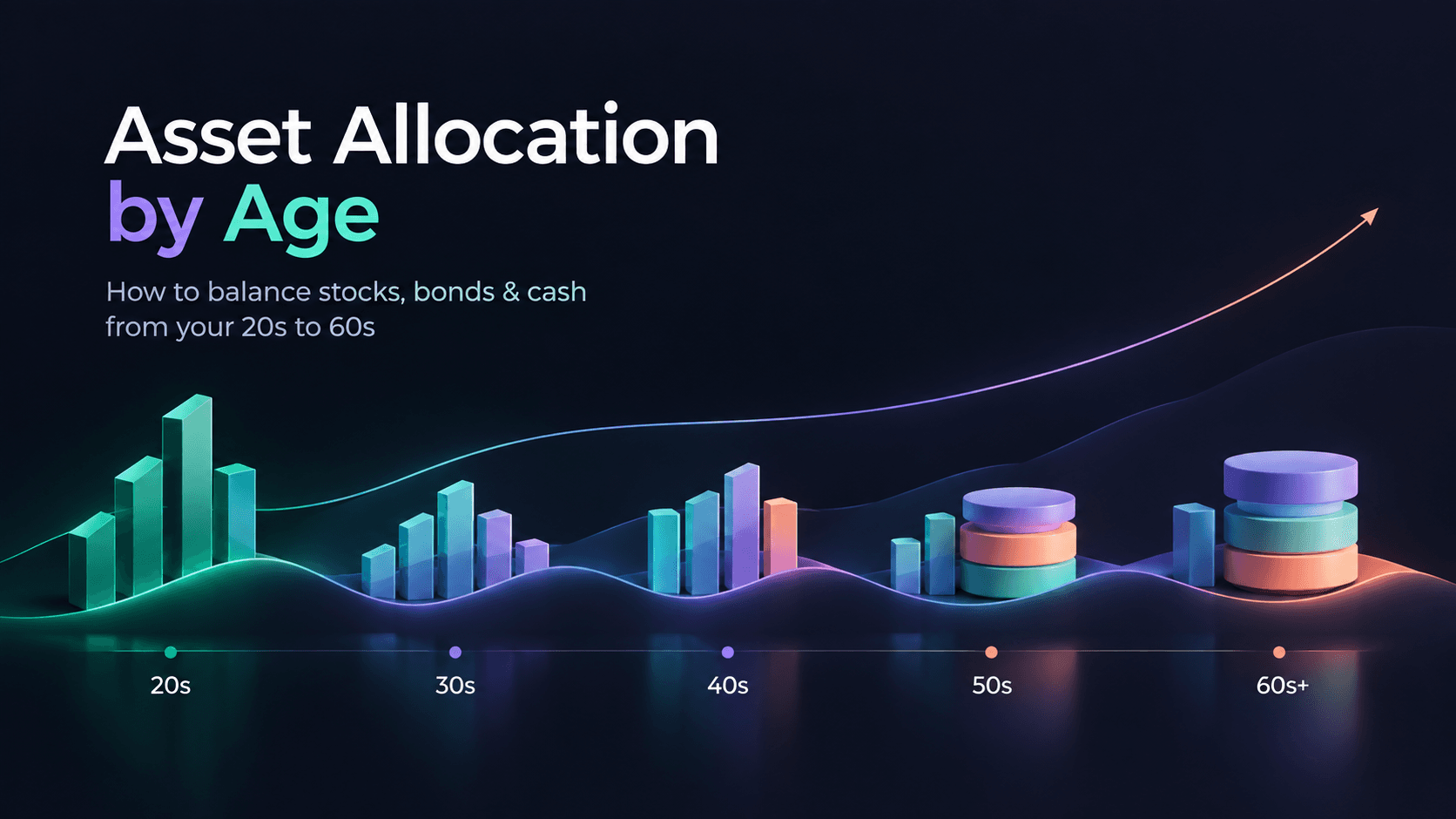
- Asset Allocation by Age: Balance Your Portfolio 20s to 60sStruggling to figure out your ideal stock-to-bond ratio? Discover decade-by-decade asset allocation frameworks, overcome the psychological barriers behind rebalancing, and build a portfolio tailored to your stage in life.
- Dopamine Spending: Why Shopping Feels Good and How to StopDopamine spending explained: why the urge to buy peaks before checkout, how it differs from a real reward, and practical ways to break the loop.