


AI Personal Finance Apps: Pick One That Changes Your Habits
Compare AI personal finance and budgeting apps by what they change, not just what they track. See criteria, pros and cons, privacy basics and a clear pick.
An AI personal finance app uses software to read your spending, spot patterns and suggest what to do next. The right one for you is the one that helps you change a habit, not just the one that draws the prettiest chart.
By Maanya Nagpal, Co-Founder of PsyFi
If you have quit a budget before, that does not say anything bad about you. Many budgets fail because they track the what and ignore the why. We make PsyFi, one of the apps below, so we say that up front and show our criteria so you can judge for yourself.
Table of Contents
TL;DR
AI finance apps fall into three types: trackers with AI features, chatbots, and coaches that work on your behavior.
Judge them on five things: habit change, setup and privacy, cost, how clear the advice is, and fit for your situation.
If stress spending or avoiding your accounts is the problem, a behavior-based coach fits best. PsyFi is built for that.
AI can help with basics, but it can be wrong. Check anything that touches investing, taxes or legal choices with a licensed professional.
Start your 7-day free trial
What “AI personal finance” actually means
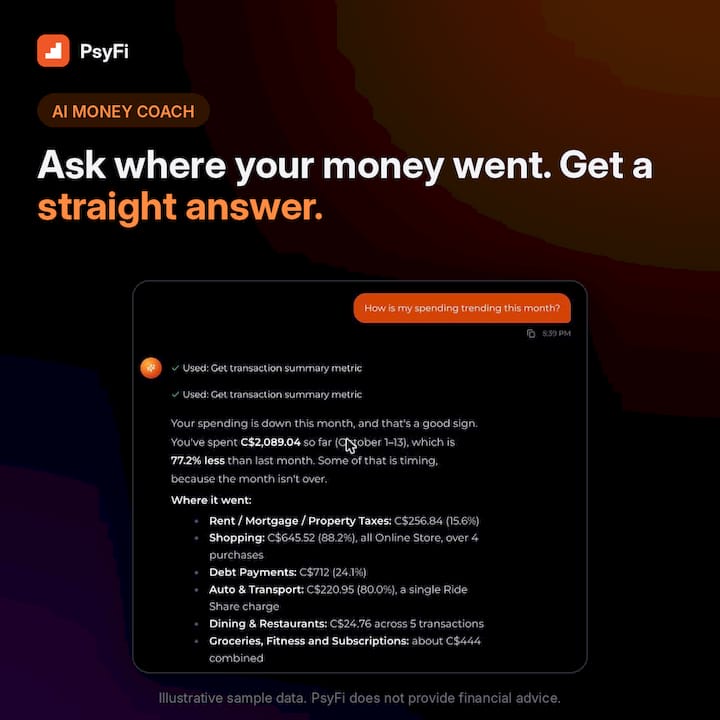
The phrase covers very different products. Some apps sort your transactions and call it AI. Some let you chat with a bot. A few look at how you behave with money and adjust the plan around you.
That difference matters more than any feature list. Here are the three types.
Type | What it does | Good for | Watch for |
|---|---|---|---|
Tracker with AI features | Sorts transactions, flags bills, shows trends | People who like to review numbers themselves | It shows what happened, but you still decide what to change |
Chatbot assistant | Answers questions in a chat window | Quick, simple questions | Answers can get weaker as your question gets harder |
Behavioral coach | Uses your own data to find patterns like stress spending, then coaches the habit | People who know the budget is not the hard part | Needs a daily habit of checking in |
The federal Consumer Financial Protection Bureau (CFPB) looked at chatbots in banking. It found they can handle basic questions, but they tend to struggle as problems get more complex. You can read that in its report on chatbots in consumer finance. So a chat window alone is a fine start for simple questions. A bigger money problem needs more than that.
How we compare AI finance apps: the criteria
Before any app names, here is how we judge. You can use the same list on any app you try.
Criterion | The question to ask |
|---|---|
Habit change | Does it help me change what I do, or only report what I did? |
Setup and privacy | How does it get my data, and do I have to hand over my bank login? |
Cost | What does it cost per month and per year, and is there a free trial? |
Clarity | Can I see why it gave me a suggestion? |
Fit | Does it match my situation: stress spending, avoiding accounts, a past budget that failed? |
We weight habit change most, because that is where most budgets break down. If your top need is something else, such as detailed category rules, weight the table your own way. A different app may win on your list.
The main options, side by side
These are well-known apps U.S. readers compare. We describe each one in general terms. Features and prices change, so check each app’s own pricing page for what it charges today before you subscribe.
App | Approach | Pros | Cons |
|---|---|---|---|
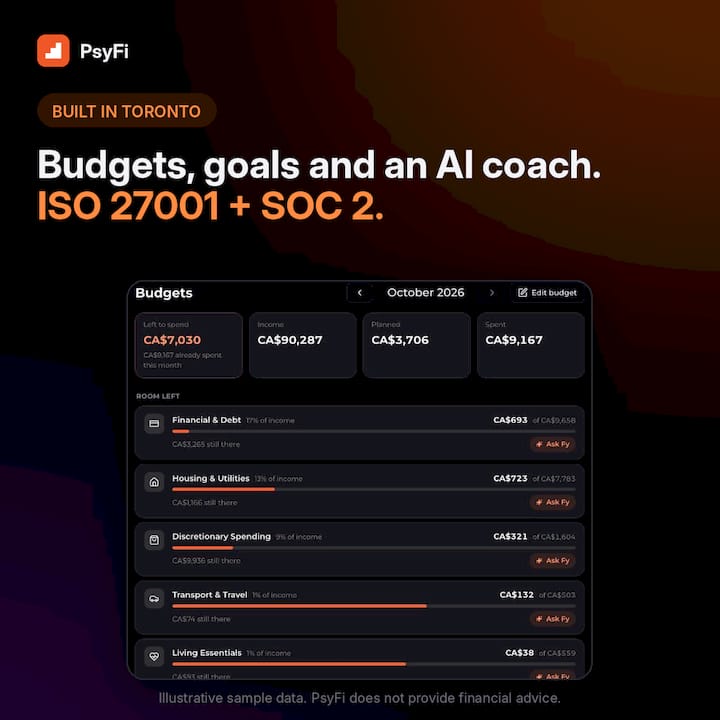
PsyFi (our app) | Behavioral coaching. Its AI engine looks at your real financial behavior, spots patterns and biases, and builds a personalized saving and spending plan. | Daily check-in, a library of behavioral interventions, real-time coaching on your own data, Plaid sync or document upload, ISO 27001 and SOC 2 Type 2 | Built for individuals, so there are no joint or couples accounts. It offers coaching, not licensed financial advice. |
YNAB | Hands-on budgeting method where you give every dollar a job | Strong for people who want to run the budget themselves | Takes regular manual effort, which is where many people drop off |
Monarch | Dashboard that brings accounts, spending and goals into one place | Good overview of your whole picture | Focus is on seeing and tracking, with less on the habits behind the numbers |
Rocket Money | Bill and subscription management | Useful for finding recurring charges | Focus is on bills, not on why spending happens |
Copilot | Polished tracker with automatic categories | Clean design for reviewing spending | Focus is on tracking rather than coaching |
Cleo | Chat-based assistant with a casual tone | Easy and conversational | Chat-style advice suits simple questions best |
Each of these is a real option, and the right one depends on how you work with money. A person who enjoys tinkering with categories may love YNAB. A person who wants one dashboard may prefer Monarch. A person who keeps ending up in the same spending loop usually needs help with the loop.
Where PsyFi fits, and who it is for
PsyFi works on the why behind your money habits. Apps like YNAB, Monarch and Rocket Money are built to track what you spent. PsyFi uses your own data and behavioral science to find the reason behind it. Then FY, our AI coach, helps you change the habit as it happens.
That is useful if any of these sound like you:
You spend more when you are stressed, tired or sad.
You avoid opening your accounts because it feels bad.
You started a spreadsheet or a budgeting app, then stopped.
You feel overwhelmed and do not know where to start.
The science behind the app is guided by a University of Toronto psychology professor. The app works in the US and Canada. It connects through Plaid bank sync or document upload, so no bank login is required if you choose to upload documents instead. You can see how it handles security on the Psyfi Trust Vault. The full list of tools is on the features page.
What it costs
Plan | Price | Notes |
|---|---|---|
Premium Monthly | $9.99 per month | 7-day free trial |
Premium Annual | $69.99 per year | 7-day free trial |
The pricing page has the current plan details.
How to use AI for budgeting without the overwhelm
AI will not fix a budget on its own. It works best when you give it a small, clear job. Here is a simple path.
Step | What to do | Where it goes wrong | How a coaching app helps |
|---|---|---|---|
1. Connect your data | Link accounts or upload statements | Giving a login to a tool you do not understand | PsyFi uses Plaid or document upload, with no bank login needed |
2. Look at the pattern | Find when and why you spend | Judging yourself instead of learning | It looks for patterns like stress spending, without the shame |
3. Pick one small goal | Choose one habit or one savings target | Setting ten goals at once | You get a plan built around your own behavior |
4. Check in daily | Take one minute to look | Skipping days, then giving up | The daily check-in keeps it short |
5. Adjust | Change what is not working | Treating one slip as a failure | Real-time coaching helps you reset |
Step 5 is where the “what the hell” effect shows up. You overspend once, think the month is ruined and spend even more. A good app helps you reset instead of quitting.
Turn a goal into a monthly number
Vague goals are hard to follow. The National Credit Union Administration (NCUA) suggests making a savings target concrete by dividing the cost by the months you have. Its example is $3,000 over 12 months, or $250 a month. The same guide says to start with a small savings habit.
If you want to try your own numbers, our free savings goal calculator does the division for you. Our guide to creating a savings plan with an exact monthly target walks through the steps.
What AI can and cannot do for you
AI is helpful for sorting, spotting and nudging. It is less reliable for decisions with big consequences.
The CFPB reported that about 37% of people in the U.S. used a bank chatbot in 2022. It also warned that inaccurate answers, weak privacy and security, and no way to reach a human can harm consumers. It also says financial chatbots must follow federal consumer finance laws.
So it helps to know the limits of any tool you pick:
Ask whether you can see why the app gave you a suggestion. PsyFi is built to be explainable, and you stay in control.
Ask whether you can reach a human or a clear help page.
Ask how your data is protected and whether the app has been audited.
Telling real AI from marketing
The U.S. Securities and Exchange Commission has penalized investment advisers for false or misleading claims about their AI capabilities. The lesson for you is to look at what a product actually does. Be wary of big promises about forecasts. If you want a closer look at how to read AI risk scoring claims, that guide explains what a score can and cannot tell you.
We also wrote about this on our own blog: Can You Trust AI With Your Money?
Using AI for investing: keep it as education
Many people search for AI investing help. Here is the general picture, and it is education only. PsyFi is not a licensed financial advisor, and nothing here is personal investment, tax or legal advice.
The American Association of Individual Investors (AAII) describes how large language models, the tech behind chatbots, can summarize company filings and earnings calls and compare companies. It also says you should verify AI-generated insights against real data and use AI to complement your own research and judgment, not replace them.
For a decision about your own money, talk with a licensed financial professional. For a plain-language look at the topic, see our post on AI for investing.
Privacy and account access: what to check
AI finance apps need data to work. That is normal, but how they get it matters.
A 2024 American Bar Association analysis says open-banking data can expose people to breach, identity theft, fraud and financial loss. It also describes a CFPB proposal that favors consumer-authorized, time-limited data sharing and API access over sharing passwords or screen scraping.
Here is a quick check you can run on any app:
Check | Why it matters |
|---|---|
How does it connect to my bank? | A secure connector like Plaid is different from handing over a password |
Is there a no-login option? | Document upload lets you use the app without linking accounts |
Is it independently audited? | PsyFi is ISO 27001 certified and SOC 2 Type 2 audited |
Does it work where I live? | PsyFi works in the US and Canada |
Is the advice explained? | You should be able to see why a suggestion appears |
Our perspective
Most people do not fail at money because they lack a budget. They fail because the budget never touches the reason they spend.
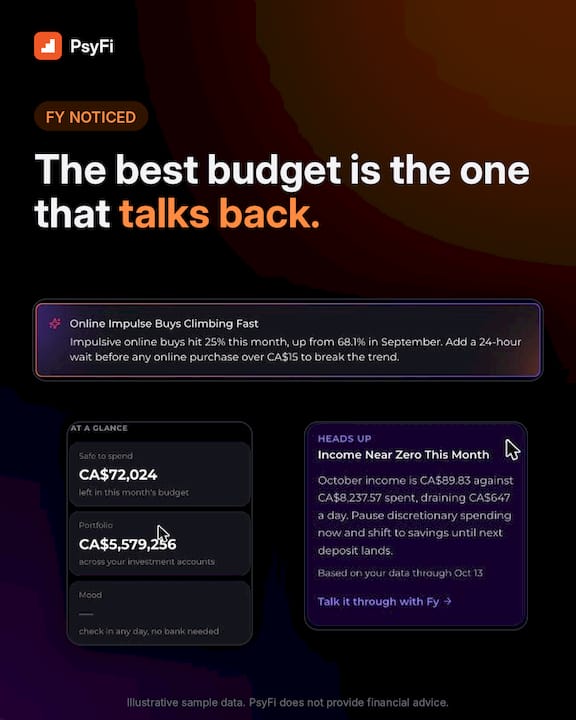
When we built PsyFi, we started from that idea. A tracker tells you that you spent $60 on takeout. It does not tell you that you tend to order after a hard day at work, or that you skip looking at your accounts when you feel anxious. Our AI engine is designed to find those patterns in your own data, and our coach, FY, is designed to help you change the habit in the moment.
We believe money advice should feel supportive, not shaming. That is why we offer a daily check-in and a library of behavioral interventions, so small steps add up. We offer coaching, not financial advice, and you stay in control of every choice.
Maanya Nagpal
Try it on your own habits
If you want to see what your own patterns look like, PsyFi gives you a 7-day free trial on either plan. Premium Monthly is $9.99 per month and Premium Annual is $69.99 per year. You can connect with Plaid or upload documents, with no bank login required, in the US or Canada.
FAQ
What is the best AI app for personal finance?
It depends on what you need. If you want to track categories yourself, a tracker may suit you. If your struggle is stress spending or avoiding your accounts, a behavioral coach like PsyFi is built for that, and we make it.
Can I use AI for budgeting if I have never made a budget?
Yes. Start with one small goal, such as a monthly savings number, and let the app show you your spending patterns. You do not need to get it perfect on day one.
Is it safe to connect my bank account to an AI finance app?
It can be, if the app uses a secure connection and is independently audited. PsyFi connects through Plaid or document upload, so no bank login is required, and it is ISO 27001 certified and SOC 2 Type 2 audited.
Can AI tell me what to invest in?
AI can help you understand and summarize information, but it can be wrong, so verify what it says. For choices about your own money, talk with a licensed financial professional. PsyFi gives coaching, not financial advice.
Does PsyFi work for couples?
PsyFi is for individuals and has no joint or couples accounts. Each partner can use it for their own habits.
Start your 7-day free trial
Sources
American Bar Association: AI and Privacy in the New Age of Open Banking
NAPA-Net: SEC Penalizes Two Investment Advisers Over False AI Claims
Recommended
Best AI Budgeting Apps in Canada: How to Pick One You’ll Keep
Best Budgeting Apps: How to Pick One You’ll Actually Keep Using
Rocket Money Alternatives: Find the App That Fits Your Habit
This content is provided for general informational and educational purposes only and does not constitute financial, investment, tax, or legal advice. PsyFi provides financial coaching tools and behavioral insights, not regulated advisory services. Always consult with a qualified financial advisor or tax professional regarding your personal situation before making financial decisions.
Keep reading
- AI for Investing: Backtests Can Mislead, So Start With a Small PilotSee where AI helps, why backtests can mislead, and how to vet and pilot investing tools safely, including a behavioral AI approach for individual investors.
- Monarch Money Alternatives: Find a Budgeting App That Fits How You SpendCompare Monarch Money alternatives by price, bank syncing, coaching and control, including PsyFi, YNAB, Simplifi, Copilot, Rocket Money and EveryDollar.

- Why Tax Refunds Vanish Fast: Understanding Mental Accounting