

Rocket Money Alternatives: Find the App That Fits Your Habits
Compare Rocket Money alternatives by price, budgeting style and how each app helps you change habits, from Monarch and YNAB to Simplifi, WalletHub and PsyFi.
By Maanya Nagpal, Co-Founder of PsyFi
The best Rocket Money alternative depends on what you want fixed. Monarch and Simplifi suit people who want a fuller budget, YNAB suits people who want hands-on control, and PsyFi suits people who want to understand why they spend the way they do. Below, we compare six apps on the same criteria so you can pick without guessing.
Disclosure: PsyFi makes one of the apps in this article. We list it alongside the others and use the same criteria for every app.
Table of Contents
TL;DR
Rocket Money is strong at finding and canceling subscriptions. If you want more budgeting depth or habit change, you will probably look elsewhere.
Monarch ($14.99/month or $99.99/year) and YNAB ($14.99/month or $109/year) are the deeper budgeting options. Simplifi is the lower-cost one at $6.99/month billed annually.
WalletHub has a free tier. Rocket Money does too, so a free switch is possible but limited.
PsyFi ($9.99/month or $69.99/year after a 7-day free trial) is built for the habits behind your spending, such as stress spending or avoiding your accounts.
Prices below are as reported in October 2026. Check each app’s own pricing page before you subscribe.
Start your 7-day free trial
How we ranked these apps
Most lists rank apps by feature count. We care more about whether an app helps you keep using it. So we compared every app on the same five criteria:
Cost: monthly and yearly price, plus any free tier or trial.
Budgeting style: automatic, zero-based, flexible or habit-focused.
Subscription help: can it track, or cancel, recurring charges?
Habit support: does it help you change behavior, or only show numbers?
Account connection and privacy: how does it get your data, and do you control it?
These criteria shape every “best for” label below. They are not a universal ranking. A different set of criteria could reorder the list.
Why people look for Rocket Money alternatives
Rocket Money, which used to be called Truebill, does a few things well. It links your accounts, sorts transactions, tracks subscriptions and can help negotiate some bills. A comparison from The Motley Fool describes it as better for simplicity, automation and saving money, while Monarch is better for detailed budgeting and customization.
That split explains most of the searches. People tend to leave for one of these reasons:
They want a real budget. Rocket Money’s “safe to spend” view is simple. Some people want more control over categories.
The price feels unclear. Rocket Money Premium uses a pay-what-you-choose model, typically $7 to $14 per month. Some people prefer one fixed number.
They want to change habits, not just see them. Knowing you spent $400 on takeout does not tell you why it keeps happening.
They are uneasy about linking a bank. That is a fair worry, and we cover it below.
None of this means you did something wrong. Budgeting apps are tools, and tools fit some people better than others.
Rocket Money alternatives at a glance
App | Best for | Free option | Paid price (US, October 2026) |
|---|---|---|---|
Rocket Money | Subscription cleanup | Free tier | Premium about $7 to $14/month, your choice |
Monarch | Detailed, customizable budgets | 7-day trial | $14.99/month or $99.99/year |
YNAB | Hands-on, zero-based budgeting | 34-day trial | $14.99/month or $109/year |
Simplifi | Lightweight spending plan | 30-day money-back guarantee | $6.99/month billed annually |
WalletHub | Free tracking | Free tier | Free |
PsyFi | Changing the habits behind spending | 7-day trial | $9.99/month or $69.99/year |
Prices for Rocket Money, Monarch, YNAB, Simplifi and WalletHub come from The Penny Hoarder’s 2026 budgeting app roundup. PsyFi’s prices come from our own site. Plans change, so confirm the current price on each company’s page.
Monarch: best for a detailed, all-in-one budget
Monarch is the usual first stop for people who outgrow Rocket Money. It has no free tier, only a 7-day trial, then $14.99 a month or $99.99 a year. It offers flexible budgeting, investment tracking and tools for households sharing finances.
It works best if you enjoy looking at your money in detail. If seeing every chart makes you anxious, that depth can become one more thing to avoid.
YNAB: best for hands-on control
YNAB (You Need a Budget) uses zero-based budgeting. That means every dollar you have gets a job before you spend it. Wall Street Survivor describes it as an envelope-style method. It costs $14.99 a month or $109 a year, with a 34-day trial.
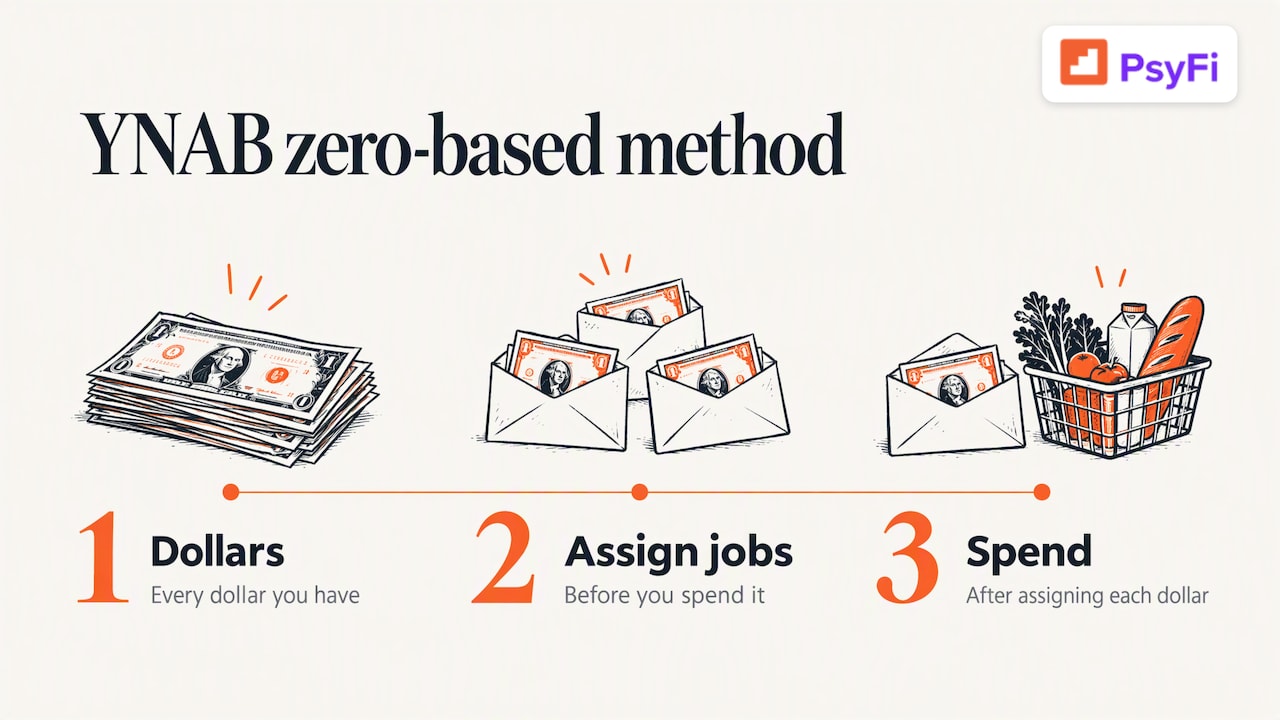
YNAB asks for regular attention. People who like that structure often love it. People who feel judged by a perfect budget sometimes quit, which is a common story among the readers we hear from.
Simplifi: best for a lighter spending plan
Simplifi costs $6.99 a month billed annually and comes with a 30-day money-back guarantee. It sits between Rocket Money’s simplicity and Monarch’s depth. If you want a spending plan without a big learning curve, it is worth a look.
WalletHub: best free option
WalletHub has a free tier, which makes it the lowest-risk way to try tracking. A free app can still cover the basics: seeing your accounts in one place and watching your spending.
If cost is your main criterion, start here or with Rocket Money’s free tier. Just know that free tools usually give you fewer coaching features.
PsyFi: best for the habits behind your spending
PsyFi is our app, so weigh this section with the disclosure above in mind. Here is what it does and does not do.
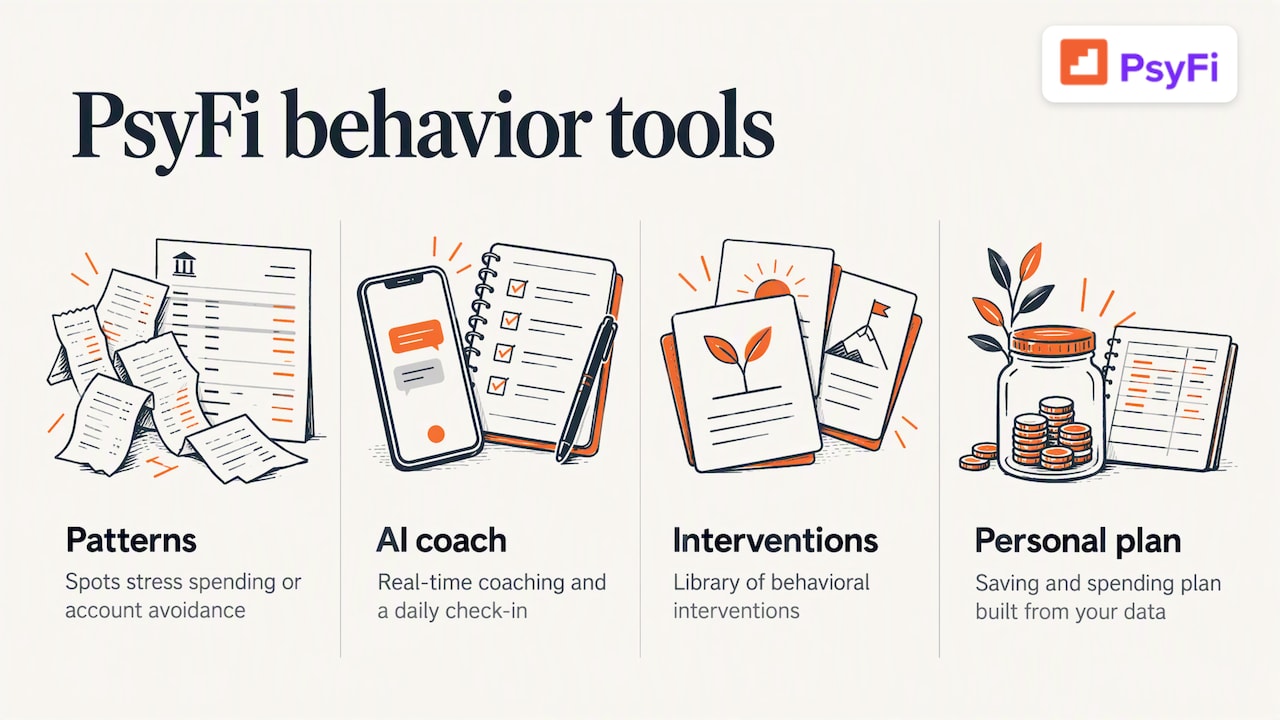
Budgeting apps mostly track what you spent. PsyFi looks at your own financial behavior to spot patterns such as stress spending or avoiding your accounts. Then FY, its AI coach, gives you real-time coaching and a daily check-in. It also has a library of behavioral interventions and builds a personalized saving and spending plan from your data. The science is guided by a University of Toronto psychology professor.
PsyFi is not a full replacement for everything Rocket Money does. We do not sell bill negotiation, for example. And PsyFi is for individuals only. There are no joint or couples accounts.
PsyFi costs $9.99 a month or $69.99 a year, after a 7-day free trial. See the PsyFi pricing page for the current plan, or explore the features.
Pros and cons of each app
App | Pros | Cons |
|---|---|---|
Rocket Money | Free tier with account linking, categories and subscription tracking; strong at subscription cleanup | Premium price varies by what you choose; less depth for detailed budgets |
Monarch | Deep customization; investment tracking; built for shared households | No free tier; highest yearly cost after YNAB; lots of detail can overwhelm |
YNAB | Clear method; long 34-day trial | Needs regular upkeep; highest yearly cost of the group |
Simplifi | Lowest paid price in this list; 30-day money-back guarantee | Billed annually, so less flexible month to month |
WalletHub | Free | Fewer coaching features |
PsyFi | Targets the behavior behind spending; daily check-in; AI coach; fixed price | No bill negotiation; individuals only; US and Canada only |
Who should pick which app
If this sounds like you | Consider |
|---|---|
“I just want to find and cancel forgotten subscriptions.” | Rocket Money |
“I want a detailed budget and charts.” | Monarch |
“I want to assign every dollar myself.” | YNAB |
“I want something simple that costs less.” | Simplifi |
“I want to pay nothing.” | WalletHub or Rocket Money’s free tier |
“I know my budget. I keep overspending anyway.” | PsyFi |
The Penny Hoarder’s roundup makes a similar point: the right app depends on whether you want automation, zero-based discipline, couples features or a free option.
How the apps connect to your accounts, and what to know about privacy
Most budgeting apps pull your data through a bank-linking service. That is convenient, but it is also the part many people hesitate over. Before you link anything, ask these questions:
Can I use the app without handing over my bank login?
Can I disconnect later and delete my data?
Does the company publish security certifications?
PsyFi works in the US and Canada. It connects through Plaid or through document upload, so no bank login is required. If you prefer not to link, you can upload statements instead. PsyFi is ISO 27001 certified and SOC 2 Type 2 audited, and you can read more at our Trust Vault. For other apps, check what each company publishes on its own security page.
What changes when you leave Rocket Money
Switching is usually simple, but plan for a few things:
Write down your subscriptions first. Rocket Money’s list is useful. Copy it before you cancel Premium.
Export what you can. If you want your history, check Rocket Money’s settings for a data export before closing your account.
Cancel Premium on purpose. Do this after you confirm your new app works. Otherwise you may pay for two.
Expect a short learning curve. Categories rarely match from app to app.
Use the trial. Run the new app for a week alongside your old one before you decide.
If you want a simple way to start tracking again, our guide on setting up automatic spending tracking walks through it step by step.
Our perspective: numbers alone rarely change habits
We built PsyFi because we kept seeing the same pattern. People could name every number in their budget and still feel stuck. The problem was rarely missing information. It was stress, avoidance or a habit that made sense in the moment.
That is why we think the question “which app has the best charts?” is only half the question. The other half is “what will help me act differently on a hard day?” Some people need a stricter budget. Some need a gentler nudge and a daily check-in that does not feel like a report card.
We also believe a budgeting app should never shame you. Debt, overspending and past mistakes are common. The goal is to understand your patterns and build one small change at a time. PsyFi is coaching, not financial advice.
If you want to learn more about the science, our applied behavioral economics article goes deeper.
— Maanya Nagpal
Try PsyFi if budgeting alone has not worked
If you have tried a tracking app and still find yourself avoiding your accounts or spending when stressed, PsyFi may fit better than another budget. Start with the 7-day free trial, then pick the monthly or annual plan. If you would rather test your habits first, try the free US calculators.
FAQ
What is the best free alternative to Rocket Money?
WalletHub has a free tier, and so does Rocket Money itself, so those are the main no-cost options in this list. Free tiers usually cover tracking and basic categories, with fewer coaching tools. If you want more, most paid apps here offer a trial.
Is Rocket Money the same as Truebill?
Yes. Rocket Money is the current name for the app that used to be called Truebill. People searching either name are looking for the same product and the same set of alternatives.
Is Monarch better than Rocket Money?
It depends on your goal. Monarch is stronger for detailed budgeting and customization, while Rocket Money is stronger for simplicity and subscription cleanup, according to The Motley Fool’s comparison. Monarch also costs more and has no free tier.
Can I use a budgeting app without giving it my bank login?
Some apps let you do that. PsyFi, for example, connects through Plaid or lets you upload documents, so no bank login is required. It works in the US and Canada.
Which app helps with stress spending or avoiding my accounts?
Most budgeting apps show what you spent, not why. PsyFi is built around the behavior behind spending, with daily check-ins and an AI coach. It offers coaching, not financial advice.
Sources
The Best Budgeting Apps of 2026: Free and Paid Options (The Penny Hoarder)
Monarch Money vs. Rocket Money: Which Is Better? (The Motley Fool)
Rocket Money vs Monarch Money (+ YNAB, Simplifi & Copilot) (Wall Street Survivor)
Start your 7-day free trial
Recommended
This content is provided for general informational and educational purposes only and does not constitute financial, investment, tax, or legal advice. PsyFi provides financial coaching tools and behavioral insights, not regulated advisory services. Always consult with a qualified financial advisor or tax professional regarding your personal situation before making financial decisions.
Keep reading
- Mint Alternatives: Apps to Replace Mint and Fit Your HabitsMint is gone. Compare Monarch, YNAB, Empower, Simplifi, Rocket Money, Goodbudget and PsyFi on price, syncing and habit support to find your fit.

- YNAB Alternatives: Budget Apps That Fit How You Really SpendLeaving YNAB? Compare Monarch, Copilot, EveryDollar, Goodbudget and PsyFi on price, bank sync and style, so you pick an app you will actually keep using.

- Is Plaid Safe? What It Sees and How to Stay in Control