


How to Identify Your Spending Triggers and Break the Pattern
Learn how to spot the feelings, places and moments that set off unplanned spending, with a simple trigger log, tables and calm next steps.
By Maanya Nagpal, Co-Founder of PsyFi
A spending trigger is a feeling, place, person or moment that sets off a purchase you did not plan. To identify yours, write down what was happening just before each unplanned purchase, then look for what repeats.
This is not about guilt. Almost everyone has spent money to cope, celebrate or fill a quiet hour. Once you can see the pattern, you can plan for it.
TL;DR
A trigger is the cue that comes before an unplanned purchase: a mood, a time of day, an app, a person or a sale.
Common emotional triggers include stress, boredom, loneliness, celebration and social pressure, according to America Saves.
A simple log of time, place, feeling and the purchase will show your pattern in a few weeks.
Once you know your triggers, a pause, a swap or an easier-to-reach limit can help you respond differently.
Slips are normal. The goal is to bounce back, not to be perfect.
Table of Contents
What a spending trigger actually is
Think of a trigger as the “because” behind a purchase. You did not just buy a sweater. You bought it because the day was stressful and the checkout was one tap away.
U.S. Bank describes an impulse buy as an unplanned purchase made for emotional reasons or on a whim. It also notes that the pleasure is usually brief and may not solve the feeling underneath.
Triggers usually fall into three groups:
Type | What it looks like | Example |
|---|---|---|
Emotional | A feeling pushes you toward buying | Ordering takeout after a rough meeting |
Situational | A time, place or routine sets it off | Browsing in bed every night |
Marketing and social | Something outside you creates urgency | A countdown timer on a sale |
Most people have a mix. That is why a one-size budget rule often fails. It does not know why you spend.
Common spending triggers to look for
Use this list as a starting point, not a diagnosis. You may see yourself in several rows, and that is fine.
Trigger | What it can sound like in your head | Source |
|---|---|---|
Stress or anxiety | “This will help me calm down.” | |
Boredom | “I’ll just look around for a minute.” | |
Loneliness | “A little treat will cheer me up.” | |
Celebration | “I earned this.” | |
Social pressure | “Everyone else is going.” | |
Fatigue and sadness | “I deserve this after today.” | |
Urgency and easy checkout | “It’s almost gone, and it’s one click.” |
Marketing triggers are just as real. A Case Western Reserve University report quotes economics professor Sining Wang on how limited-time offers, scarcity, targeted ads and social comparison can push people toward impulse spending. It also points to present bias, which is our habit of favoring a reward now over a bigger one later. If that sounds familiar, our piece on present bias explains it in plain words.
How to identify your spending triggers, step by step
You do not need a perfect system. You need honest, quick notes. Here is a simple plan.
Step | What to do | Why it helps |
|---|---|---|
1. Pick a window | Plan to track for about a month | The Louisiana Office of Financial Institutions suggests tracking daily spending for a month to see patterns by time of day or day of the week |
2. Sort the purchases | Mark each one as planned or unplanned | You only need to study the unplanned ones |
3. Add the feeling | Note your mood when you bought | Rutgers Cooperative Extension suggests logging spending and feelings at the time of purchase |
4. Add the context | Where were you, and what time was it? | Context often matters as much as mood |
5. Look for repeats | Circle anything that shows up three or more times | Repeats are your likely triggers |
6. Name your top two or three | Write them in one sentence each | A named trigger is easier to plan for |
Keep your trigger log simple
You can use a notes app, a paper notebook or a spreadsheet. Here is a sample layout with made-up entries.
Day and time | Where | Feeling | What I bought | Planned? |
|---|---|---|---|---|
Tue, 9 p.m. | Couch, phone | Bored | $28 clothing order | No |
Fri, 6 p.m. | Work parking lot | Drained | $22 takeout | No |
Sat, 2 p.m. | Mall with friends | Left out | $45 shoes | No |
Mon, 8 a.m. | Desk | Anxious about bills | $12 coffee and snack | No |
Even this tiny sample shows something. Two entries are about a hard day ending, and one is about being with others. That is already useful.
Add a few extra questions
When you feel an urge, you can also ask yourself a few things. Habit-change writers often suggest noting the location, time, your emotional state, who was with you and what you did just before the urge. A personal finance blogger lays out this approach in a guide to changing spending habits, drawing on Charles Duhigg’s work.
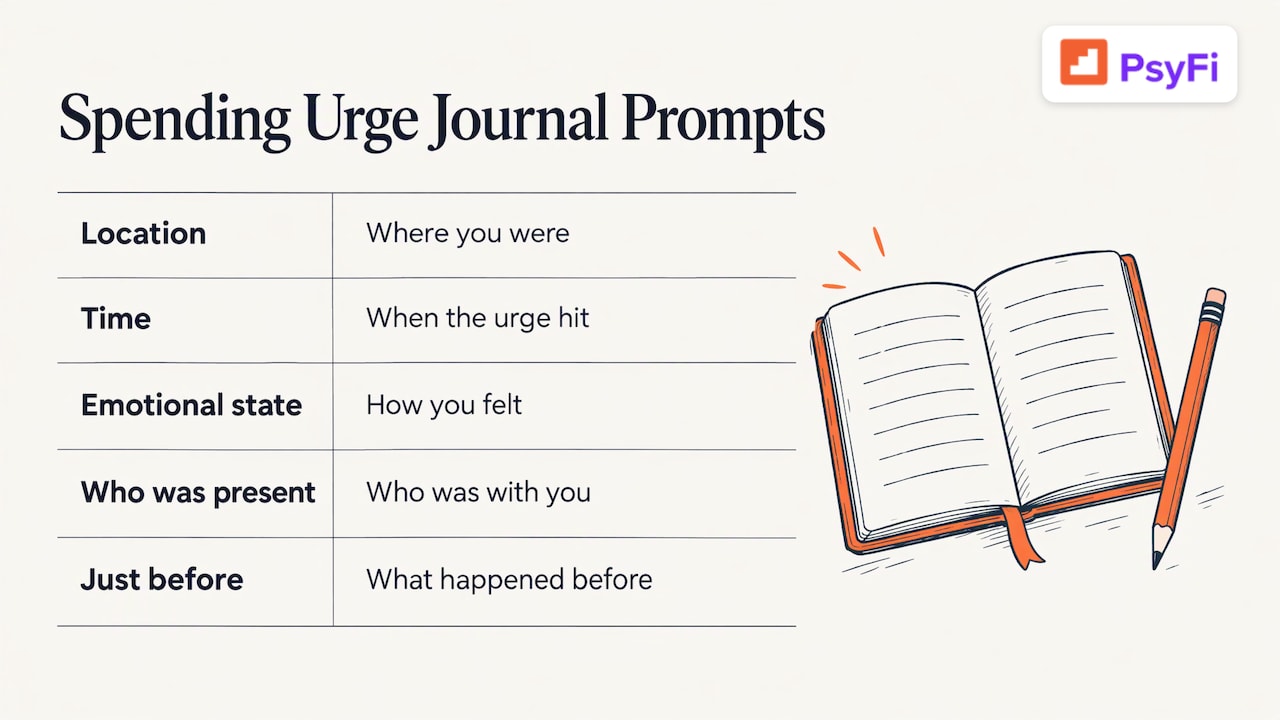
U.S. Bank suggests an “almost bought” journal. You write down things you wanted but did not buy. It shows the urge was real, and it passed.
You can also ask: does this purchase fit what I care about? That question comes from the same U.S. Bank guidance, and it shifts you from “Can I afford it?” to “Do I want it?”
Reading your log without judgment
After a few weeks, look at the log the way a friend would. You are not grading yourself. You are looking for clues.
What you notice | What it may point to | A gentle next question |
|---|---|---|
Many entries late at night | Tiredness or boredom plus easy phone access | What else could fill this hour? |
Spikes right after work | Stress release | What helps me unwind without spending? |
Spending around certain people | Social pressure or comparison | Can I plan a low-cost option ahead? |
Purchases after a sale email | Urgency and marketing | What if I unsubscribed for a month? |
Treats after good news | Celebration | Can I celebrate in a way that costs less? |
Avoiding the log itself | Money anxiety | Can I look for one minute, with no goals? |
That last row matters. If looking at your money makes you tense, you are not alone, and it does not make you bad with money. Start small. One minute is enough for now. Our guide on tracking money habits in a few minutes a day shows a low-pressure way to begin.
Add up the cost
Rutgers Cooperative Extension suggests totaling your monthly expenses and looking at the monthly and yearly cost of small spending “leaks”, such as clothing, food, drinks, entertainment and gifts. Try it with your own log:
Trigger | Typical purchase | Times per month | Monthly total | Yearly total (x 12) |
|---|---|---|---|---|
Late-night scrolling | Your amount | Your count | Amount x count | Monthly x 12 |
After-work takeout | Your amount | Your count | Amount x count | Monthly x 12 |
The point is not to feel bad. It is to see what a trigger costs, so you can decide if that trade is worth it to you.
What to do once you know your triggers
Knowing a trigger is half the work. The other half is giving yourself a different move to make. Pick one or two ideas, not all of them.
Trigger | Try this | Backed by |
|---|---|---|
Any nonessential urge | Wait 24 hours before buying | |
Something you want | Write the item and price on a wish list, then wait 48 hours | |
Big-ticket item | Wait at least a week | |
Stress or boredom | Swap in a walk, a call, music or meditation | |
Loneliness | Contact a friend, play with a pet or go to a free community event | |
Easy access | Avoid window-shopping and leave credit cards at home | |
Overspending in one category | Set an envelope or spending-plan limit for it | |
Celebration | Celebrate skipping a purchase without spending |
Make the easy choice the helpful one
The Consumer Financial Protection Bureau points to simpler choices, defaults, goal reminders and real-time budget feedback as ways to support better money decisions. The Financial Health Network adds that some spending controls let people pause certain merchants or categories while still being able to override the control.
In plain words: add a little friction where you tend to slip. Log out of shopping apps. Delete saved card details. Turn off sale alerts.
Give your money a job
America Saves also suggests setting intentional savings goals and giving money a purpose. A goal gives you something to say yes to. If you want a number to aim for, a savings goal calculator can show what a monthly amount adds up to. For the brain side of urges, see our explainer on dopamine and spending.
Our perspective
Most budgets answer the question “what did I spend?” They rarely answer “why did I spend it?” That second question is where change starts.
When we build coaching at PsyFi, we begin with your own behavior, not a generic rule. Two people can spend the same $200 on the same night out for opposite reasons. One is celebrating. The other is avoiding a stressful week. The fix is different for each.
That is why we think naming a trigger matters more than willpower. Willpower runs low when you are tired or stressed, which is often exactly when a trigger hits. A plan you made on a calm day, such as a pause, a swap or a limit, works better than a promise to try harder.
We also believe the tone matters. Shame makes people stop looking at their accounts. Curiosity keeps them looking. If you slip, that is data, not a verdict.
Maanya Nagpal
Where PsyFi can help
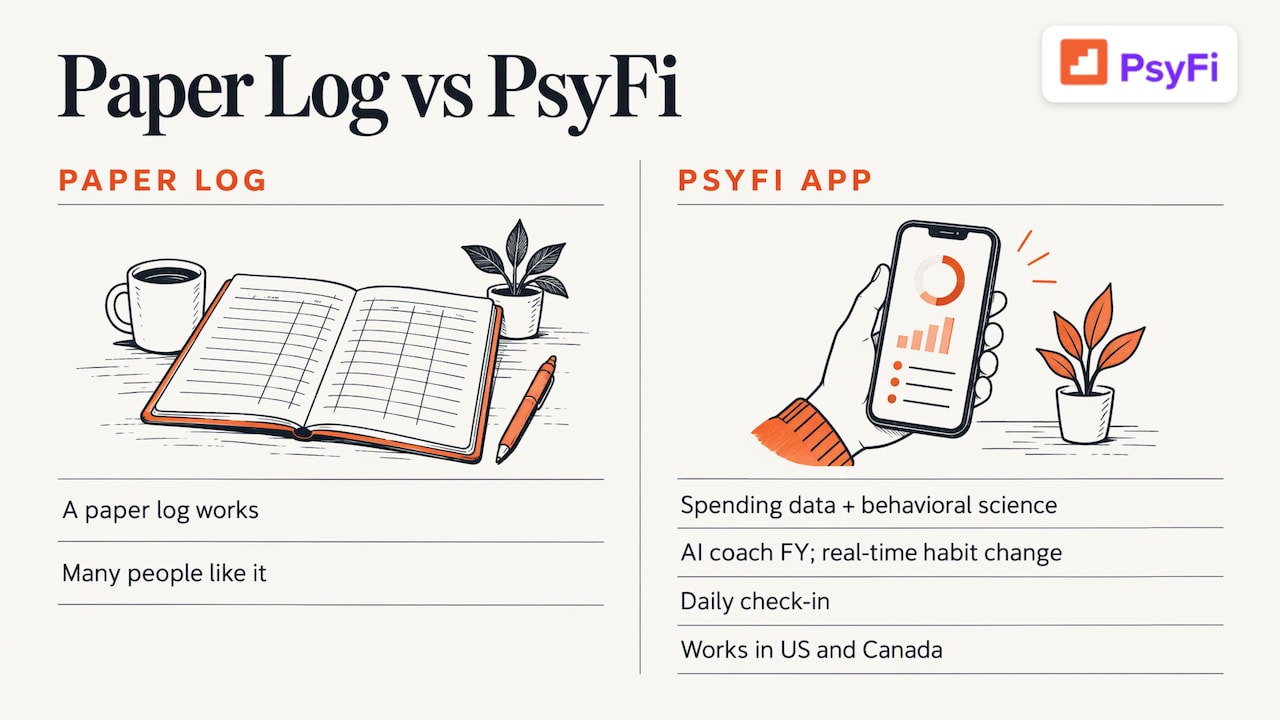
A paper log works, and many people like it. If you would rather have your patterns found for you, PsyFi is an app that uses your own spending data and behavioral science to spot the “why” behind your habits. Its AI coach, FY, then helps you change the habit in real time, with a daily check-in.
PsyFi works in the US and Canada. It connects through Plaid bank sync or document upload, so no bank login is required if you upload documents instead. It costs $9.99 per month or $69.99 per year, with a 7-day free trial. You can see the details on the pricing page or browse the features. PsyFi offers coaching, not financial advice, and it is built for one person’s own habits.
When you slip, and you probably will
One unplanned purchase does not erase your progress. A 2024 TIAA Institute research brief says habits depend on context, repetition and reward. It also says forming a habit often takes about 66 days or longer, not the popular 21 days, and suggests planning for slips and practicing how to rebound.
Here is a quick rebound plan:
Moment | What to say to yourself | What to do |
|---|---|---|
Right after the purchase | “That happened. I’m not starting over.” | Add it to your log with the trigger |
Later that day | “What was going on before I bought?” | Name the feeling and the place |
Next morning | “What will I try next time?” | Pick one pause or swap |
This keeps you out of the “what the hell” effect, where one slip turns into “I’ve blown it, so why not keep going?” You have not blown anything. You have learned something.
If impulse spending feels tied to a bigger challenge, such as ADHD, take a look at our post on ways to stop impulse spending. For a wider look at feelings and money, read how to stop emotional spending.
If money worries are weighing on your mood or sleep, talking with a licensed mental health professional or a nonprofit credit counselor can help. This article is general education, not personal financial, legal or tax advice, and PsyFi is not a licensed financial advisor.
FAQ
What are the most common spending triggers?
Stress or anxiety, boredom, loneliness, celebration and social pressure are common, according to America Saves. Marketing cues such as urgency and easy checkout also play a part. Your own list may be a mix of these.
How do I find out what triggers my emotional spending?
Track your spending for about a month and note your mood, time and place for each unplanned purchase. Look for repeats, such as the same day or the same feeling. Those repeats are your likely triggers.
Is emotional spending a sign that I’m bad with money?
No. Many people spend to cope with stress, celebrate or pass the time. It is a habit linked to feelings, and habits can change with a plan and some patience.
How long should I wait before buying something I want?
Several sources suggest a pause. America Saves suggests 24 hours for nonessential items, and Rutgers Cooperative Extension suggests at least a week for big-ticket items. Pick a length you will actually follow.
Can an app help me spot my spending triggers?
It can. Budgeting and expense-tracking tools are one of the countermeasures named in the Case Western Reserve report. PsyFi, for example, looks at your own spending data to find behavior patterns and offers coaching, not financial advice.
Tired of spending that surprises you? Start your 7-day free trial and see the patterns behind your purchases.
Sources
Why is impulse spending so tempting? | Case Western Reserve University
6 Ways to Break the Emotional Spending Cycle | America Saves
7 Ways to Reduce Emotional Spending | Louisiana Office of Financial Institutions
Organizing and managing finances | Consumer Financial Protection Bureau
Behavioral Design Guides: Tools to Manage Spending | Financial Health Network
The power of habits for improving financial wellness | TIAA Institute
Recommended
This content is provided for general informational and educational purposes only and does not constitute financial, investment, tax, or legal advice. PsyFi provides financial coaching tools and behavioral insights, not regulated advisory services. Always consult with a qualified financial advisor or tax professional regarding your personal situation before making financial decisions.