

Financial Decision Checklist: How to Choose With a Clear Head
A plain-language financial decision checklist for big purchases, debt and savings choices, built on the CFPB's SAVED steps and a simple budget check.
A good financial decision checklist has two parts. First, know your real numbers: income, bills, spending and savings. Second, run the choice through a few set questions about cost, risk and fit before you say yes.
By Maanya Nagpal, Co-Founder of PsyFi
This guide gives you both parts in tables you can copy. It works for a big purchase, a new loan, a subscription or a savings goal. Nothing here is judgment. Every one of us has made a money choice in a hurry, and a checklist just gives your future self a bit more room.
TL;DR
Pause first. The CFPB’s SAVED steps start with a mental break, because pressure leads to rushed choices.
Know your take-home pay, bills and last few months of spending before you judge any purchase.
Ask what the choice costs now and over time, and what happens in the worst case.
Compare the choice with your debt, emergency savings and goals, not just your checking balance.
Review your checklist on a regular schedule, such as once a month, so it stays current.
Table of Contents
Why a checklist helps with money choices
Money choices often feel urgent. A sale ends, a salesperson is waiting, or a stressful week makes spending feel like relief. A checklist slows that moment down and turns a feeling into a few clear questions.
The CFPB, the U.S. consumer finance agency, builds its own decision guide on this idea. Its SAVED framework says to stop and give yourself time, and not to pressure yourself or let others pressure you.
A checklist also helps if money makes you anxious. You do not have to decide how you feel. You only have to answer the next question on the list.
The five-step decision checklist
Here is the CFPB’s SAVED framework in plain words, with a prompt for each step. The agency designed it to help people find the best deal on a financial product or service, but the same steps work for most spending choices.
Step | What it means | Questions to ask yourself |
|---|---|---|
Stop | Take a mental break | Am I rushed, stressed or being pushed? Can this wait a day? |
Ask | Ask about costs and risks | What does it cost now and over time? Are there fees, taxes or penalties? |
Verify | Check what you were told | Does the official website match what the seller said? Do I have it in writing? |
Estimate | Run the numbers | What is the total cost compared with the value I get? |
Decide | Make the call | Are the costs worth the value to me? |
Source for the table: the CFPB’s SAVED guide.
The “Ask” step is where most of the useful detail sits. The CFPB suggests asking:
How much does it cost now, and over time?
Are there fees, taxes or penalties?
How do I avoid add-ons I do not want?
What is the cancellation deadline?
How does the seller make money?
What is the worst-case scenario?
The “Verify” step matters most for loans, investments and insurance. The same guide says to get everything in writing. It also says to check with your state’s banking regulator, insurance commissioner or securities regulator, or with the SEC or FINRA for investments.
Know your numbers before you decide
No checklist works if you do not know where your money goes. This is the step people skip, and it is the one that makes every other answer more honest.
The CFPB suggests looking at several months of checking-account and credit-card history. You can also use a personal financial management tool, or save receipts and add them up each week or month.
Your starting snapshot
What to gather | Where to find it | Why it matters |
|---|---|---|
Monthly take-home pay (what lands in your account after taxes) | Pay stubs, bank deposits | This is the number every purchase is measured against |
Essential bills | Rent or mortgage, utilities, insurance, minimum debt payments | These are paid before anything else |
Spending by category | Last three months of statements | Shows where money really went, not where you think it went |
Savings and debt balances | Account and loan statements | Shows your cushion and your obligations |
Less frequent costs | Annual fees, car repairs, gifts | These surprise people most |
The CFPB also recommends an as-is monthly budget that includes miscellaneous spending, regular savings contributions and less frequent expenses. You then compare the total with your take-home pay. Its budgeting guide names logging your spending as the heaviest lift. If it feels like too much, it suggests starting small and looking at one week at a time.
If you want to automate part of this, our guide to setting up automatic spending tracking walks through it. If your pay changes from month to month, see how to budget on an irregular income.
Add a net worth line
The SEC’s Investor.gov suggests creating a net worth statement. You list what you own (assets) and what you owe (liabilities), then update it every year. It also suggests tracking income and expenses monthly, with a category for saving and investing.
This is general education, not advice for your situation. For personal investment, tax or legal questions, talk with a licensed professional. PsyFi is not a licensed financial advisor.
The pre-purchase checklist
Before a big purchase, “Can I afford it?” is the wrong question if it only means “Is there enough in checking today?” A wealth planning firm, Gainspoletti, frames a better question: can you buy this and still stay on track with the goals that matter most? It points to the Federal Reserve’s finding that 63% of adults could cover a $400 emergency with cash, as a reminder that flexibility matters.
Use this table before you buy something large, like a car, a phone plan, a trip or furniture.
Question | What a good answer looks like | If the answer is unclear |
|---|---|---|
Can I still pay all my regular bills? | Yes, with room to spare | Wait and rework your budget first |
Will it cut into emergency savings? | No, or I know how I will refill it | Delay, or choose a smaller option |
Does it slow debt payments? | No | Compare it with your debt plan (see below) |
Will I still save for upcoming costs? | Yes, the plan stays intact | Adjust the amount or the timing |
What is the total cost, not just the sticker price? | I can name fees, taxes and ongoing costs | Ask the seller and get it in writing |
Can I cancel or return it? | I know the deadline | Find out before paying |
What is the worst case? | I could handle it | Pick a lower-risk option |
The list draws on the Gainspoletti questions about bills, retirement contributions, emergency savings, debt and upcoming expenses, plus the CFPB’s cost and cancellation questions.
One more thing: the first cost is often the easiest one to see. A financial firm, William Blair, notes that the longer-term impact of a major purchase is harder to judge than the price and the new ongoing expenses. So write the ongoing costs down, even the small ones.
If the purchase is a home
Home buying has more moving parts than most choices. Your rent history, credit and savings all play a part. If you rent, rent reporting before a mortgage is one way to think about how your on-time payments can support a future application.
Weigh the choice against debt, savings and your emergency fund
Most real decisions are trade-offs. Money spent on one thing is not available for another. Put the options side by side.
Check your cushion first
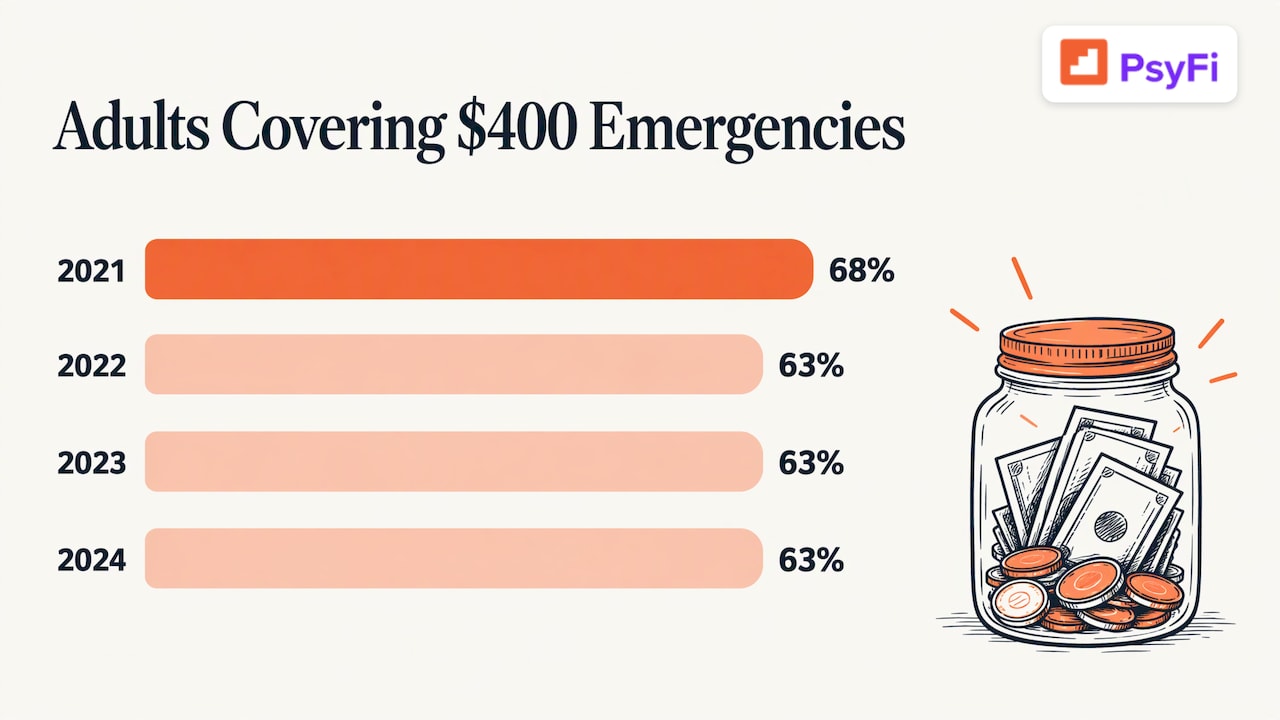
An emergency fund is money set aside for surprises. The Federal Reserve’s 2024 household survey found that 63% of U.S. adults said they would cover a $400 emergency using cash or its equivalent. That was the same share as in 2022 and 2023, and down from 68% in 2021. If you are not there yet, you are in good company, and it is a fine place to start.
How big should a cushion be? Different trusted sources give ranges:
Source | Guideline |
|---|---|
Save 10 percent of what you earn. Keep at least three months of living expenses, and six to nine months if possible. | |
Three to six months of living expenses. Use a three-month average if costs change by season. | |
Use the 50/30/20 rule (50% needs, 30% wants, 20% savings) and plan how you would refill reserves if you used them. |
To see how long a target might take, try a free savings goal calculator. Enter a goal and a monthly amount, and you get a timeline.
Compare the choice with your goals
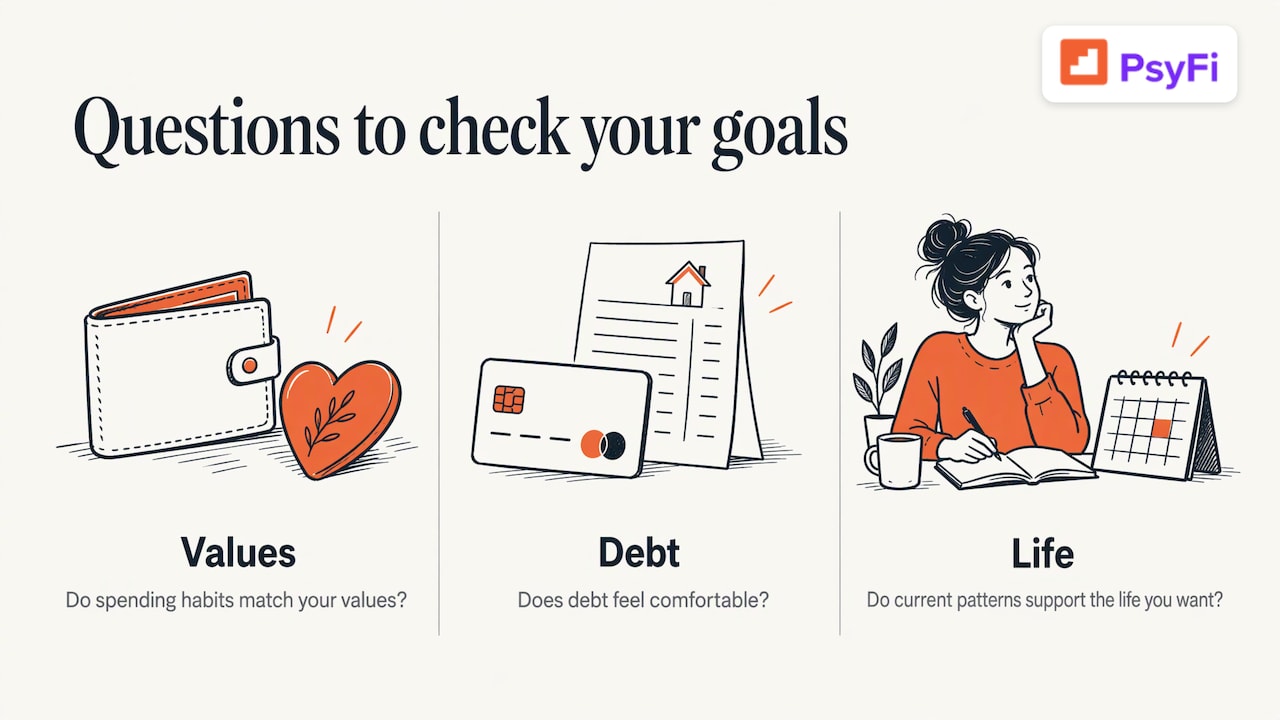
America Saves, a savings campaign, suggests asking three questions after you track your spending. Do your habits match your values? Do you have more debt than feels comfortable? Does your current pattern support the life you want? These goal-setting questions work well as the “Decide” step.
If debt is part of the choice, a set of free debt payoff calculators can show how different repayment orders compare. Our own guide on whether to pay off debt or save first explains the trade-off in plain language. This is general education, not a recommendation for your personal situation.
A worked example
Here is a made-up example to show the checklist in action. The numbers are only for illustration.
Say you are thinking about a $1,200 laptop. You use the steps like this:
Step | What you do | Result |
|---|---|---|
Stop | Wait a day before buying | The urge fades a little, and you see your old laptop still works |
Ask | Check for fees, warranty cost and return deadline | Extended warranty adds cost you did not plan for. You can skip it |
Verify | Read the store’s return policy on its website | You can return it within a set window, in writing |
Estimate | Compare the price with your monthly take-home pay and savings | It would use most of your buffer, so you consider paying over two paychecks or waiting |
Decide | Pick the option that keeps your emergency fund intact | You choose a refurbished model that fits your plan |
Notice that the checklist does not say “never buy”. It helps you buy in a way you feel good about later.
Build a checklist habit that holds up under stress
A checklist is easy to follow when you feel calm. It is harder when you feel stressed, bored or discouraged. Many of us spend to feel better, and that is human, not a flaw.
The National Credit Union Administration says saving is not about how much you save but about starting the habit. It describes saving as a discipline you commit to as part of your daily routine. It also proposes a 21-day savings goal: when you buy a “want”, you set aside an equal amount in savings.
Here are small ways to make the checklist stick:
Habit | How to do it |
|---|---|
Add a waiting rule | For any non-essential purchase, wait one day before paying |
Keep the list handy | Save the checklist in your notes app, so it is there when you need it |
Name the feeling | If you are shopping because you are stressed, tired or avoiding something, write that down first |
Match wants with savings | Move a matching amount to savings when you buy a want |
Look at one week at a time | If tracking feels heavy, start with a single week of receipts |
If you tend to avoid your accounts, a daily glance can help. Our post on tracking money habits shows a short routine. And if bills slip through, see how to prevent late payment fees.
Our perspective
We built PsyFi because most money tools show you what you spent but never ask why. A checklist is a good start. It gives you a pause and a set of questions.
But in our work on behavioral coaching, we see that the hard part is rarely knowing the steps. It is following them when you feel stressed, tired or overwhelmed. Stress spending and avoiding your accounts are habits, not character flaws, and habits respond to small, repeatable changes.
That is why our approach looks at your own data and your own patterns, then offers coaching in the moment you need it. Our AI coach, FY, is designed to help you notice the pattern behind a decision, so the checklist feels like support and not homework.
We also believe you should stay in control. You decide what to do with every answer. Our coaching is not financial advice, and we want you to feel clear, not pressured.
Maanya Nagpal
How often to revisit your checklist
Your life changes, and so should your list. The NCUA recommends a monthly check-in with yourself or your family to review your budget and spending habits. It also suggests calendar invites for monthly and quarterly follow-ups.
Here is a simple rhythm to try:
When | What to review |
|---|---|
Before any large purchase | The SAVED steps and the pre-purchase questions |
Monthly | Income, bills, spending and savings progress |
Quarterly | Goals, debt balances and your emergency fund target |
Yearly | Your net worth statement |
For a ready-made routine, see our 30-minute monthly financial checkup. If you want a lighter version, minimalist budgeting keeps the list short.
Where PsyFi fits
If you want help following your checklist, PsyFi is an app that looks at your real spending patterns and builds a personalized saving and spending plan. It offers a daily check-in and a library of behavioral interventions. You can see what is included on the features page.
Here is what to know when choosing an app:
PsyFi works in the US and Canada.
It connects through Plaid bank sync or document upload.
No bank login is required.
It is built for one person’s own habits. There are no joint or couples accounts.
It starts with a 7-day free trial, then costs $9.99 per month or $69.99 per year. See the pricing page for current details.
FAQ
What should be on a financial decision checklist?
Start with the CFPB’s five steps: stop, ask, verify, estimate and decide. Then add a quick look at your take-home pay, bills, emergency savings and debt. If the choice fits all of those, you can move forward with more confidence.
What should I check before making a big purchase?
Check the total cost, including fees and taxes, and the cancellation or return deadline. Then see whether you can still pay bills, keep saving and make debt payments. Ask what the worst case would be and whether you could handle it.
How do I know if I can afford something?
Compare the cost with your monthly take-home pay after essential bills. Also ask whether buying it would drain your emergency savings or delay a goal that matters to you. Having enough in checking today is only part of the answer.
How often should I update my financial checklist?
A monthly check-in is a good habit, as the NCUA recommends, with a deeper look each quarter and each year. Also run it before any large purchase. Update it whenever your income, housing or goals change.
Start your 7-day free trial if you often make money choices under stress and want coaching that helps you pause and see the pattern.
Sources
Gainspoletti Wealth Planners: 5 questions to ask before a big purchase
Federal Reserve: Economic well-being of U.S. households in 2024
Recommended
This content is provided for general informational and educational purposes only and does not constitute financial, investment, tax, or legal advice. PsyFi provides financial coaching tools and behavioral insights, not regulated advisory services. Always consult with a qualified financial advisor or tax professional regarding your personal situation before making financial decisions. https://www.psyfiapp.com/authors
Keep reading
- Best Financial Coaching Apps in 2026: How to Pick OneCompare the best financial coaching apps in the US: PsyFi, YNAB, Monarch, Rocket Money, Copilot and EveryDollar. See criteria, pros, cons and who each fits.

- RESP vs TFSA: The Impossible Choice for ParentsFacing choice overload between RESP, RRSP, and TFSA? Discover why Canadian parents struggle to prioritize registered accounts and how to build a clear savings hierarchy.