


Financial Boundaries: How to Protect Your Money and Your Relationships
Financial boundaries are limits on how you spend, lend and talk about money. Learn how to set them, say no kindly and keep them without guilt.
Financial boundaries are the limits you set around how you spend, save, lend, share and talk about money. They protect your stability and tell other people what to expect from you. You can set them without guilt, and this guide shows you how.
By Maanya Nagpal, Co-Founder of PsyFi
TL;DR
A financial boundary has two parts: the limit (what you can or will do) and the response (how you say it and stick to it).
Start by spotting the moments you spend or give more than you’re comfortable with. Guilt, pressure and obligation are the usual triggers.
Tie each boundary to a goal you care about. It’s easier to say no when you know what you’re saying yes to.
Short, kind scripts work. You don’t owe anyone a long explanation.
This article is general education, not personal financial, tax or legal advice. PsyFi is not a licensed financial advisor.
Table of Contents
What financial boundaries are, and how they differ from a budget
What to say when someone asks for money or pressures you to spend
What financial boundaries are, and how they differ from a budget
A financial boundary is a limit that protects your money and your peace of mind. Financial therapist Aja Evans describes money boundaries as limits you put in place to protect how you feel and to protect your finances. They can help you avoid feeling bad later on.
A budget is one kind of boundary. Evans told ABC News that a budget is a boundary that helps make sure you have what you need for the goals that matter most to you.
Boundaries cover more ground than a budget does, though. A budget answers “how much can I spend?” A boundary also answers “who can ask me for money?” and “what will I talk about, and with whom?”
Budget | Financial boundary | |
|---|---|---|
What it is | A plan for how money is divided | A limit on what you will do or allow |
Example | $400 a month for dining out | “I don’t lend money to coworkers” |
Who it involves | Mostly you | Often other people too |
Main job | Direct your money toward goals | Protect your money, time and peace of mind |
When it’s tested | At the checkout or on the app | In a conversation, often an awkward one |
One honest note: a boundary can’t create money that isn’t there. If your income doesn’t cover the basics, a boundary alone won’t fix that. You may need bigger changes, like more income or lower fixed costs, and that’s a problem with the math, not a failure on your part.
The kinds of financial boundaries people set
Most boundaries fall into a few groups. You may only need one or two of them right now.
Type | What it protects | Example boundary |
|---|---|---|
Spending | Your goals and your monthly plan | “I spend up to $50 on a night out.” |
Saving | Your future self | “Savings leave my account on payday, before I can spend them.” |
Lending and gifting | Your stability and your relationships | “I only give what I can afford to lose.” |
Sharing information | Your privacy | “I don’t share my salary or debt balances.” |
Time and effort | Your energy | “I don’t manage someone else’s money problems.” |
Shared costs | Fairness | “We agree on who pays for what before the trip.” |
If you want a simple way to protect savings, our guide to reverse budgeting shows how to pay yourself first and spend the rest.
Signs you may need stronger financial boundaries
You don’t need a crisis to set a boundary. These are common signals:
You say yes to a request, then feel resentful or anxious afterward.
You overspend when you feel guilty, pressured or obligated.
You avoid looking at your accounts because of something you agreed to.
You cover a friend’s or relative’s costs again and again.
You dread conversations about money with a certain person.
Experian suggests the best place to begin is to identify the situations where you tend to spend more than you’re comfortable with. Think back to times you overspent because of guilt, pressure or obligation.
None of this means you made mistakes. Most of us were never taught how to say no about money. It’s a skill, and skills can be learned.
How to set financial boundaries in five steps
Here is a plan you can work through at your own pace.
Step | What to do | A question to ask yourself |
|---|---|---|
1. Notice the pattern | List two or three recent times you spent or gave more than you wanted to | What was I feeling right before? |
2. Name the goal | Pick one goal the money should go toward | What am I protecting? |
3. Set the limit | Write down a clear, specific limit with a number if you can | What can I afford, without strain? |
4. Plan your response | Write one short sentence you can say out loud | How can I say this kindly and briefly? |
5. Review it | Check in monthly and adjust | Is this limit still realistic? |
Step 1 and 2: Connect each boundary to a goal
A boundary with no reason behind it is easy to drop. Experian notes that connecting boundaries to specific goals gives you the motivation to get through uncomfortable moments.
If you’re not sure what your goal is, our guide to SMART financial goals can help you make one clear. Our values-based spending guide can help you decide what matters most to you.
Step 3: Make the limit specific
“I should spend less” is a wish. “I spend $50 a month on takeout” is a boundary. Specific limits take the guesswork out of hard moments.
If you want to turn a goal into a monthly number, the free savings goal calculator can show you what to set aside.
Some limits work best as a dedicated fund. Sinking funds are a good fit for gifts, weddings and holidays, so those costs never feel like a surprise.
Step 4: Plan what you’ll say
The limit is only half the boundary. The response is the other half. Having the words ready makes a big difference when you’re put on the spot.
Step 5: Review it
Life changes, and so can your limits. Raise or lower them as your income, goals and relationships change. That’s not failing. That’s maintenance.
What to say when someone asks for money or pressures you to spend
Saying no kindly is a skill. America Saves recommends compassionate communication that says no respectfully, and offers example phrases you can borrow. Evans adds that saying no is always an option when someone asks for money.
Situation | A script you can adapt |
|---|---|
A friend invites you somewhere that’s out of budget | “I really wish I could, but it’s not in my financial plans right now.” |
Someone asks for a loan you can’t afford | “I’m working toward some important financial goals, so I need to pass.” |
A group dinner is being split evenly, and you had a salad | “Can we split by what we each ordered? It helps me stay on track.” |
A relative asks for regular help | “I can’t take this on every month. Here is what I can do.” |
Someone asks how much you earn | “I keep that private, but I’m happy to talk about what’s going on with you.” |
You can also offer something other than money. Evans suggests giving in other ways, such as your time, a listening ear or advice.
Lending money to family and friends
Lending is where many people feel the most pressure. A small amount of planning up front protects both the money and the relationship.
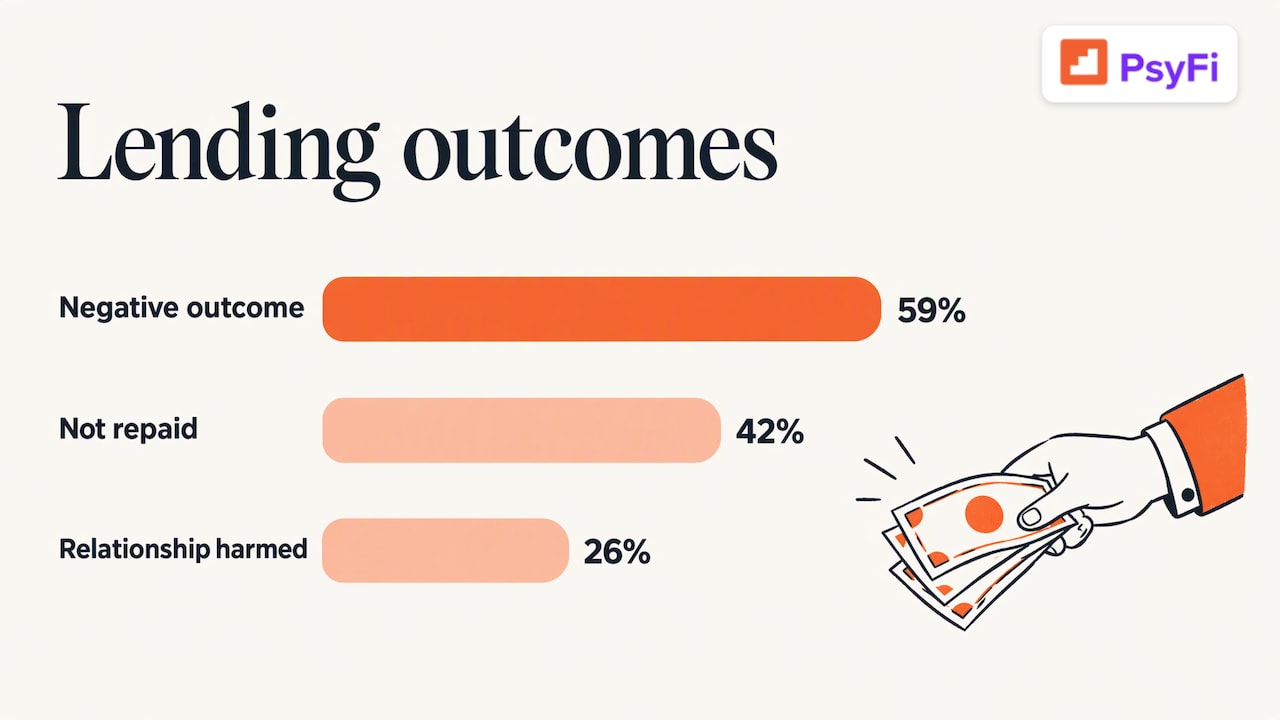
According to a 2022 CreditCards.com survey cited by Experian, 59% of people who lent money had a negative outcome. Forty-two percent were not repaid, and 26% said the loan harmed their relationship with the borrower. That is not a reason for guilt. It is a reason to decide your terms before you say yes.
Experts offer these ideas:
Idea | Why it helps | Source |
|---|---|---|
Look at your own finances first | You can only help from a stable place | |
If you can afford the loss, consider a gift instead of a loan | No repayment tension | |
Write down the amount, repayment schedule and how you want to be paid back | Everyone knows the plan | |
Lend only what you can afford to lose, and only to people you trust | Protects your stability | |
Discuss plans for future gifts or loans in advance | Prevents surprise and resentment |
If someone needs ongoing support, financial advisor Carolyn McClanahan suggests creating “engagement standards”. These spell out how long support will last, how much you will give and what the person does to keep receiving it.
If you find that helping family has become tangled with your own finances, our guide on financial enmeshment walks through it. For situations involving legal paperwork or a large sum, a licensed professional can give advice specific to you.
Financial boundaries in relationships
With a partner, boundaries are less about saying no and more about agreeing on rules you both understand. The earlier you do this, the easier it is. America Saves suggests setting agreements early if you’re in a relationship or sharing expenses.
Here are topics couples often cover:
Topic | Question to talk through |
|---|---|
Spending without asking | What amount can each of us spend without checking in? |
Shared costs | Who pays for what, and how do we decide? |
Debt and credit | What do we share, and what stays private to each of us? |
Goals | What are we each saving for, and what do we save for together? |
Family | How do we handle requests from relatives? |
Dr. James, speaking to Essence, suggests agreeing on a dollar amount that either partner can spend without talking first. For some couples that is $100, and for others $500. The point is shared awareness, not asking permission.
AP News reports that Andrew Crowell, a wealth management executive, says many successful couples set a regular time to talk about money, such as monthly or quarterly, to revisit spending, savings goals and budgets.
Families with children from earlier relationships may need extra clarity. Mikel Van Cleve of Texas Tech University says blended families need clear rules so everyone knows their role, for example how adults will share costs like car insurance, phone plans and college.
For more, see our guides on budgeting as a couple without fighting and financial infidelity.
Our perspective on financial boundaries
We see the same thing again and again: people don’t struggle with boundaries because they don’t know the numbers. They struggle because of what they feel in the moment. Guilt, fear of letting someone down, and the urge to avoid looking at an account can all push a good plan aside.
That’s why we think a boundary works best when it starts with your own behavior. Before you tell anyone else “no,” it helps to see your own pattern clearly. When do you overspend? What were you feeling? Once you know that, the limit is easier to set and easier to keep.
PsyFi is built around that idea. Our AI engine looks at your own financial data to spot patterns like stress spending or avoiding your accounts, and our AI coach, FY, helps you work on the habit as it happens. PsyFi is for individuals. If you share your life with a partner, each of you can use it for your own habits, and the two of you can still agree on shared rules together. We offer coaching, not financial advice.
Maanya Nagpal
Where PsyFi fits
If you want help seeing your own patterns before you set a limit, PsyFi can help. It reviews your real spending, points out habits behind it and gives you daily coaching. A 7-day free trial comes first. After that, Premium is $9.99 per month or $69.99 per year.
PsyFi works in the US and Canada. It connects through Plaid bank sync or document upload, so no bank login is required. You can also see what’s included on the features page. Learn more about us: https://www.psyfiapp.com/about-us
How to keep a boundary without damaging the relationship
A boundary is not a punishment. These habits help you hold your limit and keep the connection.
Habit | What it looks like |
|---|---|
Be brief and kind | “I can’t, but I’m glad you asked me.” |
Focus on one topic at a time | Talk about the loan, not every past money disagreement |
Listen actively | Repeat back what you heard in your own words |
Don’t interrupt | Let the other person finish |
Be ready to agree to disagree | You don’t have to win to keep your limit |
The last four come from Consumer Reports guidance on family money conversations. It also notes that when a family money issue is contentious, a neutral person such as a financial planner or CPA can help keep talks on track.
Expect some discomfort at first. Feeling uneasy after saying no doesn’t mean the boundary is wrong. It usually means it’s new. If you slip once, you haven’t failed. Reset at the next opportunity.
It also helps to build a cushion, so a surprise doesn’t force a hard choice. Our guide to emergency fund size can help you pick a starting target.
FAQ
What are examples of financial boundaries?
Examples include a monthly limit on dining out, a rule that you only lend what you can afford to lose, and keeping your salary private. Others include agreeing on a dollar amount each partner can spend without checking in. The best boundaries are specific and tied to a goal.
How do I say no to family who ask for money?
Keep it short, kind and clear. You could say, “I really wish I could, but it’s not in my financial plans right now,” a phrase America Saves suggests. You can also offer your time or advice instead of money.
Are financial boundaries selfish?
No. They protect your stability, which is what lets you help others over time. A boundary is a way to decide in advance what you can offer, so you’re not caught off guard and resentful later.
How do I set financial boundaries with a partner?
Talk early and talk regularly. Agree on how to split shared costs, what amount each of you can spend without checking in, and how often you’ll review your money together. Each of you can still track your own habits separately.
Should I lend money to a friend?
Look at your own finances first, and only lend what you could afford to lose. If you can afford the loss, experts quoted by HuffPost suggest a gift may be easier than a loan. If you do lend, put the terms in writing. For legal questions, talk to a licensed professional.
Ready to understand the habits behind your money limits?
Boundaries are easier when you can see your own patterns. Start your 7-day free trial and let PsyFi help you spot the habits behind your spending.
Sources
Financial therapist shares how to set boundaries around money (ABC News)
Protecting Your Peace With Financial Boundaries (America Saves)
How I’m Talking to Clients About Setting Financial Boundaries (Investopedia)
Expert Advice For When You Should Lend Friends Money (HuffPost)
The 7 Money Conversations Every Couple Should Have (Essence)
Recommended
Couples: Stop Financial Infidelity, Secure Your Credit, Rebuild Trust
Why Am I So Bad With Money? Understanding Your Money Mindset
This content is provided for general informational and educational purposes only and does not constitute financial, investment, tax, or legal advice. PsyFi provides financial coaching tools and behavioral insights, not regulated advisory services. Always consult with a qualified financial advisor or tax professional regarding your personal situation before making financial decisions.
Keep reading
- Regain Financial Independence with 5 Steps to End Financial EnmeshmentFive research backed steps to end family financial enmeshment. Use exact boundary scripts, safety actions for abuse, and PsyFi habit tools to keep your...
- Best Financial Coaching Apps in 2026: How to Pick OneCompare the best financial coaching apps in the US: PsyFi, YNAB, Monarch, Rocket Money, Copilot and EveryDollar. See criteria, pros, cons and who each fits.

- RESP vs TFSA: The Impossible Choice for ParentsFacing choice overload between RESP, RRSP, and TFSA? Discover why Canadian parents struggle to prioritize registered accounts and how to build a clear savings hierarchy.