

Reverse Budgeting: Pay Yourself First, Then Spend the Rest
Reverse budgeting means you save first and spend what is left. Learn how to set it up, how much to save, and how to keep your bills covered.
By Maanya Nagpal, Co-Founder of PsyFi
Reverse budgeting means you decide how much to save first, move that money out of your spending account, and then spend what is left. It is also called the anti-budget or pay-yourself-first method. You still pay your bills, but you skip the work of tracking every coffee and grocery run.
If budgets have never stuck for you, that is common, and it says nothing bad about you. This guide shows how the method works, how to pick a savings amount you can keep up, and how to protect your bills while you do it.
TL;DR
Reverse budgeting puts savings first: you set a savings amount, move it right away, and spend the rest. It does not mean skipping essential bills.
There is no fixed percentage. 20% of take-home pay is a common starting point, but you can and should adjust it to your life.
It works best with steady income. Variable income or high-interest debt means you need a more careful setup.
Automate the transfer, start small, and review it when your income or bills change.
Table of Contents
What reverse budgeting is
A traditional budget starts with spending. You list categories, set limits, track every purchase, and save whatever is left. For many people, nothing is left.
Reverse budgeting flips the order. Savings come first, bills come next, and the rest is yours to spend. NerdWallet describes it as prioritizing a set savings amount before bills and discretionary spending, then using the remaining income for needs and wants.
Here is the difference side by side.
Traditional budget | Reverse budget | |
|---|---|---|
First step | List and cap every spending category | Choose a savings amount |
Where savings come from | Whatever is left at month end | Moved out as soon as you are paid |
Tracking | Every purchase, often | Light. Mostly bills and the leftover balance |
Main risk | Burnout from constant tracking | Saving too much and missing a bill |
Best for | People who like detail | People who want a hands-off system |
Notice the name “anti-budget.” It does not mean “no plan.” It means fewer rules. You make one big decision up front, and automation does the rest.
Why it can feel easier than a regular budget
Most budgets fail from effort, not from bad math. Tracking dozens of categories takes daily attention, and one missed week can make you feel like you failed. Behavioral scientists call this the “what the hell” effect: once you slip, you decide you may as well give up.
Reverse budgeting cuts the number of decisions. Prudential notes that it is low maintenance once your savings deposits are automated, because you spend what remains after saving. Marcus by Goldman Sachs makes a similar point: you do not need to track category by category.
If you want more gentle options, our guide to budgeting when you hate budgeting covers three easy alternatives. And if constant tracking wore you out, budgeting burnout explains why one automatic transfer can help.
How to set up a reverse budget
The steps below follow the process described by U.S. News Money: set priorities, give each a monthly amount, save first, spend the remainder, automate, and adjust.
Step | What you do | Example question to ask yourself |
|---|---|---|
1. Look at your real spending | Review your last few bank and credit card statements | What actually leaves my account each month? |
2. List your goals | Write short-term and long-term goals | What do I want money to do for me? |
3. Give each goal a monthly amount | Put a dollar figure next to each one | What can I afford without missing bills? |
4. Subtract from your income | Take the total away from your take-home pay | What is left for bills and spending? |
5. Check your bills | Make sure the remainder covers essentials | Is rent, food and utilities covered? |
6. Automate | Set up recurring transfers or split direct deposit | Can this happen without me thinking? |
7. Adjust | Revisit when life changes | Did my pay, rent or goals change? |
Step 1: Start with your actual numbers
NerdWallet suggests reviewing your bank and credit card statements first, so you know what a normal month costs. Do this without judgment. You are collecting information, not grading yourself.
If you do not want to dig through statements by hand, our post on setting up automatic spending tracking walks through a faster route.
Step 2: Name your goals
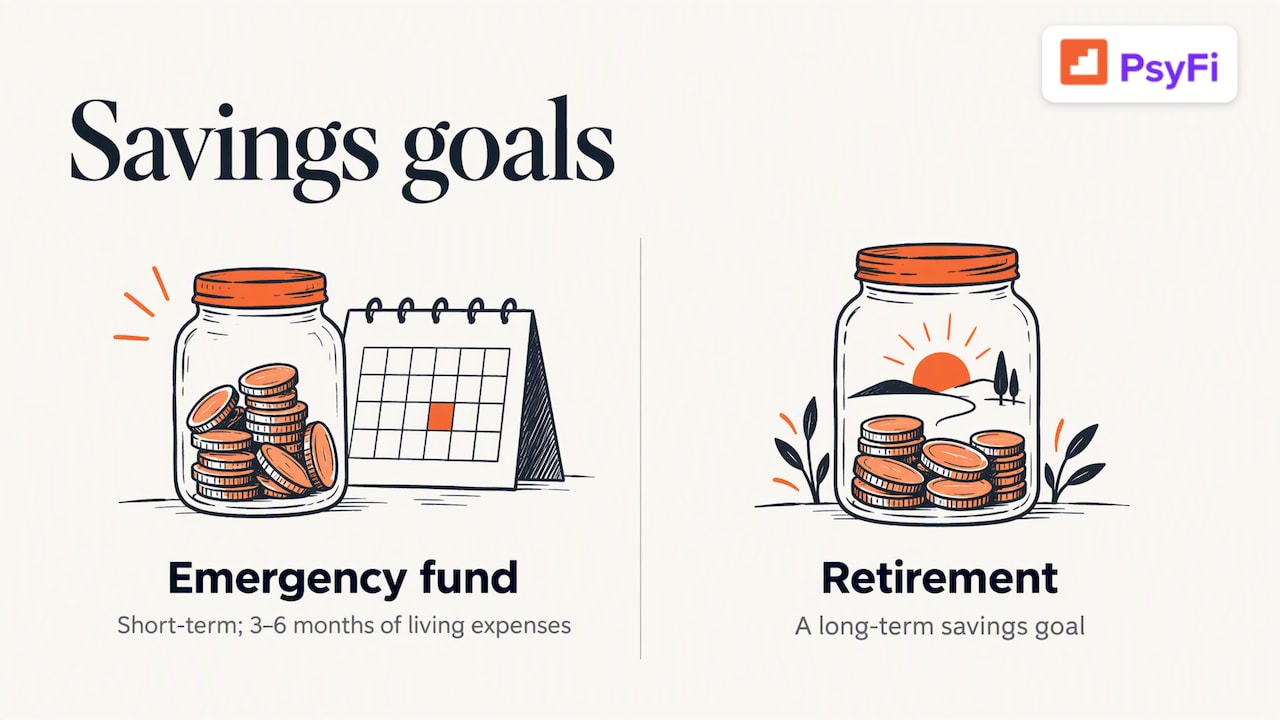
NerdWallet says to list short-term and long-term goals, and it names retirement and an emergency fund covering three to six months of living expenses as first priorities. Investopedia also suggests deciding what to save per month or paycheck for short-term goals, like an emergency fund, and long-term goals, like retirement.
This is general education, not personal advice. If you are unsure which goals fit your situation, a licensed financial professional can help. PsyFi offers coaching, not financial advice, and is not a licensed financial advisor.
Not sure what your goal should cost each month? Try the free savings goal calculator. The emergency fund calculator can help with a safety-net target.
Step 3: Move the money automatically
The “reverse” part only works if the money really moves. You have two common options:
Recurring transfer. Schedule a transfer from checking to savings the day after payday.
Split direct deposit. Investopedia reports that some payroll providers let you spread your direct deposit across several accounts. Savings land in their own account before you see them.
Once it runs on its own, you only have to watch one number: what is left in your spending account.
How much should you save?
There is no magic number. The right amount is one you can keep up through a normal month, including the bad ones.
Reference point | What it says | Source |
|---|---|---|
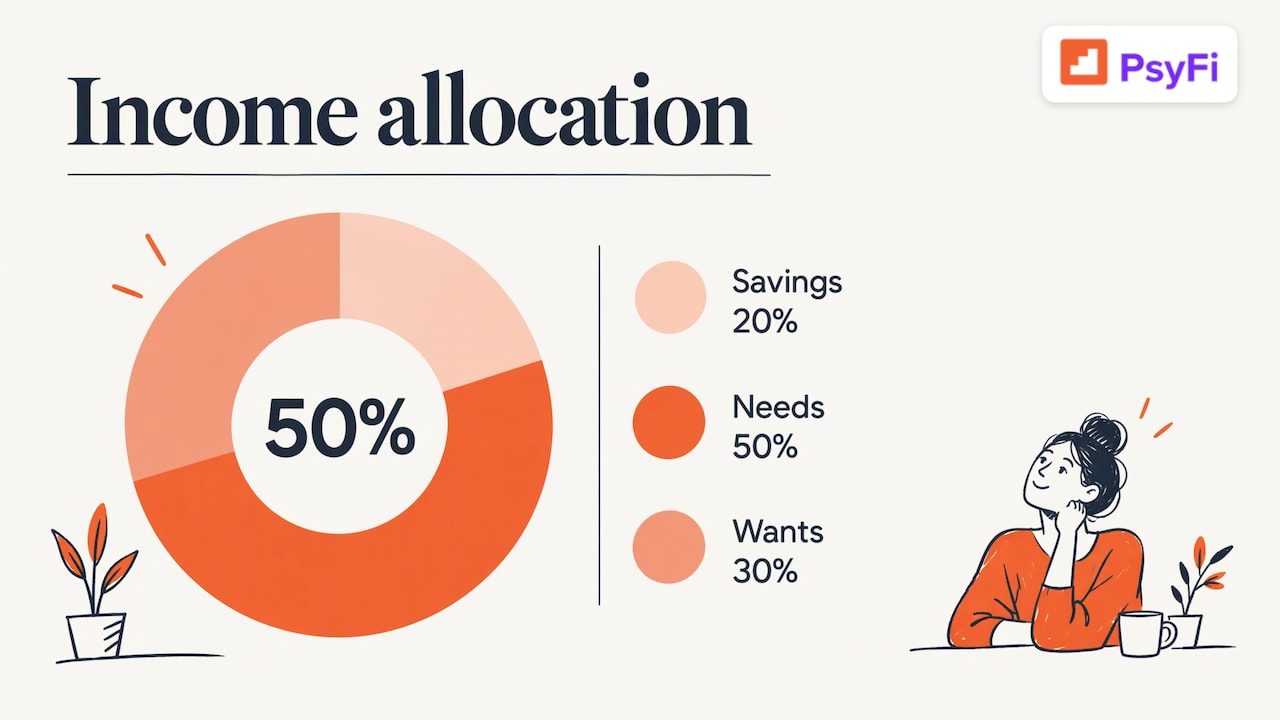
20/50/30 split | 20% to savings, 50% to needs, 30% to wants, with the percentages adjustable | |
10% to 20% of each paycheck | A range many financial gurus suggest, though living costs may make it hard | |
A flexible rate | 20% is a simple reference point, but it should change with your goal and situation |
If 10% sounds out of reach, start with 2% or 3%. A small amount you keep doing beats a big amount you cancel after two months. NerdWallet advises starting conservatively so the transfer does not cause an overdraft or a bounced check.
Reverse budgets are also not set in stone. Investopedia quotes a certified financial planner saying that when income, expenses or goals change, you should revisit the plan and raise or lower the savings rate to stay balanced.
A simple worked example
Say your take-home pay is $3,000 a month. This is an illustration only, not a recommendation.
Line | Amount |
|---|---|
Take-home pay | $3,000 |
Saved first (10%) | $300 |
Left for bills and spending | $2,700 |
Rent, utilities, groceries, transport (example) | $1,900 |
Free to spend however you like | $800 |
If the “free to spend” line turns out to be $0 or negative, the savings amount is too high for now. Lower it until bills fit, then raise it later.
Keeping bills, debt and surprise costs covered
The biggest worry with reverse budgeting is simple: what if saving first leaves too little for bills? That is a fair worry. Prudential warns that people living paycheck to paycheck may face overdrafts, late fees or utility shutoffs if they save before making sure bills are covered.
Here is how to guard against that.
Cover essentials in your plan. Rent, utilities, food, insurance, minimum debt payments and transport come before wants.
Start small. Raise the amount only after a couple of calm months.
Watch your balance after payday. If you are repeatedly short, AARP says to reduce the automated amount. It also says to increase it when you have extra cash or get a raise.
Plan for yearly bills. Car registration, annual subscriptions and holiday gifts can hit all at once. Divide each by 12 and treat it like a monthly bill.
Leave a small buffer in checking. Our guide on avoiding overdraft fees gives eight steps for that.
What about debt?
High-interest debt changes the math. Investopedia says substantial high-interest debt should be a top priority, and that reverse budgeting can be modified to put debt repayment first instead of savings. NerdWallet says to capture a 401(k) match and build a starter emergency fund before putting high-interest debt first.
Debt is common and fixable. There is nothing shameful about it. If you are weighing the two choices, read pay off debt or save first. Keep in mind this is general education, not tax, legal or investment advice.
What if your income changes month to month?
Variable income makes any fixed transfer risky. NerdWallet notes that the method suits steady, predictable income best. If you are self-employed or paid by the project, base your savings on your lowest recent month and move extra money to savings in the good months. Raising what you earn per project can also steady things out, and negotiating project management fees is one way freelancers do that.
Pros and cons
Pros | Cons |
|---|---|
Low maintenance once automated | Bills can come up short if the savings amount is too high |
Keeps your attention on big goals | Harder if you carry high-interest debt |
Easy to automate | Less detail about where your money goes |
Fewer decisions, less decision fatigue | Needs a review when income or expenses change |
The pros and cons above come from NerdWallet’s summary. The cons are mostly about setup. Start small, check your bills, and they shrink.
Who reverse budgeting fits best
Situation | Fit | Why |
|---|---|---|
Steady paycheck, money left over most months | Strong | You can save first without squeezing bills |
Tired of tracking every purchase | Strong | The method needs far less tracking |
Spending down to zero before every payday | Good, if you start small | Saving first can break that cycle |
Variable income | Needs care | Base the amount on your lowest month |
Paycheck fully committed to bills | Weak for now | Prudential says it suits people who regularly have funds left after obligations |
If your bills already take everything, the first job is finding room, not forcing a transfer. That is not a personal failing. It usually means income and costs are out of balance, and that can be worked on step by step.
Reverse budgeting vs. other methods
Method | How it starts | Effort level |
|---|---|---|
Reverse budget | Save a set amount, spend the rest | Low |
50/30/20 | Split pay into needs, wants, savings | Low to medium |
Zero-based budget | Give every dollar a job | High |
If you like more control, see our zero-based budget plan. For a deeper look at the savings-first idea, read pay yourself first. To turn goals into a number, use these steps for a savings plan.
Our view: the habit matters more than the method
We build PsyFi around one idea: the numbers are rarely the hard part. The hard part is the habit behind them, like stress spending, avoiding your accounts, or giving up after one bad week.
Reverse budgeting works for many people because it removes decisions. Our approach is to go one step further. We look at your own data to find the pattern behind your spending, then our AI coach, FY, helps you change that habit as it happens. Your savings amount then reflects how you really live, not a rule you copied from a chart.
We believe the best plan is one you can explain and control. That is why PsyFi shows you the why behind its suggestions, and why it is coaching, not financial advice.
Maanya Nagpal
Where PsyFi can help
If you want help picking a savings amount and sticking to it, PsyFi can read your real spending and suggest a plan based on your own patterns. It is for individuals only, so each person uses it for their own habits.
PsyFi works in the US and Canada. You connect through Plaid bank sync or by uploading documents, and no bank login is required. Plans are $9.99 per month or US$69.99 per year, after a 7-day free trial. You can see them on the pricing page.
FAQ
What is reverse budgeting in simple terms?
It is a way to budget where you save first and spend what is left. You choose a savings amount, move it out when you are paid, then cover bills and spending with the rest. You do not need to track every category.
Is reverse budgeting the same as the anti-budget method?
Yes, people use the names for the same idea, along with pay yourself first. All of them put savings ahead of spending. The “anti” part refers to skipping detailed category tracking, not skipping bills.
How much of my paycheck should I save with reverse budgeting?
There is no one right number. Investopedia notes that many gurus suggest 10% to 20%, but your living costs may make that hard. Start with an amount that keeps your bills safe, then raise it over time.
Does reverse budgeting work if I live paycheck to paycheck?
It can, but start very small and check your bills first. If saving first causes late fees or overdrafts, lower the amount. You may also need to look for room in your spending before the method fits.
Should I pay off debt before reverse budgeting?
It depends on the debt. Investopedia says high-interest debt should be a top priority, and you can tilt your reverse budget toward repayment. For advice on your own situation, talk to a licensed financial professional.
Ready to stop guessing what is safe to save? Start your 7-day free trial and let PsyFi help you build a savings habit that fits how you actually spend.
Sources
Why Reverse Budgeting Is the Money Hack That Could Transform Your Savings (Investopedia)
‘Pay Yourself First’: A Key Strategy for Financial Stability (Investopedia)
The 50-30-20 Budgeting Rule and Other Budgeting Methods (Marcus by Goldman Sachs)
Recommended
This content is provided for general informational and educational purposes only and does not constitute financial, investment, tax, or legal advice. PsyFi provides financial coaching tools and behavioral insights, not regulated advisory services. Always consult with a qualified financial advisor or tax professional regarding your personal situation before making financial decisions.
Keep reading
- Pay Yourself First: The Savings Strategy That Actually Works
- How to Create a Budget When You Hate Budgeting
- Goal Gradient Effect: How Nearing a Goal Helps You SaveThe goal gradient effect means you push harder the closer you get to a finish line. See real examples and how to use it for saving and debt payoff.