

Goal Gradient Effect: How Nearing a Goal Helps You Save
The goal gradient effect means you push harder the closer you get to a finish line. See real examples and how to use it for saving and debt payoff.
The goal gradient effect is the tendency to try harder the closer you get to a goal. It works for coffee punch cards, video games and savings accounts, and you can use it on purpose by making your progress visible and your finish lines close.
By Maanya Nagpal, Co-Founder of PsyFi
If you have ever sprinted through the last few pages of a book, or found yourself saving more once your balance was almost at its target, you have felt this. It is not a willpower flaw when your effort rises and falls. It is how many human brains respond to progress. This guide explains where the idea comes from, shows everyday examples, and walks through how to use it for saving and paying down debt, without shame and without gimmicks.
TL;DR
The goal gradient effect says effort and motivation rise as you get closer to a reward.
It was first seen in animals, then shown in people through café loyalty cards, games and even debt repayment.
To use it for saving, set a small first target, track progress where you can see it, and add checkpoints along the way.
Motivation can dip in the middle of a long goal, so plan small wins for that stretch.
This is general education, not personal financial advice.
Table of Contents
What the goal gradient effect means
The goal-gradient hypothesis started with animal research. It is the finding that animals put in more effort as they approach a reward, as Kivetz, Urminsky and Zheng describe in their 2006 paper. Those researchers then asked a simple question: do people do the same thing?
They do. In the same paper, members of a café reward program bought coffee more often as they got closer to a free cup. The closer the finish line felt, the shorter the gaps between purchases.
Here is the idea in plain terms:
Part of the idea | What it means | Money example |
|---|---|---|
Goal | A reward or finish line you care about | A $1,000 starter emergency fund |
Gradient | Motivation is not flat; it slopes upward | You add extra when you are 80% there |
Proximity | How close the goal feels, not only how close it is | A progress bar that shows you are nearly done |
That last row matters most. The effect depends on how near the goal seems to you. That is why the design of your tracking can change your behavior.
Goal gradient effect examples you already know
You do not need a lab to see this effect. Here are common places it shows up.
Everyday situation | What you notice | The goal gradient at work |
|---|---|---|
Coffee or sandwich punch card | You go back more often as the card fills | Each stamp makes the free item feel closer |
Fitness app streaks and rings | You close your ring on the last day of the week | Being nearly done pulls you forward |
Profile completion bars on job or social sites | You add one more detail to reach 100% | A visible gap feels worth closing |
Video games | You grind harder before a level-up | Progress is shown clearly and often |
Paying off a credit card | You send extra once the balance looks small | The end feels reachable |
A savings target | Deposits get bigger near the target | The final stretch feels exciting, not heavy |
Researchers have tested several of these. In a 2024 study using the word game Wordle, Dixon and colleagues found that feedback showing progress toward a goal raised motivation and positive mood compared with feedback that blocked progress. In two other experiments, people responded faster when a reward was near, but only when they were told how close it was.
That second point is useful. If you cannot see how close you are, the effect has nothing to work with.
The loyalty card trick: why a head start helps
A related idea is called the endowed progress effect. In a field experiment at a car wash, Nunes and Drèze gave customers loyalty cards that either started empty or came with a couple of stamps already added. Both groups needed the same number of new purchases. The researchers wanted to know whether starting partway there would change how many people finished.
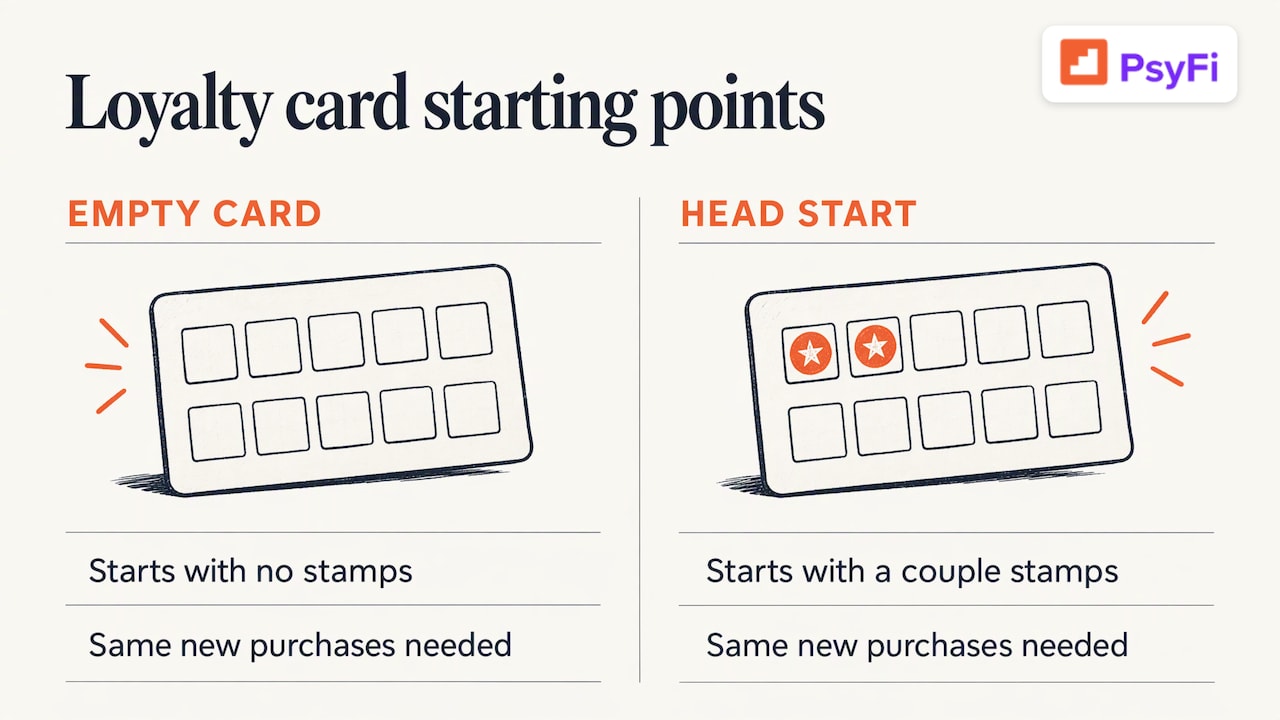
What you can take from this for your own money: a goal that already has some progress feels more doable. Kivetz and his colleagues also found that illusory progress sped up purchases, which is why a head start can work even when it is small.
You can borrow this honestly. If you already have $60 in a checking account that you can set aside, count it toward your savings goal on day one. You are not tricking yourself. You are starting from where you really are.
How to use the goal gradient effect to save money
Saving can feel slow at first, because the goal looks far away. The goal gradient effect suggests you should shrink the distance you see. Here is a simple plan.
Pick a first goal that is close. The Consumer Financial Protection Bureau (CFPB) suggests starting with $500 in emergency savings and, once you reach it, considering $1,000.
Count what you already have. Add any money you can set aside today as your starting point.
Make progress visible. Use a bar, a chart or a simple tally you will see every day.
Add checkpoints. Split the goal into quarters so you get a win every few deposits.
Automate the deposits. The CFPB toolkit points to automatic transfers or splitting your direct deposit so saving happens without a daily decision.
Celebrate each checkpoint. Make it small and free: a note, a walk, a message to a friend.
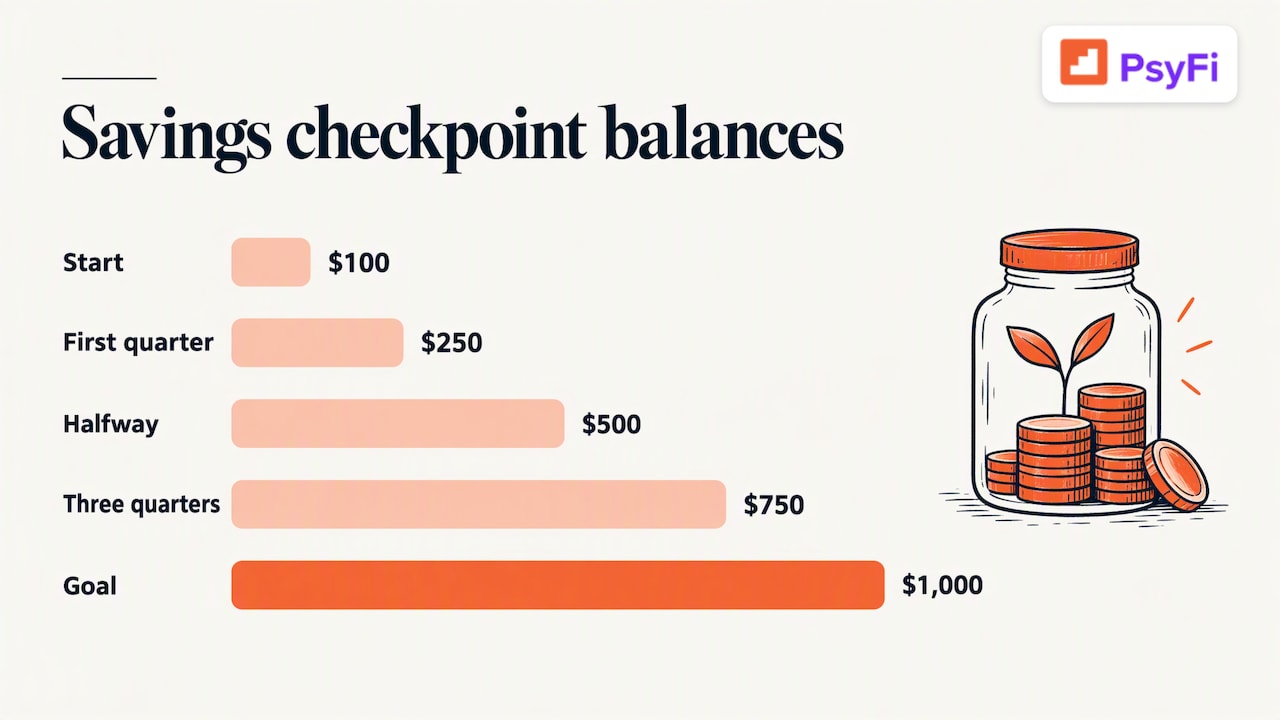
Here is an example with made-up numbers, just to show the idea. Say you want $1,000 and can save $50 a week.
Checkpoint | Balance | Weeks at $50 per week | What you tell yourself |
|---|---|---|---|
Start (you count $100 already set aside) | $100 | 0 | “I have already started.” |
First quarter | $250 | 3 | “One quarter done.” |
Halfway | $500 | 8 | “This is the first CFPB-style milestone.” |
Three quarters | $750 | 13 | “Only a quarter to go.” |
Goal | $1,000 | 18 | “My starter cushion is built.” |
Your numbers will differ. To find your own timeline, try the free savings goal calculator. To decide how big your cushion should be, see our guide on how to size an emergency fund or use the emergency fund calculator.
If you want a more playful way to make progress feel close, our seven gamified savings challenges turn deposits into small, visible wins. For a short, gentle first target, see how to build a $250 to $749 safety net with psychology-backed steps.
Using the goal gradient effect on debt
The same effect shows up when you owe money. A 2018 study of consumer credit found that borrowers without minimum repayment commitments paid more as they neared the next lower debt threshold. That is consistent with the goal gradient effect. Getting closer to a lower balance made people want to push through.
This is also the idea behind the debt snowball, where you pay the smallest debt first. Brown and Lahey’s 2015 research suggests people often finish tough tasks faster when the work is broken into parts that get steadily harder. The same coverage notes the snowball may not always be the cheapest way to cut total interest.
So you have two honest choices, and neither one is wrong:
Approach | How it works | Where it helps | Trade-off |
|---|---|---|---|
Smallest balance first (snowball) | Pay off the smallest debt, then roll that payment to the next | Quick wins keep you going | May cost more interest over time |
Highest interest first | Put extra money on the most expensive debt | Usually lowers total interest | The first win can take longer |
If you carry debt, that is not a character issue. Many people do. If you want to see how each path looks with your own numbers, the debt payoff planner can help. If you are weighing saving against paying down debt, read how to decide whether to pay off debt or save first. To understand why debt can feel so heavy, see the psychology of debt.
When motivation dips in the middle
The goal gradient effect is not a straight line for everyone. Early on, a fresh start feels exciting. Near the end, the finish is close. The middle can feel flat. Research on this “stuck in the middle” pattern by Bonezzi and colleagues in 2011 found that motivation can be lower midway through a goal than at the beginning or the end.
If you notice this, nothing is wrong with you. Your plan just needs a little help in the middle. Try these:
Middle-of-the-goal problem | What it feels like | What to try |
|---|---|---|
The goal feels far away | “I have been at this forever” | Reset the target to the next checkpoint only |
Progress feels too slow | Small deposits seem pointless | Show total saved and total deposits made |
A slip happens | “I blew it, so why bother?” | Treat it as one data point and make the next deposit |
Income changes | A smaller paycheck breaks the plan | Lower the transfer for now instead of stopping it |
That last row comes from the CFPB, which suggests that if your income swings, temporarily decreasing automatic savings rather than stopping it keeps the habit alive.
If your goal is bigger than a cushion, such as a life change that needs months of steady saving, a structured plan like this six-month finance first plan can help you keep going through the long middle.
Common mistakes when using progress to motivate yourself
Visible progress is a tool. Like any tool, it can be used in ways that backfire.
Setting only one far-off target. A single $10,000 goal gives you no wins for a long time. Add checkpoints.
Hiding the numbers. Avoiding your accounts removes the proximity signal the effect needs.
Rewarding yourself with spending. A treat is fine, but keep it small so it does not undo the checkpoint.
Treating a slip as failure. One missed week does not erase progress. Start from the balance you have.
Copying someone else’s goal. Your income, bills and comfort level are your own.
Our perspective
At PsyFi, we see the goal gradient effect as one of the most practical ideas in behavioral finance, because it explains something people often blame on themselves. When saving feels hard at the start, it is usually not a lack of discipline. The goal looks too far away, and nothing on the screen tells you that you are making headway.
We build around that. Our approach is to look at your own financial behavior, spot patterns such as stress spending or avoiding your accounts, and then coach you toward your next small step. Generic budgeting rules treat everyone the same. We think a checkpoint that fits your real data will feel closer, and so will be easier to reach.
We also believe coaching should be kind. A dip in the middle is normal. We would rather help you make the next deposit than tell you what you should have done last month.
Maanya Nagpal
Where PsyFi fits
If you would like a coach to help you set checkpoints and notice your own patterns, PsyFi is built for that. It is an AI-driven financial wellness app that offers a daily check-in, personalized saving and spending plans, and a library of behavioral interventions. It works in the US and Canada, and it connects through Plaid or document upload, so no bank login is required. Premium costs $9.99 per month or $69.99 per year, after a 7-day free trial. You can see what is included in the features or compare options on the pricing page.
PsyFi offers coaching, not financial advice, and it is not a licensed financial advisor. It is also for individuals, so if you share money goals with a partner, each of you would use it for your own habits.
FAQ
What is the goal gradient effect in simple terms?
It is the tendency to work harder as you get closer to a reward. It was first seen in animals and was later shown in people, such as café customers buying coffee more often as they neared a free cup.
What is the goal gradient effect in saving money?
In saving, it means you may deposit more, or stick with the plan longer, as your balance gets close to your target. To use it, set a small first goal, show your progress where you will see it and add checkpoints. A first target of $500, then $1,000, is the CFPB’s suggested starting point for emergency savings.
What is the difference between the goal gradient effect and the endowed progress effect?
The goal gradient effect is about effort rising as you near the end. The endowed progress effect is about getting a head start, such as a loyalty card that begins with stamps already on it. The two work well together in a savings plan.
Why do I lose motivation halfway to a goal?
Many people do. Research on the “stuck in the middle” pattern found that motivation can be lower midway than at the start or the end. Smaller checkpoints and a visible progress tracker can help you through that stretch.
Does the goal gradient effect work for paying off debt?
It can. One 2018 study found that borrowers paid more as they approached a lower debt threshold. Whether to pay the smallest or the most expensive debt first depends on your situation, and a licensed professional can advise you on your own case.
Unsure where your money habits stand, or tired of starting plans you cannot sustain? Start your 7-day free trial and let PsyFi help you find your next small checkpoint.
Sources
The Goal-Gradient Hypothesis Resurrected (Kivetz, Urminsky and Zheng, 2006)
Proximity to rewards modulates parameters of effortful behavior (2024)
Using Wordle to assess the effects of goal gradients (Dixon et al., 2024)
The goal gradient effect and repayments in consumer credit (2018)
A financial empowerment toolkit for community volunteers (CFPB, 2015)
The Endowed Progress Effect: How Artificial Advancement Increases Effort (Nunes and Drèze, 2006)
Recommended
This content is provided for general informational and educational purposes only and does not constitute financial, investment, tax, or legal advice. PsyFi provides financial coaching tools and behavioral insights, not regulated advisory services. Always consult with a qualified financial advisor or tax professional regarding your personal situation before making financial decisions.
Keep reading
- Daily Spending Limit: How to Set One That Fits Your LifeA daily spending limit is a number you choose for everyday spending. Learn how to set one after bills and savings, track it, and tell it from a bank limit.

- Windfall Money: How to Make a Plan Before You Spend ItGot a bonus, refund, inheritance or settlement? Here is a plain-language plan for windfall money: what to do first, how taxes work, and how to split it.

- Best AI Budgeting Apps in Canada: How to Pick One You’ll KeepCompare AI budgeting apps for Canadians: PsyFi, YNAB, Monarch, Copilot, PocketSmith and more. See criteria, pricing, bank sync, and pros and cons in tables.