


Windfall Money: How to Make a Plan Before You Spend It
Got a bonus, refund, inheritance or settlement? Here is a plain-language plan for windfall money: what to do first, how taxes work, and how to split it.
By Maanya Nagpal, Co-Founder of PsyFi
Windfall money is a large, one-time payment that lands outside your normal paycheck, like a bonus, tax refund, inheritance, settlement or lottery prize. The best first move is to park it somewhere safe, set aside money for taxes, and give yourself time to choose a plan. There is no rush, and no shame in feeling excited or nervous about it.
This guide shows you what to do in order, how a bonus differs from a surprise payment, and how to split the money across your goals. It is general education, not personal investment, tax or legal advice. PsyFi is not a licensed financial advisor.
TL;DR
Put the money in a safe, insured account first, then take time before any big decision.
Set aside cash for taxes. Bonuses are usually withheld at a flat federal rate that may not cover what you really owe.
Fill your emergency fund and pay down high-interest debt before you invest or splurge.
Give yourself a planned “fun” slice so you do not feel the urge to blow the whole plan.
Write your split down while you are calm, then automate it.
Table of Contents
What counts as windfall money?
A windfall is any sudden sum well above what you normally take in. The U.S. Securities and Exchange Commission’s investor site describes a lump sum payment as money paid all at once, and lists examples such as a bonus, an insurance claim or settlement, a tax refund, an inheritance or lottery winnings.
Some windfalls are happy surprises. Others come with grief, like an inheritance. If a loved one has died and you think money may be owed to them or their estate, this guide on claims after a loved one dies explains how those payouts can work.
Either way, the feelings are real. Excitement, guilt, relief and anxiety can all show up at once. That is normal, and it is one reason a plan helps.
Type of windfall | Usually expected? | Common feeling | Main thing to check first |
|---|---|---|---|
Work bonus | Often | Pride, pressure to “treat yourself” | Tax withheld vs. tax owed |
Tax refund | Yes | Relief | Whether you can adjust withholding later |
Inheritance | No | Grief mixed with relief | Who handles the estate, and any taxes |
Legal or insurance settlement | No | Stress, mixed emotions | How the payment is taxed |
Gift from family | No | Gratitude, guilt | Any strings attached |
Lottery or prize | No | Shock, excitement | Taxes and requests from others |
Step 1: Pause and park the money somewhere safe
The first job is to protect the money while you think. FINRA, the securities industry’s self-regulator, suggests holding off on major moves for six to 12 months, keeping the cash in a relatively safe bank or credit union account such as a savings account or CD, getting organized, and talking with financial professionals.
You may not need the full six to 12 months. The point is that nothing about a windfall expires in a week. A pause protects you from rushed choices made on adrenaline.
For safety, look at deposit insurance. The FDIC insures deposits up to $250,000 per depositor, per insured bank, for each account ownership category. That same FDIC guide says stocks, bonds, mutual funds and crypto assets are not covered. So a plain insured savings account is a calm holding spot. If you want to compare options, see our guide to picking a high-yield savings account.
If your windfall is bigger than $250,000, a financial professional can help you understand how to stay within insurance limits.
A simple first-week checklist
Do this | Why it helps |
|---|---|
Move the money into an insured savings account | Keeps it safe and out of easy spending reach |
Tell only a few people you trust | Fewer people means fewer requests |
Gather paperwork (pay stub, settlement letter, estate documents) | You will need it for taxes and planning |
Write down your debts and balances | You cannot split money without knowing the targets |
Book time with a tax pro or fee-only planner if the amount is large | Objective advice beats guessing |
Step 2: Set aside money for taxes
Taxes are the part people forget, and it can sting later. The rules depend on the type of windfall, so treat this as general education and check with a tax professional about your case.
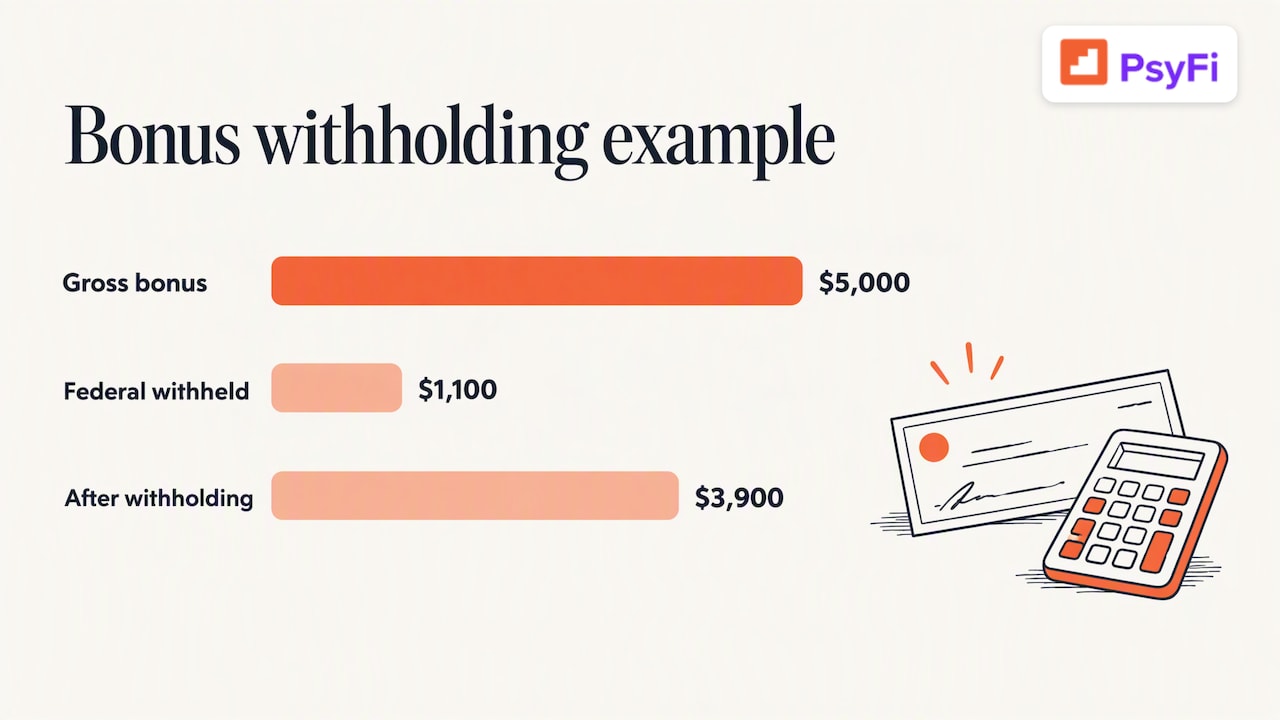
For work bonuses, the IRS says supplemental wages are typically withheld at a flat 22% federal rate for amounts up to $1 million in 2026, and 37% above that. Bloomberg notes that bonuses may also face payroll and state or local taxes, and that the withheld amount may not match your real tax bill, so it is wise to estimate your total burden and set extra cash aside.
Here is a made-up example to show the idea. It is not a prediction for you.
Example: $5,000 bonus | Amount |
|---|---|
Gross bonus | $5,000 |
Federal withholding at 22% | $1,100 |
Left after federal withholding only | $3,900 |
Social Security, Medicare and state or local taxes | Vary by where you live and work |
So the check you see could be well under $5,000. Plan with the smaller number. If your real tax turns out lower, you have a pleasant extra later.
Inheritances, settlements and prizes are taxed under different rules. Some are not taxed the same way a bonus is. A tax professional can tell you which applies to you.
Step 3: Build your windfall allocation plan
Once taxes are covered, split what is left. The Investor.gov guide to making the most of a lump sum points to the same core order: start an emergency fund, pay off high-interest debt, then choose investments that fit your goals, time frame and risk tolerance.
Here is a simple order of operations you can adapt.
Priority | Bucket | Why it comes here |
|---|---|---|
1 | Taxes | A bill is coming, so cover it first |
2 | Emergency fund | Protects you from the next surprise |
3 | High-interest debt | Cuts interest you pay every month |
4 | Goals and long-term savings | Turns one-time money into lasting progress |
5 | Giving and helping others | Planned generosity feels better than pressured generosity |
6 | Fun money | Keeps the plan human and sustainable |
Emergency fund first
An emergency fund is cash you keep for surprises, like a car repair or a gap in income. If you do not have one, a windfall is a great chance to start. Our emergency fund size guide and the free emergency fund calculator can help you pick a target that fits your life.
High-interest debt next
AICPA and CIMA, professional accounting groups, note that expert advice for windfalls puts paying down high-interest debt, like credit card balances, near the top to save on interest. If you carry debt, that is not a failure. Many people do. A windfall is simply a tool.
Not sure whether to pay debt or save first? Read how to decide between paying debt and saving. To see how a lump sum changes your payoff date, try the debt payoff planner.
Goals and long-term savings
Investor.gov mentions tax-advantaged accounts such as IRAs, workplace 401(k)s, 529 plans and ABLE accounts for disabled dependents as things to consider. Which one fits depends on your situation, so this is where a licensed professional earns their fee. Please do not treat any of this as a recommendation for you.
If you are unsure how to turn goals into numbers, SMART financial goals give you a simple format, and the savings goal calculator shows what a lump sum could do toward a target date.
Once you decide where to invest, Investopedia suggests that you automate your payments. Automation takes willpower out of the picture.
Invest all at once or in pieces?
Many people wonder whether to put a lump sum in the market right away or spread it out. We cover the tradeoffs in lump sum vs. dollar-cost averaging. It is general education only, and a licensed advisor can speak to your own case.
What to do with a bonus
A bonus is a windfall you can often see coming. That gives you an edge: you can plan before the money arrives.
Bonus | Surprise windfall | |
|---|---|---|
Timing | Often known in advance | Usually sudden |
Taxes | Withheld before you get it, but may fall short | Depends on the source |
Emotions | Pressure to reward yourself | Shock, grief or guilt, depending on the source |
Best prep | Decide your split before payday | Pause and park first |
Try this three-step bonus routine:
Before it arrives, write down your split. Use the table above as a starting point.
When it arrives, move the saving and debt portions the same day, ideally by automatic transfer.
Keep the fun slice in your checking account and enjoy it without guilt.
An example split
This example uses round numbers to show how the buckets work. It is not a recommendation, and your split should reflect your own debts and goals.
Bucket | Share | On $3,900 after withholding |
|---|---|---|
Extra tax cushion | 10% | $390 |
Emergency fund | 30% | $1,170 |
High-interest debt | 30% | $1,170 |
Long-term goal | 20% | $780 |
Fun money | 10% | $390 |
If you already have a full emergency fund and no debt, shift more toward your goals. If you have neither, tilt toward the first three buckets.
How to avoid stress spending and pressure from others
Money that shows up suddenly can trigger old habits. Some people spend to feel better. Others avoid looking at their accounts because it feels like too much. Both are human, and neither means you are bad with money.
One common pattern is the “what the hell” effect: you slip once, decide the plan is ruined, and spend the rest. A planned fun slice helps, because a treat inside the plan is not a slip.
AICPA and CIMA also warn that family and friends may have ideas for your found money, and that objective professional advice helps you avoid emotional or impulsive decisions. They suggest deciding how much to set aside for gifts or loans, putting it in a separate account, and stopping when it is gone.
Here are some kind, simple lines you can use:
Situation | What you can say |
|---|---|
A relative asks for a loan | “I have a plan for this money, but I set aside a small amount for helping family. Here is what I can do.” |
A friend pitches an investment | “Thanks for thinking of me. I am waiting a few months and talking to a professional first.” |
You feel pulled to buy something big | “I will sleep on it and decide after my plan is written.” |
The FINRA view is worth keeping in mind: treat a windfall as a long-term asset for your well-being, not only a short-term splurge. That does not mean you cannot enjoy it. It means enjoyment is one part of the plan.
Our perspective
Most windfall advice tells you what to do with the money. We think the harder question is why you tend to do what you do with money.
Two people can get the same $5,000. One feels pressure to spend it right away. The other feels so anxious that they never look at the account. A generic rule does not fix either one.
That is why we built PsyFi around your own behavior. Our AI coach, FY, looks at your real data to spot patterns like stress spending or avoidance, then helps you build a saving and spending plan and nudges you in the moment. We offer coaching, not financial advice.
If a windfall is coming, our suggestion is simple: decide your split while you are calm, automate the parts you can, and treat any plan as something you adjust with kindness, not something you pass or fail.
Maanya Nagpal
Where PsyFi fits
If you want help sticking to your plan after the money arrives, PsyFi is built for that. It links your accounts to track spending and net worth, offers a daily check-in, and gives coaching based on your habits. It works in the US and Canada, connects through Plaid or document upload, and does not require a bank login. You can see what is included on the features page and the pricing page. PsyFi is for individuals, so each person uses it for their own habits.
FAQ
What should I do first when I get a windfall?
Put the money in a safe, insured account and give yourself time before any big decision. FINRA suggests considering a pause of six to 12 months on major moves. Use that time to cover taxes, list your debts and talk to a professional.
What is the smartest thing to do with a bonus?
Decide your split before the bonus arrives, then move the saving and debt portions right away. Most plans start with an emergency fund and high-interest debt. Keep a small fun slice so the plan feels livable.
How much of a windfall should go to taxes?
It depends on the type of windfall and where you live. For bonuses, the IRS says a flat 22% federal withholding rate typically applies up to $1 million in 2026, but that may not match your real bill. A tax professional can give you a number for your situation.
Should I pay off debt or save my windfall?
Many experts put high-interest debt, like credit cards, ahead of investing, but an emergency fund matters too. A common approach is to do some of both. Our guide on paying off debt versus saving walks through the decision.
Is windfall money safe in a savings account?
For deposits at FDIC-insured banks, coverage goes up to $250,000 per depositor, per insured bank, per ownership category. That does not cover stocks, bonds, mutual funds or crypto. Check that your bank is insured before you deposit.
Ready to turn a windfall into a plan you stick to?
If you worry you will overspend or avoid the money, you do not have to figure it out alone. Get a plan that fits your habits with PsyFi and start with a free trial.
Sources
Recommended
This content is provided for general informational and educational purposes only and does not constitute financial, investment, tax, or legal advice. PsyFi provides financial coaching tools and behavioral insights, not regulated advisory services. Always consult with a qualified financial advisor or tax professional regarding your personal situation before making financial decisions.
Keep reading
- Daily Spending Limit: How to Set One That Fits Your LifeA daily spending limit is a number you choose for everyday spending. Learn how to set one after bills and savings, track it, and tell it from a bank limit.

- Best AI Budgeting Apps in Canada: How to Pick One You’ll KeepCompare AI budgeting apps for Canadians: PsyFi, YNAB, Monarch, Copilot, PocketSmith and more. See criteria, pricing, bank sync, and pros and cons in tables.

- Monarch vs YNAB: Which Budgeting App Fits the Way You Handle Money?