

Daily Spending Limit: How to Set One That Fits Your Life
A daily spending limit is a number you choose for everyday spending. Learn how to set one after bills and savings, track it, and tell it from a bank limit.
By Maanya Nagpal, Co-Founder of PsyFi
A daily spending limit is a number you pick for the money you can spend freely in one day. You work it out by taking what is left after bills and savings, then dividing it across the days you have. It can feel tight at first, but it also takes a lot of daily guesswork off your plate.
There is a second meaning of the phrase that can confuse things. Your bank or card issuer may also set a daily limit on what your card can do. That one is about security, not budgeting. We cover both below, so you know which one you are dealing with.
This article is general education. It is not personalized financial advice, and PsyFi is not a licensed financial advisor.
TL;DR
A personal daily spending limit is a self-chosen cap on everyday, flexible spending. A bank’s daily limit is a separate cap the bank sets on your card.
To set yours: take home pay, minus fixed bills, minus savings, minus a buffer, divided by the number of days left.
Track your real spending for a few weeks first, so the number reflects your life and not your wishes.
If a daily number feels too rigid, use a weekly pool. It works the same way with more room for uneven days.
Going over is data, not failure. Adjust the limit, not your self-worth.
Table of Contents
Two kinds of daily spending limit
People search this phrase for two different reasons. Here is the difference.
Personal daily spending limit | Bank or card daily limit | |
|---|---|---|
Who sets it | You | Your bank, credit union, or card issuer |
Purpose | Keep everyday spending in line with your budget | Protect the account from fraud and large unauthorized charges |
What happens at the limit | Nothing automatic. You choose to stop or adjust | Purchases or withdrawals may be declined |
Can you change it | Any time | Only within the institution’s allowed maximum |
Chase makes this same distinction. An issuer’s credit limit is the most you can charge to the card, while you can set a lower personal limit for budgeting and debt control.
The rest of this guide focuses on the personal kind. The bank kind gets its own section further down, because a declined card is stressful and you deserve a clear answer.
What a personal daily spending limit really is
Think of it as a small allowance for the parts of life that change every day: coffee, lunch, rides, a snack, a impulse add-on at checkout. Rent and insurance do not belong in it. Those are fixed and already planned for.
The Consumer Financial Protection Bureau (CFPB) describes the idea as choosing a spending limit based on your budget for small purchases that can add up. It also suggests tracking your spending first, so the limit matches where your money actually goes.
That last part matters. A limit built on a guess usually breaks in a week. A limit built on what you really spend gives you something you can keep.
Why one number can feel easier
Most of us make dozens of tiny money choices a day, often when we are tired or stressed. A limit lets you make one decision in a calm moment, then follow it later. You do not have to debate every purchase.
That can be a relief if you stress-spend or avoid looking at your accounts. Mental Health America suggests budgeting and setting spending limits based on that budget. It also suggests delaying purchases that may not fit, and picking one manageable action when money feels overwhelming. It adds that asking for help is okay.
How to calculate your daily limit, step by step
You do not need a complicated spreadsheet. You need five numbers and a calculator.
Step | What to do | Example |
|---|---|---|
1 | Start with your take-home pay (what lands in your account after taxes and deductions) for the month | $3,600 |
2 | Subtract fixed bills: rent, utilities, insurance, minimum debt payments, phone | $2,100 |
3 | Subtract savings and goals you want to protect | $400 |
4 | Subtract a buffer for irregular costs (gifts, car repairs, annual fees) | $100 |
5 | Divide what is left by the days in the month | $1,000 ÷ 30 = about $33 per day |
The figures above are made up to show the math. Your numbers will differ, and that is fine.
Why savings come out before the limit
If savings come last, there is rarely anything left. A University of Southern California wellness guide recommends including your financial goals in your budget and deciding how much to give them each month. When that money is already set aside, your daily limit only covers what is truly free to spend.
If you are not sure how much to save toward a goal, our free savings goal calculator can show the monthly amount for a target and timeline.
Do not forget irregular costs
Some costs show up once or twice a year, such as car registration, a vet visit, or holiday gifts. The same USC guide suggests estimating the average monthly cost of these irregular expenses and putting that in your budget. That is what the buffer in step 4 is for.
To estimate it, add up what these costs came to last year, then divide by 12. A rough number beats no number.
Find a limit you can keep
Your first number is a draft. Test it before you commit to it.
Track for two to four weeks. Write down or log every flexible purchase. The CFPB says you can track by logging expenses, reviewing receipts, or checking your account. A daily log catches the small stuff that slips by.
Compare your real average to your calculated limit. If you usually spend $45 a day and your math says $33, you have a gap to close.
Decide how to close it. You can trim a category, raise the limit and lower savings slightly, or find more income. No answer is wrong. The goal is a plan you believe in.
Set the limit and review it. The CFPB recommends comparing actual spending with your budget monthly or more often, and adjusting the budget if it is regularly out of line.
If tracking has felt exhausting in the past, you are not alone. Our guide on how to track expenses without losing your mind is built for that.
Pick a rhythm that matches your life
A strict daily number does not suit everyone. Your spending may bunch up on weekends or payday. MyMoney.gov, a U.S. government financial education site, advises setting maximum spending amounts each week or month, tracking over several weeks or months, and sticking with the plan.
Style | How it works | Good fit if |
|---|---|---|
Daily cap | Same amount every day, nothing carries over | You overspend in small, frequent ways |
Daily with rollover | Unspent money moves to tomorrow | Your days are fairly even |
Weekly pool | One amount for the week, spend it as you like | Your spending is uneven, with a big weekend |
Monthly envelope | One amount for the month | You want freedom and can pace yourself |
If a daily cap makes you feel watched, try the weekly pool. A limit that fits you is better than a strict one you drop after four days.
Make the limit stick without shame
A limit is a tool, not a verdict on you. Some days you will go over. That does not mean you failed or that the plan is broken.
There is a well-known trap in behavioral science called the “what the hell” effect. You slip once, decide the day is ruined, and then spend freely. Here is how to avoid it.
Treat a miss as information. Ask what happened. Was it hunger, stress, a social plan, or a limit set too low?
Reset the next day. Yesterday’s overspend does not need to be repaid with guilt.
Rebalance if you want to. Take a little from tomorrow, or from a flexible category later in the week.
Raise the number if it is unrealistic. Changing a limit that never worked is smart, not weak.
Plan for the spending that sneaks in
USC notes that convenience has a cost, such as eating out or buying coffee rather than making food at home, and that this is an area where people can shape their budget. You do not have to give these up. You can give them a spot inside the limit.
If stress is what drives the extra spending, these guides may help:
Lean on other people
The CFPB also notes that trusted family and friends can help you stick to a budget, either by budgeting with you or by listening when you are struggling. If you share finances with a partner, each of you can set your own personal limit and check in with each other. Your limits stay yours.
A feedback loop beats willpower
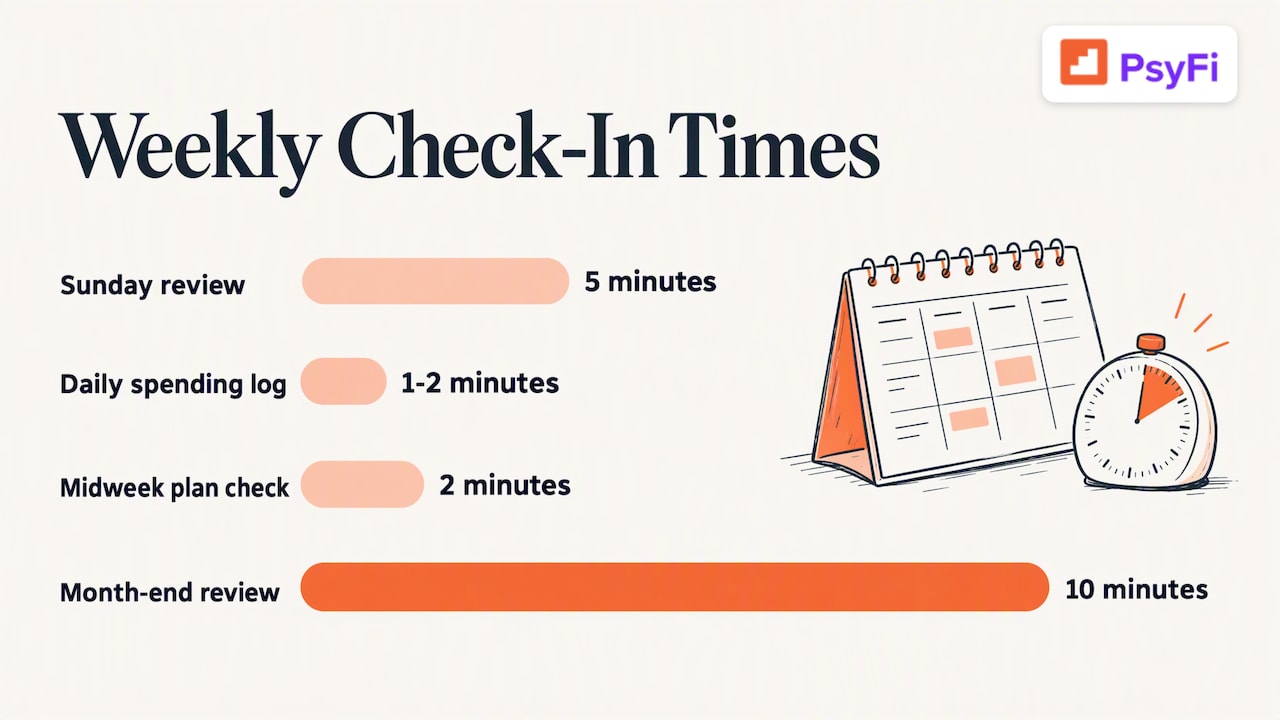
The CFPB frames spending limits as part of a loop: observe what you actually spend, set a limit from your budget, check balances, and compare results often. The point is to keep learning from your own numbers.
Here is what a simple weekly loop looks like.
Day | Action | Time |
|---|---|---|
Sunday | Look at last week’s total against your limit | 5 minutes |
Daily | Log or glance at your flexible spending | 1 to 2 minutes |
Midweek | Check the weekly pool and adjust plans | 2 minutes |
End of month | Review the average and change the limit if needed | 10 minutes |
If you want to keep this light, see how to track money habits in a few minutes a day. You can also set up automatic spending tracking so the numbers come to you.
Our perspective
We see the same pattern again and again. People do not overspend because they lack a budget. They overspend because of what is happening in the moment: stress, boredom, a rough day, or a dread of opening their banking app.
That is why we think a daily limit works best when it is built from your own data and checked by something that notices your patterns. A number alone tells you how much. It does not tell you why you went past it on Thursday night.
PsyFi is designed around that gap. Our AI coach, FY, looks at your real spending, spots patterns like stress spending or avoidance, and helps you shape a plan and change the habit as it happens. We want you to understand the reason behind each suggestion and stay in control of it. This is coaching, not financial advice.
A limit should feel like support. If it feels like punishment, the number or the method needs to change, not you.
Maanya Nagpal
What if you go over your limit?
There are two situations here, and they call for different steps.
You went over your personal limit
Nothing is blocked and nothing is lost. Look at what happened, note it, and carry on tomorrow. If it happens often, your limit may be too low for your real life. Raise it a little or look at the category that is pulling it up.
You hit a bank or card limit
This one can be embarrassing at a checkout, but it is common and it is usually fixable. Chase says that when a credit limit is exceeded, the issuer may block more purchases. Its suggestions are to stop purchases, review transactions, pay down the balance where you can, and contact the issuer.
If you are carrying a balance and feel anxious about it, there is no shame in that. Calling your issuer early is a normal step, and many people take it.
Bank and card daily limits, explained
Banks set these limits for security. Current’s support center explains that a financial institution’s daily limit can apply to debit or credit purchases and ATM withdrawals. It can usually be adjusted only up to the institution’s own maximum, and it resets on the institution’s schedule.
PayPal notes that most credit card issuers do not set a daily limit by default, but may set one to guard against fraud or for large purchases. Debit cards are different, since limits are common.
Here is how to find yours and what to do about it.
Question | What to do |
|---|---|
How do I find my debit limit? | Call your bank, visit a branch, check your account agreement, or use secure messaging in the bank’s app. Debit limits often are not shown on statements or in apps. |
Can I raise it? | Often yes. You can ask for a temporary or permanent increase from your bank or credit union. |
Can I lower it on purpose? | Some banks and card apps let you. Ask yours. A lower limit can double as a guardrail. |
Why was a big purchase declined? | You may have hit the daily limit even with enough money in the account. Contact the bank before trying again. |
Limits vary by bank and account type, so check your own bank’s current terms. Do not rely on a general number you saw online.
Using a tool to keep your limit in view
Tracking is where most people give up. Doing it by hand is slow, and checking accounts can feel stressful. An app can lighten that load.
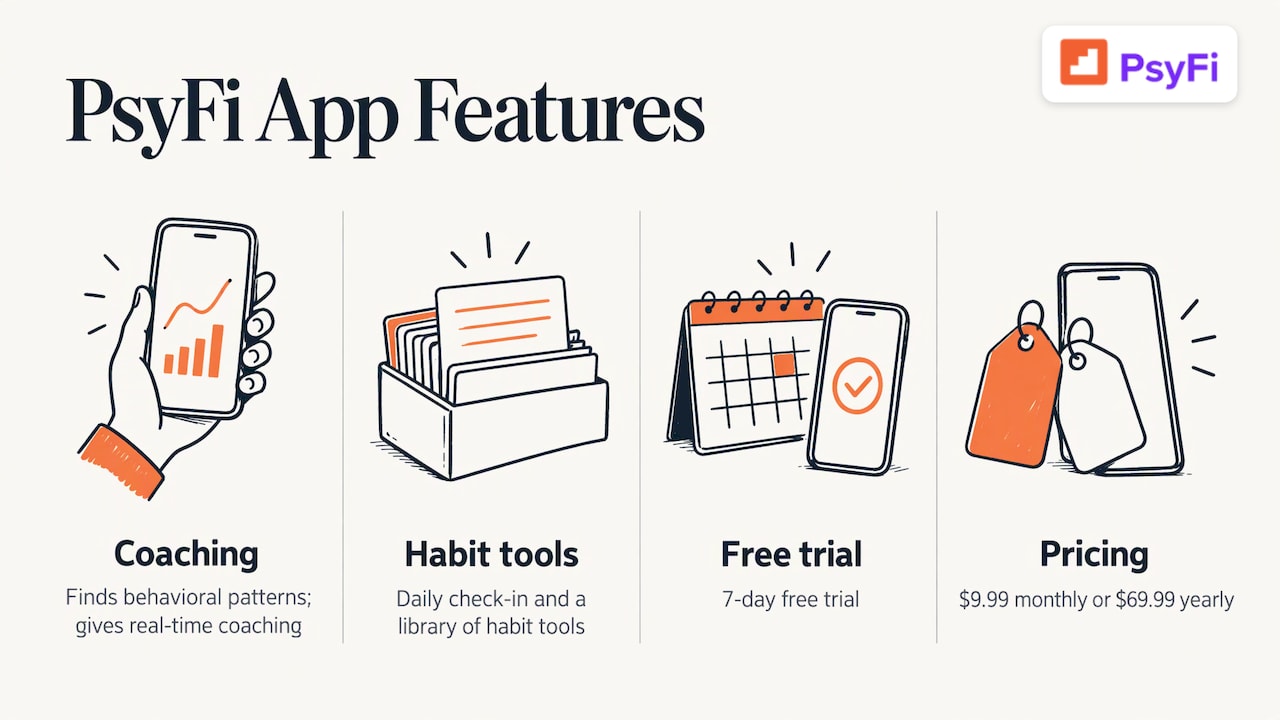
PsyFi is a financial wellness app that finds the behavioral patterns in your spending and gives real-time coaching on your own data. It has a daily check-in and a library of habit tools. You can try it with a 7-day free trial, and after that it is $9.99 per month or $69.99 per year. See PsyFi features or the pricing page for details.
If you are choosing an app, it helps to know how it connects. PsyFi works in the US and Canada. It connects through Plaid bank sync or document upload, and no bank login is required. PsyFi is for individuals and has no joint or shared accounts, so each person in a household uses it for their own habits.
Common questions about setting a limit
A few worries come up often, and each has a simple answer.
Worry | A practical response |
|---|---|
“My income changes each month.” | Base your limit on your lowest recent month, and treat extra income as a bonus for savings or goals. |
“I do not know my fixed bills.” | Look back through two or three statements and list what repeats. Add anything that renews yearly. |
“The number looks tiny.” | That is useful information. Check whether bills, savings, or both can be trimmed, or whether your income plan needs attention. |
“I keep forgetting to track.” | Attach it to a habit you already have, like your morning coffee, or use automatic tracking. |
“I feel anxious just thinking about it.” | Start with one action only, such as writing down today’s spending. Small steps count. |
If ADHD makes routines hard, our guide on money management for adults with ADHD is a gentler place to start.
FAQ
How much should my daily spending limit be?
Take your monthly take-home pay, subtract fixed bills, savings, and a buffer for irregular costs, then divide what is left by the days in the month. Compare it with what you really spend over a few weeks, then adjust. The right number is the one you can keep.
What is the daily spending limit on a debit card?
That depends on your bank and account type, so there is no single answer. Your bank sets it to guard against fraud, and it can cause a decline even when you have enough money. Call your bank or check your account agreement to see yours.
Is a daily spending limit the same as a credit limit?
No. A credit limit is the most an issuer lets you charge to a card. A daily spending limit you set yourself is a budgeting tool, and it can be lower than any limit the bank sets.
What if my spending is different every day?
Use a weekly or monthly limit instead of a strict daily one. Government guidance suggests setting maximum amounts each week or month. You can still divide it by days to get a rough daily guide.
Can a spending limit help with stress spending?
It can help, because you decide in a calm moment instead of in the middle of a rough day. Pair it with a pause before non-essential purchases. If money worries feel heavy, talking with someone you trust or a professional can help too.
Start with one number
You do not need to fix everything this month. Pick a rough daily number, track it for a few weeks, and adjust. If you would like support seeing the patterns behind your spending, we are here.
Start your 7-day free trial and find a daily limit that feels realistic, not punishing.
Sources
Recommended
This content is provided for general informational and educational purposes only and does not constitute financial, investment, tax, or legal advice. PsyFi provides financial coaching tools and behavioral insights, not regulated advisory services. Always consult with a qualified financial advisor or tax professional regarding your personal situation before making financial decisions.
Keep reading
- Windfall Money: How to Make a Plan Before You Spend ItGot a bonus, refund, inheritance or settlement? Here is a plain-language plan for windfall money: what to do first, how taxes work, and how to split it.

- Best AI Budgeting Apps in Canada: How to Pick One You’ll KeepCompare AI budgeting apps for Canadians: PsyFi, YNAB, Monarch, Copilot, PocketSmith and more. See criteria, pricing, bank sync, and pros and cons in tables.

- Monarch vs YNAB: Which Budgeting App Fits the Way You Handle Money?Monarch is a broad money dashboard and YNAB is a hands-on every-dollar budget. Compare prices, trials, features and fit, plus where PsyFi comes in.