
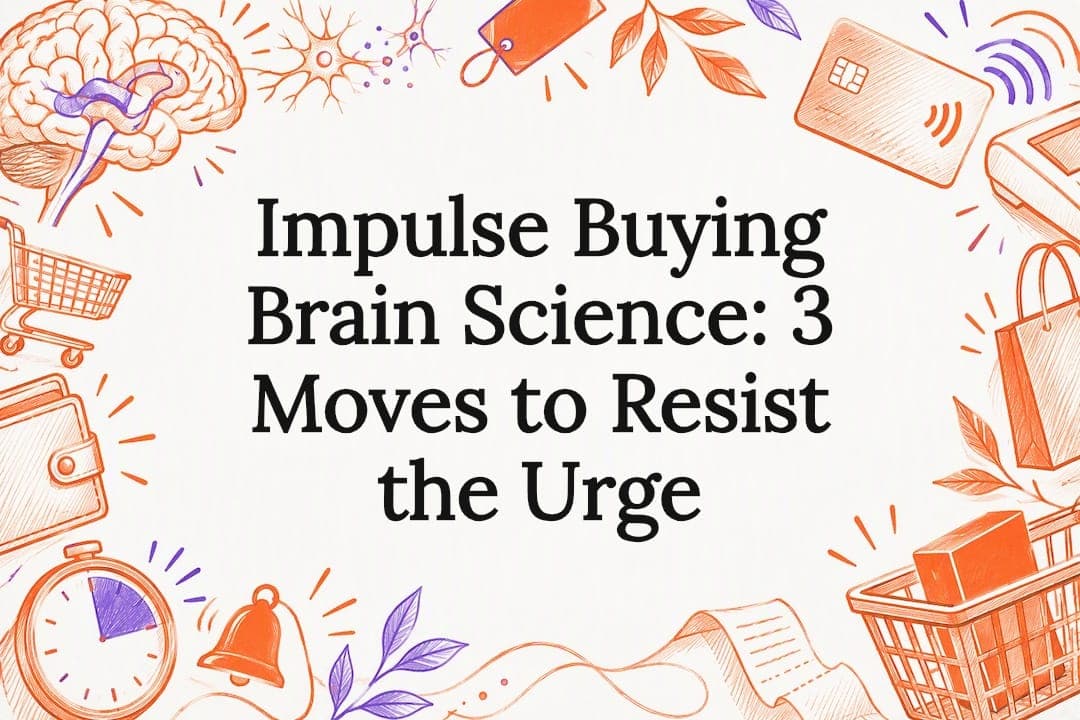
Impulse Buying Brain Science: 3 Moves to Resist the Urge
Learn the neuroscience behind impulse buys and three science-backed moves—pause, add friction, and make total cost visible—to stop impulsive spending and...
Impulse buying happens when fast reward signals in the brain’s mesolimbic circuits outpace the slower, deliberate control exercised by the prefrontal cortex. The single most reliable defence is to slow that competition down: delay the decision, make the full cost visible, and add friction before checkout. These three moves shift both the timing and the valuation of a purchase in favour of what you actually want long term.
TL;DR:
Delaying purchases and increasing checkout friction are the most effective ways to activate prefrontal control and reduce impulsive buying behaviors.
Reward anticipation triggers in the brain fire before conscious evaluation, making rapid decision cues like promotions and one-click checkout potent impulse triggers.
Environmental cues such as scarcity messaging and social proof manipulate reward circuits, emphasizing the need for deliberate pauses before completing a purchase.
Emotional states like stress or boredom are common drivers, so addressing mood regulation is crucial alongside friction-based strategies for sustainable control.
Apps that automate commitment devices and provide real-time cost visibility can reinforce impulse control by aligning digital environments with neuroscientific insights.
Table of Contents
Individual differences in impulse control and susceptibility
Reward prediction error and the neuroscience of overspending
How advertising and marketing exploit brain impulse mechanisms
How impulse buying works in the brain
Two systems argue every time you consider a purchase. The nucleus accumbens (NAcc) and ventral tegmental area (VTA) form part of the brain’s reward circuitry, firing when something looks desirable, anticipating the payoff before you have even decided to buy. The anteroventral prefrontal cortex (avPFC) and medial prefrontal cortex (MPFC) handle the slower job of weighing cost, consequence, and whether this purchase fits your actual goals.
Imaging research backs this up directly. In one widely cited study using the SHOP paradigm, product preference reliably activated the NAcc, signalling anticipated reward, while price information activated the insula and reduced MPFC activity, a pattern that tracked with people choosing not to buy. The neural signals predicted actual purchases better than participants’ own self-reports did.
This is why “dopamine” gets thrown around so loosely in articles about shopping. Dopamine is involved in reward anticipation, but it is not a standalone explanation: behaviour emerges from the interaction between reward circuits, cost-processing regions, and prefrontal regulation, not from one chemical acting alone. Separate imaging research on self-control found that resisting an immediate reward depends on inverse functional coupling between the avPFC and NAcc, meaning the prefrontal cortex actively dampens reward signals when regulation succeeds.
The NAcc and VTA generate the pull toward an item before conscious evaluation finishes.
The insula and MPFC process cost and can trigger hesitation when price feels like a loss.
Stronger negative coupling between avPFC and NAcc predicts a better shot at resisting the urge.
The brain’s purchase-prediction signal fires before self-report does: in the SHOP task, neural activity in reward and cost circuits predicted buying decisions more accurately than what participants said they intended to do. That gap is exactly what a pause is designed to close.
Common triggers and psychological drivers of impulse buying
Impulse purchases rarely come out of nowhere. They cluster around specific situations and specific states of mind, which is useful, because both can be anticipated.
On the situational side, retailers design environments to shorten the distance between wanting and buying:
Limited-time promotions and countdown timers that manufacture urgency.
Scarcity messaging (“only 2 left”) that reframes a purchase as a loss if you wait.
Physical or digital product proximity, from endcap displays to algorithmic recommendations.
One-click checkout that removes the natural pause between decision and payment.
Social cues, including reviews, influencer endorsement, and visible popularity signals.
Psychological drivers sit underneath these triggers. Mood regulation is a major one: shopping can function as a quick way to self-soothe stress, boredom, or a bad day. Present bias, the tendency to overweight immediate reward against a future cost, makes the item in front of you feel more urgent than the goal it competes with. Identity expression also plays a role, since a purchase can feel like a statement about who you are, not just an acquisition. Trait impulsivity varies by person and shapes how much resistance any of this requires.
Payment method matters too. Stored cards and tap-to-pay reduce the “pain of paying” that cash makes concrete, while limited time or attention (shopping while distracted, tired, or rushed) weakens the prefrontal oversight that would otherwise catch the urge.
Evidence-based strategies to reduce impulse purchases
Strategies work at three levels: what you do in the moment, what you change in your environment, and what you lock in ahead of time. Layering all three gives you more protection than relying on willpower alone.
Notice the urge and name it. Simply recognizing “this is an impulse” reintroduces the prefrontal evaluation that fast reward signals try to skip.
Postpone the decision. A short pause, or a full 24-hour rule for non-essentials, gives avPFC-NAcc regulation time to engage instead of being overridden.
Distract or reassess. Field research on e-commerce behaviour found that reflection prompts, distraction, and desire-reduction techniques reduced impulse urges among online shoppers, though results varied by person.
Make the total cost visible. Showing a running total, including recurring subscription costs, activates the same cost-processing circuitry that naturally discourages overspending.
Add environmental friction. Removing stored payment details, disabling promotional push notifications, and avoiding one-click checkout all reinstate the gap that quick-conversion interfaces are built to erase.
Use commitment tools. Automatic savings transfers, pre-set spending limits, and other commitment devices reduce how often you have to rely on in-the-moment self-control at all.
Digital environments deserve particular attention, since most checkout flows are built to minimize friction rather than support reflection. Research on self-controlled online purchasing points to deliberation prompts and disabled one-click payments as scalable ways to counter interfaces optimized for speed. Readers who want a hands-on starting point can work through a delayed gratification calculator to make the future cost of a purchase concrete before deciding.
Pro Tip: Set your bank or card app to send a notification for every purchase over a threshold you choose, so the cost becomes visible right when the urge is strongest.
For anyone further down this road, a breakdown of app-based tools can help translate these tactics into daily habits rather than one-off fixes.
When impulse buying becomes a clinical problem
Occasional impulse purchases are normal. Compulsive buying-shopping disorder is different: persistent urges, a felt loss of control over spending, continued buying despite financial or relationship harm, and interference with work or daily functioning are the red flags that separate a habit from a disorder.
Urges feel intrusive or hard to resist even when you know the consequences.
Spending continues despite debt, conflict, or clear financial strain.
Shopping starts crowding out responsibilities or relationships.
On treatment, the evidence is cautiously specific rather than sweeping. A systematic review of treatment studies found that group cognitive behavioural therapy shows promise for compulsive buying-shopping disorder, while pharmacological trials have produced mixed results and have not reliably outperformed placebo. If any of the red flags above sound familiar, a mental health professional and a structured CBT programme are the evidence-supported next steps, while putting basic financial safeguards in place in the meantime.
The role of memory and learning in impulse buying
Impulse buying is not purely reactive: past experience shapes which triggers hit hardest. Each time a purchase delivers quick relief from a bad mood or boredom, the brain’s reward circuitry reinforces the association between spending and feeling better, making the behaviour more automatic the next time a similar mood arises. This is basic associative learning applied to money: the stimulus (stress, a sale notification, a familiar store layout) gets linked to the reward (the purchase), and the link strengthens with repetition.
Memory also shapes which products trigger a stronger pull. Brands and items tied to positive past experiences carry an associative advantage, activating reward anticipation faster than something unfamiliar, regardless of whether the item itself is a good fit for your current goals. This is part of why “limited edition” or nostalgic marketing works: it borrows existing memory traces rather than building desire from scratch.
The practical implication is that breaking an impulse-buying pattern is not just about resisting a single temptation. It involves weakening a learned association, which is why repeated use of friction and delay tends to work better over time than a one-off effort. Each successful pause is itself a new learning event, one that reinforces restraint instead of relief.
Individual differences in impulse control and susceptibility
Not everyone faces the same odds in this fight, and the difference is partly structural. Research comparing people with low and high trait impulsivity found that successful self-control in highly impulsive individuals relies on compensatory neural mechanisms, including avPFC-NAcc coupling and dampened activity in reward-related regions, rather than simply “trying harder.”
Developmental factors matter too. Prefrontal regions involved in impulse regulation mature later than reward-related circuits, which is one reason self-control around spending tends to strengthen with age in most people. Genetic and dispositional factors also contribute to how strongly someone responds to reward cues in the first place, meaning two people can face an identical sale and experience very different intensities of urge.
The practical takeaway is that a single tactic will not work equally well for everyone. Someone with high trait impulsivity may need heavier environmental friction (removing stored cards, blocking one-click checkout) because their compensatory prefrontal mechanisms are doing more work already. Someone with lower baseline impulsivity might find a simple 24-hour pause sufficient. Matching the defence to the person, rather than applying one rule universally, reflects what the neural evidence actually shows.

How emotion regulation and impulse buying interact
Impulse purchases are frequently an emotion regulation strategy in disguise. When stress, sadness, or anxiety spikes, shopping offers a fast, reliable hit of relief, and the brain’s reward circuitry does not distinguish neatly between “I want this item” and “I want to feel better right now.”
This matters because standard willpower advice often targets the wrong layer of the problem. Telling someone to “just resist” a purchase addresses the decision point, but if the underlying driver is mood regulation, the urge will simply resurface around the next stressor unless the emotional need gets addressed some other way. Substituting a different coping action, a walk, a call to a friend, a few minutes of deliberate breathing, gives the brain an alternative route to the same relief without the financial cost.
This is also where so-called doom spending and revenge spending fit in: both describe emotionally driven purchasing in response to stress, loss of control, or a sense of being owed something after a hard stretch. The spending itself is a symptom of an unmet emotional need, not a standalone impulse-control failure, which is why pairing a pause with an actual coping substitute tends to outperform pause alone. A closer look at emotional spending tactics covers this layer in more detail.
Reward prediction error and the neuroscience of overspending
Reward prediction error is the gap between what the brain expects and what it actually gets, and it plays a quiet but significant role in impulsive purchases. When a product, a sale, or a notification delivers reward that exceeds expectation (a bigger discount than anticipated, a surprise restock of something scarce), the resulting signal strengthens the association between that trigger and future buying behaviour.
This mechanism helps explain why unpredictable rewards, like flash sales or mystery boxes, can be more compelling than predictable ones. A consistent, expected discount generates a smaller prediction error than an unexpected one, and the brain’s reward system responds more strongly to the unexpected version. Retailers exploit this pattern deliberately, using surprise and variability to keep reward circuitry engaged rather than relying on simple, flat discounts.
For the reader trying to manage impulse buying, the relevant point is that unpredictability itself is a trigger, independent of the actual value of the deal. Recognizing that a “surprise” offer is designed to spike a prediction-error response, rather than representing genuinely exceptional value, is a useful piece of context to bring into the pause-and-reassess step described earlier.
How advertising and marketing exploit brain impulse mechanisms
Marketing strategies are, in large part, applied neuroscience. Advertising aims directly at the mesolimbic reward pathway, using imagery, scarcity cues, and social proof to activate anticipatory reward before the prefrontal cortex has a chance to weigh in on cost or necessity. Broader neuroeconomic research frames impulse buying as the product of interacting determinants, reward anticipation, perceived cost, emotion, self-control, personal traits, available resources, and marketing stimuli, rather than any single factor acting alone.
One-click checkout, auto-filled payment details, and countdown timers are not incidental design choices. They are built to shrink the window between the NAcc’s reward signal and the moment of payment, before the avPFC can engage its cost-weighing function. The CFPB’s work on savings behaviour makes the inverse point: when friction is added deliberately, even small incentives can meaningfully increase sustained saving behaviour, suggesting that interface design shapes financial behaviour in both directions.
Understanding this does not mean distrusting every advertisement, but it does mean recognizing that a well-designed checkout flow is working against your prefrontal cortex by design, not by accident. That recognition itself is part of what makes the pause-and-friction approach effective: it is not fighting willpower against willpower, it is restoring a deliberation window that modern commercial design is built to remove.
What the research actually tells us to prioritize
The biggest mistake in popular advice on impulse buying is treating it as a willpower problem with a dopamine villain. The neuroscience says otherwise: resistance comes from a measurable prefrontal-reward interaction, and that interaction can be shifted with design, not just discipline. Telling someone to “want less” ignores that the reward signal fires before conscious evaluation even starts.
What gets underrated is friction. Adding a 24-hour pause or removing a stored card looks almost too simple next to advice about mindset or self-discipline, yet it is the lever with the most direct neural support, because it buys time for prefrontal regulation to actually engage. What gets overrated is relying on insight alone: knowing why you overspend rarely changes the moment of temptation if the environment still makes buying effortless.
If you take one thing from this, prioritize friction over motivation. Change the environment before you try to change your mindset, and treat emotional triggers as a separate problem from checkout design, because they require different fixes.
— Maanya
Put the science to work with PsyFi
PsyFi is an AI-driven financial wellness app that applies behavioural science to everyday spending decisions, built around the same mechanisms covered above rather than generic budgeting advice. Its patent-pending engine analyzes your actual financial behaviour to flag patterns and biases, then builds a personalized saving and investing plan around them.
It automates commitment devices, like scheduled transfers, so you are not relying on in-the-moment willpower every time.
It surfaces real-time coaching based on your own data, nudging a pause before a purchase pattern repeats.
It tracks spending and net worth together, making the true cost of a habit visible rather than abstract.
You can start with a free trial through the Premium plan at $9.99 USD per month, or $69.99 USD per year on the annual plan, and see how automated friction and salient-cost tracking work for your own spending patterns.
Selected primary studies and reviews
Neural predictors of purchases: fMRI evidence linking reward and cost circuits to actual buying decisions.
avPFC-NAcc interactions: how prefrontal coupling supports resisting temptation.
Compulsive buying treatment review: evidence on CBT and medication for shopping disorder.
fNIRS impulse-buying detection: lab evidence on prefrontal involvement in impulse suppression.
Sources
When desire collides with reason: avPFC–NAcc interactions (PMC)
Systematic update on treatment studies for compulsive buying (PMC)
FAQ
What are the four types of impulse buying?
Researchers commonly describe pure impulse (a spontaneous, novelty-driven buy), reminder impulse (triggered by seeing or remembering a need), suggestion impulse (prompted by seeing a new product with no prior want), and planned impulse (buying unplanned items while shopping, often driven by a deal). These categories describe the shopper’s mindset at the moment of purchase rather than distinct brain mechanisms.
What is the psychology behind impulse buying?
Impulse buying reflects a competition between fast reward anticipation in circuits like the nucleus accumbens and slower prefrontal evaluation of cost and consequence. Mood regulation, present bias, and situational triggers like scarcity or promotions tip that balance toward quick reward over long-term goals, as imaging research on self-control shows.
How to cure impulse buying?
There is no single cure, but a combination of delaying purchases, adding checkout friction, and making total cost visible addresses the mechanisms directly. For persistent or harmful patterns, group CBT shows the strongest evidence base among current treatment options, and a mental health professional can help determine whether the pattern has become clinically significant.
What are the common triggers for impulse buying?
Common triggers include promotions and scarcity messaging, product proximity, one-click checkout, social proof, and emotional states like stress, boredom, or low mood. Payment method also matters, since stored cards and tap-to-pay reduce the natural hesitation that paying with cash creates.
Can an app actually help reduce impulse spending?
An app can help when it operationalizes evidence-based tactics like automated commitment devices, salient cost tracking, and real-time behavioural nudges rather than offering generic budgeting tips. Tools that surface your own spending patterns and automate the pause-and-friction approach reflect what the neuroscience above actually supports.
Recommended
This content is provided for general informational and educational purposes only and does not constitute financial, investment, tax, or legal advice. PsyFi provides financial coaching tools and behavioral insights, not regulated advisory services. Always consult with a qualified financial advisor or tax professional regarding your personal situation before making financial decisions.
Keep reading
- 30.9% Never Return: Panic Selling Psychology, Evidence and AI FixesDiscover why 30.9% of panic sellers never return, what peer‑reviewed data shows, and regulator‑backed steps plus AI tools to prevent selling at market lows.
- 3 Research Backed Ways to Stop Keeping Up With the Joneses in DaysUse three research backed, mental health first practices: self compassion, social savoring, and simple micro habits to cut comparison driven spending and...
- 5 A/B Tests Marketers and Researchers Can Run to Measure Price FramingApplied behavioural briefing for marketers and researchers. Get concise evidence, five test-ready A/B templates, PsyFi case notes, and FTC compliance...