


Monarch vs YNAB: Which Budgeting App Fits the Way You Handle Money?
Monarch is a broad money dashboard and YNAB is a hands-on every-dollar budget. Compare prices, trials, features and fit, plus where PsyFi comes in.
By Maanya Nagpal, Co-Founder of PsyFi
Choose YNAB if you want a hands-on system where you give every dollar a job. Choose Monarch if you want one clear dashboard that shows your spending, net worth and goals without much daily work. Neither choice is wrong, and the better one is the one you will still open in three months.
A quick disclosure: we make PsyFi, an app that competes with both. We cover them fairly below and say where each one is strong. Prices and trial lengths come from 2026 reviews by NerdWallet and CNBC Select. Apps change plans often, so confirm current numbers on each app’s own pricing page before you pay.
Table of Contents
TL;DR
YNAB is a zero-based budgeting tool. You plan every dollar ahead of time. It takes more effort and gives you more control.
Monarch is a wider money dashboard. It shows accounts, net worth, investments and goals in one place, and many reviewers find it easier to navigate.
Price: Monarch is reported at $99.99 a year and YNAB at $109 a year. YNAB has the longer free trial, at 34 days versus 7.
PsyFi is a third path. It looks at why you spend the way you do and coaches the habit. It costs $9.99 a month or $69.99 a year.
Start your 7-day free trial
How we compare these apps
We judge each app on five criteria. You can disagree with the weighting, so here it is up front.
Method: How does the app want you to think about money?
Effort: How much time does it ask of you each week?
Visibility: Can you see your whole picture, including net worth and goals?
Cost and trial: What do you pay, and how long can you test it?
Habit support: Does the app help you change behavior, or only record it?
We did not test every feature ourselves. The facts about YNAB and Monarch come from the published reviews linked in this article.
Monarch vs YNAB at a glance
YNAB | Monarch | |
|---|---|---|
Core idea | Give every dollar a job | See all your money in one place |
Style | Hands-on, forward-looking | Broad overview, easier to navigate |
Best for | Control, debt payoff, intentional spending | Net worth, investments, goals, households |
Monthly price | $14.99 | $14.99 |
Annual price | $109 | $99.99 |
Free trial | 34 days | 7 days |
Sharing | YNAB Together, up to five people | Collaboration mode for couples |
Prices and trial lengths are as reported by NerdWallet for YNAB and CNBC Select for Monarch in 2026.
The real difference: method versus dashboard
The two apps look similar in a screenshot. They ask different things of you.
NerdWallet describes YNAB as zero-based budgeting. You assign every dollar of income a job, such as bills, savings or debt, before you spend it. Zero-based means income minus planned spending equals zero. It does not mean you spend everything. Savings count as a job too. If you want to learn the method itself, our zero-based budget guide walks through a simple plan.
Monarch works the other way around. CNBC Select describes it as the easier-to-navigate option, with a customizable dashboard, a net worth tracker, investment tracking, forecasting and more than 13,000 institution connections. You connect your accounts and the app pulls the picture together.
Think of it like this:
YNAB asks, “What do you want your money to do?”
Monarch asks, “Where is your money right now?”
NerdWallet’s assessment is that YNAB suits people who want proactive, hands-on budgeting and debt payoff, and is less suited to anyone who wants a set-and-forget system. That is a fair summary of the trade.
YNAB: who it fits
YNAB rewards people who like to plan. It can link checking, savings, credit card and loan accounts, or you can enter and import transactions by hand, according to NerdWallet. It also includes a loan payoff simulator and works on desktop, mobile and Apple Watch.
It tends to work well if:
You want to decide on purpose where each dollar goes.
You are paying down debt and want a plan.
You do not mind checking in several times a week.
It may feel heavy if you have many small transactions a day. One large family wrote in a Reddit thread that moving money between envelopes became tedious at 10 to 15 transactions daily. That is one household’s story, not a rule, but it shows where the effort can pile up.
If you are paying off debt, a planner can help you see the finish line. Our free debt payoff planner lets you test different monthly payments without linking anything.
Monarch: who it fits
Monarch is built for visibility. You see spending, accounts, investments and net worth together. Net worth means what you own minus what you owe. Many people like seeing that number move over time.
It tends to work well if:
You want all your accounts, including investments, on one screen.
You and a partner want to look at household money together.
You want a lighter routine than a strict envelope system.
CNBC Select also reports that Monarch uses read-only access, AES 256-bit encryption, multifactor authentication and SOC 2 Type 2 certification. Read-only means the app can see your data but cannot move your money.
The trade-off is that a dashboard shows you what happened. It does not push you to plan ahead the way YNAB does. If your problem is awareness, that is enough. If your problem is follow-through, you may need more.
Price and free trial
Plan | YNAB | Monarch | PsyFi |
|---|---|---|---|
Monthly | $14.99 | $14.99 | $9.99 |
Annual | $109 | $99.99 (about $8.33 a month) | $69.99 |
Free trial | 34 days | 7 days | 7 days |
Checked | 2026 reviews | 2026 reviews | Our site, October 2026 |
Figures for YNAB come from NerdWallet. Figures for Monarch come from CNBC Select. Both are 2026 US prices from those publications. The gap between the two annual plans is small, so price alone should not decide this. The trial length may matter more. A 34-day trial gives you more than a full month to see if the method sticks.
You can see our own plans on the PsyFi pricing page.
Pros and cons of each app
App | Pros | Cons |
|---|---|---|
YNAB | Clear method with strong control. Good for debt payoff. Long free trial. Sharing with up to five people. | Takes regular effort. Less suited to a set-and-forget approach. Higher annual price in the reviews we cited. |
Monarch | Easy to navigate. Net worth and investment views. Forecasting and goals. Couples collaboration mode. | Shorter trial. Shows the picture more than it coaches the habit. |
PsyFi | Coaching based on your own behavior. Daily check-in. Lower listed price. Works with document upload as well as bank sync. | Built for individuals only, so no shared or joint accounts. Not a full investment dashboard. Not licensed financial advice. |
Which one should you pick?
Here is a simple way to decide. Read each line and notice which one sounds like you.
If this sounds like you | Lean toward |
|---|---|
“I want to plan every dollar.” | YNAB |
“I want to see everything in one place.” | Monarch |
“I am tackling debt and want a strict plan.” | YNAB |
“I track investments and net worth.” | Monarch |
“I plan well but my spending drifts when I’m stressed.” | A coaching approach like PsyFi |
“I quit budgeting apps because I stopped checking.” | Something lighter, or coaching |
If you are trying to stay on top of spending without much effort, our guide to automatic spending tracking shows how to set it up. If you want fewer categories, try minimalist budgeting.
What if you tried a budgeting app and quit?
This is very common, and it is not a character flaw. Budgets often fail for emotional reasons, not math reasons. You overspend one day, feel bad, and stop looking. People call this the “what the hell” effect: once you slip, you give up on the whole plan.
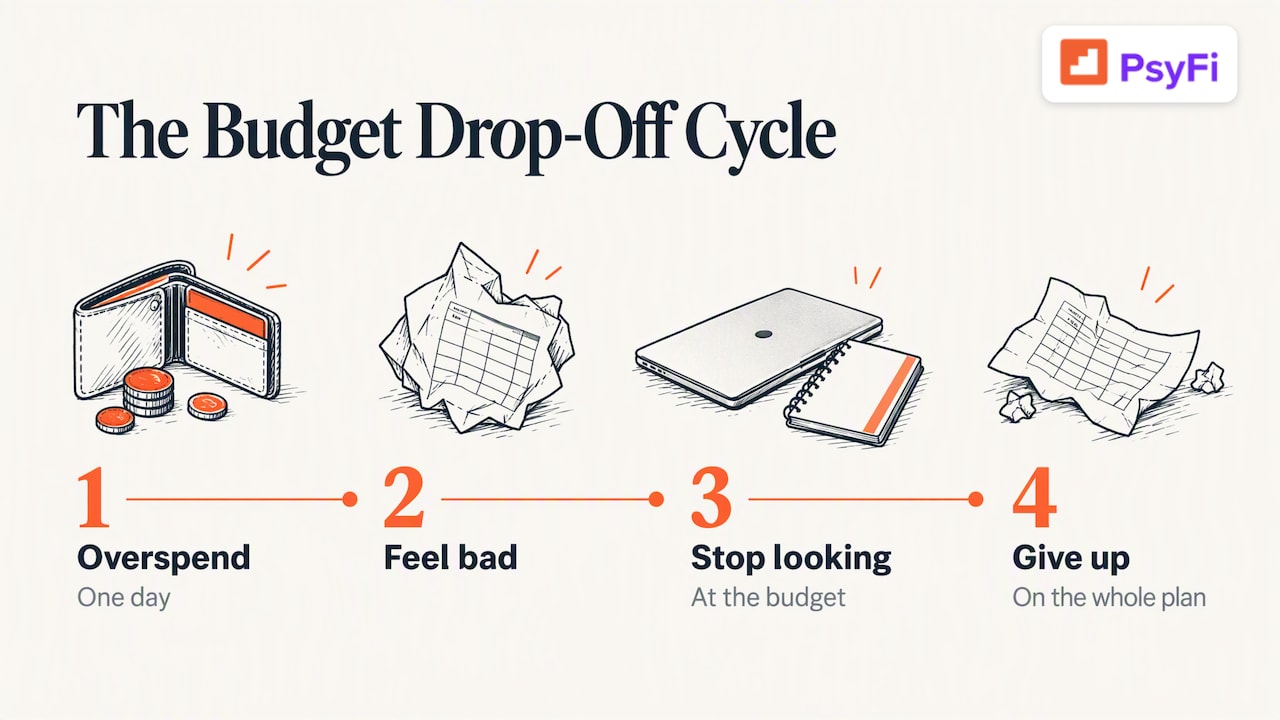
Both YNAB and Monarch can show you the numbers. Neither is designed mainly to help with the feeling behind them. That gap is where we built PsyFi.
Our perspective
We talk to a lot of people who have tried YNAB, Monarch, Mint or a spreadsheet. The story is usually the same. The tool worked for a few weeks. Then a stressful month came, they stopped opening it, and they felt guilty.
So we start with a different question. Instead of asking what you spent, we ask why. Do you spend more after a hard day at work? Do you avoid looking at your accounts when you feel anxious? Those patterns are real, they are common, and they are fixable without shame.
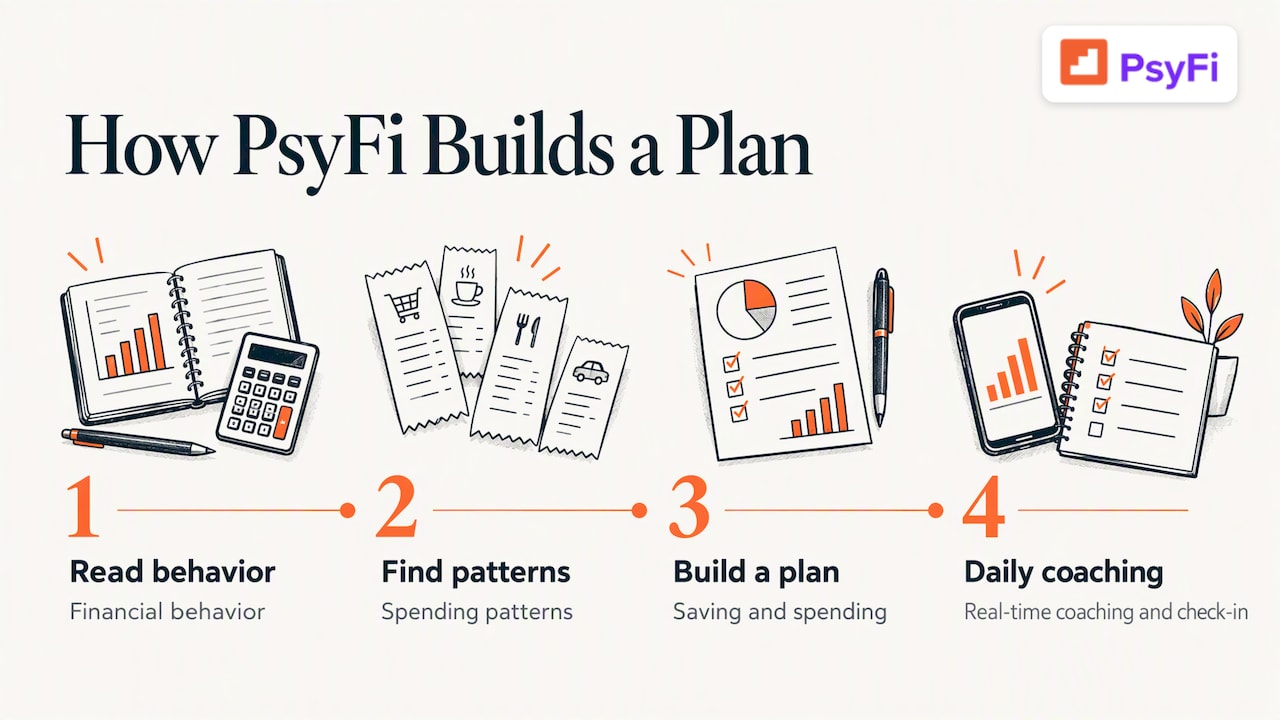
PsyFi reads your own financial behavior, finds those patterns, and builds a saving and spending plan around them. Our AI coach, FY, gives you real-time coaching and a daily check-in. The science is guided by a University of Toronto psychology professor. We think a good tracker and a good coach do different jobs, and some people will want both.
We also want to be clear about limits. PsyFi is coaching, not financial advice, and we are not a licensed financial advisor. For investment, tax or legal questions, talk to a qualified professional.
— Maanya Nagpal
Where PsyFi fits in
PsyFi does not replace a careful zero-based budget or a net worth dashboard. It tackles the habit side. Here is how it differs.
YNAB | Monarch | PsyFi | |
|---|---|---|---|
Main question | Where should each dollar go? | Where is my money now? | Why do I spend this way, and how do I change it? |
How you use it | Plan and categorize | Review and track | Daily check-in and coaching |
Strength | Control | Overview | Habit change |
If you want to try it, PsyFi works in the US and Canada. You can connect through Plaid, a service that links apps to banks, or upload documents instead. No bank login is required for the upload route. You can start on the PsyFi plans page with a 7-day free trial, then pay $9.99 a month or $69.99 a year.
Curious how we compare with Monarch in particular? Read our piece on a smart alternative to Monarch Money.
A note for couples: PsyFi is for individuals. It has no joint or shared accounts. Each partner can use it for their own habits, while you talk about shared goals in whatever tool you already use.
Privacy and account linking: what to ask any app
Before you connect a bank account to any app, check these points.
Access type. Is it read-only, so the app cannot move money?
Security audits. Does the company name an independent audit such as SOC 2 Type 2?
Alternatives to linking. Can you upload statements instead?
Control. Can you disconnect and delete your data?
PsyFi is ISO 27001 certified and SOC 2 Type 2 audited. You can read more at our Trust Vault.
FAQ
Is Monarch better than YNAB?
Neither is better for everyone. Monarch suits you if you want a broad, easy-to-read view of your money. YNAB suits you if you want a hands-on system to plan every dollar.
Which is cheaper, Monarch or YNAB?
In 2026 US reviews, Monarch is listed at $99.99 a year and YNAB at $109 a year. Both are listed at $14.99 a month. Check each app’s pricing page for the current rate.
Is YNAB hard to learn?
It takes more effort than a dashboard app, because you assign every dollar a job. Many people find the method clicks after a few weeks. The longer trial, reported at 34 days, gives you time to find out.
Can couples use Monarch or YNAB together?
Yes. CNBC Select notes a collaboration mode for couples in Monarch, and NerdWallet reports YNAB Together for up to five people.
What is a good option if I keep quitting budgeting apps?
Look for something that helps with the habit, not just the numbers. PsyFi is built for that, with daily check-ins and coaching based on your own spending patterns. It is coaching, not financial advice.
Ready to understand your spending habits?
If you have tried budgets and stopped, you are not alone, and it is not your fault. Try a different approach.
Start your 7-day free trial
Sources
Recommended
This content is provided for general informational and educational purposes only and does not constitute financial, investment, tax, or legal advice. PsyFi provides financial coaching tools and behavioral insights, not regulated advisory services. Always consult with a qualified financial advisor or tax professional regarding your personal situation before making financial decisions.
Keep reading
- Rocket Money Alternatives: Find the App That Fits Your HabitsCompare Rocket Money alternatives by price, budgeting style and how each app helps you change habits, from Monarch and YNAB to Simplifi, WalletHub and PsyFi.

- Mint Alternatives: Apps to Replace Mint and Fit Your HabitsMint is gone. Compare Monarch, YNAB, Empower, Simplifi, Rocket Money, Goodbudget and PsyFi on price, syncing and habit support to find your fit.

- YNAB Alternatives: Budget Apps That Fit How You Really SpendLeaving YNAB? Compare Monarch, Copilot, EveryDollar, Goodbudget and PsyFi on price, bank sync and style, so you pick an app you will actually keep using.