


Financial Coach vs Financial Advisor: Which One Fits Your Money Problem?
A financial coach helps with spending habits, budgets and debt. A financial advisor handles investing and planning. See which fits you, and what to check first.
By Maanya Nagpal, Co-Founder of PsyFi
A financial coach helps you change everyday money habits, like spending, saving and facing your accounts. A financial advisor helps you plan and invest for bigger goals, like retirement, taxes and growing wealth. If your problem is “I can’t seem to stick to a plan,” start with coaching. If it is “I have money and need to decide where it goes,” start with an advisor.
Neither choice is a sign you did something wrong. Most people reach for help when they feel stuck, stressed or unsure where to begin. This guide shows what each role does, what each costs, what to check before you hire, and how to decide.
Table of Contents
TL;DR
Coach: works on habits, budgets, savings, debt and accountability. Usually does not recommend investments.
Advisor: works on investing, retirement, taxes and long-term planning. Must meet registration rules if they give investment advice.
Rule of thumb: habits and day-to-day money point to a coach. Investment decisions and complex planning point to an advisor.
Check first: coaching has no general license. Advisors have public records you can look up for free.
Start your 7-day free trial
The short answer: it depends on the task
The U.S. Consumer Financial Protection Bureau (CFPB) draws the line by task. In its guide to choosing a financial professional, money coaches and credit counselors help with budgets, expenses and spending tracking, and usually do not give investment advice or full financial planning. Planners can help with one issue or a full plan, including retirement, college savings, taxes, insurance and estate planning.
Here is the same idea in a table.
Your situation | Likely fit |
|---|---|
You overspend when stressed and don’t know why | Coach |
You avoid opening your bank app | Coach |
You want a budget you can actually follow | Coach |
You want help paying down debt with a routine | Coach |
You want to know how to invest a lump sum | Advisor |
You need a retirement or tax plan | Advisor |
You want someone to manage a portfolio | Advisor |
You have a mix of habit and planning questions | Both, at different times |
This is general education, not personal advice. PsyFi is not a licensed financial advisor.
What a financial coach does
The CFPB describes financial coaching as help that is directed by you. You define your goals, build an action plan, track progress and get ongoing support and accountability. Its 2021 coaching report says coaches can help with budgeting, money management, savings, credit and debt.

NerdWallet’s financial coach guide adds that coaches often help you understand your spending, build emergency savings and handle the emotional side of money. It also says a coach does not pick stocks or make investment recommendations.
In plain words, a coach helps you do what you already know you should do. Many of us know we should save. Fewer of us know why we skip it every month.
What a session or check-in looks like
Step | What happens |
|---|---|
1. Look at the facts | You and your coach review where your money goes |
2. Find the pattern | You spot triggers, like stress spending or avoiding statements |
3. Set a small goal | One habit, such as a weekly five-minute look at your accounts |
4. Check in | You report back and adjust, without blame |
The check-ins matter most. Habits change through repetition and support, not through one big talk.
What a financial advisor does
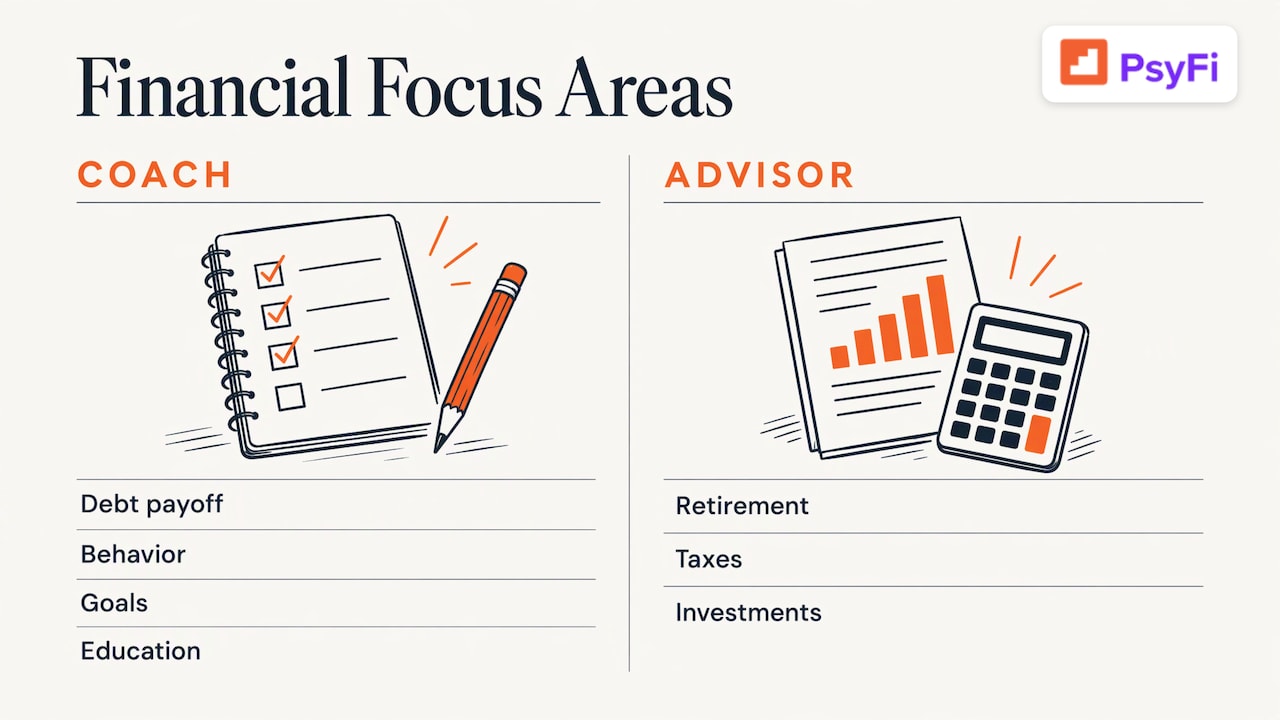
An advisor works on the money decisions that come after the basics. That can mean retirement accounts, taxes, insurance, estate planning and investments. Morningstar’s 2025 comparison says advisors more often address retirement, taxes and investments, while coaches more often focus on debt payoff, behavior, goals and education.
The word “advisor” covers several jobs. A financial planner may build a plan for one issue or your whole life. An investment adviser may manage your money. NerdWallet’s guide to types of advisors notes that a plan can be a one-time service or updated over time.
If you want to learn the basics of putting money to work, an investment strategy workbook can help you think through what questions to bring to an advisor. Questions about specific products or taxes in your situation belong with a licensed professional.
Side by side: coach vs advisor
Financial coach | Financial advisor | |
|---|---|---|
Main focus | Habits, budgeting, savings, debt, accountability | Investing, retirement, taxes, long-term plans |
Investment recommendations | Usually none | Yes, if properly registered |
License required | No general license | Depends on the services offered |
Legal duty to put you first | Not automatic | Fiduciary duty for investment advisers and CFP® professionals |
Typical pay | Varies by provider | Hourly, flat fee, percent of assets, commissions, or a mix |
Best for | “I can’t stick to a plan” | “I need to decide where my money goes” |
Morningstar also notes the roles do not have to be separate. Some advisors add behavioral support to their planning. You can also use both: a coach to build steady habits now, and an advisor when you have money to invest.
What each one costs
Advisor fees are well documented. The CFPB says planner pay may be hourly or fixed, a percentage of the assets managed, commissions on products, or a combination. NerdWallet says investment management commonly charges a percentage of managed assets.
Because pay can come from products you buy, ask every advisor, “How are you paid?” before you share any details.
Coaching prices vary widely, and no single official source sets a standard rate. Ask for the price in writing, and ask what it covers. An app is another route, with a fixed, public price. PsyFi, for example, costs $9.99 per month or $69.99 per year after a 7-day free trial.
Fee type | How it works | Good to know |
|---|---|---|
Hourly | You pay for time | Clear cost for one question |
Flat fee | One price for a plan | Easy to compare |
Percent of assets | A yearly share of the money managed | Grows as your balance grows |
Commission | Paid when you buy a product | Ask about conflicts of interest |
What to check before you hire anyone
A title tells you very little. Morningstar notes financial coaches have no generally required license or coursework, and are not automatically held to a fiduciary standard. Optional training and certifications exist. The CFPB’s 2016 report on coaching programs found that the groups it studied hired staff from varied backgrounds and trained them for the work, and formal accreditation was not universal.
If you are looking at a coach
Ask about their training and experience.
Ask what they will and will not help with.
Ask what it costs and what is included.
Notice if they start recommending specific investments. That is outside coaching.
If you are looking at an advisor
Investment advisers must register with the SEC or their state regulator, with some exceptions. The Arkansas Securities Department’s disclosure guide says you can check registration and disciplinary history through IAPD and BrokerCheck, and that you should read disclosure documents rather than trust a job title.
Tool | What it shows | Cost |
|---|---|---|
Registration status and filings of investment adviser firms | Free | |
Backgrounds of brokers, brokerage firms and adviser firms | Free |
Also ask for the firm’s Form ADV brochure, which describes services, fees and conflicts.
What “fiduciary” means
A fiduciary is someone legally or ethically bound to act in your interest. The CFP Board’s compliance guide says CFP® professionals must act as fiduciaries at all times when giving financial planning. It describes the duties as loyalty, care and following your instructions, with conflicts avoided or properly disclosed and managed. Ask any advisor whether they act as a fiduciary at all times.
Which one should you start with?
Use these questions.
Question | If yes |
|---|---|
Do you often spend more than you planned and feel bad about it? | Coach |
Do you avoid checking balances or bills? | Coach |
Have you quit budgets before, like YNAB, Mint or a spreadsheet? | Coach |
Do you have savings but don’t know how to invest them? | Advisor |
Do you need help with taxes or a retirement plan? | Advisor |
Are you carrying debt and don’t know where to start? | Coach first, advisor if the plan is complex |
If you have quit budgets before, that is common and it says nothing bad about you. Many budgets fail because they track numbers but ignore feelings. A coaching approach asks why you spend, not only how much.
Where PsyFi fits
PsyFi is an AI-driven financial wellness app that uses behavioral science. It looks at your real financial behavior, spots patterns like stress spending or avoiding your accounts, and builds a personalized saving and spending plan. Our AI coach, FY, gives real-time coaching based on your own data, with a daily check-in and a library of behavioral interventions. The science is guided by a University of Toronto psychology professor.
Plan | Price |
|---|---|
Premium Monthly | $9.99 per month |
Premium Annual | $69.99 per year |
Both start with a 7-day free trial. See PsyFi pricing or the features page for details.
PsyFi works in the US and Canada. It connects through Plaid bank sync or document upload, so no bank login is required. PsyFi is for individuals only, and it offers coaching, not financial advice. PsyFi also holds ISO 27001 certification and a SOC 2 Type 2 audit.
If you want to set a number to aim for, the free Savings Goal Calculator is a gentle place to begin. For habit ideas, see our guide to building financial discipline. If you are weighing apps, our look at the best financial coaching apps explains how to compare them. PsyFi makes one of the apps in that comparison.
Our perspective
Most money advice starts with the numbers. We start with the person. When you overspend after a hard day, or put off opening your banking app, the problem is rarely math. It is a pattern, and patterns can change.
That is why we built PsyFi around behavior. Budgeting rules are the same for everyone, but your habits are yours. FY learns from your own data and helps you in the moment, with a daily check-in that keeps the effort small and steady.
We are clear about what we are. PsyFi gives coaching, not financial advice, and it is not a licensed financial advisor. For many people, building steady habits is the first step, and it makes every later decision, including a conversation with an advisor, easier.
Maanya Nagpal
Questions people ask
Is a financial coach worth it?
It can be if your main struggle is habits, such as overspending, avoiding your accounts or sticking to a budget. The CFPB describes coaching as support with goals, action plans and accountability. If your need is investing or tax planning, an advisor is the better fit.

Can a financial coach give investment advice?
Usually not. NerdWallet says coaches do not pick stocks or make investment recommendations, and the CFPB says coaches usually do not give investment advice. Investment advice comes from a registered investment adviser.
Do I need a financial advisor if I have little money saved?
Not necessarily. Many people start with budgeting, an emergency fund and debt habits, which are coaching topics. An advisor becomes more useful as your needs grow, such as retirement planning or investing a larger sum.
How do I check if a financial advisor is legitimate?
Look them up on the SEC’s IAPD database and FINRA’s BrokerCheck, both free. Read their Form ADV brochure for services, fees and conflicts, and ask whether they act as a fiduciary.
Can I use both a coach and an advisor?
Yes. A coach can help you build the saving and spending habits, and an advisor can help you decide what to do with the money you save. Morningstar notes the two roles can overlap and do not exclude each other.
Start your 7-day free trial
Sources
CFPB, Financial Coaching Initiative: Results and Lessons Learned (2021)
Morningstar, Should All Financial Advisors Also Be Financial Coaches?
Arkansas Securities Department, Investment Professional Disclosure Forms
Recommended
This content is provided for general informational and educational purposes only and does not constitute financial, investment, tax, or legal advice. PsyFi provides financial coaching tools and behavioral insights, not regulated advisory services. Always consult with a qualified financial advisor or tax professional regarding your personal situation before making financial decisions.
Keep reading
- Paycheck Budgeting: Give Each Paycheck a Plan So Bills Get PaidLearn how paycheck budgeting works, how to set up a biweekly plan, and what to do in three-paycheck months, with tables and a simple template.

- Cleo Alternatives: Apps That Fix Money Habits, Not Just Cash GapsLooking for a Cleo alternative? Compare cash advance, budgeting and AI coaching apps by what they fix, how they link accounts and what to check first.

- Budget App for Young Professionals: How to Choose One You’ll Keep