


Budget App for Young Professionals: How to Choose One You’ll Keep
Comparing budget apps for young professionals? See how PsyFi, YNAB, Goodbudget and Simplifi differ by method, setup and support, and pick one you'll stick with.
The best budget app for a young professional is the one that matches why your money slips, not just how you want to track it. If you stress-spend or avoid your accounts, look for an app that coaches your habits. If you like control and structure, a rules-based budget may fit. We make PsyFi, so we explain our criteria first and let you check them.
By Maanya Nagpal, Co-Founder of PsyFi
Table of Contents
TL;DR
Most budget apps answer what you spent. A habit-focused app also asks why, which matters if you keep starting and quitting budgets.
YNAB uses zero-based budgeting, Goodbudget uses envelopes with manual entry, and Simplifi builds a spending plan from your income, bills and goals (WhistleOut, 2026).
PsyFi costs $9.99 per month or $69.99 per year, with a 7-day free trial. It works in the US and Canada.
Pick on five things: method, setup, coaching, privacy and cost.
Start your 7-day free trial
How we ranked the apps
A list means little without the rules behind it. We judged each app on five criteria that young professionals tell us matter most when they pick a budget app:
Budgeting method. Does the app ask you to follow rules, or does it adapt to you?
Setup effort. How much work is it to start, and can you link accounts or enter things by hand?
Help with habits. Does it only show numbers, or does it help you change what you do?
Privacy and access. What does it need from you to work?
Cost. What do you pay after any trial?
Disclosure: PsyFi makes one of the apps below. We describe the others by their method, using a published comparison, and we don’t give their prices here because plans change. Check each app’s own pricing page before you subscribe.
Why young professionals quit budget apps
Most people who quit a budget did not fail. The tool asked for the wrong kind of effort at the wrong time.
You may recognize some of these:
You started a spreadsheet with energy, then skipped it after one busy week.
You felt guilty seeing a number, so you stopped opening the app.
You shopped when stressed, and the budget only showed the damage later.
Your first real paycheck, rent and student loans arrived all at once, and you did not know where to begin.
None of that is a character flaw. It is a very common pattern, and it is worth choosing a tool that fits it.
Research on app use points the same way. A study hosted by the University of California’s eScholarship followed 27 people aged 18 to 34 who tried assigned personal finance apps for a month. It found that budgeting apps often raised awareness of financial behavior rather than changing behavior directly. Awareness is a useful first step. The next step is changing the habit, and that is where apps differ most.
Budget apps for young professionals, compared
Here is how four options differ on method and what each is built to do. The method details for YNAB, Goodbudget and Simplifi come from a WhistleOut comparison for new graduates published in April 2026.
App | Budgeting method | Best fit for | Tracking style |
|---|---|---|---|
PsyFi | Personalized saving and spending plan built from your own behavior | People who stress-spend, avoid their accounts or keep quitting budgets | Bank sync through Plaid or document upload, plus a daily check-in |
YNAB | Zero-based budgeting, where every dollar gets a job | People who like a hands-on, rules-first system | Account sync with active budgeting |
Goodbudget | Envelope budgeting | People who like the envelope idea and are fine with manual entry | Manual entry |
Simplifi | A spending plan built from income, bills and savings goals that updates as you spend | Beginners who want a plan without a strict method | Account sync that updates the plan |
Pros and cons at a glance
App | Pros | Cons |
|---|---|---|
PsyFi | Looks at your real behavior to spot patterns like stress spending or avoiding accounts. Real-time coaching from our AI coach, FY. A daily check-in and a library of behavioral interventions. No bank login needed. ISO 27001 and SOC 2 Type 2. | Built for individuals only, so there are no shared or joint accounts. Coaching, not financial advice. Available in the US and Canada. |
YNAB | Clear, structured method that teaches you to plan every dollar. | Assigning every dollar takes regular effort, which some people find hard to keep up. |
Goodbudget | Simple envelope system that makes limits easy to see. | Manual entry means you add each transaction yourself. |
Simplifi | Approachable plan built from income, bills and goals that moves with your spending. | Focuses on the plan and the numbers rather than the habits behind them. |
None of these is wrong. They answer different questions, and the right one depends on yours.
Match the app to your money style
Before you compare features, name your pattern. This table links common patterns to what to look for.
If this sounds like you | Look for | Why |
|---|---|---|
“I love a system but never stick to it” | An app that adapts to your behavior | Rigid rules break when life gets busy |
“I avoid opening my accounts” | Low-effort check-ins and a supportive tone | Small, regular contact beats rare big reviews |
“I spend when I’m stressed or bored” | Pattern spotting and in-the-moment coaching | The trigger matters more than the category |
“I want total control of every dollar” | A structured method like zero-based budgeting | Hands-on tools reward hands-on people |
“I just want to see where it all goes” | Automatic tracking and clear dashboards | Visibility first, changes second |
If you want to learn how zero-based budgeting works, our guide to a zero-based budget walks through a plan you can set up in one sitting.
What to check before you connect your accounts
Setup is where many people give up, so check these before you start.
Question | Why it matters |
|---|---|
Does it need your bank login? | Some people prefer not to share bank credentials. |
Can you upload documents instead? | A backup path means you can start even if linking fails. |
Which countries does it support? | Apps built for one market may not work in another. |
Is it explainable? | You should be able to see why the app suggests something. |
Are there security audits? | Independent audits show how a company handles data. |
For PsyFi, the answers are these. We work in the US and Canada. You can connect through Plaid, a service that securely links your bank to apps, or upload documents instead. No bank login is required. We hold ISO 27001 certification and a SOC 2 Type 2 audit, and the plan stays explainable so you stay in control.
If you are moving from a spreadsheet or another app, start with one account and one month of spending. You don’t need a perfect history. Our guide on setting up automatic spending tracking shows the steps.
What budget apps cost
Price matters when you are paying off loans or building a first emergency fund. Here is PsyFi’s published pricing, read from our site in September 2026.
Plan | Price | Trial |
|---|---|---|
Premium Monthly | $9.99 per month | 7 days free |
Premium Annual | $69.99 per year | 7 days free |
The annual plan works out to less per month than the monthly plan. See the current details on our pricing page.
For other apps, prices, free plans and trial lengths change often. Look at each company’s pricing page on the day you decide, and compare the yearly cost, not just the monthly one.
Why we built PsyFi around habits
We started PsyFi because we kept seeing the same thing. People did not need one more place to see a list of transactions. They needed help with the reason behind the transactions.
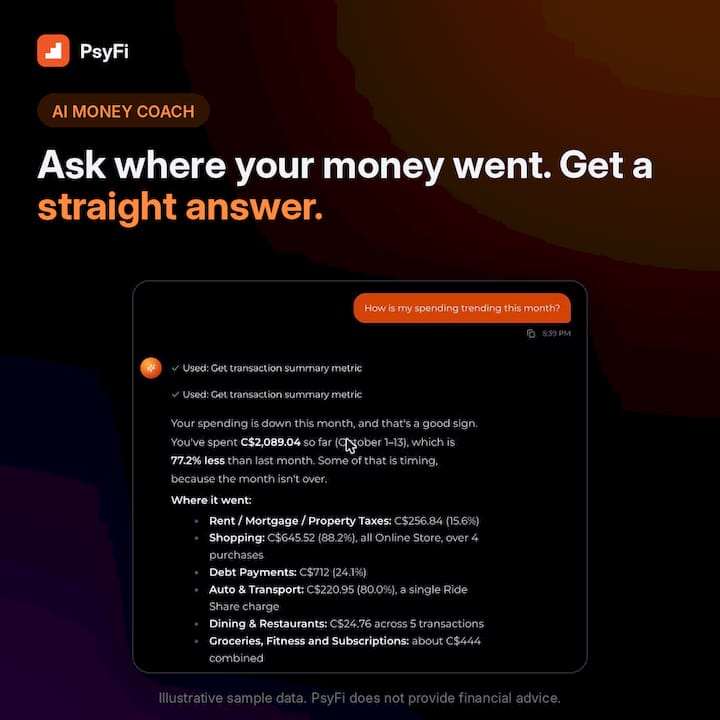
Apps like YNAB, Monarch and Rocket Money track what you spent. PsyFi uses your own data and behavioral science to find why, such as stress spending or avoiding your accounts. Then FY, our AI coach, helps you change the habit in real time.
Our patent-pending AI engine builds a saving and spending plan from your real behavior, not from generic rules. A University of Toronto psychology professor guides the science. We keep it explainable, so you can see the reasoning and stay in control.
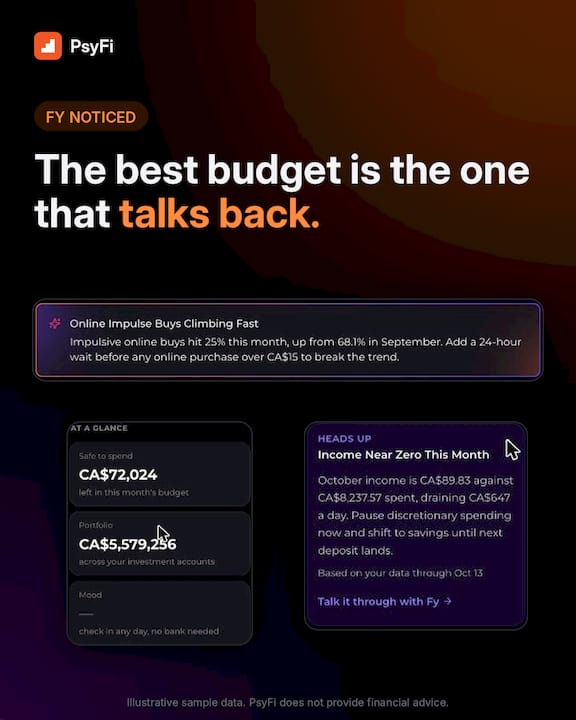
Money is emotional. We think a budget tool should be supportive, not a source of guilt. That is why the daily check-in is short and why we coach instead of lecture.
Maanya Nagpal
Where PsyFi fits
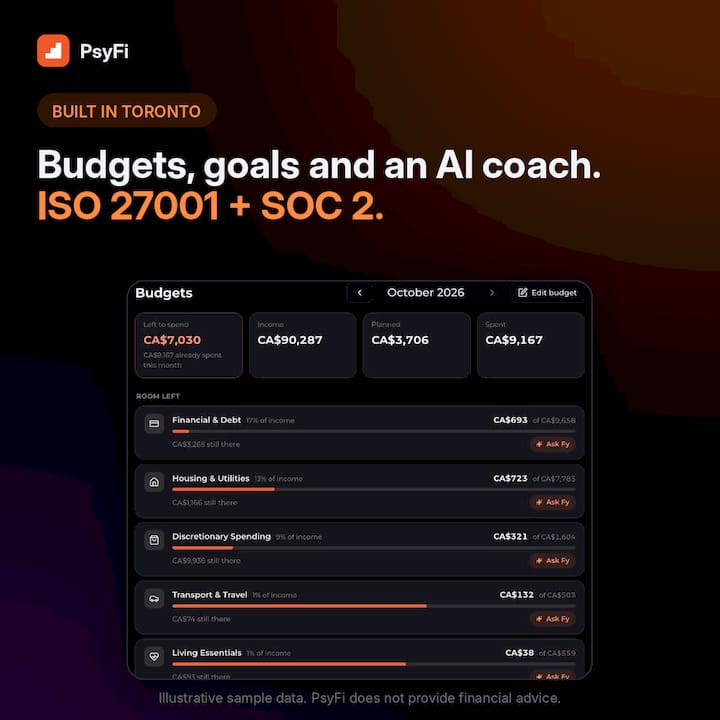
PsyFi is for you if you have tried budgets before and they did not stick. You get a personalized plan, a daily check-in, a library of behavioral interventions, spending and net worth dashboards, and habit tracking. You can try everything free for 7 days on the Premium Monthly plan, and see the full list on our features page.
A few notes on how we work:
PsyFi is coaching, not financial advice. We are not a licensed financial advisor.
It is built for individuals. If you share money with a partner, each of you can use PsyFi for your own habits. We don’t offer joint or shared accounts.
Investing, tax and legal topics we cover are general education only.
If you want to size up a first goal, try the free savings goal calculator. It shows how much to set aside each month to reach a target.
A simple way to choose in one evening
You don’t need to research for weeks. Use this plan.
Step | What to do |
|---|---|
1 | Write down why your last budget stopped working. Be honest and kind to yourself. |
2 | Pick your top two criteria from the list above. |
3 | Choose two apps that fit those criteria. |
4 | Start the free trial or free plan of one. Link one account or upload a statement. |
5 | Use it daily for a week, even for two minutes. |
6 | Keep it if checking in feels easier than avoiding. |
Two minutes a day is enough to build the habit. Our piece on a 5-minute budget tracking habit explains why small and steady works.
If you want more comparisons, see our guides to the best budgeting apps, YNAB alternatives and apps for money anxiety. If impulse buys are your main worry, read about apps that help stop impulse spending. If your paycheck varies, see how to budget on an irregular income.
Ready to try a budget app that works with your habits instead of against them? Start your 7-day free trial
FAQ
What is the best budget app for a young professional?
It depends on why budgets stop working for you. If you like strict rules, a method-based app like YNAB may suit you. If you stress-spend or avoid your accounts, a habit-focused app like PsyFi is designed for that.
Is YNAB worth it for someone just starting out?
YNAB uses zero-based budgeting, where every dollar gets a job, so it suits people who enjoy planning in detail (WhistleOut, 2026). Check its current price on its own site before you commit. If a hands-on system has not stuck for you before, try a coaching-based app too.
Do I have to give a budget app my bank login?
Not always. PsyFi connects through Plaid or lets you upload documents, and no bank login is required. It works in the US and Canada.
How much does PsyFi cost?
PsyFi costs $9.99 per month or $69.99 per year, and both plans start with a 7-day free trial. You can see the current plans on our pricing page.
Can my partner and I share one PsyFi account?
No. PsyFi is for individuals only, with no joint or couples accounts. Each partner can use their own account to work on their own habits.
Sources
Recommended
This content is provided for general informational and educational purposes only and does not constitute financial, investment, tax, or legal advice. PsyFi provides financial coaching tools and behavioral insights, not regulated advisory services. Always consult with a qualified financial advisor or tax professional regarding your personal situation before making financial decisions.
Keep reading
- Paycheck Budgeting: Give Each Paycheck a Plan So Bills Get PaidLearn how paycheck budgeting works, how to set up a biweekly plan, and what to do in three-paycheck months, with tables and a simple template.

- Cleo Alternatives: Apps That Fix Money Habits, Not Just Cash GapsLooking for a Cleo alternative? Compare cash advance, budgeting and AI coaching apps by what they fix, how they link accounts and what to check first.

- Financial Coach vs Financial Advisor: Which One Fits Your Money Problem?A financial coach helps with spending habits, budgets and debt. A financial advisor handles investing and planning. See which fits you, and what to check first.