


Apps for Money Anxiety: 5 Options Compared for 2026
Money anxiety makes budgeting apps hard to open. Compare PsyFi, YNAB, Monarch, Rocket Money and Empower on calm, cost and privacy to find your fit.
The right app for money anxiety is one you will open on a hard day. It should show your money without scolding you, and it should help with the feelings behind your spending, not only the numbers. Below, we compare five popular options on the same criteria. We make one of them, PsyFi, and we say so up front.
Table of Contents
TL;DR
Money anxiety often shows up as avoiding your accounts or spending to feel better. Pick an app that helps with those habits, not just one that tracks purchases.
Budgeting apps like YNAB and Monarch give structure. Rocket Money and Empower are easy to start with and have free options. PsyFi is built around the why behind your habits.
Prices in the US run from free to $14.99 a month. Check each app’s own pricing page, because plans change.
Before you link accounts, check what access the app needs, where it works, and whether you can skip a bank login.
Start your 7-day free trial
Why money anxiety makes most apps hard to use
If opening your banking app makes your stomach drop, you are far from alone. The Penny Hoarder’s April 2026 survey of 1,000 U.S. adults found that 43% worry about money several times a week. It also found that only 14% feel in control of their finances.
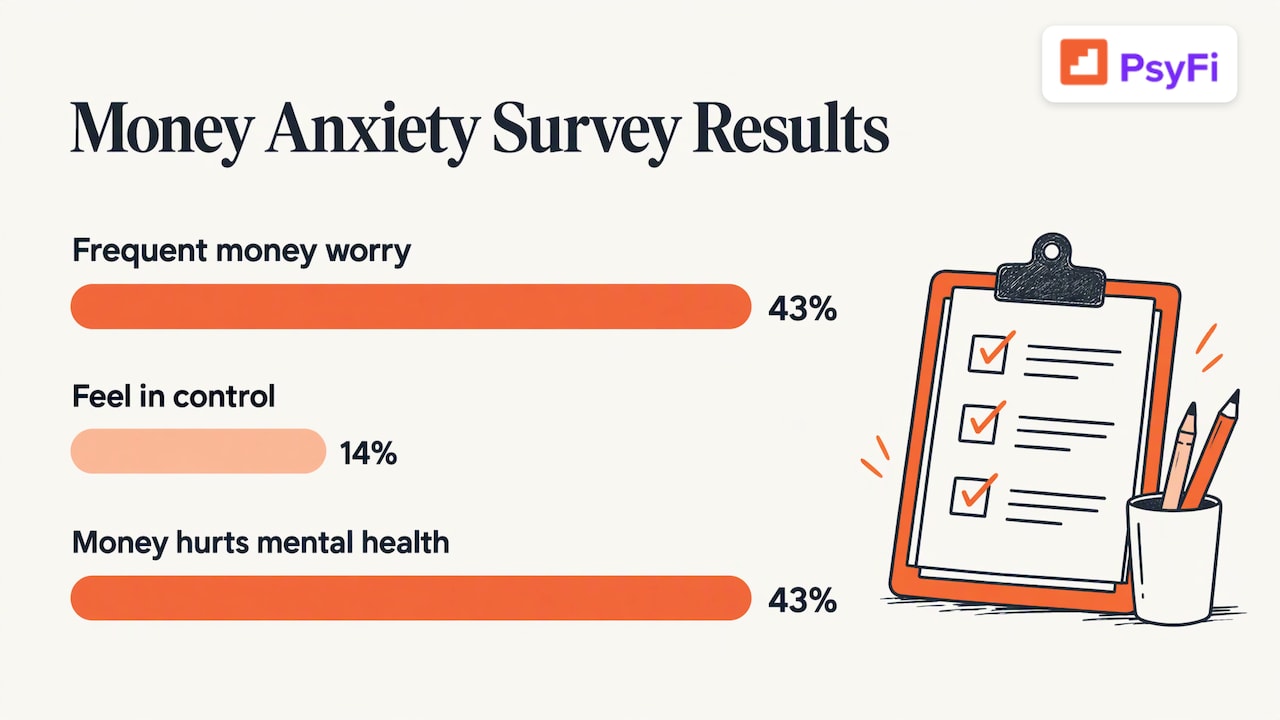
Bankrate’s March 2025 survey points the same way. 43% of U.S. adults said money hurts their mental health at least occasionally. That made money the most common factor on its list, ahead of current events and personal health.
Anxiety tends to push people in two directions:
Avoiding. You stop checking balances because the number feels scary. Bills and fees pile up in the dark.
Doom-spending. You shop to feel better for a moment. A Psychology Today piece on financial anxiety describes this cycle and suggests breathing exercises and waiting 24 hours before big money decisions.
None of this is a character flaw. It is a normal stress response, and the right tool can make it easier to handle. If you want to see where you stand first, the free Financial Stress Score is a quick starting point.
How we ranked these apps
We judged each app on the same six criteria. They are based on what tends to help people who feel anxious about money. Yours may differ, so weigh them your way.
Low-pressure design. Does it feel calm and doable, or like a daily report card?
Help with habits and emotions. Does it address avoiding or stress spending, or only record transactions?
Structure. Does it give you a clear plan, like a budget method?
Cost. What do you pay in the US, and is there a free trial?
Account access. How does it get your data, and can you use it without handing over a bank login?
Fit for beginners. How easy is it to start if you feel overwhelmed?
We cover pricing from published reports and the apps’ own plans. Prices below for YNAB, Monarch, Rocket Money and Empower come from a January 2026 roundup by Clark.com. Check each company’s own pricing page for today’s price before you subscribe.
The five apps at a glance
App | Best known for | US price | Free trial |
|---|---|---|---|
PsyFi | Behavioral coaching on your own habits | $9.99 per month or $69.99 per year | 7 days |
YNAB | Zero-based budgeting | $14.99 per month or $109 per year | 34 days |
Monarch Money | All-in-one account view and planning | $14.99 per month or $99.99 per year | 7 days |
Rocket Money | Finding subscriptions to cancel | Free to download, premium $6 to $12 per month | 7 days |
Empower | Free net worth and planning tools | Free to download | None listed |
Pros and cons of each app
Every app below can help. The question is which one matches how your anxiety shows up.
App | Pros | Cons |
|---|---|---|
PsyFi | Looks at your real behavior to spot patterns like stress spending or avoiding your accounts. Daily check-in and real-time coaching from its AI coach, FY. Works with Plaid or document upload, so no bank login is needed. Explainable, and you stay in control. | Built for one person’s habits, with no joint or couples accounts. US and Canada only. It offers coaching, not financial advice. |
YNAB | Gives every dollar a job, which can feel steady and clear. Long 34-day trial. | Highest monthly price here. The method takes effort to learn, which can feel heavy if you are already overwhelmed. |
Monarch Money | Tracks investments, lets you customize your plan, and lets you share your budget. | Many features can mean a lot to look at. Costs $14.99 a month, or $99.99 a year. |
Rocket Money | Easy to start and free to download. Strong at spotting forgotten subscriptions. | Focuses on bills and cancellations more than on the feelings behind spending. Premium pricing varies. |
Empower | Free planning tools, including net worth tracking, cash-flow tracking and budgeting. | Wide focus on planning and investing can feel like a lot for a first step. No coaching on habits. |
A few notes on how to read this table:
A long trial like YNAB’s can help if you need time to settle in.
A free app like Empower costs nothing to try, which lowers the stakes if you are nervous.
Price is only part of it. An app you open every day is cheaper than a free one you avoid.
What kind of app fits which kind of anxiety
Apps for money anxiety fall into a few types. They do different jobs, and they can work well together.
Type | What it does | Examples from this list | Good if you… |
|---|---|---|---|
Budgeting apps | Track spending and plan where money goes | YNAB, Monarch | Want a clear system and like seeing numbers |
Bill and subscription finders | Spot recurring charges you may have forgotten | Rocket Money | Feel stress from surprise charges |
Net worth and planning dashboards | Show the big picture over time | Empower, Monarch | Want to see progress, not only monthly spending |
Behavioral coaching apps | Look at your habits and help you change them in the moment | PsyFi | Avoid your accounts or stress-spend |
Peer-support apps | Let you share worries anonymously with others | AFK, a free app with a financial anxiety category | Need to talk it out, not plan it out |
Peer support and therapy can matter a lot. An app is not a replacement for a licensed therapist. If money worry is affecting your sleep, health or relationships, talk to a mental health professional.
Features that make a money app feel manageable
Anxious minds do better with less to decide. Look for these features.
Clear labels for your money
The Financial Health Network describes how money labeling can help people make smarter spending decisions. Setting money aside for a purpose before you spend makes the math simpler. It also makes your plans visible. If you like this idea, our guide to a zero-based budget walks through a 30-minute version.
A small daily habit
Big monthly reviews can feel like a test. A short daily check-in is easier to keep. It also helps you get used to seeing your numbers, which is the best answer to avoidance.
Help in the moment
The hardest time is right before an impulse buy. An app that can nudge you then, based on your own patterns, is more useful than a report you read next week. We write more on this in our guide to emotional spending and on doom spending.
A tone that does not judge
If an app uses red warnings and guilt, you may stop opening it. Try the first screens and notice how they make you feel. You should feel informed, not graded.
Our perspective
Most money apps start with a budget and hope the habits follow. In our work, we see it the other way around. People rarely fail at money because they cannot add. They fail because stress, avoidance and old patterns get in the way.
That is why we built PsyFi around the why. Apps that track what you spent can tell you where the money went. We use your own data and behavioral science to look for the patterns behind it, like stress spending or avoiding your accounts. Then our AI coach, FY, helps you change the habit in real time.
We also think you should stay in control. PsyFi is explainable, so you can see why it suggests something. It is coaching, not financial advice. And it is for you as an individual, so each person works on their own habits at their own pace.
If you are anxious about money, you do not need a harsher budget. You need a calmer way to look.
Maanya Nagpal
Privacy and account access: what to check
Money anxiety and privacy worries often go together. Before you link anything, run through this list.
Question to ask | Why it matters |
|---|---|
How does the app get my data? | Some use a bank-connection service. Others let you upload statements. |
Do I have to share my bank login? | If not, you keep more control over your credentials. |
Is the app available where I live? | Many apps work only in certain countries. |
Which security checks does the company publish? | Look for independent audits and certifications on its security page. |
Can I use it without linking accounts? | This lets you start small, which helps if linking feels scary. |
For PsyFi, here is the short version. It works in the US and Canada. It connects through Plaid bank sync or through document upload. You do not need to give a bank login. It is ISO 27001 certified and SOC 2 Type 2 audited.
For other apps, read their own security and privacy pages. Each handles access in its own way, and the details can change.
A gentle way to start this week
You do not need to fix everything at once. Here is a small plan that fits most anxious starts.
Step | What to do | Why it helps |
|---|---|---|
1 | Pick one app from the table above and start its free trial or free plan | Lowers the stakes |
2 | Look at one account, for two minutes | Builds comfort with seeing the number |
3 | Write down one bill you are worried about | Gives the worry a shape |
4 | Wait 24 hours before any non-essential purchase | A pause can break the doom-spending loop, as the Psychology Today piece above suggests |
5 | Set one small savings goal with the savings goal calculator | Turns a vague fear into a number you can act on |
6 | Check in once a day, briefly | Makes looking normal |
For a longer version, see our first-week plan to reduce financial stress. If you tried budgeting before and it did not stick, our guides to budgeting apps you will actually keep and YNAB alternatives may help. You can also read about Rocket Money alternatives.
If you know what to do but still do not do it, the gap has a name. We cover it in apps for the intention-action gap. And if focus is part of the struggle, see money management with ADHD.
Try PsyFi if you avoid or stress-spend
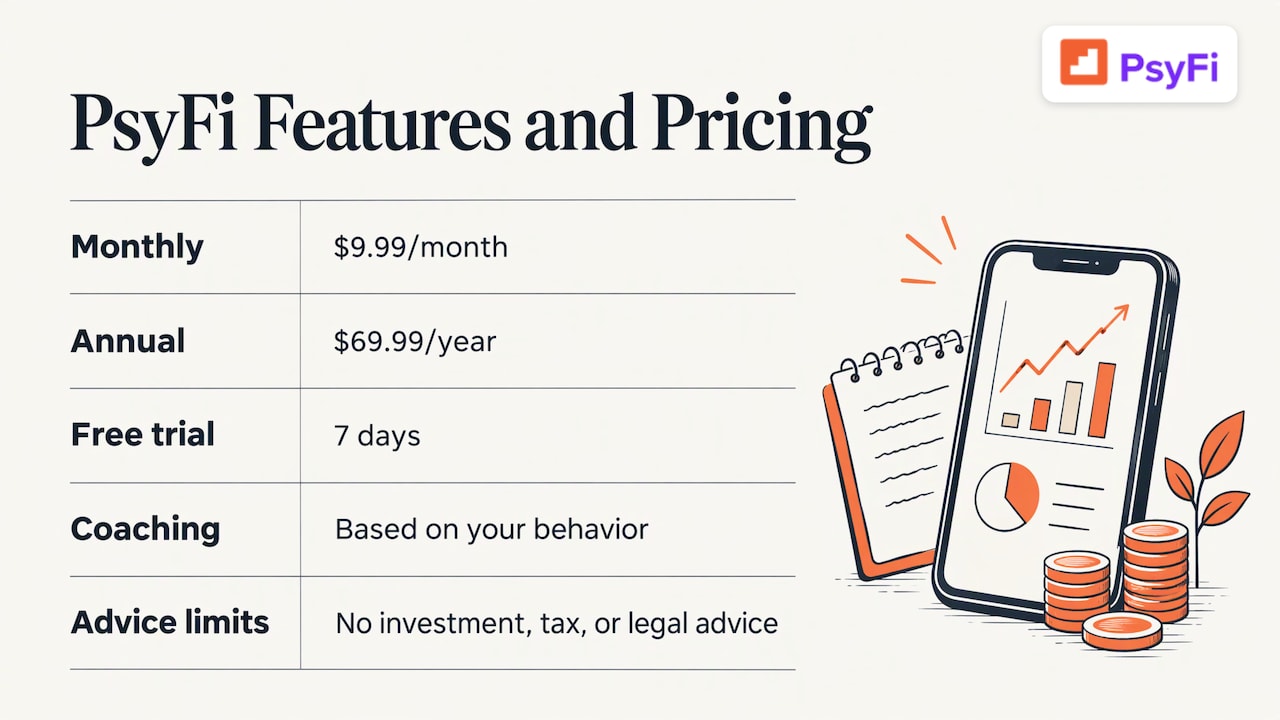
If your pattern is avoiding your accounts or spending to cope, PsyFi is made for that. Premium is $9.99 a month or $69.99 a year, and it starts with a 7-day free trial. You can see what is included on the features page. PsyFi gives coaching based on your own behavior. It is not a licensed financial advisor and does not give personalized investment, tax or legal advice.
How to choose: a quick decision guide
If this sounds like you… | Consider |
|---|---|
“I avoid my accounts and spend when I’m stressed.” | PsyFi |
“I want a strict, clear method for every dollar.” | YNAB |
“I want everything in one place, including investments.” | Monarch Money |
“I think I’m paying for things I forgot about.” | Rocket Money |
“I want free tools to see my net worth.” | Empower |
“I need to talk to someone who gets it.” | A peer-support app, or a licensed therapist |
You can also combine tools. Many people use one app for daily habits and another for a big-picture view. Pick what feels calm, not what looks most impressive.
FAQ
What is the best app for money anxiety?
It depends on how your anxiety shows up. If you avoid your accounts or stress-spend, a behavioral coaching app like PsyFi may fit. If you want a clear method, a budgeting app like YNAB or Monarch may suit you better.
How do I calm down money anxiety right now?
Start with slow breathing, and wait 24 hours before making any big money decision, as Psychology Today suggests. Then look at just one number, like a single account balance. If the worry keeps affecting your sleep or health, talk with a licensed mental health professional.
Can a budgeting app actually reduce financial stress?
For many people, seeing the full picture feels better than guessing. Features like money labeling can make planning clearer. An app is a tool, not a cure, so pair it with small habits and support if you need it.
Is it safe to link my bank account to a money app?
Check how the app connects, what security audits it publishes, and whether you can skip the bank login. PsyFi works in the US and Canada, connects through Plaid or document upload, and does not require a bank login. Always read an app’s own privacy page before you link anything.
Is PsyFi financial advice?
No. PsyFi is coaching based on your own habits and data. It is not a licensed financial advisor, and for investment, tax or legal questions you should speak with a qualified professional.
Ready to look at your money without the dread? Start your 7-day free trial
Sources
Overcoming Financial Anxiety and Doom Spending, Psychology Today
Helping Users Make Smarter Spending Decisions With Money Labeling, Financial Health Network
Recommended
This content is provided for general informational and educational purposes only and does not constitute financial, investment, tax, or legal advice. PsyFi provides financial coaching tools and behavioral insights, not regulated advisory services. Always consult with a qualified financial advisor or tax professional regarding your personal situation before making financial decisions.
Keep reading
- Reduce financial stress fast: a behavioural first-week planDiscover effective steps to quickly reduce financial stress today. Start with budgeting and small savings to take control of your finances.

- Best Financial Coaching Apps in 2026: How to Pick OneCompare the best financial coaching apps in the US: PsyFi, YNAB, Monarch, Rocket Money, Copilot and EveryDollar. See criteria, pros, cons and who each fits.

- RESP vs TFSA: The Impossible Choice for ParentsFacing choice overload between RESP, RRSP, and TFSA? Discover why Canadian parents struggle to prioritize registered accounts and how to build a clear savings hierarchy.