

Paycheck Budgeting: Give Each Paycheck a Plan So Bills Get Paid
Learn how paycheck budgeting works, how to set up a biweekly plan, and what to do in three-paycheck months, with tables and a simple template.
Paycheck budgeting means planning your money one paycheck at a time instead of one month at a time. You list what each paycheck must cover before the next one arrives, so rent, bills, savings and spending all have a place.
By Maanya Nagpal, Co-Founder of PsyFi
If a monthly budget never quite worked for you, that is not a character flaw. Your money does not arrive once a month. It arrives on payday, and bills land on their own dates. A plan that follows your pay schedule fits real life better. This guide shows you how to build one, how to handle biweekly pay, and what to do when money is tight before payday.
TL;DR
Paycheck budgeting assigns each paycheck a job: bills due before the next payday, savings, and spending.
The key step is putting dates on your income and bills, so shortfalls show up before they happen.
On biweekly pay, you get 26 paychecks a year. Two months usually bring a third paycheck, which is a good chance to save.
Percentage rules like 50/30/20 are starting points, not verdicts. Adjust them to your life.
Check in often and adjust without guilt. A budget that bends is a budget that lasts.
Table of Contents
What paycheck budgeting is, and how it differs from a monthly budget
A monthly budget adds up your income and bills for the whole month and checks that the totals match. That works on paper. In real life, the timing matters just as much as the amounts.
The Consumer Financial Protection Bureau (CFPB), the federal agency that protects consumers in financial products, describes cash-flow budgeting as accounting for the timing of income and expenses, not only their amounts. The same toolkit explains that a monthly plan can miss shortages caused by timing, because income and bills may arrive on different days. Adding dates makes those gaps visible.
Here is a simple picture of the difference.
Monthly budget | Paycheck budget | |
|---|---|---|
Unit of planning | The whole month | One paycheck at a time |
Question it answers | Do my totals add up? | Can this paycheck cover what is due before the next one? |
Handles uneven bill dates | Often not | Yes, bills are matched to the paycheck that pays them |
Fits biweekly or weekly pay | Awkward | Natural |
Best for | Steady monthly pay and bills | Anyone paid on a schedule, especially with tight timing |
Neither is wrong. Many people use both: a monthly view to see the big picture, and a paycheck view to make daily decisions.
Why it feels easier for many people
A month is a long time. Money that looks plentiful on the first can be gone by the twentieth, and that can make you want to stop looking. A paycheck is a smaller, clearer window. You know what came in, what is already spoken for, and what is left.
If you tend to avoid your accounts when you feel stressed, a smaller window can feel less scary. You are not judging a whole month. You are answering one question: what does this paycheck need to do?
How to make a budget by paycheck
You do not need special software. A notes app, a spreadsheet or paper works. Here is the routine, step by step.
Step | What to do | Where it can go wrong |
|---|---|---|
1. List your income | Write down your take-home pay, the amount that lands in your account after taxes and deductions, and the dates it arrives. | Using gross pay (before taxes) makes the plan look bigger than it is. |
2. List your bills with due dates | Include rent, utilities, phone, insurance, debt payments and subscriptions. | Forgetting yearly or quarterly bills, like car insurance. |
3. Match each bill to a paycheck | Assign each bill to the last paycheck that arrives before it is due. | Assigning a bill to a paycheck that arrives after the due date. |
4. Set aside savings | Pick a fixed amount per paycheck. | Saving only what is “left over,” which is often nothing. |
5. Plan spending | Whatever remains covers food, gas, fun and everything flexible. | Setting the number so low that you give up by day three. |
6. Check in and adjust | Compare plan to reality, then update. | Treating one off week as failure. |
Let’s go through the steps in more detail.
Step 1: Gather your income
The CFPB’s budgeting guide says to start by recording all income sources, including jobs, self-employment, child support and government benefits. Use your pay stubs or bank deposits to find the real take-home amount.
If your pay changes from one check to the next, use your lowest recent paycheck as your planning number. Anything above it is a bonus you can assign later. If your income is irregular all the time, our guide to budgeting on an irregular income goes deeper.
Step 2: Find your real spending
You cannot plan what you cannot see. The same CFPB guide recommends tracking spending, and says you can begin with one week at a time if a full review feels overwhelming. It also suggests using receipts or account activity to catch small purchases.
That tip matters. If looking at three months of transactions feels like too much, start with seven days. That is enough to begin. If you want to automate the tracking, here is how to set up automatic spending tracking.
Step 3: Put every bill on a calendar
This is the step that makes paycheck budgeting work. The CFPB’s bill-calendar booklet says to enter income dates and bills on a calendar. It suggests marking online payments two days before their due date and mailed payments seven days before. That small buffer helps keep you from paying late.
Once your calendar is filled in, draw a line at each payday. Everything between two paydays belongs to the earlier paycheck.
Step 4: Pay yourself first
Pick a savings amount for every paycheck, even a small one. The CFPB’s savings booklet recommends choosing a savings frequency that fits your circumstances, including once per paycheck. It also recommends setting money aside automatically for periodic lump-sum expenses. The booklet notes that this approach needs regular income and an account at a bank or credit union.
If you want help picking the number, our savings plan guide shows how to turn a goal into an exact target. You can also try the free savings goal calculator.
Step 5: Give spending a number you can live with
What remains after bills and savings is your flexible spending. Be honest and kind with yourself here. If you love eating out, plan for it. A budget with no room for joy tends to break, and then the “what the hell” effect kicks in: once you overspend a little, it feels pointless to keep trying, so you spend more. A realistic number prevents that spiral.
A biweekly paycheck budget, with an example
Biweekly pay means you are paid every two weeks. That is 26 paychecks a year, not 24, so two months in most years bring three paychecks.
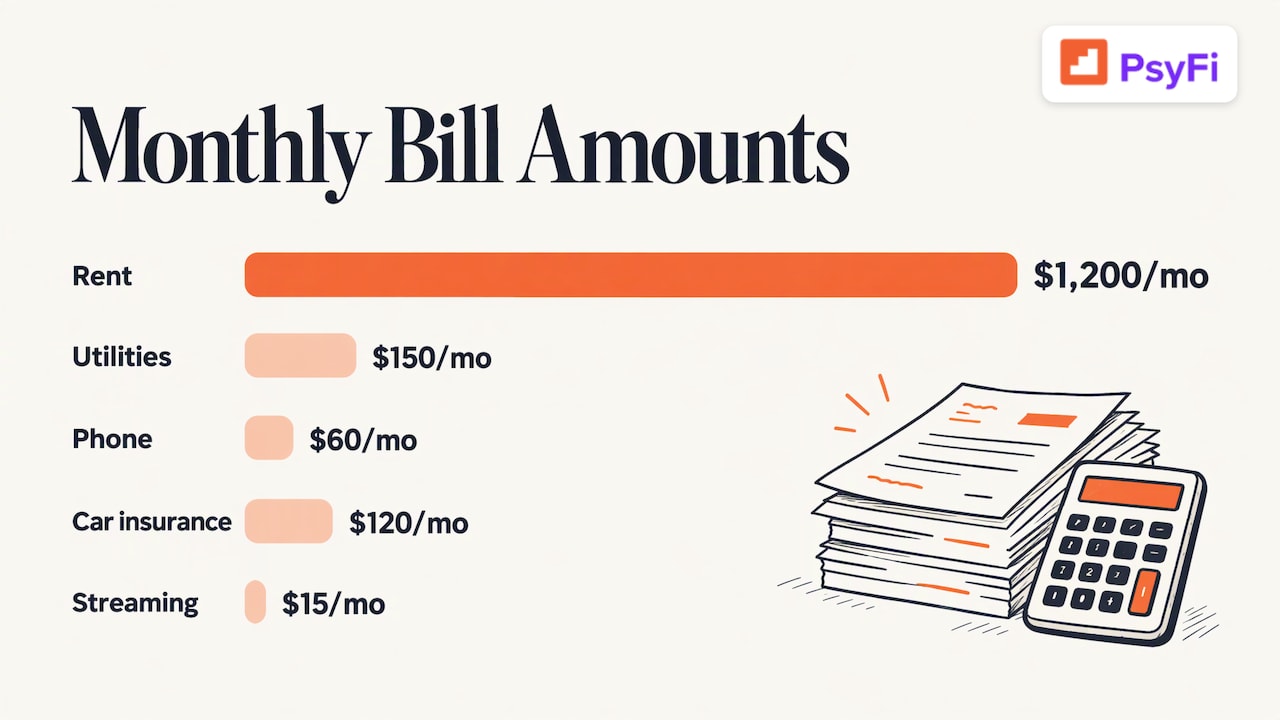
Here is a sample using made-up numbers. Say your take-home pay is $1,800 per paycheck, and your bills are: rent $1,200, utilities $150, phone $60, car insurance $120 and a streaming service $15 per month.
Item | Paycheck 1 (1st half of month) | Paycheck 2 (2nd half of month) |
|---|---|---|
Take-home pay | $1,800 | $1,800 |
Rent | $1,200 | $0 |
Utilities | $0 | $150 |
Phone | $60 | $0 |
Car insurance | $0 | $120 |
Streaming | $15 | $0 |
Savings | $100 | $100 |
Left for food, gas and fun | $425 | $1,430 |
See the problem? The first paycheck is crowded and the second is roomy. Paycheck budgeting shows you this before it hurts. You have a few options:
Move some bills to the other paycheck, if your biller allows it.
Save the roomy paycheck’s extra for the crowded one.
Set a smaller weekly spending number for the tight half of the month.
The CFPB’s savings booklet suggests asking billers about changing due dates or splitting a large monthly payment into smaller ones. Its example splits $700 rent into $350 payments on the first and fifteenth. Not every landlord agrees, but asking is free.
What to do in a three-paycheck month
With 26 paychecks, two months a year bring a third one. It is tempting to treat it as spending money. Try deciding its job before it arrives.
Idea for the third paycheck | Why it helps |
|---|---|
Put most of it toward savings | Builds a cushion without touching your usual routine |
Fund an upcoming irregular bill | Covers things like car registration or annual fees |
Pay extra toward debt | Lowers what you owe over time |
Keep a small amount for fun | Makes the plan feel sustainable |
A split such as part savings, part bills, part fun is perfectly fine. The goal is that the paycheck has a plan, not that you follow one right answer.
Percentage rules: how they fit paycheck budgeting
You may have seen rules like 50/30/20 or 70-10-10-10. They split your take-home pay into categories. One popular version suggests putting up to 50% of after-tax income toward needs, 30% toward wants and 20% toward savings.
Other rules use different slices. Fidelity’s budget worksheet uses 60% of take-home pay for essentials, 30% for non-essentials and 10% for emergency savings and goals. NerdWallet’s article on a 70/20/10 method uses 70% for living expenses, 20% for savings and investments, and 10% for debt repayment and giving. The same article notes that putting needs and wants in one category can make the framework a poor fit for some households.
The lesson is that percentages vary because lives vary. If rent in your city takes a large share of your pay, a 50% needs limit may not be possible, and that says something about housing costs, not about you.
To use any percentage rule at the paycheck level:
Take your paycheck amount.
Multiply it by each percentage.
Compare the result to your real bills and habits.
Adjust until the plan matches your life.
For a closer look at sorting needs from wants, see our guide to a needs vs wants budget. Once your plan leaves room for savings, you can also compare personal finance products such as accounts and cards to see where that money might sit.
This is general education, not personal investment, tax or legal advice. If you have questions about taxes or investments, a licensed professional can look at your full situation.
Saving $2,000 in three months on biweekly pay
A common question is how much to save from each biweekly check to reach $2,000 in three months. Three months is about 13 weeks, which means six or seven paychecks. Here is the math.
If you get | Per-paycheck amount to reach $2,000 |
|---|---|
6 paychecks | About $334 |
7 paychecks | About $286 |
Saving $1,000 per paycheck, by comparison, adds up to $26,000 over 26 paychecks. Whether that is realistic depends on your take-home pay and fixed bills. For many households it is out of reach, and that is okay. A smaller amount you keep doing beats a bigger one you drop in week three.
If the number feels too big, stretch the timeline. Saving $100 a paycheck for six months is still real progress. Our 52-week savings challenge guide shows how to fit a savings habit to your pay cycle.
When a bill is due before your next paycheck
This is the most stressful part of living paycheck to paycheck. The CFPB’s toolkit says cash-flow budgeting can reveal shortfalls within the month and help make sure money is available for important expenses such as rent. It also notes that income may be regular, irregular, seasonal or one-time, while bills like rent keep coming either way.
Here are practical ways to handle the gap:
Situation | What you can try |
|---|---|
A bill is due the day before payday | Ask the biller to move the due date |
A large monthly bill strains one paycheck | Ask about splitting it into two smaller payments |
Two big bills hit one paycheck | Set aside part of the previous paycheck in advance |
Income changes from check to check | Plan around your lowest recent paycheck |
None of this is about blame. Timing gaps happen to careful people every day.
How to track and adjust when life happens
No plan survives contact with real life untouched. A car repair, a birthday or a bad week will change the numbers. That does not mean the budget failed.
The CFPB’s budgeting guide advises updating your budget when your job or spending habits change, and choosing a tracking tool that is easy to use in real time. Its toolkit recommends tracking earnings and spending, studying your patterns, and using what you learn to set future spending targets.
A gentle weekly routine looks like this:
When | Action | Time |
|---|---|---|
Payday | Assign the paycheck to bills, savings and spending | A few minutes |
Midweek | Glance at your spending number | A minute or two |
Before next payday | Note what worked, what did not, and adjust | A few minutes |
If even that feels like a lot, try a 5-minute daily tracking habit. Small and steady beats big and rare.
Where paycheck budgets usually break, and why
Most budgets do not fail because of math. They fail because of feelings and habits. Stress spending, avoiding your accounts and the “what the hell” effect are common, human and fixable.
A spreadsheet can tell you that you overspent on Friday. It cannot tell you why. Maybe it was a hard week, or you were tired and ordered food. Seeing the pattern behind the number is what helps you change it, and that is the part most tools skip.
Promo: seeing the pattern behind your paycheck
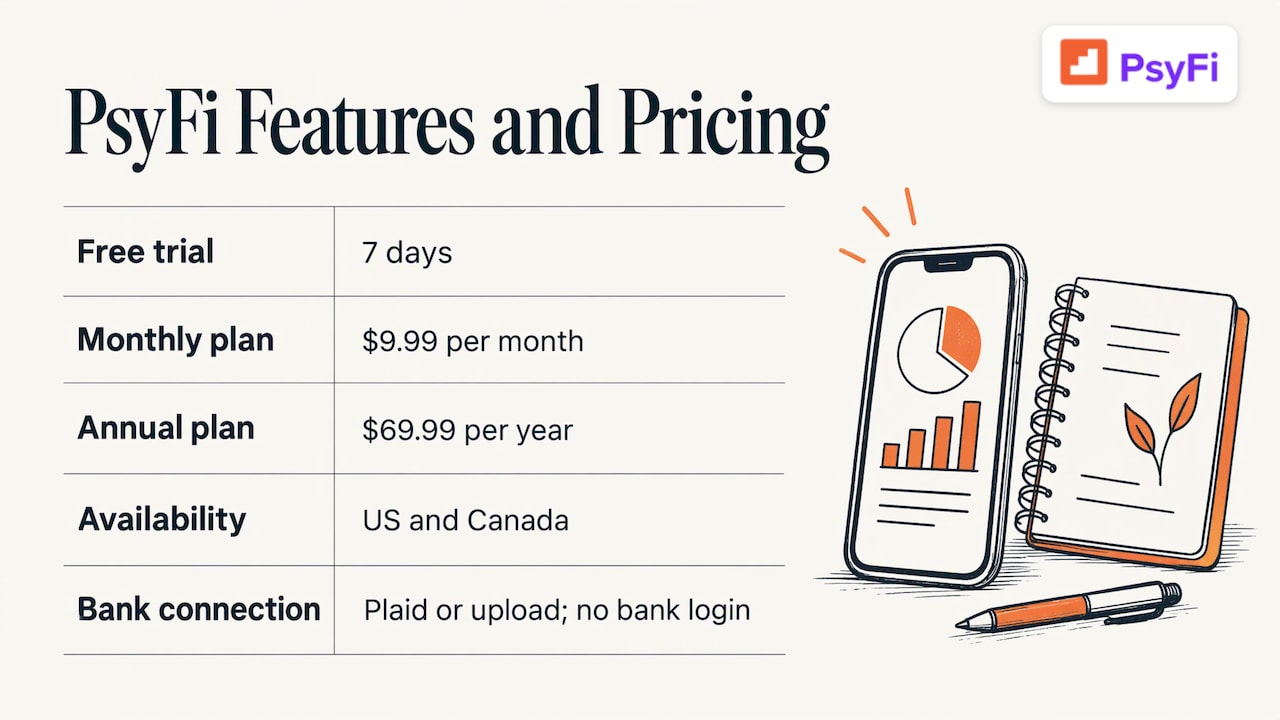
PsyFi is an AI-driven financial wellness app that looks at your real financial behavior, spots patterns like stress spending or avoiding your accounts, and builds a personalized saving and spending plan. It offers a daily check-in and a library of behavioral interventions. It works in the US and Canada, connects through Plaid or document upload, and does not require a bank login.
Premium costs $9.99 per month or $69.99 per year, after a 7-day free trial. See the pricing page for details, or browse the features. PsyFi offers coaching, not financial advice, and it is built for individuals: each person uses it for their own habits.
Our perspective
We built PsyFi on a simple idea: a budget tells you what happened, but it rarely tells you why. Paycheck budgeting is a great structure because it matches how money really arrives. But structure alone does not change habits.
When someone tells us they quit a budget, it is rarely about math. It is stress, avoidance or a rough week that turned into a rough month. Our science is guided by a University of Toronto psychology professor, and our AI engine is designed to find those patterns in your own data and turn them into a plan that fits you.
That is why we pair a paycheck plan with a daily check-in. It keeps the habit small, gentle and in front of you, without shame or guilt.
Maanya Nagpal
FAQ
What is the best way to budget my paycheck?
The best way is the one you will keep using. Start by listing your take-home pay and your bills with due dates, match each bill to the paycheck that pays it, set a savings amount, and spend what is left. Adjust each payday.
What is the 70-10-10-10 budget rule?
It is a percentage rule that splits take-home pay into one large share and three smaller ones. Different sources use different categories, so check what each slice covers before you copy it. Then adjust the numbers to your real bills.
How do I budget a biweekly paycheck?
Treat each paycheck as its own mini budget. Put the bills due before the next payday on that paycheck, add a savings amount, and set the rest as spending money. In the two months a year with a third paycheck, give that extra check a job ahead of time.
Is saving $1,000 every paycheck good?
It is a strong goal, but it adds up to $26,000 a year on biweekly pay, so it only fits some budgets. Start with an amount your bills allow and raise it when you can. Steady saving matters more than the size of any single deposit.
Start with one paycheck
You do not have to fix everything today. Pick your next payday, list what it needs to cover, and give the rest a plan. If you want help seeing why your money slips away between paychecks, Start your 7-day free trial.
Sources
Recommended
This content is provided for general informational and educational purposes only and does not constitute financial, investment, tax, or legal advice. PsyFi provides financial coaching tools and behavioral insights, not regulated advisory services. Always consult with a qualified financial advisor or tax professional regarding your personal situation before making financial decisions.
Keep reading
- Cleo Alternatives: Apps That Fix Money Habits, Not Just Cash GapsLooking for a Cleo alternative? Compare cash advance, budgeting and AI coaching apps by what they fix, how they link accounts and what to check first.

- Budget App for Young Professionals: How to Choose One You’ll KeepComparing budget apps for young professionals? See how PsyFi, YNAB, Goodbudget and Simplifi differ by method, setup and support, and pick one you'll stick with.