


Cleo Alternatives: Apps That Fix Money Habits, Not Just Cash Gaps
Looking for a Cleo alternative? Compare cash advance, budgeting and AI coaching apps by what they fix, how they link accounts and what to check first.
The best Cleo alternative depends on what you need Cleo for. If you need a small advance before payday, look at cash advance apps. If you keep ending up short because of stress spending or avoiding your accounts, an app that coaches the habit behind the gap fits better, and that is what PsyFi does.
By Maanya Nagpal, Co-Founder of PsyFi
Disclosure: PsyFi makes one of the apps in this comparison. We say so up front and show our ranking criteria below, so you can judge the list yourself. PsyFi offers coaching, not financial advice, and nothing here is personal investment, tax or legal advice.
Table of Contents
TL;DR
Cleo mixes a chatty AI assistant with budgeting tools and cash advances. Alternatives fall into three groups: cash advance apps, budgeting apps and habit coaching apps.
Cash advance apps solve a short-term gap. They do not explain why the gap keeps coming back.
Budgeting apps show where your money went. Many people quit them after a few weeks, which is common and nothing to feel bad about.
PsyFi is built for the second problem: finding the pattern behind your spending, then coaching you through changing it. It costs $9.99 per month or $69.99 per year after a 7-day free trial.
Start your 7-day free trial
What Cleo does, and why people look elsewhere
Cleo is an AI money assistant you chat with. It helps with budgeting, saving and, for some people, small cash advances when your balance runs low. That mix is why “alternatives” can mean very different things.
People usually search for a replacement for one of four reasons:
They want a bigger or different kind of advance.
They do not want to pay a monthly subscription for a chat-style assistant.
They want clearer budgeting, not jokes and roasts.
They want to stop running low in the first place.
The first two are about access to cash. The last two are about habits. Knowing which one is yours saves you from downloading three apps and keeping none.
If money feels overwhelming right now, start with one question: Do I need cash this week, or do I need to change what keeps happening? Both are fair needs. You can have both. They just call for different tools.
How we compare the options
We judge each app on five criteria. These are the criteria behind every “fits you if” statement below, so we are not calling any app better or worse in general.
What problem it targets: a cash gap, tracking, or the habit behind spending.
How it gets your data: bank linking, manual entry or document upload.
What it asks of you in cost: subscriptions, optional tips or fees.
How it helps you act: reports and charts, or coaching in the moment.
Eligibility and repayment: who qualifies and how money is paid back.
Prices change often. Read each app’s own pricing page for current terms before you subscribe, and note the month you checked.
Cleo alternatives at a glance
App | Best known for | Fits you if | Watch for |
|---|---|---|---|
PsyFi | Behavioral coaching on your own data | You stress-spend, avoid your accounts or quit budgeting apps | Not a cash advance app and not financial advice |
EarnIn | Access to earned pay before payday | You have steady direct deposit | Eligibility rules on deposits and account type |
Dave | Small advances plus budgeting tools | You want an advance and basic tracking in one app | Repayment comes from your account |
Brigit | Advances and balance alerts | You want low-balance warnings | Plan terms vary, so read the plan page |
Albert | Banking, saving and advice-style features | You want one app for saving and banking | Check which features need a paid plan |
MoneyLion | Banking, advances and credit-building tools | You want a bundle of products in one place | More products means more terms to read |
YNAB | Hands-on, give-every-dollar-a-job budgeting | You like a detailed system | Takes steady weekly effort |
Monarch | Dashboards for accounts and net worth | You want a clean, full picture | Shows what happened, not why |
The table is a starting map, not a verdict. The sections below explain the three groups.
Group 1: cash advance apps
If you came for the advance, these apps are the closest match to that part of Cleo. EarnIn, Dave, Brigit, MoneyLion and Albert all sit in this space in some form.
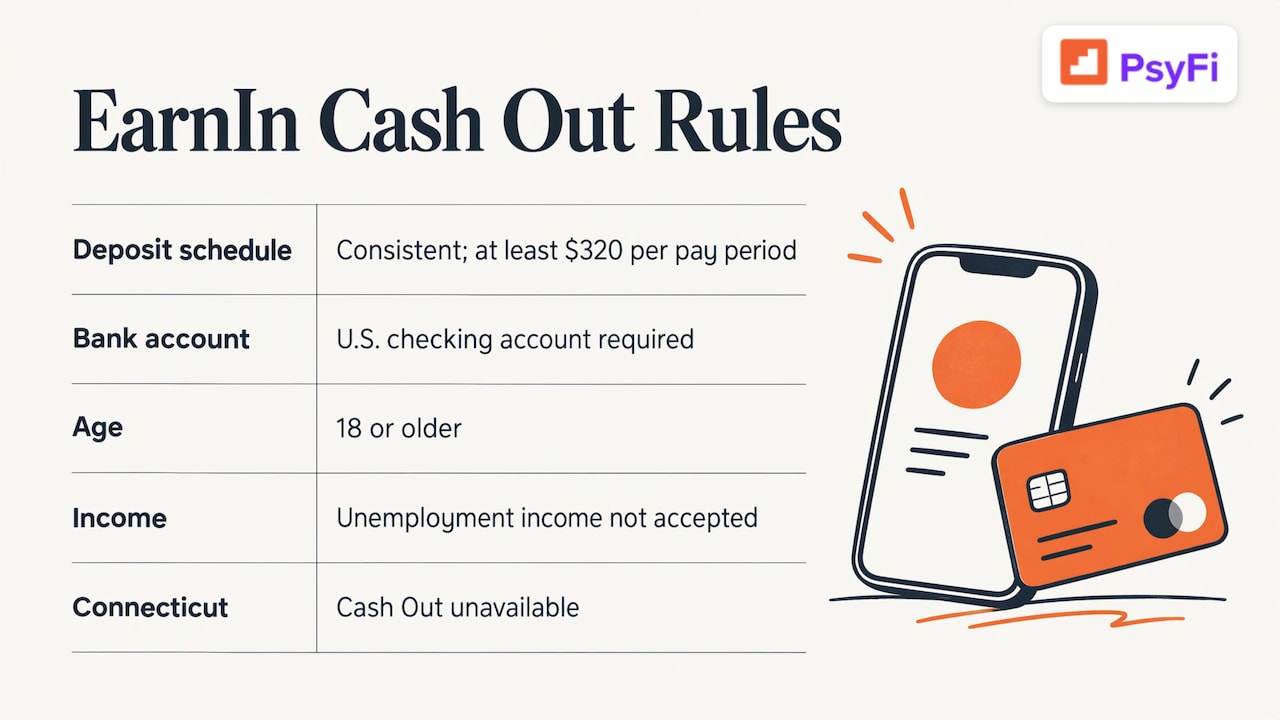
They differ in the rules that decide whether you qualify and how you repay. Here is what one independent comparison reports about EarnIn: it expects a consistent direct-deposit schedule, at least $320 per pay period, a U.S. checking account and age 18 or older. It does not accept unemployment income, and Cash Out is not offered in Connecticut. Rules like these can change, so confirm them on the app’s own page.
Repayment deserves the same attention. According to the same comparison, EarnIn and Dave both collect from an account you control, not from your paycheck. So a late or short direct deposit becomes your problem on both. That is useful to know before you rely on one, because it tells you how to plan the week after an advance.
A simple routine for using any advance app
Step | What to do | Why it helps |
|---|---|---|
1 | Write down your next paycheck date and amount | You know what will repay it |
2 | List bills due before that date | You see the real size of the gap |
3 | Take only what covers the gap | Smaller amounts are easier to repay |
4 | Check your balance the day repayment is due | Avoids a second shortfall |
5 | Note what caused the gap | This is the part that prevents the next one |
Step 5 is where cash advance apps stop. They get you to Friday. They do not tell you that, for example, delivery orders spike after hard workdays.
If late fees are part of your gap, our guide on how to prevent late payment fees walks through practical fixes.
Group 2: budgeting and tracking apps
YNAB, Monarch, Rocket Money, PocketGuard and Copilot Money show where your money went. They are good at structure: categories, subscriptions, net worth and trends.
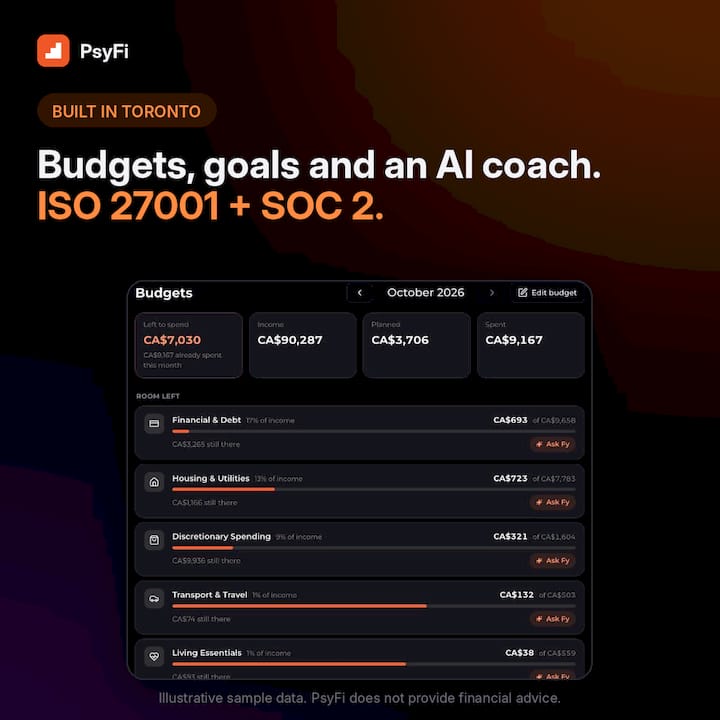
Many readers tell us they tried one, kept it going for a few weeks, then stopped opening it. That is very common. A spreadsheet or tracker works only if you keep looking at it, and for people with money stress, looking is the hard part. It is not a character flaw. Avoidance is a normal response to feeling behind.
If you want to compare tools in this group, these guides can help:
Group 3: habit coaching apps
This is where PsyFi sits. A tracker tells you that you spent $180 on takeout. A coaching app asks when it happens and what was going on.
PsyFi uses your own financial data to spot patterns and biases, such as stress spending or avoiding your accounts. It then builds a personalized saving and spending plan and gives real-time coaching through FY, its AI coach. There is a daily check-in and a library of behavioral interventions. The science is guided by a University of Toronto psychology professor.
Here is how the three groups differ in practice.
Cash advance apps | Budgeting apps | PsyFi (habit coaching) | |
|---|---|---|---|
Main job | Cover a short gap | Track and categorize | Find the why, change the habit |
Works on | Next paycheck | Past spending | Your recurring patterns |
Daily use | Only when short | Check-ins and reviews | Daily check-in |
Plan built from | Income deposits | Your categories | Your behavior and data |
For a wider look at this category, see our guides to financial coaching apps and AI personal finance apps.
PsyFi and Cleo, side by side
Both use AI and a conversational style. They aim at different results.
Criterion | Cleo | PsyFi |
|---|---|---|
Problem targeted | Budgeting, saving and, for some people, cash advances | The behavior behind spending and saving |
How you get help | Chat with an AI assistant | Daily check-in and real-time coaching from FY |
Data approach | Account linking | Plaid bank sync or document upload, no bank login needed |
Cash advances | Offered | Not offered |
Where it works | U.S. | U.S. and Canada |
Cost | See Cleo’s pricing page | $9.99 per month or $69.99 per year, after a 7-day free trial |
The honest summary: if you need cash this week, choose a cash advance app. If you want fewer low-balance moments next quarter, a coaching app is built for that. Some people use one of each. That is fine.
What to check before you pick any app
Whether you choose PsyFi or something else, run through this list first.
Check | What to look for |
|---|---|
Account access | Does it need your bank login, or can you upload documents instead? |
Privacy and security | Look for named standards such as ISO 27001 and a SOC 2 Type 2 audit |
Where it works | Is it available in your country? Some apps cover only the U.S. |
Total cost | Subscription, optional tips and fees, added together for a year |
Repayment | Where and when money is taken back |
Legal history | Whether the company faces state or federal lawsuits. One comparison lists pending cases against both EarnIn and Dave |
Cancellation | How easy it is to stop, and whether there is a free trial |
Repeated advances deserve extra care. If you are borrowing against each paycheck, the pattern itself is the signal. It is not a failure, and many people are in the same spot. A nonprofit credit counselor can help you build a plan for debt, and that is worth considering if balances keep growing.
On PsyFi: it works in the U.S. and Canada. It connects through Plaid or by document upload, and no bank login is required. It is ISO 27001 certified and SOC 2 Type 2 audited. You stay in control of what the app sees.
Pros and cons of each option
App type | Pros | Cons |
|---|---|---|
Cash advance apps | Quick relief for a short gap | Repayment lands on your account; they do not address why you ran short |
Detailed budgeting apps | Clear structure and reports | Need steady upkeep, easy to abandon |
Dashboard apps | Full view of accounts and net worth | Show results, not causes |
PsyFi | Behavior-based plan, daily coaching, document upload option | Does not offer cash advances; coaching, not financial advice |
A worked example
Say Jordan, a 27-year-old analyst, runs low every month around the 20th. Jordan tries a cash advance app. It covers the gap, and the next month the same gap appears.
Jordan then looks at the spending data and sees a pattern: grocery delivery and impulse buys cluster on the days after long meetings. The problem was never the budget total. It was the stress response.
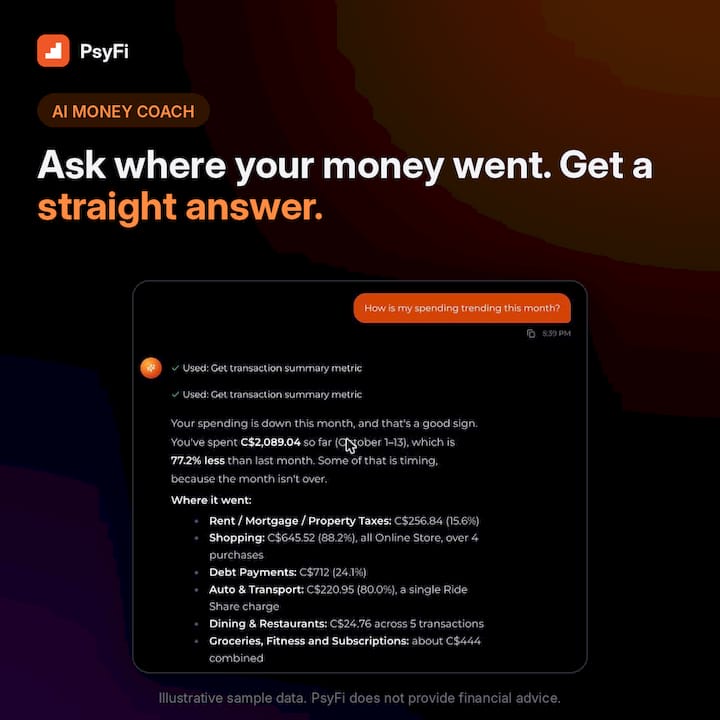
That is the kind of pattern PsyFi’s AI is designed to find. From there, the plan can be small: a pause before ordering, a set aside amount on payday, and a daily check-in that takes less time than scrolling. Jordan’s story is an illustration, not a result from a study. You can try the same idea on your own numbers with our free savings goal calculator.
Our perspective
Most people who look for a Cleo alternative are tired of a cycle. The money runs low, something patches it, and the same thing happens next month. They usually blame themselves.
We built PsyFi on a different view: spending is behavior, and behavior has reasons. Stress, avoidance and habit show up in your data long before they show up in your savings. When an app can name those patterns without judgment, change feels possible.
That is why we focus on the why behind money habits, not only the budget. Tracking apps tell you what you spent. Our AI coach, FY, uses your own data and behavioral science to help you change the habit as it happens.
We also keep you in charge. You choose how to connect, with Plaid or document upload, and you never have to hand over a bank login. We are coaching, not a financial advisor.
Maanya Nagpal
Try PsyFi
PsyFi has one paid plan, available monthly at $9.99 or yearly at $69.99, and every account starts with a 7-day free trial. You can see what is included on the features page and the pricing page. It is made for individuals, so each person uses it for their own habits.
If worry about money makes you want to look away, our guide to apps for money anxiety is a gentle place to continue. And if you already know what to do but struggle to do it, see the apps for the intention-action gap.
Start your 7-day free trial
FAQ
What is the best alternative to Cleo?
It depends on what you use Cleo for. For short-term cash, cash advance apps such as EarnIn or Dave are the closest match. For changing the habits that leave you short, PsyFi is built to find the pattern and coach you through it.
Is there an app like Cleo without cash advances?
Yes. Budgeting and coaching apps give you tracking and guidance without lending you money. PsyFi is one: it focuses on behavior, uses Plaid or document upload, and does not require a bank login.
How is PsyFi different from Cleo?
Both use AI, but PsyFi centers on the behavior behind your spending. It reads your own data, builds a personalized plan and offers a daily check-in with real-time coaching from FY. It does not offer cash advances.
Does PsyFi work in Canada?
Yes. PsyFi works in the U.S. and Canada. It connects through Plaid bank sync or document upload, so you can use it without giving the app your bank login.
Can my partner and I share a PsyFi account?
No. PsyFi is for individuals and has no joint or couples accounts. Each partner can use their own account to work on their own habits.
Sources
Recommended
This content is provided for general informational and educational purposes only and does not constitute financial, investment, tax, or legal advice. PsyFi provides financial coaching tools and behavioral insights, not regulated advisory services. Always consult with a qualified financial advisor or tax professional regarding your personal situation before making financial decisions.
Keep reading
- Paycheck Budgeting: Give Each Paycheck a Plan So Bills Get PaidLearn how paycheck budgeting works, how to set up a biweekly plan, and what to do in three-paycheck months, with tables and a simple template.

- Budget App for Young Professionals: How to Choose One You’ll KeepComparing budget apps for young professionals? See how PsyFi, YNAB, Goodbudget and Simplifi differ by method, setup and support, and pick one you'll stick with.

- Financial Coach vs Financial Advisor: Which One Fits Your Money Problem?A financial coach helps with spending habits, budgets and debt. A financial advisor handles investing and planning. See which fits you, and what to check first.