

The rent affordability rule doesn’t fit most budgets
The traditional 30% rent rule often fails to reflect real household budgets. Learn why residual income is a far more accurate gauge of true rent affordability and how to calculate yours.
The 30% rule is a decent starting filter, not a verdict. It tells you almost nothing about your actual debt, childcare costs, or savings targets, which is why so many renters who “pass” the 30% test still feel broke by the 15th of the month.
The better move: run a residual income check right now. Take your take-home pay, subtract every fixed bill and essential expense, and see what’s left for rent before you sign anything.
If residual income comfortably covers the rent plus a savings cushion, you’re likely fine even above 30% of gross.
If it doesn’t, no percentage rule will save you from a shortfall.
Quick check: Rent-to-income ratios above 30% now describe many U.S. renter households, according to Harvard’s Joint Center for Housing Studies, which means the rule of thumb and the reality on the ground have drifted apart. Run the math yourself with a paycheck calculator and keep the steps below handy.
Key Takeaways
Residual income, not a flat percentage of gross pay, is the most reliable way to determine what rent your household can actually sustain.
Point | Details |
|---|---|
Treat 30% as a starting filter | Use it as a rough screen, then confirm with a residual-income calculation before committing. |
Know your real take-home pay | Base every rent decision on net income, since gross figures overstate your spending power. |
Account for fixed and variable costs | Subtract debt, insurance, groceries, and utilities before deciding what’s left for rent. |
Fund savings before rent, not after | Set an emergency fund target first so a higher rent doesn’t quietly erase your safety net. |
Landlord screens aren’t affordability tests | Passing a 3x income check doesn’t mean the rent fits your personal budget. |
Table of Contents
What the rent affordability rule actually says
The classic rent affordability rule says spend no more than 30% of your gross monthly income on rent. It came out of federal housing policy decades ago, originally as a threshold for public housing subsidies, not as personal financial advice. Somewhere along the way, it got adopted as a universal rule of thumb for every renter, regardless of debt load, city, or family size.
Landlords use a cousin of this rule: the 3x rent-to-income screening test, which requires your gross monthly income to be at least three times the rent. A $2,000 apartment under this test requires $6,000 in gross monthly income, no exceptions for existing debt or dependents.
Here’s where confusion creeps in:
The 30% rule is usually applied to gross income (before taxes and deductions).
Your actual spending power comes from net, or take-home, income.
A renter earning $60,000 gross might take home closer to $45,000 to $48,000 after taxes, depending on state and withholding, which shrinks the real cushion the 30% figure implies.
Gross-based rules are convenient for landlords and lenders because gross income is easy to verify. For your own budgeting, net income is the number that matters, since that’s the cash that actually lands in your account.
Why the 30% rule can mislead so many renters
It says nothing about student loan payments, car notes, child support, health insurance premiums, or the $400 a month someone spends on commuting because they can’t afford to live closer to work. Two people earning the same salary can have wildly different amounts of money actually available for rent once debt and required costs are subtracted.
Rent burdens have also shifted since the rule became popular. Harvard’s JCHS research points to rising rent-to-income ratios across renter households, and Goldman Sachs’ housing analysis ties much of that pressure to constrained housing supply rather than income growth catching up.
Housing economists increasingly argue that a single percentage cap obscures more than it reveals, because it ignores the debt, dependents, and fixed obligations that vary enormously from one household to the next.
It tends to work better for mid-to-high earners with light debt loads and no dependents, where gross income and real spending capacity are closer together. Research on housing supply constraints suggests these gaps are widening, not narrowing, in many U.S. rental markets.
How to calculate the rent you can actually afford
Skip the shortcut and build your own number in four steps.
Calculate your take-home pay. Start with net income, not gross. A paycheck calculator will factor in federal and state withholding so you’re working with real dollars, not a theoretical salary figure.
List your fixed monthly obligations. Minimum debt payments, insurance premiums, child support, subscriptions you can’t easily cancel. These are the bills that show up every month whether you like it or not.
Estimate essential variable costs. Groceries, transportation or gas, utilities, and phone service fluctuate but rarely swing wildly. Use a realistic average from the last three months, not a best-case guess.
Set a savings target and subtract it. Before you even think about rent, decide what you need to put toward an emergency fund or existing goals. A common benchmark is working toward three months of expenses in reserve.
Whatever’s left after steps two through four is your residual income, and that number, not a percentage, is what should guide your rent ceiling.
Pro Tip: Run this calculation once a year or after any income change. A raise doesn’t automatically mean you can afford more rent if your fixed obligations grew at the same time.
Once you have a residual income figure, cross-check it against the traditional guidelines.
Three quick scenarios that show the math
Numbers make this concrete faster than theory does.
$70,000 a year, single, no debt: Monthly take-home pay varies by state taxes. After subtracting fixed and variable essentials, a significant portion can be available for rent, savings, and discretionary spending.
Targeting $1,200 rent: Under the landlord’s 3x rule, you’d need a gross monthly income three times the rent amount. Under a residual-income check, someone with heavier debt might need closer to $55,000 to hit the same comfort level.
$20 an hour, full time: Gross monthly income from full-time work at $20/hour is a calculated figure, with take-home pay lower due to taxes. Residual-income checks often yield a lower rent ceiling than a strict 30% of gross income calculation.
Build in a buffer. A conservative renter subtracts a small cushion, $100 to $150 a month, from whatever the calculation produces, to absorb rent increases or a slow month.
What landlord screening rules mean for your apartment search
It’s fast to check and easy to enforce, but it treats a $6,000-a-month earner with $2,000 in student loan payments the same as someone with zero debt. Passing the screen tells a landlord you’re low risk on paper. It tells you nothing about your own cash flow.
If your income multiple falls short, you still have options:
Offer a larger security deposit to offset perceived risk.
Bring a guarantor or co-signer with sufficient income.
Show documented savings or a steady freelance income history if your pay is irregular.
Provide proof of consistent on-time rent payment from a previous landlord.
A written income-multiple policy is often more flexible than it first appears, especially when an applicant brings solid documentation to the table.
When rent doesn’t fit your budget
If your residual-income number comes in below the rent you’re eyeing, you have real options, not just belt-tightening advice.
Negotiate the rent or lease terms first. Longer leases, off-peak move-in dates, or waived fees can shave real dollars off the total cost.
Bring in a roommate or explore a sublet. Splitting a two-bedroom often beats a one-bedroom on a per-person basis by a wide margin.
Trim discretionary spending temporarily. Subscriptions and dining out are the fastest categories to cut without touching essentials.
Prioritize your emergency fund even while stretched. A modest ongoing contribution protects you from one missed paycheck becoming a missed rent payment.
Look into rental assistance or voucher programs through your local housing authority if your cost burden is severe; eligibility and process vary by jurisdiction, so confirm details directly with the agency.
Pro Tip: Before signing a lease that stretches your budget, ask yourself whether a raise, a second income stream, or a cheaper unit is realistically available in the next six months. If none of those are likely, the math won’t fix itself later.
What the research says about affordability measures
Federal and policy researchers have moved past fixed percentages for good reason. Harvard’s JCHS recommends residual-income measures because they capture what a household actually has left after unavoidable costs, not just a slice of gross pay. The GAO’s review of affordability metrics flags similar measurement problems with one-size-fits-all thresholds. FREOPP’s policy work points to supply constraints as a structural driver of rising rent burdens and argues for targeted, cash-based responses rather than blanket rules. PBS NewsHour’s reporting echoes the same conclusion from housing economists directly.
Household-specific measures beat fixed percentage caps because they account for the debt, dependents, and location costs that a flat rule simply can’t see.
Check whether your housing costs are leaving you house poor before you sign anything.
Why the 30% rule survives despite its flaws
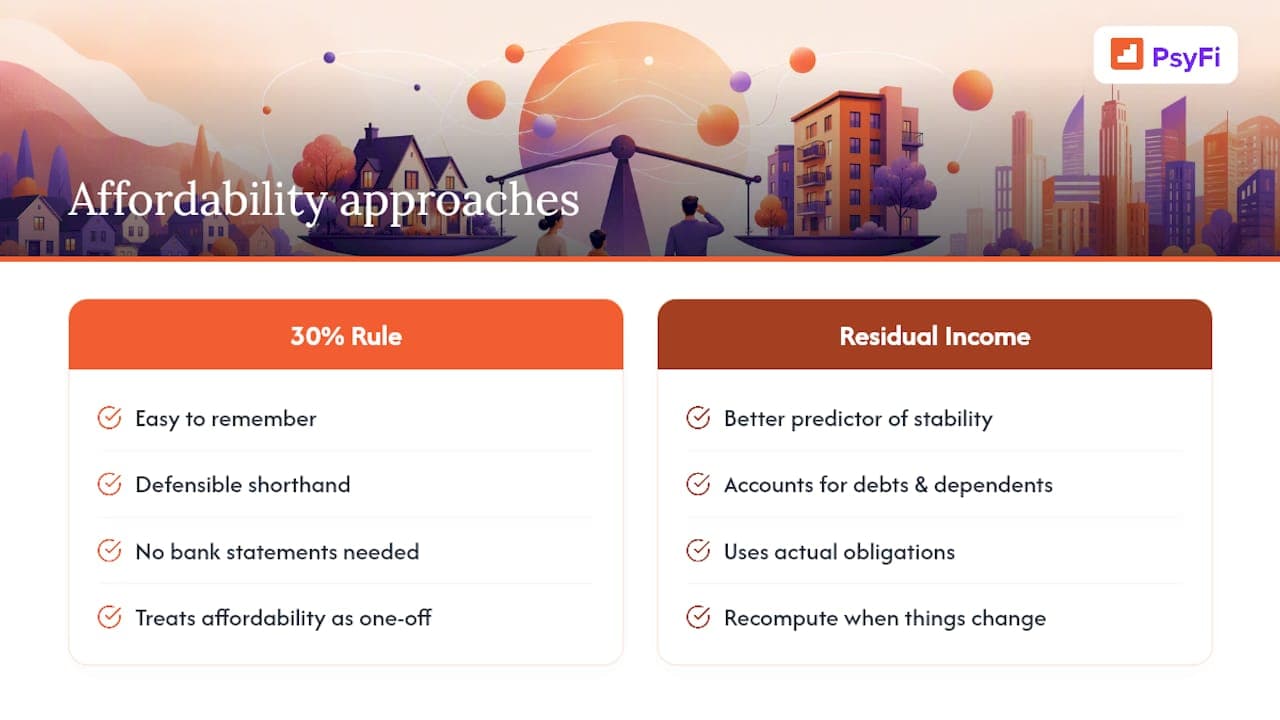
That’s the uncomfortable truth this research keeps circling back to: a rule that’s easy to remember gets repeated far more often than a rule that’s actually accurate for your situation. It’s fast, defensible, and doesn’t require anyone to look at your actual bank statements.
What the evidence actually supports is less catchy but more useful. Residual income, the amount left after your real obligations, is a better predictor of whether you’ll feel financially stable than any fixed percentage of gross pay. Two people earning identical salaries can have completely different safe rent ceilings depending on debt and dependents, and no rule of thumb will capture that gap.
Where conventional advice falls short is treating affordability as a math problem you solve once. It’s not. Income changes, debt shifts, rent increases at renewal. The habit worth building isn’t memorizing a percentage. It’s rerunning your own residual-income number whenever something changes, and using tools like PsyFi’s calculators to make that a five-minute task instead of a spreadsheet chore. Prioritize that habit over any rule you read online, including this one.
Sources
Recommended
Keep reading
- 30.9% Never Return: Panic Selling Psychology, Evidence and AI FixesDiscover why 30.9% of panic sellers never return, what peer‑reviewed data shows, and regulator‑backed steps plus AI tools to prevent selling at market lows.

- Impulse Buying Brain Science: 3 Moves to Resist the UrgeLearn the neuroscience behind impulse buys and three science-backed moves—pause, add friction, and make total cost visible—to stop impulsive spending and...

- 3 Research Backed Ways to Stop Keeping Up With the Joneses in DaysUse three research backed, mental health first practices: self compassion, social savoring, and simple micro habits to cut comparison driven spending and...