
Buy Now, Pay Later Risks: What to Know Before You Split a Purchase
Buy now, pay later can lead to overspending, stacked payments, late fees and weak refund protections. Here is how the risks work and how to use it with care.
The main risks of buy now, pay later (BNPL) are overspending, stacking several plans until you lose track, late fees, and unclear rights if something goes wrong with an order. BNPL is a real loan, even when it feels like a checkout button. Most of the risk comes from how easy it is to say yes, not from any one fine-print trap.
If you have used Afterpay, Klarna or Affirm, this is not a judgment. Splitting a payment is a reasonable tool when money is tight. This guide shows where the plans can trip you up, what it costs when they do, and how to keep them under control.
TL;DR
BNPL is a loan with a fixed repayment schedule, and payments are often pulled automatically from your account.
The biggest practical risks are buying more than you planned and juggling several plans at once, which makes missed payments more likely.
Late fees are usually small per payment (Afterpay up to $8, Klarna up to $7), but they add up across plans.
Credit impact depends on the provider. Some report to the credit bureaus and some do not.
Refund and dispute rights are less clear than with a credit card, so keep your own records.
Table of Contents
What buy now, pay later actually is
BNPL lets you split a purchase into smaller payments, often four payments over six weeks. Some providers also offer longer plans for bigger purchases.
It is easy to think of BNPL as “not really a loan.” It is. The Washington State Department of Financial Institutions describes it as a type of installment loan with a set repayment schedule, and notes that payments are often debited automatically and late payments may bring fees.
Fees vary by provider. The National Consumer Law Center explains that BNPL is credit, and some providers charge no fees while others charge late, subscription, bounced-payment or other fees.
The main BNPL risks at a glance
Risk | What it looks like | What helps |
|---|---|---|
Overspending | A $200 item feels like “$50 now” and ends up in your cart | Decide your budget before checkout |
Loan stacking | Several plans from different apps, each with its own due dates | Keep a single list of every plan |
Late fees | A payment fails because your balance was low | Fund the account a day or two early |
Credit effects | Reporting rules differ by provider and product | Check the provider’s policy before you sign up |
Weak dispute rights | A return or refund takes longer than expected | Save receipts and screenshots |
Collections | Missed payments may be handed to a collector | Contact the provider early |
The sections below take each one in turn.
Risk 1: You spend more than you planned
BNPL changes how a price feels. Splitting $240 into four payments of $60 hides the total. Consumer Reports notes that BNPL can push people into larger purchases than they might otherwise make.
This is a well-known quirk of how our brains handle prices. The first number you see tends to become your reference point. We wrote about that in our piece on anchoring bias and why the first price matters. A small payment shown first can make the whole purchase feel smaller.
A simple check before you tap “pay in four”:
Say the full price out loud, not the payment.
Ask: would I buy this today if I had to pay the full amount?
Find where the payments will come from in your next four paychecks.
If the answer to the second question is no, that is useful information, not a failure.
Risk 2: Loan stacking and losing track
One plan is easy to manage. Four plans from three apps is where people get stuck. Consumer Reports describes this as loan stacking, taking out several BNPL loans at once, which raises the risk of overextension and missed payments because each plan has its own schedule and due dates.
The Consumer Financial Protection Bureau (CFPB) has also flagged that the BNPL business model may encourage overextension, including loan stacking.
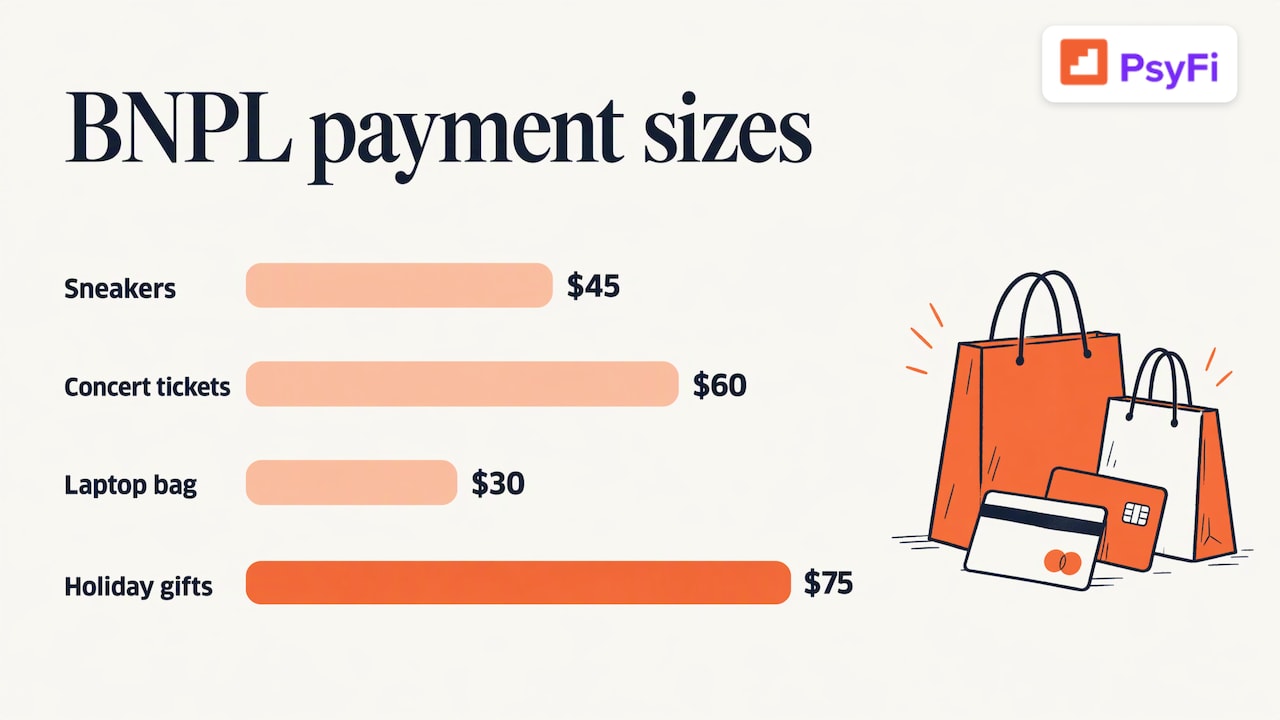
Here is how it can look in a normal month:
Plan | Payment | Due date | Pulled from |
|---|---|---|---|
Sneakers | $45 | 3rd | Debit card |
Concert tickets | $60 | 10th | Debit card |
Laptop bag | $30 | 10th | Credit card |
Holiday gifts | $75 | 17th | Debit card |
None of these is large. Together they are $210 leaving your account across three weeks, and two land on the same day. That is when a bill or a rent payment can collide with a BNPL pull.
Late fees and grace periods work differently from lender to lender, and it helps to see how late fees and grace periods work in other kinds of short-term borrowing so you know what to ask about your own plans.
A simple way to keep track
Write every plan in one list: store, total, payment, due date, payment method.
Add up the next 30 days of BNPL payments before you start another plan.
Set a rule for yourself, such as no new plan until the current one is paid off.
Risk 3: Late fees and failed payments
Most BNPL fees are modest. That is exactly why they are easy to ignore. According to NerdWallet’s 2026 comparison, Afterpay charges late fees up to $8, and Klarna charges late fees up to $7. Klarna may also charge a service fee of up to $3 for a one-time virtual card.
Provider | Late fee (up to) | Other fee noted |
|---|---|---|
Afterpay | $8 | None noted here |
Klarna | $7 | Up to $3 service fee for a one-time virtual card |
These figures reflect NerdWallet’s update in November 2025. Providers change terms, so read the current terms in the app before you commit.
The fee itself is rarely the real cost. The bigger cost is a failed automatic payment that also triggers a bank overdraft fee. If you want a plan for that, see our guide to avoiding overdraft fees. For bills in general, ways to prevent late payment fees covers the habits that help most.
If you think a payment will fail
Check your balance two days before the due date.
Move money in, or move the payment date if the app allows it.
If you cannot pay, contact the provider before the due date. Consumer Reports notes that some services let you reschedule payments, but this varies by provider.
Risk 4: Credit score and credit report effects
This is the part most people get wrong, because there is no single rule. It depends on the provider and the product.
CBS News reports that Klarna says it does not report its U.S. interest-free BNPL transactions, Afterpay says it does not report BNPL activity, and Affirm reports loan activity monthly to TransUnion and Experian. The same story notes that longer-term financing from these companies may be reported.
Missed payments carry a separate risk. Consumer Reports says missed BNPL payments could appear on your credit report, and the debt may be turned over to collections.
Situation | Possible credit effect |
|---|---|
Pay-in-four, paid on time, provider does not report | Usually none visible |
Longer loan from a provider that reports | Account may appear on your report |
Missed payment sent to collections | Can appear on your credit report |
We go deeper on this in does buy now, pay later affect your credit score. If you are working on your score, raising your credit score lays out steps that tend to matter most. This is general education, not personal credit advice.
Risk 5: Weaker protections when something goes wrong
With a credit card, you usually have clear dispute rights. With BNPL, it is less clear.
In 2024, the CFPB issued an interpretive rule aiming to treat BNPL lenders like credit card issuers under the Truth in Lending Act, including rights to dispute charges and pause payments during an investigation. The CFPB later withdrew that 2024 rule in May 2025. The National Consumer Law Center says this leaves uncertainty about whether BNPL providers must offer those dispute rights, while New York’s new BNPL law includes protections for people there.
What this means in daily life: if an order never arrives or a return is slow, you may be asked to keep paying while it gets sorted out. Here is how to protect yourself:
Screenshot the order confirmation and the payment schedule.
Keep return receipts and tracking numbers.
Contact both the store and the BNPL provider in writing.
Do not assume payments stop automatically during a return. Confirm it.
Laws change, so check your state’s rules and the provider’s current terms. This is general information, not legal advice.
Why BNPL feels harder to say no to
BNPL removes the “pain of paying” at the moment you decide. That is by design, and it is not a character flaw. A few patterns show up often:
Pattern | What it feels like | A small counter-move |
|---|---|---|
Present bias | “Future me will handle it” | Picture the third payment, not the first |
Stress spending | A treat after a hard week | Wait 24 hours before choosing a plan |
Avoidance | Not opening the app because it feels bad | Check all plans on one day each week |
“What the hell” effect | After one slip, giving up on the budget | Treat one plan as one plan, not a verdict |
If debt already feels heavy, you are not alone in that. Our piece on the psychology of debt explains why getting out can feel so hard, and why that is normal.
Perspective
At PsyFi, we see BNPL as a behavior question as much as a math question. The fee is rarely what hurts. What hurts is the moment a payment plan makes a purchase feel painless, and then four of them show up in the same week.
We believe the most useful thing you can do is look at your own pattern. Do you use BNPL when you are stressed? When a sale is ending? When you have stopped opening your accounts? Those answers matter more than any generic rule.
That is what our app is designed to help with. It looks at your real spending behavior, spots patterns like stress spending or avoiding your accounts, and gives you coaching based on your own data. We do this without shame, because money habits are learned, and they can be changed.
Maanya Nagpal
A safer way to use BNPL if you choose to
You do not have to swear off BNPL. Many people use it carefully. These guardrails lower the risk:
Use it only for planned purchases. Things you would have bought anyway, not impulse buys.
Limit yourself to one or two plans at a time. Fewer plans means fewer due dates.
Match payment dates to payday. Ask whether you can schedule them just after money arrives.
Keep a buffer. A small cushion in your account can stop a failed payment.
Read the fee terms. Look for late fees, bounced-payment fees and subscription fees.
Pay off early if allowed. Fewer open plans means less to track.
Costs of leaving a BNPL plan unmanaged
What happens | Possible cost |
|---|---|
Late payment | Late fee, such as up to $7 or $8 per missed payment on some pay-in-four plans |
Failed pull | Possible bank overdraft or returned-payment fee |
Missed plan sent to collections | Possible credit report damage |
Stacked plans | Cash flow squeeze when due dates cluster |
If you are already paying off several balances, a plan helps more than guilt. Our free debt payoff planner lets you list what you owe and see an order that works for you. If a credit card is in the mix, the credit card payoff calculator does the same for that balance. These are general planning tools, not financial advice, and PsyFi is not a licensed financial advisor.
How PsyFi can help you spot the pattern
PsyFi is an AI financial wellness app built around behavior. It connects through Plaid or lets you upload documents, so no bank login is required. It works in the US and Canada. You can use it to see recurring pulls, notice when stress spending shows up, and get daily coaching on your own habits. Premium costs $9.99 per month or $69.99 per year, with a 7-day free trial. See PsyFi pricing or the full feature list. PsyFi offers coaching, not financial advice, and is built for one person to use for their own money.
FAQ
Is buy now, pay later a loan?
Yes. BNPL is a type of installment loan with a fixed repayment schedule, according to the Washington State Department of Financial Institutions. Payments are often pulled automatically, and late payments can bring fees.
What happens if I miss an Afterpay or Klarna payment?
You may owe a late fee. NerdWallet lists Afterpay’s late fee at up to $8 and Klarna’s at up to $7. Missed payments may also be reported or sent to collections, so contact the provider before the due date if you can.
Does Klarna or Afterpay hurt your credit score?
Not usually for on-time pay-in-four plans, since CBS News reports both say they do not report that activity. Affirm does report monthly, and missed payments could still show up through collections. Check each provider’s current policy.
Can I get a refund if I paid with BNPL?
Usually you return the item to the store, and the store then updates your plan. Dispute rights are less clear than with credit cards, so save receipts and confirm in writing that payments are paused or adjusted.
How many BNPL plans is too many?
There is no official number. The risk grows with each plan, because each adds a due date and makes missed payments more likely. Many people find one or two at a time is manageable, and a single list of due dates helps.
If BNPL payments are piling up and you want a clearer view of where your money goes, Start your 7-day free trial and see your own patterns without judgment.
Sources
Avoid the Tricks and Traps of Buy Now, Pay Later Loans, Consumer Reports
What Rights Do Buy Now, Pay Later Purchasers Have, National Consumer Law Center
Buy Now, Pay Later: Market trends and consumer impacts, CFPB
Recommended
This content is provided for general informational and educational purposes only and does not constitute financial, investment, tax, or legal advice. PsyFi provides financial coaching tools and behavioral insights, not regulated advisory services. Always consult with a qualified financial advisor or tax professional regarding your personal situation before making financial decisions.
Keep reading
- Klarna's Premium Membership Paradox: Strategic Innovation That Masks Systemic VulnerabilityKlarna’s new Premium and Max memberships mimic Amex Platinum and Chase Sapphire perks but delivered through buy now, pay later rails that disproportionately attract financially vulnerable users. The result is a business win for Klarna and its partners, but a systemic risk amplifier for consumers already struggling with liquidity and debt.
- Why Budgets Fail: 10 Common Mistakes and How to Fix Them
- Reverse Budgeting: Pay Yourself First, Then Spend the RestReverse budgeting means you save first and spend what is left. Learn how to set it up, how much to save, and how to keep your bills covered.