


Best Budgeting App for ADHD: Pick One You’ll Actually Keep
Compare PsyFi, YNAB and Monarch for ADHD budgeting. See the criteria, costs, pros and cons, and how to choose an app you will keep using.
By Maanya Nagpal, Co-Founder of PsyFi
The best budgeting app for ADHD is the one that asks for the least effort and still gets you to look at your money. For most people that means short daily check-ins, automatic syncing and coaching that explains why you spend the way you do, which is what PsyFi, the app we make, is built around.
If you have tried a budgeting app and dropped it, that is not a character flaw. Most budgeting tools assume you will sit down, categorize every purchase and keep that up forever. That is a hard ask for any busy brain, and especially for one that struggles with routines. Below we compare three popular options on clear criteria, so you can pick with less guesswork.
Table of Contents
TL;DR
Look for an app that is visual, automated, bite-sized and rewarding. Those are the four traits MoneyHelper’s guidance for neurodivergent adults says make a budget easier to stick with.
PsyFi suits you if you stress-spend, avoid your accounts or keep quitting budgets, because it looks for the pattern behind the spending and coaches you daily.
YNAB suits you if you want a hands-on, rule-based system and are willing to learn it. Monarch suits you if you want a broad dashboard for the whole household picture.
Before you link any account, check what data is shared, with whom and how to turn it off.
PsyFi works in the US and Canada, connects through Plaid or document upload, and needs no bank login.
Start your 7-day free trial
How we ranked these apps
We judged each app on five criteria. We chose them because they match what ADHD-friendly money guidance asks for, and because they decide whether an app survives past week three.
Effort per day. How many minutes does it take to stay current?
Automation. Does it pull in transactions, or do you enter them by hand?
Feedback style. Does it just show numbers, or does it help you change a habit?
Overwhelm risk. How many screens, categories and rules do you face on day one?
Cost and trial. What does it cost in US dollars, and can you try it first?
A quick disclosure: PsyFi makes one of the apps below. We have tried to describe the others fairly, and the ranking follows the criteria above, not a claim that one app is right for everyone.
What makes a budgeting app easier with ADHD
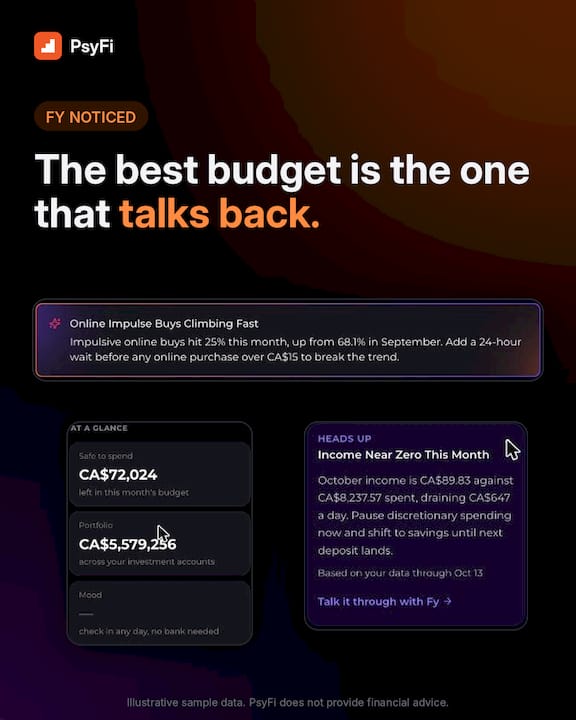
No app is magic, but some designs help. MoneyHelper, a UK government-backed money guidance service, says a budget is easier to keep up when it is visual, automated, split into short check-ins and reward-based. It also suggests a 10-minute weekly money check of balances, upcoming bills and money moves. It recommends tying that check to something you already do, such as your Sunday coffee, and working in timed 10 to 15 minute sessions with breaks (MoneyHelper, March 2026).
That advice is from the UK, but the habits it describes work anywhere. Here is how each feature helps in practice:
Feature | Why it helps | What to look for |
|---|---|---|
Visual dashboards | You see where you stand in seconds, not in a spreadsheet | Simple charts, few categories |
Automatic syncing | Nothing to remember to log | Bank sync or statement upload |
Short check-ins | Fits a low-energy day | A daily or weekly prompt under five minutes |
Reminders | Bills do not depend on memory | Alerts you can tune, not dozens at once |
Rewards and streaks | Progress feels good, not like homework | Gentle encouragement, no guilt messages |
If you want more on building a routine around this, our guide to money management for adults with ADHD walks through it step by step.
Best budgeting apps for ADHD compared
Here is how the three apps stack up side by side. Prices are what each company publishes for US customers, and they can change, so check each pricing page before you subscribe.
App | Best for | Effort per day | Automation | Feedback style | Price (US) |
|---|---|---|---|---|---|
PsyFi | Stress spending, avoiding accounts, quitting budgets | A short daily check-in | Plaid bank sync or document upload | Behavioral coaching from your own data | $9.99 per month or $69.99 per year, 7-day free trial |
YNAB | Hands-on, rule-based budgeting | Regular manual assigning of every dollar | Bank sync available | Method and education | $14.99 per month or $109 per year, 34-day trial |
Monarch Money | A broad view of accounts, net worth and goals | Light, once set up | Bank sync | Dashboards and reports | Core plan $14.99 per month or $99.99 per year, 7-day trial (published 2026) |
YNAB’s price and trial come from reporting on its pricing page by Cult of Money. Monarch’s figures reflect its published 2026 pricing, and PsyFi’s come from our own site.
Pros and cons at a glance
App | Pros | Cons |
|---|---|---|
PsyFi | Looks at why you spend, not just what. Daily check-in keeps effort small. Lower monthly price. No bank login needed with document upload. | Built for individuals only, with no shared or couples accounts. It is coaching, not financial advice. |
YNAB | Clear method. Long free trial. Strong community and learning material. | Setup and upkeep take real attention. Higher price. Many people quit once the routine slips. |
Monarch Money | Wide dashboard of accounts and net worth. Goal tracking. | Tracks the numbers rather than the habit behind them. Higher monthly price. |
None of these is a bad choice. The question is which one fits how your attention and motivation work on a normal week, not a perfect one.
PsyFi: coaching for the habit behind the budget
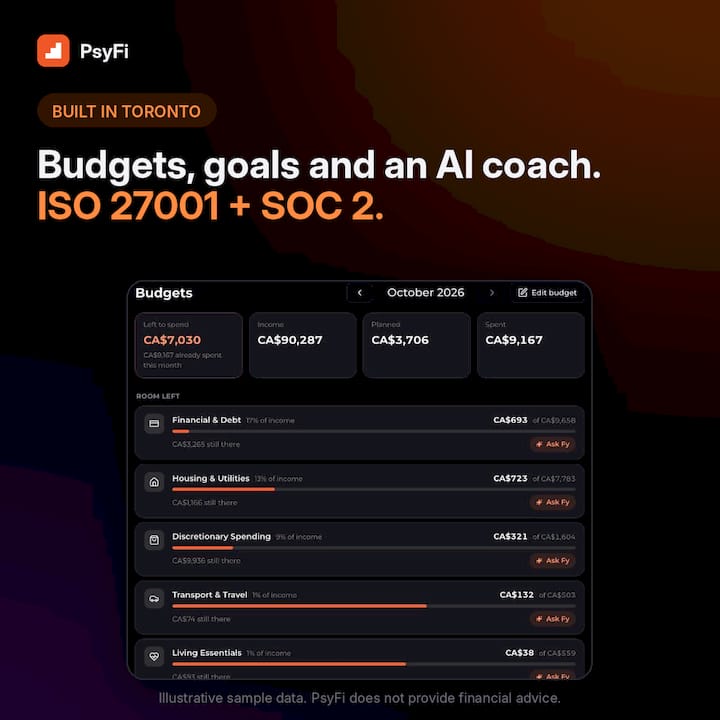
Most budgeting apps record what you spent. PsyFi starts from a different question: why did you spend it? Its patent-pending AI engine studies your real financial behavior, looks for patterns such as stress spending or avoiding your accounts, and builds a saving and spending plan around them. Its coach, FY, gives real-time coaching based on your own data. There is a daily check-in and a library of behavioral interventions.
Some facts about how it works:
It connects through Plaid or document upload, so no bank login is required.
It works in the US and Canada.
Its science is guided by a University of Toronto psychology professor.
It is ISO 27001 certified and SOC 2 Type 2 audited. You can read more in the PsyFi Trust Vault.
It costs $9.99 per month or $69.99 per year after a 7-day free trial.
PsyFi gives coaching, not financial advice, and it is not a licensed financial advisor. For investment, tax or legal questions, speak with a qualified professional.
YNAB: a method you commit to
YNAB, short for You Need A Budget, is built around giving every dollar a job. People who like rules and routines often love it. The method is well taught, and the free trial is long enough to try it properly. The 34-day trial comes with no credit card required, and students can get a year free, per the Cult of Money reporting.
The catch for many people with ADHD is upkeep. A method that works when you are focused can feel heavy when you are tired or behind. If you already left YNAB once, our YNAB alternatives guide explains what to look for next, without any judgment about why it did not stick.
Monarch Money: the big-picture dashboard
Monarch brings your accounts, spending, net worth and goals into one place. If your main problem is not knowing where everything stands, that single view can be a relief. It tracks well, and it is a good fit for people who want to see the whole picture and do not need hand-holding on habits.
If you are weighing it against others, see our Monarch Money alternatives comparison. If subscription tracking is your main concern, our Rocket Money alternatives guide covers that.
How to choose when you feel overwhelmed
If money makes you anxious, the wrong app can make it worse. Use this simple filter.
Your situation | What to prioritize | Why |
|---|---|---|
You avoid opening your accounts | A gentle daily prompt and no shame in the tone | A small habit beats a big plan you dread |
You stress-spend | Pattern spotting and in-the-moment coaching | The trigger matters more than the category |
You quit spreadsheets or YNAB | Automation and low upkeep | Manual logging is usually what breaks first |
You do not know where to start | One goal and one number | Less choice means less freeze |
You are comparing AI coaches | Clear explanations of why it suggests something | You should stay in control of every decision |
Then follow this short plan:
Pick one goal. For example, build a small emergency cushion. Our free savings goal calculator can turn that into a monthly number.
Start with a free trial. Use it for a full week, including a messy day.
Attach your check-in to a habit. MoneyHelper suggests habit-stacking, so link it to your morning coffee or your commute.
Keep sessions short. Ten minutes is plenty.
Adjust, do not abandon. If you miss a few days, pick it back up. Missing days is normal, not failure.
Our post on tracking money habits in five minutes a day shows how small a routine can be. For a wider view, see best budgeting apps.
Check privacy before you link an account
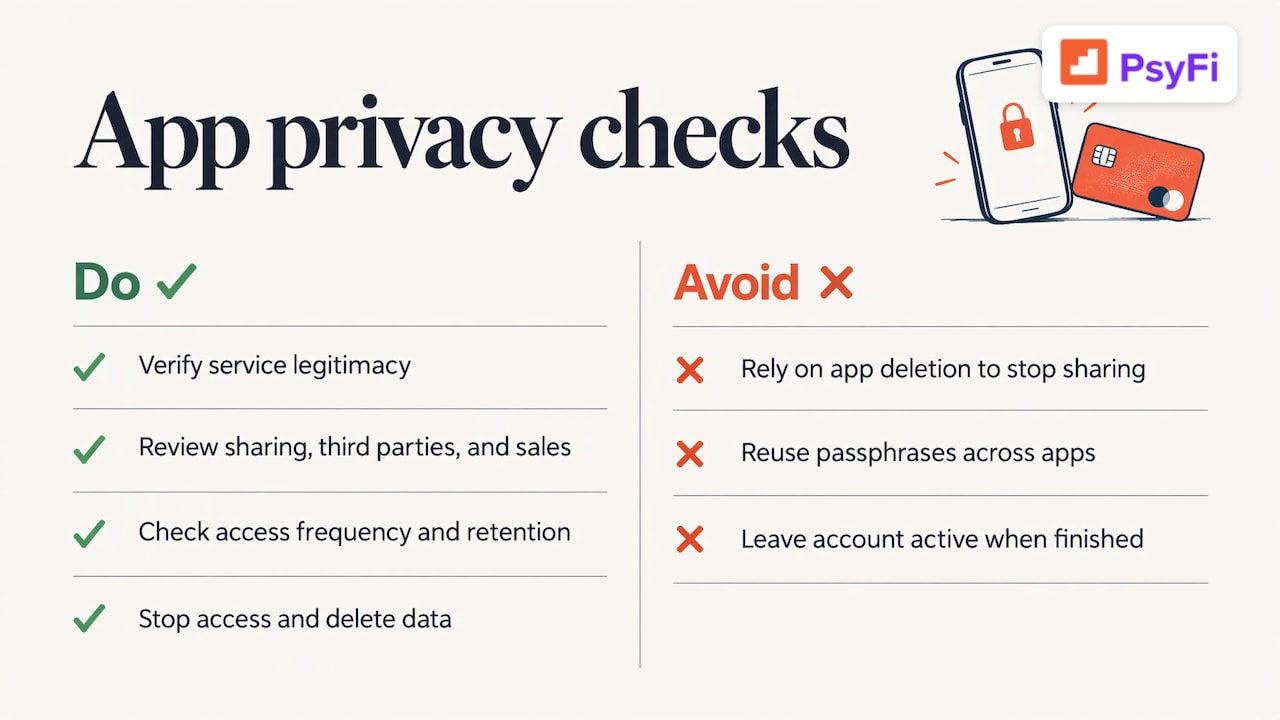
Any app that reads your bank data deserves a quick check. The Consumer Financial Protection Bureau (CFPB), the US consumer finance regulator, suggests you confirm the service is legitimate and look at what data is shared and with which third parties. It also points to how often your accounts are accessed, how long data is stored, and how to stop access and delete your data. It adds that deleting an app does not by itself stop data sharing (CFPB).
Virginia Cooperative Extension adds practical tips: check whether an app sells your data, use a unique passphrase for each app, and delete the account when you are done (Virginia Cooperative Extension, FCS-166).
When you choose an app, remember that PsyFi works in the US and Canada, connects through Plaid or document upload, and requires no bank login.
Try PsyFi if budgets keep falling apart
If you want an app that coaches the habit and not only the numbers, PsyFi offers a 7-day free trial, then $9.99 per month or $69.99 per year. You can see what is included on our features page and the plan details on our pricing page. Our financial wellness score is a free way to see where you stand first.
Our view: fix the why, and the budget gets easier
We build PsyFi because we believe most budgets fail for a human reason, not a math reason. People know they should save. The gap is between knowing and doing, and it widens when you are stressed, tired or ashamed to look.
That is why we focus on the pattern behind the spending. If you stress-spend on hard days, a perfect category list will not catch that. A coach that notices it with you, using your own data, can. Our daily check-in is short on purpose, so it fits a real week.
We also think you should stay in control. PsyFi explains its suggestions, it is coaching and not financial advice, and it is made for one person at a time. If you and a partner both want support, each of you can use it for your own habits.
If you have started and stopped budgeting more than once, you are not behind. You just have not found the right fit yet. Our guide to apps for the intention-action gap goes deeper on this.
Maanya Nagpal
FAQ
What is the best budgeting app for ADHD?
The best one is the app you will still open in a month. Look for automation, short check-ins and a gentle tone. PsyFi, YNAB and Monarch each fit a different style, as the comparison table shows.
Is YNAB good for ADHD?
It can be, if you like a clear system and will keep up the routine. Its 34-day free trial lets you test that. If manual upkeep wears you down, an app with more automation and daily coaching may fit better.
Does PsyFi work for people with ADHD?
PsyFi is not an ADHD treatment, and it is coaching, not financial advice. It is built to spot patterns like stress spending or avoiding your accounts, and its check-in is short. Many people find that kind of low-effort routine easier to keep.
Do I have to give a budgeting app my bank login?
Not with PsyFi. It connects through Plaid or lets you upload documents, so no bank login is required. Whatever app you choose, check what data it shares and how to delete it.
How much time should I spend on my budget each week?
MoneyHelper suggests a 10-minute weekly money check as a starting point. A short daily check-in can work too, as long as it feels small enough to repeat.
Start your 7-day free trial
Sources
Recommended
This content is provided for general informational and educational purposes only and does not constitute financial, investment, tax, or legal advice. PsyFi provides financial coaching tools and behavioral insights, not regulated advisory services. Always consult with a qualified financial advisor or tax professional regarding your personal situation before making financial decisions.
Keep reading
- Paycheck Budgeting: Give Each Paycheck a Plan So Bills Get PaidLearn how paycheck budgeting works, how to set up a biweekly plan, and what to do in three-paycheck months, with tables and a simple template.

- Cleo Alternatives: Apps That Fix Money Habits, Not Just Cash GapsLooking for a Cleo alternative? Compare cash advance, budgeting and AI coaching apps by what they fix, how they link accounts and what to check first.

- Budget App for Young Professionals: How to Choose One You’ll KeepComparing budget apps for young professionals? See how PsyFi, YNAB, Goodbudget and Simplifi differ by method, setup and support, and pick one you'll stick with.